Title: The Little Review, November 1917 (Vol. 4, No. 7)
Author: Various
Editor: Margaret C. Anderson
Release date: October 4, 2026 [eBook #79714]
Language: English
Original publication: Chicago, New York: Apparently none other than the Editor (see above)., 1922
Other information and formats: www.gutenberg.org/ebooks/79714
Credits: Jens Sadowski and the Online Distributed Proofreading Team at http://www.pgdp.net. This book was produced from images made available by the Modernist Journal Project, Brown and Tulsa Universities.
THE MAGAZINE THAT IS READ BY THOSE
WHO WRITE THE OTHERS
Margaret Anderson, Publisher
NOVEMBER, 1917
| Poems of Li Po | translated by Maxwell Bodenheim |
| Sketches | jh. |
| Hanrahan’s Oath | Lady Gregory |
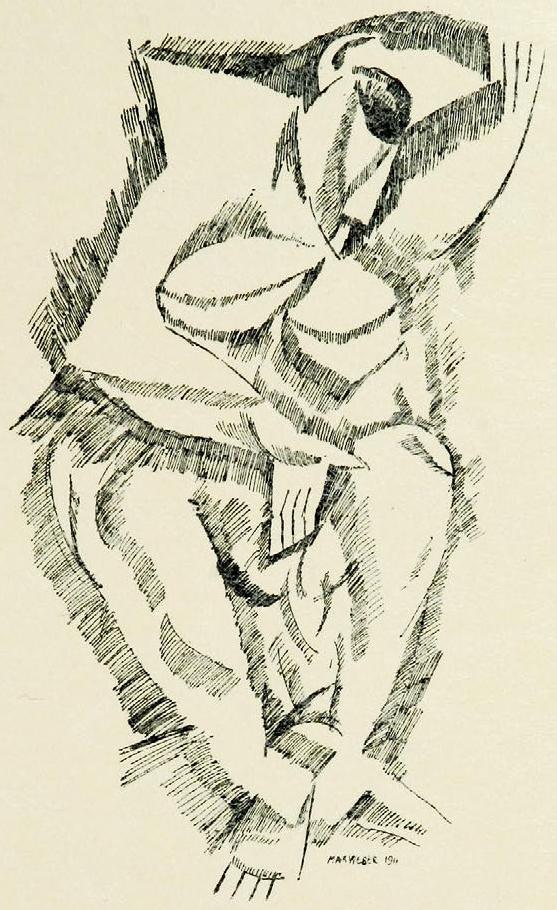
| Drawing | Max Weber |
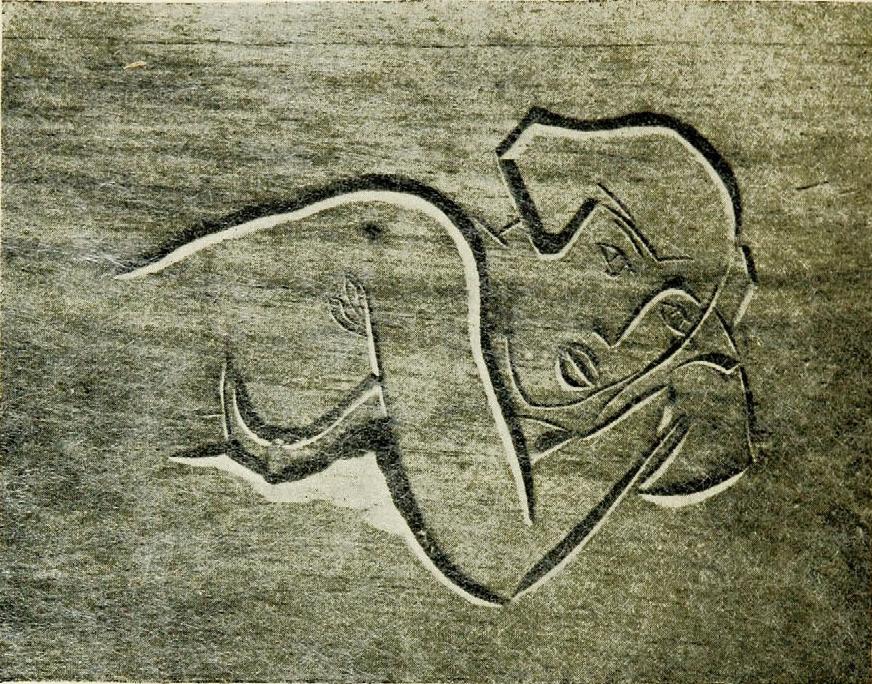
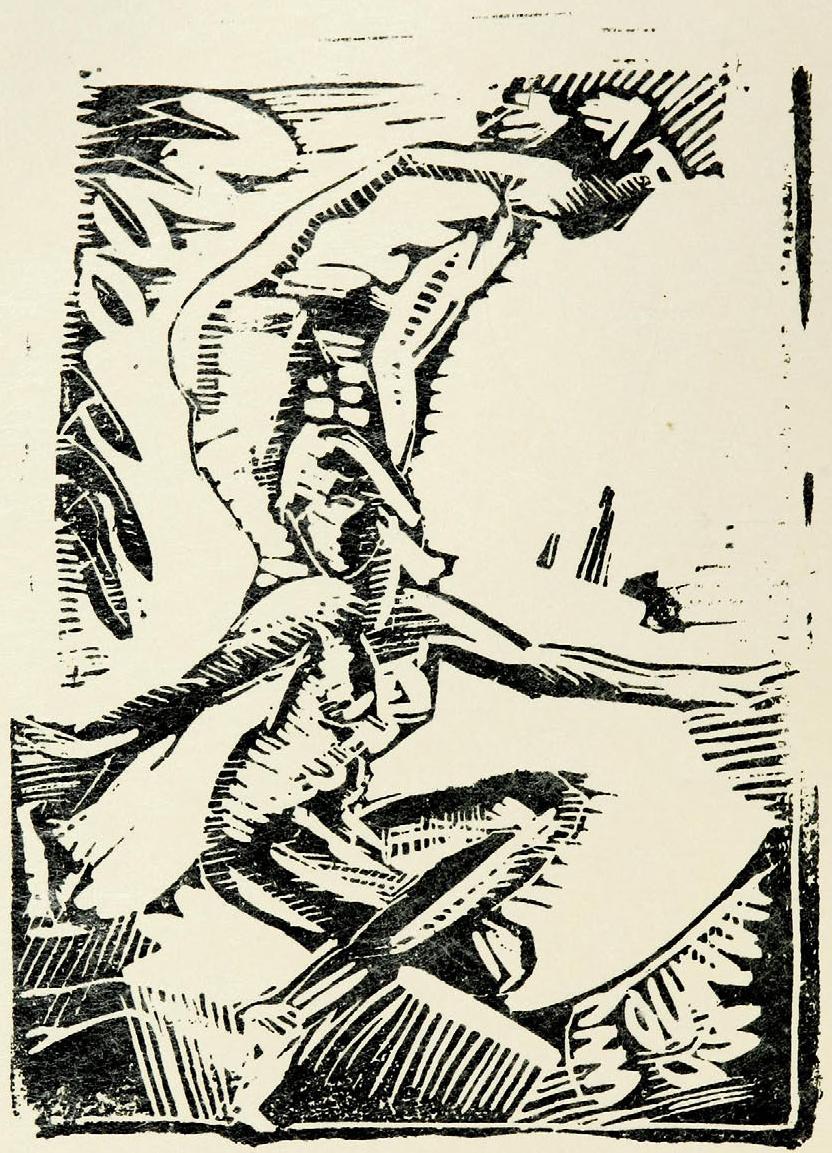
| Carving | Walt Kuhn |
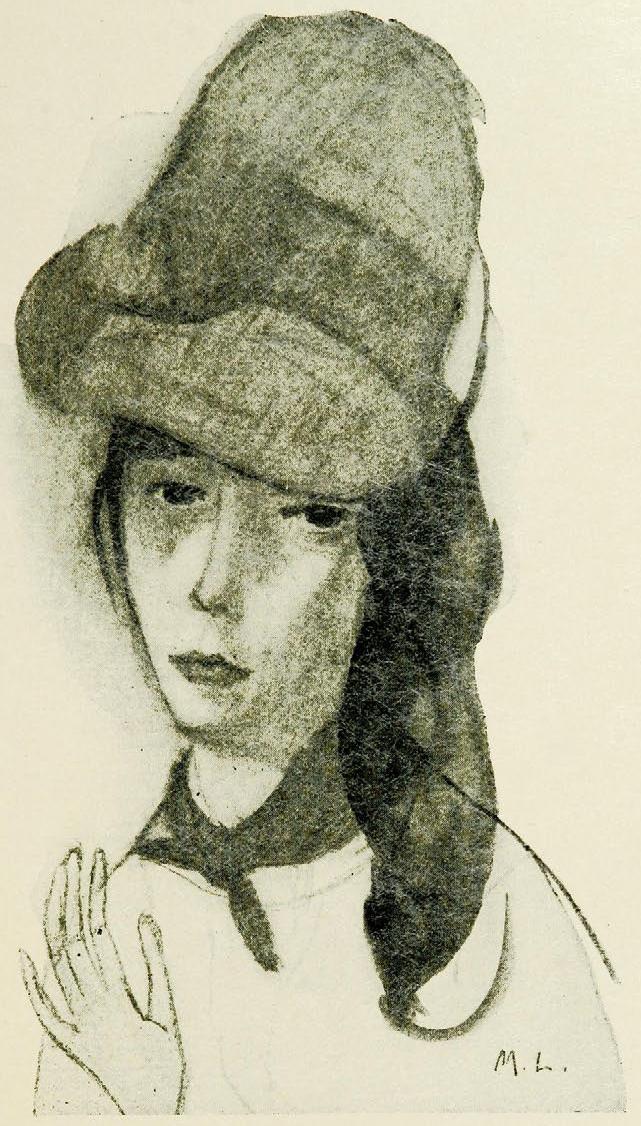
| Drawing | Marie Laurencin |
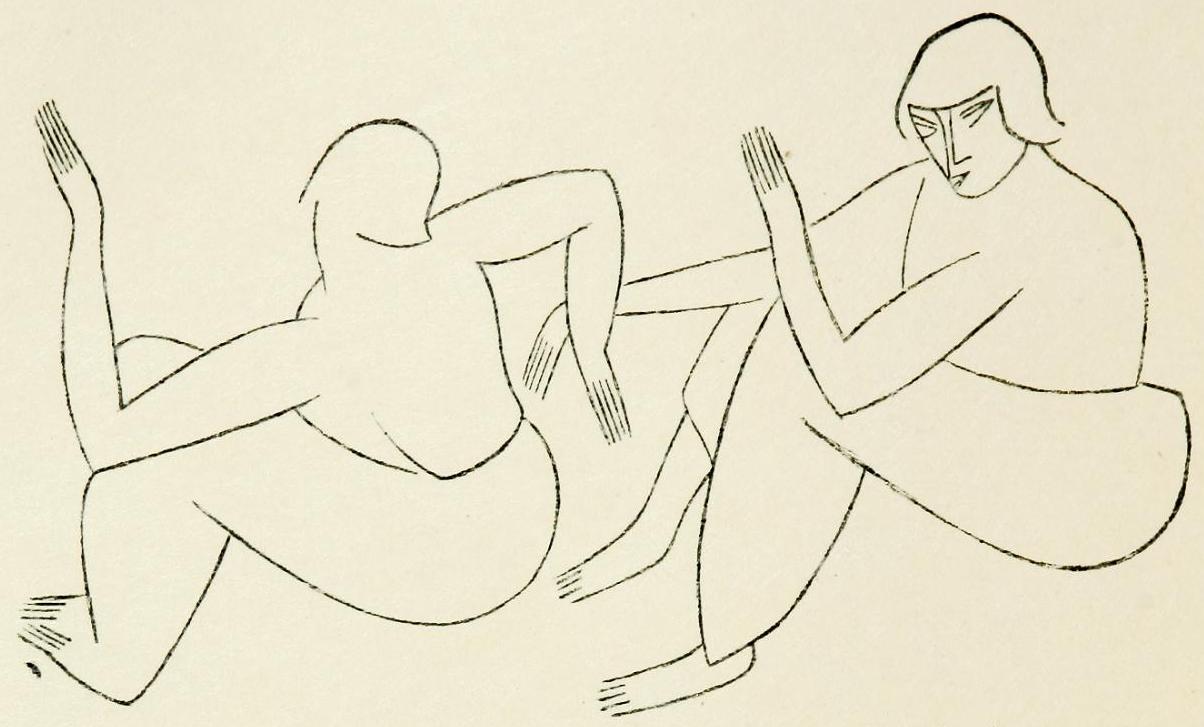
| Drawing | Henri Gaudier-Brzeska |
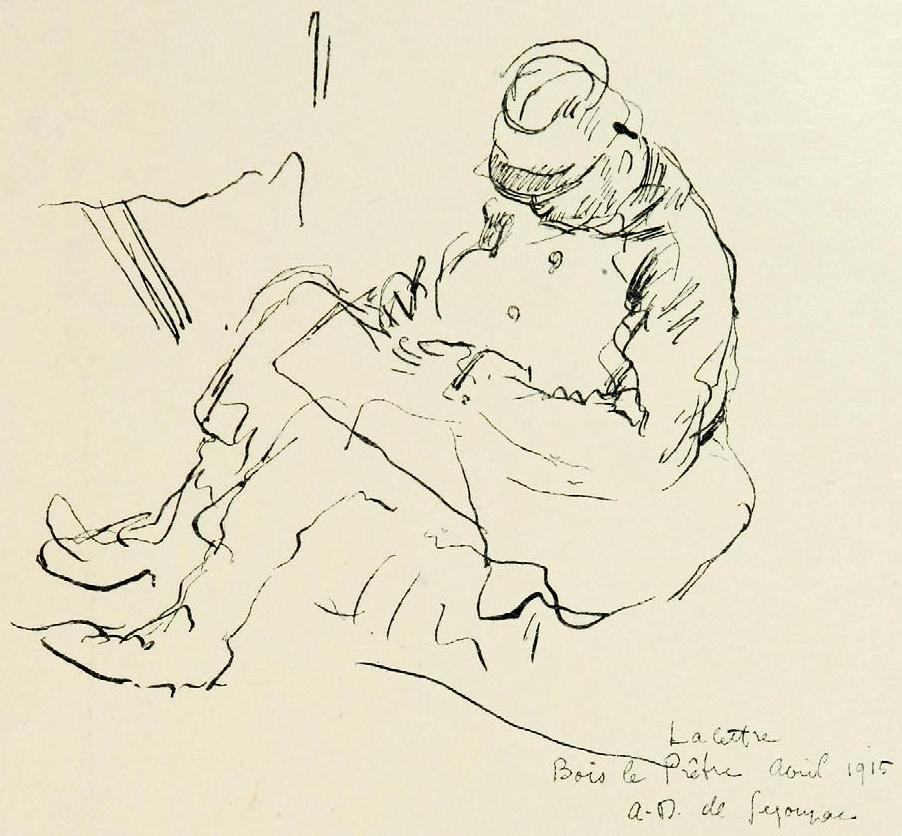
| Drawing | Andre D. de Segonzac |
| Engraving | Arthur Davies |
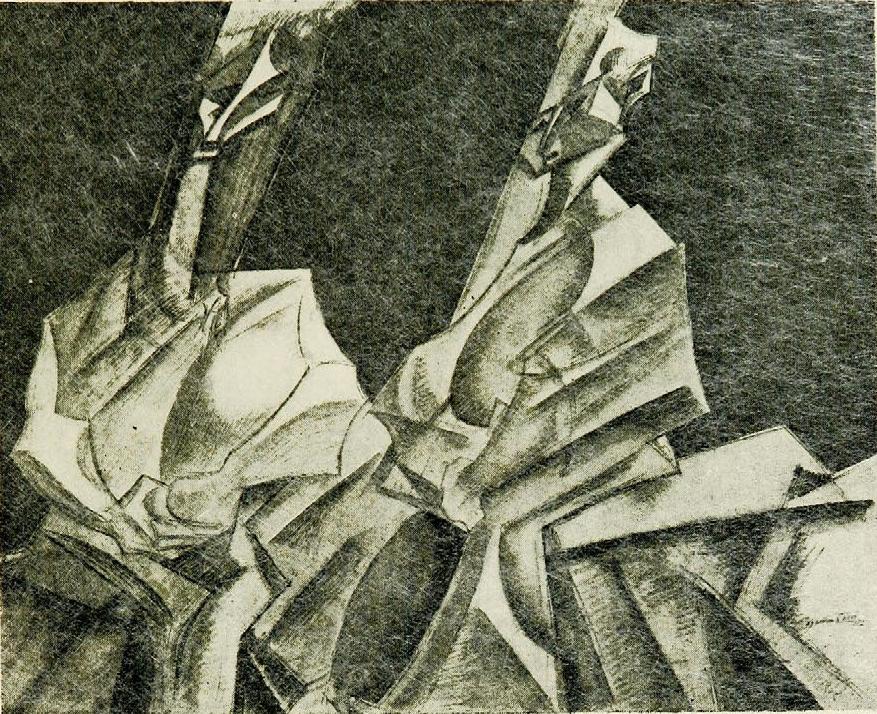
| The Starry Sky | Wyndham Lewis |
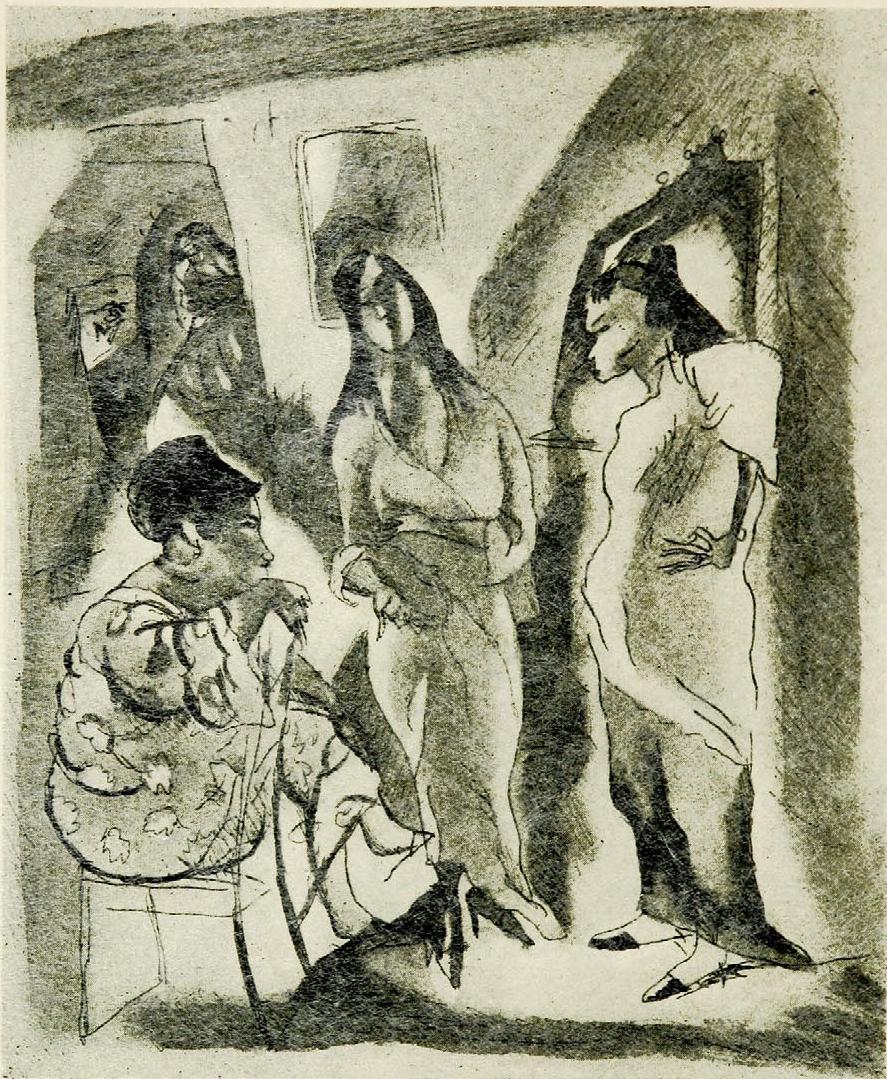
| Drawing | Jules Pascin |
| The Soul’s Awakening | J. R. White |
| Imaginary Letters, VI. | Ezra Pound |
| The Raised Arms | translated from De Gourmont by Stéphane Boecklin |
| To Subscribers |
Copyright, 1917, by Margaret Anderson.
MARGARET ANDERSON, Editor
EZRA POUND, Foreign Editor
24 West Sixteenth Street, New York
| 15 cents a copy | $1.50 a year |
Entered as second-class matter at P. O., New York, N. Y.
Translated from the Chinese of Li Po
by Sasaki and Maxwell Bodenheim
Fling me harp-notes almost soundless,
From your hidden white window.
Your coming is like a flower petal
Wavering down from the sky.
Walk after me, across the water
Like a drifting flower.
You sing of So-land, and speak of Ko-land.
You seem older than you are
And that opens my love.
I take your hand and we walk past many springs.
The keenest of swords plunges into leaping water
And cannot cut it.
My love for you is like that sword,
But winds around your heart.
After you go, the weeds shrouding my garden-gate
Fade, and become the ground of autumn.
But spring slips back from your foot-marks
Prisoned in the soft ground, about the gate.
And my heart becomes like a peach-blossom
On a tree that grows from the bottom of a shallow well.
The peach-blossom opens in a smile
But why, since he has gone?
He was like a quick moon
That gave but one moon-strand.
I look down at the water in the well
But I cannot recognize myself
For I am shrivelled by the lack of him.
Her skirt of veils is like curling water
Covered with golden nets of frail dust.
How can I drop to the bottom of her heart?
I cannot refuse a thousand cups of green wine.
Her red cheeks sink into me, and make me dead.
A group of mountains, like blue screens,
Scrape the sky.
Nothing is written upon the blue screens.
I walk over them, pushing apart the clouds
And search for a slender road.
I lean against a tree
And hear rushing springs, and see warm flowers.
A green cow lies amid the warm flowers
And white cranes sleep on the tops of pine trees.
Twilight rises from a lake below the mountains,
And meets a cold haze from the mountain-tops.
jh.
Sharp, empty air.... Out of the black mouths of engines white smoke rises on thin stems into white ghosts of ancient trees; together they rise into ghosts of ancient forests, sway and surge and are gone again a million years.
The hot air of the day stays in the city until night. The long slope of my roof presses the heat down upon me. Soon it will rain. But there is no rest in me: my heart is wandering too far. My friends may still be in the city, but I do not seek them. I go to the animals in the park. Within their enclosures black shadows of camels lie in the darkness. A great white camel broods in the moonlight, apart from the rest. His lonely eyes are closed and he moves his head slowly from side to side on his long neck, swaying in pain, searching in a dream for his lost world. I have seen a Norwegian ship carrying its carved head through the waters of a fjord with such a movement....
Now the high clouds cover the moon. Out on the lake a wind assails the layers of heat. A white peacock sits in a tree, aloof, elegant, incorruptible.... A light green spirit.... Across the first thunder he lifts his long white laugh at us like a maniac.
I cannot live long in your city: it has no zones of pain for me where I may rest, no places where old joys dwell and I may suffer. It is as empty for me as the honeycomb cliff cities of the Southwest. For I shall not know love again in this or any place.
Lady Gregory
MARY GILLIS
MARGARET ROONEY
OWEN HANRAHAN
COEY
MRS. COEY
MICHAEL FEENEY
SCENE: A wild and rocky place. Door of stone cabin to LEFT, that is the bed of a Saint.
MARY GILLIS (coming from right).—Did you get any tidings of him, Margy?
MARGARET ROONEY.—All I heard was he was seen going over the scalp of the hill at daybreak.
MARY GILLIS.—Bad cess to him! Why wouldn’t he stop in the house last night beyond any other night?
MARGARET ROONEY.—You know well it was going to the preaching of that strange friar put disturbance in his mind.
MARY GILLIS.—Take care is he listening to him yet.
MARGARET ROONEY.—He is not. I went in the archway of the chapel and took a view. The missioner is in it yet, giving out masses and benedictions and rosaries and every whole thing. But as to Owen Hanrahan, there was no sign of him in it at all.
MARY GILLIS.—It is the drink houses I went searching for him.
MARGARET ROONEY.—He was never greatly given to drink.
MARY GILLIS.—If he isn’t, he is given to company and he’d talk down all Ireland.
MARGARET ROONEY.—So he is a terror for telling stories, and it is yourself made your own profit by it. It is his gift of talk brought the harvesters, would live and die with him, to your house this five weeks past.
MARY GILLIS.—Yourself that is begrudging me that, where you want to keep him to yourself.
MARGARET ROONEY.—So I would keep him, I to find him. I wouldn’t wish him to go travelling. He had his enough of hardship. There is no great stay in him.
MARY GILLIS.—There are but the two roads for him to travel from the scalp, over and hither. He to come this way, believe me I’ll bring him back to the town.
MARGARET ROONEY.—He wouldn’t go with you.
MARY GILLIS.—I have a word will bring him, never fear.
MARGARET ROONEY.—What word is that?
MARY GILLIS.—What was it he was giving out to the two of us ere yesterday, the time he came back after having drink taken at the sailor’s wake?
MARGARET ROONEY.—I don’t keep in mind what he said.
MARY GILLIS.—You, maybe, remember the story he gave us of one Feeney that he was with at a mountain still and that made an assault on a gauger.
MARGARET ROONEY.—Feeney, that was the name—, but what signifies that?
MARY GILLIS.—That’s right. I’ll make a spancel from that story will bring him into hiding in the Currough.
MARGARET ROONEY.—You might not. It’s little you know the twists of a poet’s mind. He to have the fit of wandering, it is round the wide world he might go.
MARY GILLIS.—Hurry on now, let you go the lower road and see will you bring him any better than myself. (pushes her).—Go on now, he might pass and go on unknownst to you!
MARGARET ROONEY.—I’ll not be three minutes going down the hill. (Goes).
MARY GILLIS (sitting down).—That you may! It’s the hither road he is coming!
HANRAHAN (coming in, head down).—Isn’t it a terrible place we are living in and terrible the wickedness of the whole world!
MARY GILLIS.—What is it ails you, Owen Hanrahan?
HANRAHAN.—People to be breaking all the laws of God and giving no heed to the beyond!
MARY GILLIS.—It is likely the preaching of the friar put those thoughts athrough your head.
HANRAHAN.—Murders and robberies and lust and neglecting the mass!
MARY GILLIS.—Ah, come along home with me to the dinner. You are fasting this good while back.
HANRAHAN.—What way can people be thinking of gluttony, and the terrors of the grave before them.
MARY GILLIS.—Come on now to the little house, and the drop of drink will put such thoughts from your mind.
HANRAHAN.—Drink! That was another of them! Seven deadly sins in all!
MARY GILLIS.—What call has a poet the like of you to go listening to a missioner stringing talk? You, that is so handy at it yourself.
HANRAHAN.—A lovely saint he was! He came from foreign. To let fall a drop of scalding water on your foot would be bad he said, or to lay your hand on a hot coal on the floor; but, to die with any big sin on our soul, it will be burning for ever and ever, and that burning will be worse than any burning upon earth. To say that he did, rising up his hand. The great fear he put on me was of eternity. Oh, he was a darling man!
MARY GILLIS.—Ah, that is the way that class to be beckoning flames at the people, or what way would they get their living? Come along now where you will have company and funning.
HANRAHAN.—Leave touching me! I have no mind to be put away from my holy thoughts. Three big mastiffs, their red gullets open and burning the same as three wax candles!
MARY GILLIS.—Come along, I tell you, to the comforts of the town.
HANRAHAN.—Get away, you hag, before I’ll lay a hand on you!
MARY GILLIS.—After the good treatment I gave you this five weeks past, beyond any lodger was in the house!
HANRAHAN.—Be off, or I’ll do you some injury!
MARY GILLIS.—It’s kind for you do an injury on me, the same as you did on the man that was sent before the judge!
HANRAHAN.—Who was that?
MARY GILLIS.—Feeney that stuck down the gauger.
HANRAHAN.—Anyone didn’t see who did it! He was brought before no judge!
MARY GILLIS.—You didn’t know he was taken and charged and brought to the Tuam Assizes?
HANRAHAN.—They could have no proof against him. It was a dark cloudy night.
MARY GILLIS.—That is what they are saying. It was in no fair way it was made known who did it.
HANRAHAN.—Ah what did he do but put up his fist this way ... and the gauger was standing where you are supposing ... and there was a naggin in poor Feeney’s hand (stoops for a stone)—and there lit a stroke on him (strikes as if at her)—It’s hard say was it that knocked him or was it the Almighty God.
MARY GILLIS.—There is another thing the people are saying.
HANRAHAN.—What is that?
MARY GILLIS.—They are saying there was another man along with Feeney at the bog-still.
HANRAHAN.—What harm if they are saying that?
MARY GILLIS.—It will be well for that man not to be rambling the countryside, but to stop here in the shelter of the town where it is not known. It is likely his name is given out the baronies of Galway and to the merings of County Mayo.
HANRAHAN.—Little I care they to know I was in it. What could they lay to my charge?
MARY GILLIS.—You had drink taken. You have no recollection what you said in the spree-house in Monivea. It is the name of an informer you have gained in those districts, where you gave out the account of Feeney’s deed, in the hearing of spies or of Government men.
HANRAHAN.—That cannot be so! An informer! That would be a terrible story!
MARY GILLIS.—A poor case they are saying, you to be roaming the country free and Feeney under chains through your fault.
HANRAHAN.—An informer! I’ll go give myself up in his place! I’ll swear it was I did it! Maybe I did too. I am certain I hit him a hit or kick that loosed the patch on my shoe. (holds foot up). I’ll go set Feeney free.
MARY GILLIS.—You cannot do that. He is gone to his punishment where he was convicted of assault and attempt to kill.
HANRAHAN.—In earnest?
MARY GILLIS.—It is much he escaped the death of the rope. It is to send him to transportation they did.
HANRAHAN.—The Lord save us!
MARY GILLIS.—Sent out in the ship with thieves and vagabones to Australia or Van Dieman’s Land, to be yoked in traces along with blacks driving a plough for the over-Government.
HANRAHAN.—Transported and judged! It is a bad story for me that judgment is! And to be brought about through me giving out too much talk!
MARY GILLIS.—Ah come along and get a needleful of porter and we’ll have a good evening in the town.
HANRAHAN.—There will be no good evening or good morrow come to me for ever! Let me run to take his place in the ship and in the chains.
MARY GILLIS.—Sure it sailed away yesterday. It is ploughing his way across the green ocean Michael Feeney should be at this hour.
HANRAHAN.—I’ll go to judgment all the same! They’ll set me out after him and set him free!
MARY GILLIS.—Not a fear of them, and they having him in their hand. And it’s likely anyway the ship might go down in some storm.
HANRAHAN.—To have sent a man to his chastisement through chattering! That is not of the nature of friendship. That is surely one of the seven deadly sins!
MARY GILLIS.—Sure there is nothing standing to you only your share of talk.
HANRAHAN.—It is that was my ruin! It would be better for me be born without it, the same as a blessed sheep! It is the sin of the tongue is surely the blackest of all! A man that died with drink in him, the missioner was saying, the soul would sooner stop in torment a thousand years than come back to the body that made it so unclean. And surely my soul would think it worse again, to be coming under the sway of a tongue that had it steered to the mouths of the burning mountain, that are said to be the door of hell!
MARY GILLIS.—Ah it is your own talk had always pleasantness on it—come on now—the people love to see you travelling through the town.
HANRAHAN.—It is the tongue that does be giving out lies and spreading false reports and putting the weighty word on a neighbour, till a character that was as white as lime will turn to be black as coal!
MARY GILLIS.—No but good words yourself does be putting out. Whoever you praised was well praised.
HANRAHAN.—A cross word in this house, and a quarrel out of it in the next house, and fighting in the streets from that again, till the whole world wide is at war. The man that would make a gad for the tongue would be out far beyond Alexander that laid one around all the kingdoms of the world!
MARY GILLIS.—It is the roads would be lonely without the sound of your own songs.
HANRAHAN.—To make silence in the roads for ever would be a better task than every Orpheus, and he playing harpstrings to the flocks!
MARY GILLIS.—It is not yourself could keep silence in the world without you would be a ghost.
HANRAHAN.—My poor Feeney! He that wore out the night making still whiskey would put courage into armies of men, and the hares of the mountain gathered around him looking on. I could cry down my eyes, he at this time in the black hole of a vessel you couldn’t hardly go into head and heels, among rats and every class of ravenous thing! Have you ere a knife about you or a sword or a dagger, that you’ll give it to me to do my penance, till I’ll cut the tongue out from my head and bury it under the hill!
MARY GILLIS.—Ah, come along and do your penance the same as any other one, saying a rosary alongside your bed.
HANRAHAN.—I’ll go no more into the room with lodgers and strangers and dancers and youngsters enjoying music. I will out my time in this cabin of a saint, shedding tears unknownst to the world, hearing no word and speaking no word will be putting my repentance astray. There is great safety in silence! It will cut off the world and all of sins at the one stroke.
MARY GILLIS.—It is not yourself could keep from the talk without you would be dumb.
HANRAHAN.—So I will be dumb and live in dumbness, if I have my mind laid to it! I will make an oath with myself (puts up hands) by the red heat of anger and by the hard strength of the wind I will speak no word to any living person through the length of a year and a day! I will earn Feeney’s pardon doing that! I’ll be praying for him on all my beads!
MARY GILLIS.—Ah, before the year is out he will have his escape made, or maybe have done some crime will earn him punishment, whether or no without any blame upon yourself. It will fail you to stop in this wilderness. You were always fond of life.
HANRAHAN (sitting down and taking off boots).—Bring away my shoes to some safe place to the end of my penance, that I will not be tempted to break away! Mind them well till I will be wanting them again.
MARY GILLIS.—It is a big fool you are and a cracked thief and a blockhead and a headstrong ignorant man!
HANRAHAN.—I am not in this place for wrastling! It is good back answers I could give you, if it wasn’t that I am dumb!
MARY GILLIS.—I’m in no dread of your answers! I’d put curses out of my own mouth as quick as another the time I would be vexed!
HANRAHAN.—Get out now of this! The devil himself couldn’t do his repentance with the noise and the chat of you! (Threatens her).
MARY GILLIS.—Whisper now, one thing only and I’ll go.
HANRAHAN.—Hurry on so, and say what is it.
MARY GILLIS.—What place did you put the keg of still-whiskey you were saying you brought away at the time Feeney ran, the gauger being stretched on the bog?
HANRAHAN.—What way can I whisper it, and I under an oath to be dumb!
MARY GILLIS.—Is it in the bog you hid it? Or within a ditch or a drain. Let you beckon your hand at me, the time I’ll give out the right place and you’ll not break your promise and your oath. Under a dung-heap maybe.... Let you make now some sign....
HANRAHAN. (seizing stick and rushing at her).—Sign is it? Here’s signs for you! My grief that I cannot break my oath!
MARY GILLIS (who has rushed off, looking back).—Your oath is it? You may believe me telling you, it will fail you for one day only to keep a gad upon your tongue. (Goes).
(HANRAHAN shakes fist at her and sits down. Rocks himself and moans.
A man with basket or sack of seaweed comes in and looks at him timidly).
COEY.—Fine day! (HANRAHAN takes no notice). Fine day! (louder)—Fine day, the Lord be praised!... (HANRAHAN scowls) What is on you? FINE DAY! Is it deaf you are.... Is it maybe after taking drink you are? To put your head down in the spring well below would maybe serve you. (HANRAHAN shakes head indignantly).—Is it that you are after being bet? A puck on the poll is apt to put confusion in the mind. (Another indignant shake) Tell me out now, what is on you or what happened you at all?
HANRAHAN gets up. Gives some dumb show as he did to MARY GILLIS, stoops, picks up stone, rushes as if to threaten COEY.
COEY.—The Lord be between us and harm! It is surely a wild man is in it! (He throws down basket and rushes off right).
HANRAHAN.—Ah, what is it ails you? That you may never be better this side of Christmas.... What am I doing? Is it speaking in spite of myself I am? What at all can I do! I to speak, I am breaking my oath; and I not to speak, I have the world terrified. (sits down dejectedly, then starts)—What is that? A thorn that ran into me ... a thorn bush.... It is. Heaven put it in my way. There is no sin or no harm to be talking with a bush, that is a fashion among poets. Oh, my little bush, it is a saint I am out and out! It is a man without blame I will be from this time! To go through the whole gamut of the heat and of the frost with no person to be annoying till I get a fit of talk and be letting out wicked words, that is surely the road will reach to Paradise. It is a right plan I made and a right penance I put on myself. As I converse now with yourself, the same as with a living person, so every living person I may hold talk with, and my penance ended, I will think them to be as harmless as a little whitethorn bush. It is a holy life I will follow, and not to be annoyed with the humans of the world that do be prattling and prating, carrying lies here and there, putting trouble in people’s mind, lavish in tale-bearing and talk! It is a great sin from God Almighty to be ballyragging and drawing scandal on one another, rising quarrels and rows! I declare to honest goodness the coneys and the hares are ahead of most Christians on the road to heaven where they have not the power to curse and damn or to do mischief through flatteries and chatterings and coaxings and jestings and jokings and riddles and fables and fancies and vanities and backbitings and mockeries and mumblings and grumblings and treachery and false reports! It is free I am now from the screechings and vain jabberings of the world in this holy quiet place that is all one nearly with the blessed silence of heaven! (He takes beads).
(COEY and MRS. COEY come on and look at him from behind).
COEY.—A wild man I tell you he is, wild and shy.
MRS. COEY.—Wording a prayer he would seem to be, letting deep sighs out of himself. A wild man would be apt to be a pagan or an unbeliever.
COEY.—I tell you he rose up and made a plunge at me and ruz a stone over my poll. If it wasn’t for getting the bag I left after me, I couldn’t go anear him. It’s a good thought I had taking out of it the two shillings I got for the winkles I sold from the strand, and giving them into your own charge.... Take care would he turn and make a run at me!
MRS. COEY.—He is no wild man but a spoiled priest or a crazed saint or some thing of the sort.
COEY.—Striving to put curses on me he was, but it failed him to bring them out. It might be that he was born a dummy into the world, and drivelling from his birth out.
(HANRAHAN listens).
MRS. COEY.—Would you say now would he be Cassidy Bawn, the troubled Friar, that the love of a woman put astray in his wits?
COEY.—A half-fool I would say him to be. But it might be that he has a pain in the jaw or a tooth that would want to be drawn. Or is it that the tongue was cut from him by some person had a cause against him.
(HANRAHAN turns indignantly and puts tongue out).
MRS. COEY.—He is not maimed or ailing. It is long I was coveting to see such a one that would have power to show miracles and wonders or to do cures with a gospel or put away the wildfire with herbs.
COEY.—Let him show a miracle or do something out of the way, and I’ll believe it.
MRS. COEY.—If he does, it is to myself he will show it. I am the most one is worthy.
COEY.—Have a care. He is about to turn around.
MRS. COEY (sitting down).—Let me put a decent appearance on myself before he will take notice of me. (begins putting on boots).
COEY.—A pair of shoes! What way did they come into your hand?
MRS. COEY.—It is that I found them on the road....
COEY.—They are belonging so to some person will come looking for them.
MRS. COEY.—They are not but to myself they belong ... it is that they were sent to me by messenger.
COEY.—And who would bestow you shoes, you that never put a shoe or a boot on you and snow and frost 3 feet on the ground! and you after going barefoot through the snow and the frost of two score of years!
MRS. COEY.—There’s plenty to bestow them to me. Haven’t I a first cousin went harvesting out in England where there is maybe shovel fulls of gold.
(HANRAHAN comes across quickly, seizes boots angrily and takes them away, shaking his fist at her).
COEY (retreating).—There is coming on him a fit of frenzy! Run now. Let you run!
(HANRAHAN seizes and shakes her).
MRS. COEY (on her knees).—Oh leave your hand off of me, blessed father! I’ll confess all! Oh it is a miracle is after being worked on me! (Another shake) A miracle to put shame on me where I told a lie, may God forgive me! on the head of the boots!
COEY.—I was thinking it was lying you were.
MRS. COEY.—How well he knew it, the dear and the holy man! He that can read the hidden thoughts of my heart as the same as if written on my brow!
COEY.—Is it to steal them you did?
MRS. COEY (to HANRAHAN).—Do not look at me so terrible wicked, and I’ll make my confession the same as if it was the Bishop in it!
COEY.—Is it that I am wedded with a thief and a robber?
MRS. COEY.—I am not a thief but to tell a lie I did, laying down that I got them from my first cousin, where I bought them from a woman going the road.
COEY.—That’s another lie, where would you get the money?
MRS. COEY.—Your own two shillings I gave for them that you put in my care a while ago. Take the shoes, holy saint, for I’ll lay no hand on them any more. There never was the like of it of a start ever taken out of me.
COEY.—You asked a miracle and you got a miracle you’ll not forget from this day. (takes off hat) I’ll never go against such things from this out. A good saint he is, by hell!
(MARGARET ROONEY comes on, HANRAHAN catching sight of her flings down boots and crouches behind bush).
MARGARET ROONEY.—Did you see anyone passing the road?
COEY.—Not a one.
MARGARET ROONEY.—I am in search of a friend I have, that is gone travelling the road.
MRS. COEY.—There is not a one in this place but the blessed saint is saying out prayers abroad under the bush.
MARGARET ROONEY.—I knew no saint in this place. What sort is he?
COEY.—You would say him to be a man that has not a great deal of talk.
MRS. COEY.—He is a great saint; he is so saintly as that there couldn’t be saintlier than what he is. He living in the wilderness on nuts and the berries of the bush, and his two jaws being bloomy all the time.
COEY.—He to be known, the people will come drawing from this to Dublin till he will have them around him in droves.
MARGARET ROONEY (seizing boots).—What way did you get those shoes?
COEY.—It was the saint threw them there in that place.
MARGARET ROONEY.—What happened the man that owned them?
MRS. COEY (pointing to bush).—Sorra one of me knows. Go crave to the saint under the bush to give out knowledge of that. It’s himself should. He beckoned the hand at me a while ago and told me all that ever I did.
MARGARET ROONEY (Goes to back of bush but HANRAHAN moves round from her). I ask your pardon father, but will you tell me what happened the man I am in search of and what way did his shoes come in this place? I am certain he would not part them unless he would be plundered and robbed. Tell me where can I find him.
MRS. COEY.—Do not be annoying him now. It is likely he is holding talk with heaven.
MARGARET ROONEY (to COEY).—It is maybe you yourself took the shoes.
COEY.—Let you stop putting a stain on my character. I that never put a farthing astray on anyone!
MARGARET ROONEY.—What at all can I do to know is he living or dead. Or is he gone walking the round world barefoot!
MRS. COEY.—Hurry on and get news from that man is under the bush before there might angels come would give him a horn and rise him through the sky!
MARGARET ROONEY.—Saint or no saint, I’ll drag an answer out of him!
(She goes to him, he moves away from her round bush. She takes hold of his shoulders).
COEY.—Ah there will thunder fall on her!
(HANRAHAN tries to escape but MARGARET ROONEY holds him and looks at his face).
MARGARET ROONEY.—Is it you, Owen, is in it! Oh what is it happened at all!
COEY.—Will you hearken to her speaking to him as if he was some common man.
MARGARET ROONEY.—Tell me now what parted you from your shoes and are you sound and well?... Answer me now.... I think you very dark not speaking to me. It would be no great load on you to say “God bless you”!
(He keeps moving on; she holding and following him).
Is it your spirit I am looking on, or your ghost!
MRS. COEY.—Look at how he will not let his eye rest upon a woman, the holy man!
MARGARET ROONEY.—Get him to speak one word to me and you will earn my blessing!... Do you not recognize me, Owen, and I standing in the pure daylight!... Don’t now be making strange, but stretch over to the road to be chatting and talking like you used....
COEY.—He has lost the talk, I am telling you. It is but by signs he makes things known.
MRS. COEY.—It is that the people of this district are not worthy to hear his voice.
MARGARET ROONEY.—Is it that you went wild and mad, finding the place so lonesome? What at all but that, would cause you to go dumb in the heel?
MRS. COEY.—Have some shame on you? Can’t you see he is not acquainted with you at all.
MARGARET ROONEY.—Did there some disease fall upon you, or some sickness? Why wouldn’t you come back with me, and I would tend you and find you a cure.... Let you answer me back, if it is but to spit at me! Is it that I vexed you in any way, and the stocking I mended with kind worsted covering your foot yet.... (He draws it back). Is it to break my heart, you will?... Is it to put ridicule on me and to me making a mockery of me, you are? Letting on to be dumb? (He weeps). I had great love for him and I thought he had love for me. (She turns away. He is stretching out his arms to her when MARY GILLIS comes on. HANRAHAN breaks away, making a grab at boots, he sits down to put them on, sideways, making a face at her).
Is that yourself, Mary Gillis. It is in the nick of time you are come.
MRS. COEY.—Give me back now the two shillings I gave you for that pair of shoes.
MARGARET ROONEY.—Will you draw down on these fools of the world that this is no saint but Owen Hanrahan.
MRS. COEY.—No, but she is under delusions! A man from God he is! Miracles he can do, and he living, and at the time he’ll be dead there is apt to be great virtue in his bones.
MARGARET ROONEY.—Tell them, can’t you, that he is Owen Hanrahan?
MARY GILLIS (puts arms akimbo).—And what is it makes you say this to be Owen Hanrahan?
(MRS. COEY picks up triumphantly the string of herrings she drops).
MARGARET ROONEY.—Are you gone cracked along with them?
COEY and MRS. COEY.—That’s the chat! That’s the chat!
MARY GILLIS.—There will a judgment come on you, Margy Rooney, for putting on a holy Christian, is dwelling in the blessed bed of a saint, the name of a vagabone heathen poet does be filling the long roads with his follies and his lies! (He grimaces).
COEY.—That’s right! That’s right! A great shame the name of this holy friar to be mixed with any sinful at all.
MARGARET ROONEY.—Is it the whole world has gone raging wild?
MARY GILLIS.—Hanrahan the poet is it? God bless your health! That is a man should not be spoken of in this saintly place. He is the greatest schemer ever God created! There is no beat to him! Putting lies on his own father and mother in Cappaghtagle! Letting his father be buried from the poorhouse that was gaoled for sheepstealing! Sure that one would hang the Pope!
(HANRAHAN makes faces at her again).
MARGARET ROONEY.—Give over now cutting him down! (tries to put hand over her mouth.)
MARY GILLIS (freeing herself).—It is not dumb I am myself, the Lord be praised, the same as this holy man. And I say, if you must put a name on him, let it be the name of some poet worth while, such as Carolan or Virgil or Sweeney from Connemara. It is Sweeney that is great! (MARGARET ROONEY tries to stop her, but she backs and goes on.) It is himself can string words through the night-time. But as to poor Owen Hanrahan, it is inhuman songs he makes. Unnatural they are, without mirth or loveliness or joy or delight.
(HANRAHAN writhes with anguish and makes threatening signs).
You’d laugh your life out, listening to the way he was put down one time by Sweeney, the Connemara boy!
(HANRAHAN throws himself down and bites at the grass.)
MARGARET ROONEY.—If you are Hanrahan, let you put her down under a poet’s curse. And if you are a saint, let you make a grasshopper of her with the power of a saint!
MARY GILLIS.—It is bawneen flannel and clean, that dumb friar is wearing; but as to Owen Hanrahan, it is a stirabout poet he is, and greasy his coat is, with all the leavings he brings away from him and he begging his dinner from door to door.
(HANRAHAN gets up and rushes at her. She shrieks and runs right. She knocks against FEENEY who is coming on. HANRAHAN stops short and goes quickly into cabin.)
FEENEY.—Mind yourself, woman! You all to had me knocked, barging and fighting and raising rings around you! I’ll make you ax my pardon so sure as my name is Feeney!
MARY GILLIS.—Michael Feeney is it? (He nods.)
MARGARET ROONEY.—What is it brings you here?
FEENEY.—This is a place if you’d go astray, you’d go astray very quick in it. Crosscutting over the mountain I was, till I’d face back to my own place near Tuam. And I got word there is a friar from foreign here in some place, giving out preachings and absolutions.
MRS. COEY.—No, but a holy man that is in the cabin beyond. A great saint he is, out and out!
FEENEY.—That’ll serve me as well, where I missed attending mass this fortnight back, where I was ... travelling.... In very backward places, I was. It is home I am facing now, and I’d sooner give out my confession to a stranger than to our own priest, might be questioning me where is my little mountain still. He being a Father Matthew man, that couldn’t so much as drink water out of a glass but from a cup.
COEY.—You did well coming to himself that can put no question to you at all.
MRS. COEY.—My grief that he cannot word out a rosary or give us newses of the fallen angels, being dumb and bereft of speech.
FEENEY.—That will suit me well, so long as his ears are not closed, and that he can get me free from going ta confession for another quarter of a year on this side of St. Martin’s Day.
(He kneels at door.)
MARGARET ROONEY (trying to move him away).—Do not be pushing on him where he might be in a sleep or a slumber.
MRS. COEY (awed).—It is maybe away in a trance he might be, and the angels coming around him. It is in that way his miracles and wonders come to him.
COEY (getting behind him).—Mind yourself. He might likely burst demented out from his trance and destroy the world with one twist of the hand.
MRS. COEY.—He is bended now, holy father. Be so liberal as to reach your hand for the good of his soul.
MARY GILLIS.—It would maybe be right, the whole of us to go in and see is there a weakness come upon him with his fast.
(A hand is hurriedly stretched out.)
FEENEY (having knelt a moment shouts).—What is that I see! I recognise that yellow patch! Owen Hanrahan’s boot! (jumps up and drags) Come out now, out of that!
MARGARET ROONEY.—Let you leave dragging him! (tries to stop him.)
FEENEY (dragging him out and amused).—Is it yourself, Owen Hanrahan, is setting up to be no less than a saint? Is it for sport or for gain you are working miracles and giving out benedictions?
HANRAHAN.—Is it not transported you are!
FEENEY.—Why should I be transported, without you would be wishful of it?
HANRAHAN.—Taken and judged and sent out to Van Dieman’s Land!
FEENEY.—It is seemingly well pleased you would be, I to be there, and my neck in the hemp along with ilt.
HANRAHAN.—Is that the thanks you are giving me, for doing penance under dumbness, on the head of you being gaoled in a ship!
FEENEY.—Little you’d care, I to linger my life out on a treadmill or withering in a cell!
HANRAHAN.—Don’t I tell you I am working out my repentance with the dint of my grief, where it was through my talk you are made a prisoner, and brought to the Court, and let away under chains, and blacks maybe beating you with whips.
FEENEY.—What are you raving about, making me out a rogue and putting that stain on my name, I that never stood in a court, or a dock, or was brought away in a ship, or ever rattled a chain, or put my head upon a block!
HANRAHAN.—Having the name of an informer put on me for your sake!
FEENEY.—Is it that you are after being an informer? Giving out to the world the hidden bog-hole where I have my still!
HANRAHAN.—I did not!
FEENEY.—And you lurking in a cleft and letting on to be wording your beads! But I’ll knock satisfaction out of you. I’ll have you baulked!
HANRAHAN.—It is likely the gauger gave it out!
FEENEY.—He wouldn’t put the people against him, saying that a neighbour made me out and told me he swore he disremembered all that happened. Death and destruction on me, but he’s a more honourable man than yourself!
MARGARET ROONEY.—What have you against one another so?
FEENEY.—Blessed if I know.
HANRAHAN.—If I haven’t anything against him, there are others I have it against. (to MARY GILLIS) Let you be ashamed and under grief, for the way you have us made fools of, and earning my forgiveness to the end of your life! It is up here in this cabin yourself has a right to stop for the centuries, sleeping in your pelt and scraping your bare feet on the rock, like myself was doing, and speechless, and without defence, the same as I was myself, through the story you made up and the lies!
MARGARET ROONEY.—That’s the chat, Owen! That is yourself is come back to us!
MRS. COEY.—Well now, for a saint of silence hasn’t he a terrible deal of talk!
MARY GILLIS.—As savage as a wasp out of a bottle, he is. His talk is seven times sharper than before! and a holy terror to the whole world. I’ll go call to the true friar at the Chapel to say are you not bound to silence for a year and a day by your oath!
HANRAHAN (putting arm round MARGARET ROONEY and shaking fist at MARY GILLIS and picking up coat).—You will, will you? Well I’m not bound! How would I know, when I took the oath in my lone there would be schemers coming around me challenging and annoying me. It is yourself that broke the bond, following after me! And you have a great wrong done to me. The next time I will take an oath of silence it is in the market square I will take it, the night before the spring fair, and the pigs squealing from every paling and every car, and hawkers bawling sooner than to be narrowed up on a crag where I cannot make my escape from the tongue of a woman that is more lasting than the sole of my shoe! It’s bad behaviour you showed, with your lies and a great shame for you, and you being a widow and advanced out a while! It’s a great wonder the Lord to stand the villainy is in you! I’ll make you go easy! The time you ruz me out of my senses, tearing away my character, and I being dumb, I had myself promised I would make a world wonder of you in the bye and bye and my year and a day being passed! You disgrace, you! The curse of my heart on you! Go on now, you withered sloe bush, you cranky crab fish, you hag, you rap, you vagabone! May your day not thrive with you, and that you may be seven hundred times crosser this time next year, and it is good curses I’ll be making, and the first I’ll put on you is the curse of dumbness, for that is the last curse of all!
THE END
J. R. White
I am as drunk as drunk
And in the ebb of that last wave of wine
I did opine that I had sunk.
I am as drunk as drunk
But on the crest of this last wave of drink
I really think I can not sink
So I will rest.
(Walter Villerant to Mrs. Bland Burn)
Ezra Pound
My Dear Lydia:
Levine is a clever man. Yes, “of course”, of course I agree with you. He is a clever man. He is constantly being referred to, by the Cincinnati papers, as the “brains behind the single-tax movement in England”, or the “brains behind” the neo-vegetarians, or the “brains behind” the reformed simple-lifers. Were he in France he would undoubtedly get himself referred to as the brains behind the Claudel pseudo-romancatholocoes. All things are grist to his mill. He knows the psychological moment: i.e., when a given idea or “form” will fetch the maximum price per thousand. I don’t wonder William wants you to get rid of him.
There is no reason why William should see him, there is no reason why William should not punch his face in an orgy of sensuous gratification, there is no reason why William should not kick him down stairs. There is no reason why any one should see him, or hear him, or endure him. And there is no reason why I should not see him. Besides he once procured me £12. I use the word “procure” with intention. It applies—temperamentally it applies to all of his acts: does he write, does he commission an article, it is all, in some way, procuration.
On the whole, I do not even dislike him. He has unbounded naïveté. I am civilized man; I can put up with anything that amuses me.
As for the french pseudo-catholicians, ages of faith, Jeanne d’Arc canonized, capitalized and the rest of it. They are a pestilent evil. The procurer is an honest ... and boastful ... tradesman in comparison. And they are on the whole rotten writers.
“But pray what sort of a gentleman is the devil? For I have heard some of our officers say, there is no such person; and that it is only a trick of the parsons, to prevent their being broke. For if it was publicly known that there was no devil, the parsons would be no more use than we are in time of peace.”
Said the sergeant. Fielding would not have put up with their dribble. And he was quite as good as the Russians. The Russians and half Flaubert thrown in. And he is as modern as the last vorticist writers:
“First having planted her right eye sideways against Mr. Jones....”
Not having been at Rugby or Eton, I can take up anglo-philia as a decent and defendable bastion, and leave William to enthuse over moujiks. I believe there is just as much good ... no, dear lady, I forget myself, or rather I forget I am not writing to William, and that this is not the siècle de Brantôme. I “believe” there is just as much animal energy latent ... or patent in the inhabitants of your esteemed chalk hummock. At any rate I was born in a more nervous and arid climate.
De Gourmont is dead, and with him has ceased Monsieur Croquant, and I suppose the washy rhetoricans, this back-flush of dead symbolism, dead celticism etc., will have its way, their ways, south of the channel. There seems no one to stop it. The “sociétés” will be full of it. The french mystic is most footling of all mystics. France herself will go under. I mean France as the arbitress of our literary destinies, the light we look to, from our penumbra. Or perhaps Dr. Duhamel, with his realism of hospitals, and the brilliant, long silent Romains, the humane Vildrac will save us? Damn Romain Rolland. Ch. Louis Phillipe is excessive. Meritorious, doubtless, but excessive.
Amitiés WALTER.
(Theatre Muet)
Remy de Gourmont.
Translated by Stéphane Boecklin
The scene represents an ocean of heads, whence arises, like buoys half revealed by the waves, a forest of raised arms. It is a people on its knees and in prayer.
The heads bob to and fro between the raised arms: lichens and seaweed clinging to the buoys; the wind, blowing off the East, swells out all the hair upon them and excites it in a rhythm that seems also a prayer.
The people is on its knees; from invisible eyes, ecstatic with terror and hope, a milky radiance is exhaled, and ascends to heaven. The souls climb the milky way, bedewed with splinters of pearl, and the white road, streaked with nocturnal bars, with flaming tears and bloody scum, is engulfed and in its supreme altitudes lost within the refulgent glory of the Pentagon.
The Pentagon oscillates, then rotates about itself like a wheel; the flames that spurt from its angles gyrate around the wheel; the Pentagon whirls with an infinite velocity and propels into the very confines of the world a vortex of flaming air, agitated by disorbed eye-balls, phosphorescent nut-shells, swept down the obscure and tortuous current of the universal maelstrom.
At this divine spectacle the kneeling people trembles in love and recognition; piety prostrates itself in all hearts, and in all bellies humility crouches upon the stones among the débris of life. Against the white road, which has resisted the impact of the vortex, the souls hurl themselves and confuse one another; one perceives them, corpuscles of incombustible amianthus, stumbling among the splinters of pearl, scaling the nocturnal bars, vaulting over the flaming tears, swimming athwart the bloody scum....
The wheel stops and becomes again the pentagon; its angles diminish: it is a circle; it swells: it is a sphere. This spectacle appears no less divine than the first. The arms stretch forth more nervously, the heads are all upturned, resolved to contemplate the Infinite face to face and in all its glory. The white road is saturated with a heavy dust of souls: one swarm rises to the assault of heaven and menaces the limpid gold of the immaculate sphere.
Behold how all the hands and all the heads have swayed beneath the same force: the first swarms make a stain upon the glorious sphere, and straightway a line of souls extends from pole to pole. The Sphere is obliterated: the people has vanquished its God.
Below, one by one the torches are extinguished; one by one the lamps go out; the arms and the heads become one with the air, and the East Wind, which passes above the stricken bodies, carries toward the Future the imponderable perfume of life.
The world is become black; a formless and stolid God hangs above the shadows like an extinguished lustre; having no more spectators the Infinite closes the doors of the Theatre;—but it meditates, and it thinks, “I was Pentagon; I will be Triangle.”
The darkened Sphere is shaken upon its axis; once more it swells; points of gold appear upon its skin; once more the swarms commence to rain down upon the world where the radiance strikes. The Sphere bursts asunder and out of its ruins, impelled to the centre by attraction, the Triangle is formed.
All the souls are hurled again to earth, and, as they touch the slime, the atoms group themselves about their essence, for the East Wind, having made the circuit of the globe, is returned, laden with the imponderable perfume of life.
Again the torches and the lamps are lit; the heads bob to and fro; the arms stretch forth; the unconscious prayer ascends in milky radiance towards the multiform Ideal, and the souls again climb along the white road of heaven, the road which, henceforth, is to be swallowed up and in its supreme altitudes lost within the refulgent glory of the Triangle.
Who did not receive their October issue
Our October issue has been lying in the Postoffice for the last twenty days!
We did not know this until November 2!
The issue was mailed on October 18. No notice was sent us of any sort, so we assumed it had reached subscribers as usual. There was no reason for us to imagine that it had not.
No responses came in about the October number, as they usually do within a week. We inquired of the Postoffice but could get no information except that “all deliveries are likely to be slow these days”.
But complaints of non-receipt kept coming in, and I went to the Postoffice, November 2, to find out what was the matter. I was informed that the issue was being held on account of the short story by Wyndham Lewis, called “Cantleman’s Spring Mate”.
This story, by a distinguished man of letters, a man who at present is in the English army and is fighting in the trenches, is about a young soldier, who has a rustic encounter with a girl in “the offending fires of the spring”. Also it happens to be a very good piece of prose, which was our reason for printing it. We had no hope that such a good piece of prose could gain the interest of the Postoffice for a minute.
November 9
There is nothing lewd or obscene in that story. It is a piece of literature. I can’t find a word or phrase or sentence in it that anyone could dream of distorting into indecency.
The decision of the Post Office is in our opinion quite absurdly wrong. We believe that there have been various complaints of other magazines and that because of those complaints, the Post Office officials have been aroused to excessive zeal and that we are therefor hit with the others, wrongly and unjustly, we believe. We expect to take matter into Court. The decision may take a month. We hope and believe it will be favorable to The Little Review.
We do not question the motives of the official who acted in this case. We know our rights. We are going to defend our rights. We are sure we will win.
The Little Review is not for sale on all the newsstands. Newsdealers are not particularly interested in displaying a magazine which makes no bids for popularity, and our means of distribution to casual readers are therefore somewhat limited.
Many readers have placed standing orders with their newsagents, in order to insure as many copies as they may want every month. This is the next best thing to subscribing.
If you are planning to subscribe, do it now. After January 1 the price of The Little Review will be raised to $2.50 a year, 25 cents the single copy.
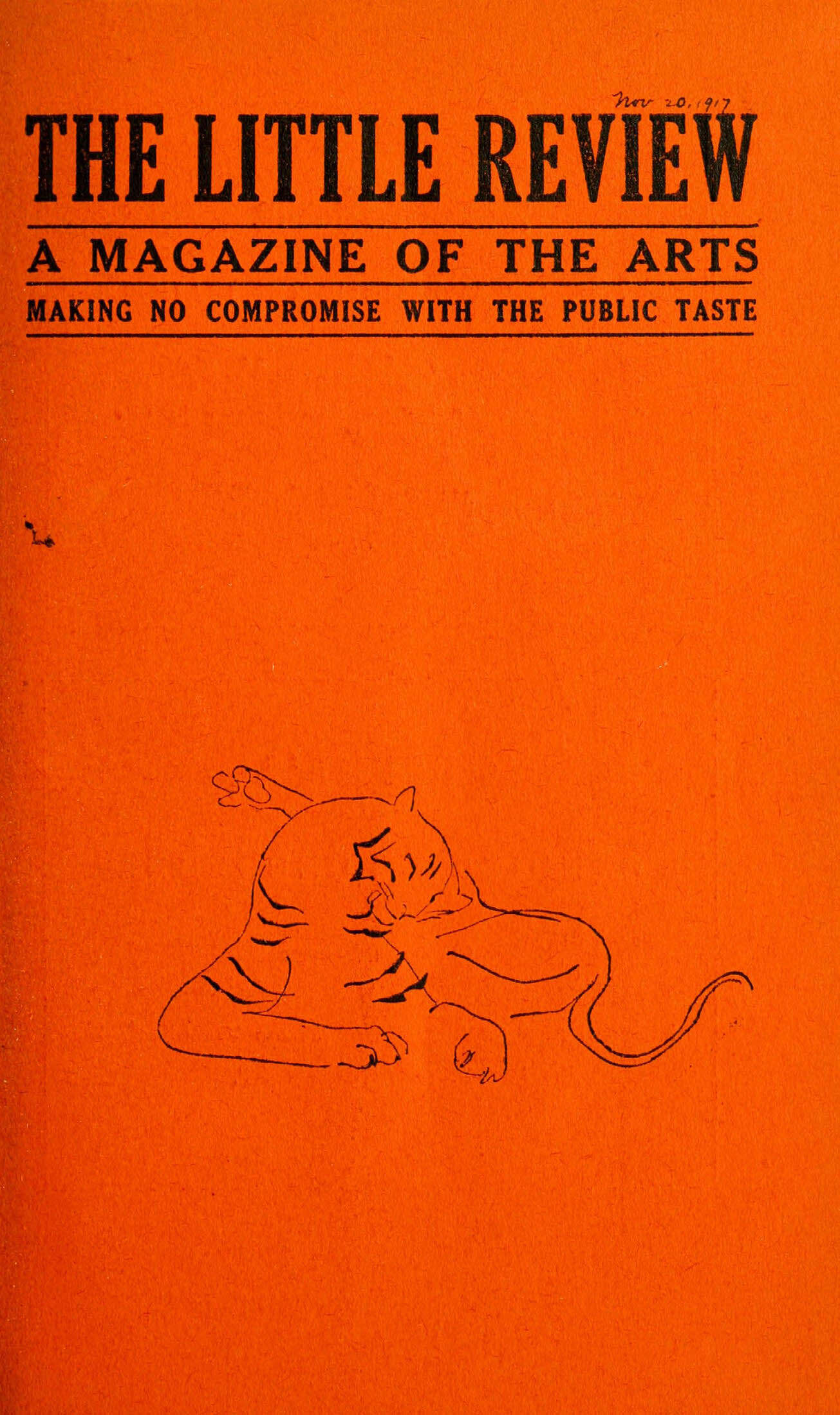
The drawing on the cover is by Gaudier-Brzeska.
Mason & Hamlin
THE STRADIVARIUS OF PIANOS
Mason & Hamlin Co.
313 FIFTH AVENUE
NEW YORK
SPOEHR’S
CANDIES—LUNCHEONS
Chicago Stores
106 NO. STATE ST. 164 WEST ADAMS ST.
Phone Central 1940 Phone Franklin 5047
17 SO. DEARBORN ST.
Phone Central 678
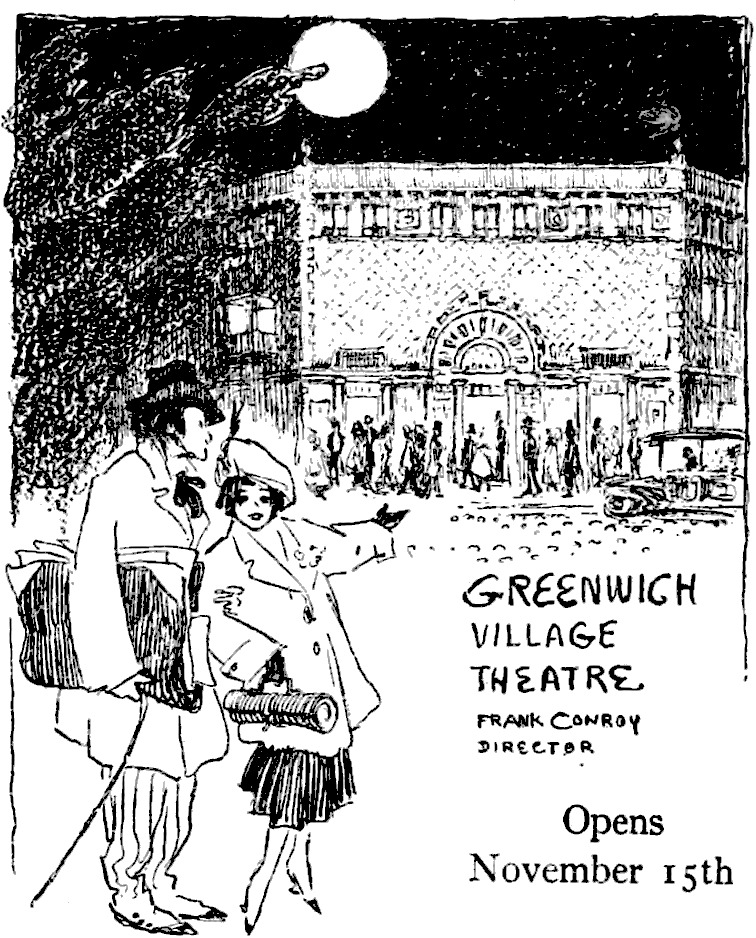
THE GREENWICH VILLAGE THEATRE
4th Street & 7th Avenue
THE
OPENING
BILL:
A Fantasy in two scenes, Behind the Watteau Picture, by Robert E. Rogers, with Incidental music by W. Franke Harling.
Efficiency by Robert H. Davis and Perley Poore Sheehan.
The Festival of Bacchus by Arthur Schnitzler, translated by Charles Henry Meltzer.
Subscription Books Now Open
A BOOK OF REAL
POETRY!
RENASCENCE AND OTHER
POEMS
By
Edna St. Vincent Millay
Limited edition on Handmade Paper
$1.50
Miss Millay’s poems have a remarkable freshness, sincerity and power. They do not depend upon curious and involved artifice, upon waywardness of method or metre, upon the presence of what should be absent. They do not present uncouthness, or mere triteness, as strength. They are not facile outpourings of one form of shallowness, nor the curt trivialities of another. They deal, as poetry should deal, primarily with emotion; with the sense of tears and of laughter, in mortal things; with beauty and passion; with having and losing; with discoveries and inventions. In other words, they deal with life, in a big, true and fine way; and they should appeal to all who care for work that is assuredly worth-while and notable.
Send in your subscription today.
MITCHELL KENNERLEY
PUBLISHER NEW YORK
By LUDWIG LEWISOHN

THE SPIRIT OF
MODERN GERMAN
LITERATURE
An essay in aesthetic and philosophical criticism founded upon an intensive study of the recent German fiction, poetry and speculative works. The soul of the real Germany can best be understood through an interpretation of its literature.
$1.00 net
B. W. HUEBSCH,
225 Fifth Avenue, New York
FANNY HERSELF
By EDNA FERBER
Author of “Emma McChesney & Co.” etc.
A story of a remarkable girl and her adventures in business, small and big. She is, as the New York Tribune says, “the central figure of a train of incidents of more than ordinary interest. Miss Ferber has done no better work than this.” With 4 illustrations by J. Henry. Cloth, 12mo, net $1.40.
THE WORKS OF R. B. CUNNINGHAME GRAHAM
“No one who is interested in the best recent English literature should miss any one of them.... Cunninghame Graham is a unique phenomenon in modern English letters and, if justice is done, he will outlive Wells. He has done something almost new in fiction....”—N. Y. Evening Mail.
BROUGHT FORWARD—Just Published
FAITH PROGRESS HOPE SUCCESS CHARITY
Each, cloth, 12mo, net $1.35.
The LIVING PRESENT
By GERTRUDE ATHERTON
Author of “The Conqueror,” etc.
What Women Can Do in wartime, as exemplified by the supreme achievement of the women of France since 1914. The second part of the book deals with the problems confronting American women. Illustrated. Cloth, 12mo, net $1.50.
GRENSTONE POEMS
By WITTER BYNNER
Author of “Young Harvard,” etc.
“There are few poets who, like Witter Bynner, can put into their lines genuine feeling, the passion of beauty, which is the authentic mark of true poetry,” is the Literary Digest’s comment preceding the quotation of several of the “Grenstone Poems.” Cloth, 8vo, illustrated, net $1.75. Cloth, 12mo, not illustrated, net $1.35.
PIANO MASTERY—Second Series
By HARRIETTE BROWER
Author of “Piano Mastery,” etc.
Talks with master pianists and teachers. Cloth, 8vo, illustrated, net $1.75.
CONTEMPORARY RUSSIAN COMPOSERS
By M. MONTAGU-NATHAN
Studies of the lives and works of contemporary Russian musicians. Cloth, 8vo, illustrated, net $2.50.
FREDERICK A. STOKES COMPANY
Publishers New York
J. ADAM
LADIES’ TAILOR
(Furs and Dressmaking)
A perfect fit guaranteed
425 FIFTH AVENUE
Opposite Lord and Taylor
New York City
Telephone Vanderbilt 5622
STATEMENT OF OWNERSHIP, MANAGEMENT, CIRCULATION, ETC., REQUIRED BY THE ACT OF CONGRESS, OF AUGUST 24, 1912. OF THE LITTLE REVIEW, published monthly at New York, N. Y., for October 1, 1917.
State of New York, County of New York—ss.
Before me, a Notary Public in and for the State and county aforesaid, personally appeared Margaret C. Anderson, who, having been duly sworn according to law, deposes and says that she is the Publisher, Editor, Owner, Business Manager of THE LITTLE REVIEW, and that the following is, to the best of her knowledge and belief, a true statement of the ownership, management (and if a daily paper, the circulation), etc., of the aforesaid publication for the date shown in the above caption, required by the Act of August 24, 1912, embodied in section 443, Postal Laws and Regulations, printed on the reverse of this form; to wit:
1. That the names and addresses of the publisher, editor, managing editor, and business managers are:
Publisher, Margaret C. Anderson, 24 W. Sixteenth St., New York; Editor, Margaret C. Anderson, 24 W. Sixteenth St., New York; Managing Editor Margaret C. Anderson, 24 W. Sixteenth St., New York; Business Manager, Margaret C. Anderson, 24 W. Sixteenth St., New York.
2. That the owner is, Margaret C. Anderson.
3. That the known bondholders, mortgagees, and other security holders owning or holding 1 per cent. or more of total amount of bonds, mortgages, or other securities are: None.
4. That the two paragraphs next above, giving the names of owners, stockholders, and security holders, if any, contain not only the list of stockholders and security holders as they appear upon the books of the company but also, in cases where the stockholder or security holder appear upon the books of the company as trustee or in any other fiduciary relation, the name of the person or corporation for whom such trustee is acting, is given; also that the said two paragraphs contain statements embracing affiant’s full knowledge and belief as to the circumstances and conditions under which stockholders and security holders who do not appear upon the books of the company as trustees, hold stock and securities in a capacity other than that of a bona fide owner; and this affiant has no reason to believe that any other person, association, or corporation, has any interest direct or indirect in the said stock, bonds, or other securities than as so stated by her.
MARGARET C. ANDERSON.
Sworn to and subscribed before me this 29th day of Sept., 1917.
W. J. HADLEY, Notary Public.
(My commission expires March 30th, 1919.)
THE ARTISTS’ GUILD
A NATIONAL ORGANIZATION INCORPORATED ON
A “NOT FOR PROFIT BASIS”.
Paintings, Sculpture
AND
Handwrought Objects
As security for the purchase and to insure merit, all works are approved by a jury.
Exquisite and Rare Gifts
The Artists’ and Craft Workers’ own organization
GALLERIES, EXHIBITION AND SALESROOMS
FINE ARTS BUILDING CHICAGO, ILLINOIS
“Hello Huck!”

Recall that golden day when you first read “Huck Finn”? How your mother said, “For goodness’ sake, stop laughing aloud over that book. You sound so silly.” But you couldn’t stop laughing.
Today when you read “Huckleberry Finn” you will not laugh so much. You will chuckle often, but you will also want to weep. The deep humanity of it—the pathos, that you never saw, as a boy, will appeal to you now. You were too busy laughing to notice the limpid purity of the master’s style.
MARK TWAIN
When Mark Twain first wrote “Huckleberry Finn” this land was swept with a gale of laughter. When he wrote “The Innocents Abroad” even Europe laughed at it itself.
But one day there appeared a new book from his pen, so spiritual, so true, so lofty that those who did not know him well were amazed. “Joan of Arc” was the work of a poet—a historian—a seer. Mark Twain was all of these. His was not the light laughter of a moment’s fun, but the whimsical humor that made the tragedy of life more bearable.
A Real American
Mark Twain was a steamboat pilot. He was a searcher for gold in the far West. He was a printer. He worked bitterly hard. All this without a glimmer of the great destiny that lay before him. Then, with the opening of the great wide West, his genius bloomed.
His fame spread through the nation. It flew to the ends of the earth, until his work was translated into strange tongues. From then on, the path of fame lay straight to the high places. At the height of his fame he lost all his money. He was heavily in debt, but though 60 years old, he started afresh and paid every cent. It was the last heroic touch that drew him close to the hearts of his countrymen.
The world has asked is there an American literature? Mark Twain is the answer. He is the heart, the spirit of America. From his poor and struggling boyhood to his glorious, splendid old age, he remained as simple, as democratic as the plainest of our forefathers.
He was, of all Americans, the most American. Free in soul, and dreaming of high things—brave in the face of trouble—and always ready to laugh. That was Mark Twain.
The Price Goes Up
25 VOLUMES Novels—Stories—Humor—Essays—Travel—History
This is Mark Twain’s own set. This is the set he wanted in the home of each of those who love him. Because he asked it, Harpers have worked to make a perfect set at a reduced price.
Before the war we had a contract price for paper, so we could sell this set of Mark Twain at half price.
Send the Coupon Without Money
L. R. S HARPER & BROTHERS
Franklin Sq., N. Y.
Send me, all charges prepaid, a set of Mark Twain’s works in 25 volumes, illustrated, bound in handsome green cloth stamped in gold, gold tops and untrimmed edges. If not satisfactory, I will return them at your expense. Otherwise I will send you $1.00 within 5 days and $2.00 a month for 12 months, thus getting the benefit of your half-price sale.
Little Review
Name ......................
Address ...................
The last of the edition is in sight. The price of paper has gone up. There can be no more Mark Twain at the present price. There never again will be any more Mark Twain at the present price. Get the 25 volumes now, while you can. Every American has got to have a set of Mark Twain in his home. Get yours now and save money.
Your children want Mark Twain. You want him. Send this coupon today—now—while you are looking at it.
HARPER & BROTHERS, New York
THE LITTLE REVIEW
Respecting no vested interests, no publishers’
interests, no aged magazines and reviews
nor staffs of the same.
In the December number:
A Letter from Remy de Gourmont
A Soldier of Humor, I., by Wyndham Lewis
T. S. Eliot: A Criticism, by May Sinclair
The beginning of a new type of book reviewing
Women and Men, by Ford Madox Hueffer, (probably his most important book) begins in the January number and will run until June 1919.
James Joyce will begin a new novel in February or March.
SPECIAL ANNOUNCEMENT
The subscription price of The Little Review will be raised, beginning with the January number, to $2.50 a year. Single copies will sell for 25 cents.
Those who subscribe before January 1, 1918, will be entitled to the present rate of $1.50.
FOR CHRISTMAS
The bound volumes of The Little Review now constitute a definite property. Our supply of back numbers is not limitless, but you can obtain the first six months of the present volume (May-October, 1917), in distinctive bindings, for $2.50. This applies to orders sent in before January.
Those who have saved their back numbers and wish to send them to us for binding can have them done for $1.00.
You could not find a more suitable Christmas gift for your “literary” friends.
Or, if you wish to send The Little Review for the next year to some one, let us have your order as soon as possible. All orders received before January 1, 1918, will come under the present subscription price of $1.50.
24 West Sixteenth Street, New York City
SPECIAL OFFER
James Joyce’s A Portrait of the Artist as
a Young Man and a year’s subscription to
The Little Review for $2.50.
We are glad to announce that through the courtesy of Mr. Huebsch we are able to make the following unusual offer, open to any one who sends in a subscription (or a renewal) to The Little Review.
Mr. Joyce’s Portrait of the Artist as a Young Man, the most important and beautiful piece of novel writing to be found in English today, retails for $1.50. The subscription price of The Little Review is $1.50. We will cut the latter to $1.00, for this special offer, and you may have the book and the subscription for $2.50. Or you may have Mr. Joyce’s Dubliners instead.
ORDER FORM
“A PORTRAIT OF THE
ARTIST AS A YOUNG MAN”
Please send me .... cop. .... of A PORTRAIT OF THE ARTIST AS A YOUNG MAN by James Joyce, published by Mr. B. W. Huebsch, for which I enclose ....
Name ...............
Address ............
....................
Orders, accompanied by remittance should be sent to
THE LITTLE REVIEW
24 West 16th Street, New York City
Transcriber’s Notes
Advertisements were collected at the end of the text.
The table of contents on the title page was adjusted in order to reflect correctly the headings in this issue of The Little Review.
The original spelling was mostly preserved. A few obvious typographical errors were silently corrected. All other changes are shown here (before/after):