Title: The lost dirigible
Author: Ralph Henry Barbour
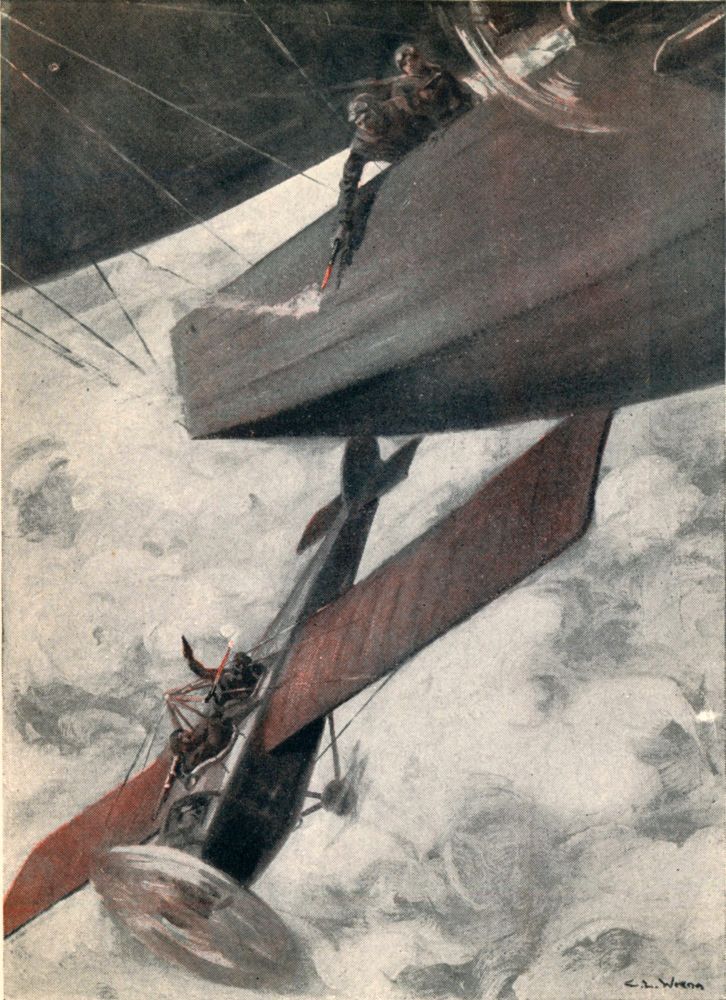
Illustrator: Charles L. Wrenn
Release date: October 4, 2026 [eBook #79722]
Language: English
Original publication: New York: D. Appleton and Company, 1920
Other information and formats: www.gutenberg.org/ebooks/79722
Credits: Produced by Donald Cummings and the Online Distributed Proofreading Team at https://www.pgdp.net
THE
LOST DIRIGIBLE
BY
AUTHOR OF “FOR THE FREEDOM OF THE SEAS,” “GUARDING HIS GOAL,”
“UNDER THE YANKEE ENSIGN,” ETC.

FRONTISPIECE
NEW YORK LONDON
1920
COPYRIGHT, 1920, BY
Copyright, 1920, by
The Sprague Publishing Company
PRINTED IN THE UNITED STATES OF AMERICA
[v]
[1]
THE LOST DIRIGIBLE
“Report to Commanding Officer Naval Aviation Base, Punta Rio, Texas.”
Such was the order that sent Jack Sterling hiking south that first hot week in August. Forty-eight hours’ leave allowed him a visit home, however, and it was not until the morning of the sixth that he bade good-by to his folks and started off for the station in one of Mike Connell’s rattling taxis, his battered suit-case beside him and his small trunk swaying tipsily about on the seat outside. Oddly enough, it was Jerry Connell who drove that morning. He and Jerry had gone to school together in Mount Warren, had played together and, at times, had fought together. The fact that Jack was the son of Judge Sterling, a citizen of prominence and some wealth, and that Jerry was the heir [2]apparent to the town’s principal liveryman had made no difference. Nor did it now, for the two had nearly wrung each other’s hands off at meeting, and all the way to the station Jack, sitting well forward on his seat, conversed with the driver through the open front window of the little car. As Jack had not been home since shortly after Christmas, there was much news to be told, and as they rattled and bumped down the long, straight length of Adams Street, Jerry’s head was turned half around and his tongue kept busy. When, however, he had guided the car through the traffic of the Square and was bouncing over the cobbles of Ferry Street, under the many-windowed front of the knitting mill, he began to put questions himself. Because of the whirring and clicking that came from the building beside them he had to shout to make himself heard.
“Well, you got your commission, didn’t you?” he asked.
“Last month.”
Jerry turned further around and cast an admiring look at the insignia adorning the sleeve of his friend’s coat. “I heard you had,” he continued. “Steve Perry, down at the Post Office, said you’ve got a stripe and he read it in the paper. Ensign, aren’t you?”
[3]
“Yes,” answered Jack, “and without ever being at sea!”
“Get out!”
“Fact. The nearest I got to it was six months at Norfolk on a receiving ship that never left the dock. Maybe I’m due for better luck now, though. I’m going down to Texas.”
“That so? But, say, Texas isn’t— There isn’t any water around Texas, is there?”
“Well, there’s considerable of it along one side, Jerry, about four hundred miles of the Gulf of Mexico.”
“That’s right, too. I’d forgot that. I always think of Texas as being inland like. I never was any good at geography, anyway. I suppose you’ll be fighting Mexicans before long, eh? Is there really all the trouble down there the papers say there is?”
“I don’t believe so. The papers generally make those things out rather worse than they are. Still, there’s a chance of trouble, I guess, and I’m tickled to death to get down there. All the fellows back at the Yard were green with envy when I told them about my transfer. What’s bothering me is that I’m ordered to report to the Aviation Corps. That doesn’t sound much like salt water. I’ve never qualified for the flying service. I’m guessing!”
[4]
“Radio’s your line, isn’t it?” asked Jerry.
“Yes, and if they stick me in an aëroplane I’ll probably die of fright! Mother’s worried sick for fear I’ll get killed. I had to promise her I’d wear a parachute around my neck every minute!”
“Gosh, Jack, I’d certainly love to go up in one o’ those things! Wish I’d tried for the navy when you did that time. Guess they wouldn’t have taken me, though, on account of my eyes. That’s what kept me out of the army, you know. Made me feel like an awful fool, too. Folks used to ask me when I was going, and when I’d tell ’em I hadn’t passed they’d sort of grin, and I’d know they thought I was lying. Guess the old Kaiser wasn’t any gladder than I was when they signed that armistice! Say, you must be eighteen now, aren’t you? You’re about a year younger than me if I remember right.”
“Eighteen next month. I try hard to look older, but I don’t succeed very well, I guess.”
Jerry grinned. “You surely don’t, kid. Fact is, you look more like seventeen than eighteen. You were always like that, though. I remember when we went to the old primary school together. You looked like you’d climbed out of the cradle and run away!”
“If I could only raise a mustache it mightn’t [5]be so bad,” said Jack, ruefully. “But a mustache on anything under an admiral isn’t thought well of in the navy! Well, I’m awfully glad to have seen you again, Jerry. I’ll drop you a post-card some day when I get down there and tell you what I’m doing. Mind lugging that trunk around to the baggage-room? Here, I’ll give you a hand with it.”
“Lay off!” protested Jerry. “You’d look fine toting your own trunk around, wouldn’t you? Don’t they teach you respect for your uniform where you come from?”
“Sure,” laughed Jack. “And they teach us to take hold when there’s work to be done, too! All right, Jerry, I’ll toddle behind with the bag.”
Jack’s father had come down from his office for a final leave-taking and was waiting on the platform when he got there. The remaining minutes were occupied in securing transportation and checking the trunk, and then the long train was puffing into the station and Jack was climbing aboard. The Judge’s smile never faltered, but there was much earnestness in his final grip and in his words as the train moved off.
“Write often, son,” he said, “for we’re going to be pretty anxious now, mother and I. I sort of hope you’ll land on a ship and not a flying [6]machine. But, you be careful and—and do your duty and——”
If there was more, Jack didn’t hear it, for the train was moving fast. He smiled reassuringly, waved from the car steps and saw his father and Jerry Connell and all the others on the platform merge and dwindle and pass from sight. Then, from his seat in the parlor car he watched the home town gradually disappear; the mills and the long lines of operatives’ houses, the wagon bridge over North Creek, the pool in the old brick yard where he and Jerry and many others had skated in winter and paddled in summer, the pretty stucco, vine-clad cottages in the new residence district on what had used to be Town Line Hill, the old Fair Grounds, with the withered reminders of a war garden bleaching in the hot morning sunlight, and then the open, rolling country glimpsed between rows of freight cars along the sidings.
Presently Jack opened his bag and took out a book. It was a treatise on aërial navigation which he had hurriedly procured in the city two days before. For awhile he studied the pictures and diagrams and then, settling back in his seat, began to read. Jack’s ignorance of the subject was colossal, for, save that he had watched airplanes and seaplanes in flight often enough, he [7]couldn’t have told why they flew had his life depended on it. But he meant to find out, since, no matter what sort of duty might be awaiting him at Punta Rio, it certainly behooved him to know something at least of the theory of flying. Even if his assignment should prove to be ground work, and he rather expected it would, he would nevertheless be thrown in with men who knew aviation as well as he knew radiotelegraphy, and it would be a convenience, if no more, to be able to understand their talk. When he passed into the dining car for luncheon he took the book along and went on reading as he ate. There was much he couldn’t quite understand, but on the whole he made progress, and when, shortly after three o’clock, the train drew into the city he could have spoken quite knowingly of torsion and stability and poise, having reached page 114. Nevertheless there was a perplexed look on his face as he stuffed the book back into his suit-case, and he mentally echoed his father’s hope that the deck of a ship and not the car of an aëroplane would prove to be his station!
He had a wait of over two hours in the city, and, checking his suitcase, he went forth and made a few simple purchases, consuming as much time as possible over each. But it still lacked an hour of train time when he got back to the terminal [8]and so, buying an evening paper at the news stand, he found a seat in the waiting-room and spread it out before him. The first headline to meet his gaze gripped his attention. “Mexican Situation Grows More Acute,” he read. “British and French Warships Reach Tampico. War Department Gives Number of American Troops Along Border as 154,000. Raiders Cross Rio Grande at Las Orgas and Thurston. Twelve Mexicans Killed and Many Taken Prisoner. Eight Americans Wounded and Three Missing. State Department Denies Receipt of Answer to President’s Note.” Jack read the dispatches with pursed lips. Maybe, after all, the papers were for once telling no more than the facts, he thought. At all events, affairs along the border were in bad shape. And the arrival of British and French ships at Tampico looked like business. He didn’t pretend to understand the right and wrong of Mexico’s position in the controversy regarding her oil fields, but he was willing to bet a month’s pay that if they’d just give the word to the United States Navy the whole thing could be settled in a wink! Whereupon, stuffing the paper in his pocket, he retrieved his suit-case and sought the train-shed. Of course he couldn’t hurry that train off, but at least he could see that it wasn’t delayed on his account!
[9]
Two days later, dust-covered, parched by the heat until he felt as he believed a slice of dried apple must feel, Jack lolled in a corner of his seat in the sleeping car and watched the sun-bathed fields of southeastern Texas dawdle past the window. Houston was four hours behind and the end of his journey was as many hours ahead. It was too hot to read, too hot to move around and too hot to sit still, and his frame of mind was far from serene. Until last night the trip had been rather pleasant. His fellow passengers had proved companionable and the country through which he had passed had been novel and interesting. But at Houston the occupants of the sleeper had changed. So far as he knew, he was the only one of the original members left; and the new lot, fewer in number, seemed unusually commonplace.
There was, however, one exception; in fact, two. The first was a youth of perhaps nineteen [10]who wore the navy uniform and the foul anchor of an ensign on the collar of his service coat. He was a good-looking chap, if a trifle haughty. Jack thought no less of him for looking haughty, but it certainly lessened the chance of becoming acquainted. It seemed rather a shame, too, for Jack wanted some one to talk and ask questions of, and it was a fair wager that the two lone representatives of the United States Navy were bound for the same destination. But the second ensign seemed absolutely uninterested in the existence of the first and, after a swift, appraising look on entering the car at Houston, had never again so much as glanced Jack’s way. Instead, he had immediately become immersed in a book—Jack was grimly certain it wasn’t on the subject of aërial navigation!—and scarcely once lifted his eyes from its pages. He sat five seats beyond Jack, on the other side of the car, and only the top of his head was visible, and after awhile Jack had lost interest in it. Whereupon he had become aware of Señor Gonzales.
Of course, that was probably not his name, but it was what Jack mentally dubbed him. He, too, was across the aisle and one seat back, and Jack could see him from his corner without really turning his head. He was unmistakably Mexican, belonging to what the boy presumed to be the better [11]class. He was ridiculously small, small any way you judged him. In height he couldn’t have been above five feet and four inches, and that in shoes, that were, as Jack noted, uncommonly high of heel. Everything was small about him, almost delicate. His hands and feet were about half the size of Jack’s, his head was small, his limbs alarmingly slight. But he appeared to be perfectly built for all of that. His complexion was dark and his skin smooth, and everything about him, from his waxy brown shoes to his wide Panama hat, was immaculate. He was dressed for the climate, it seemed, in a white silk shirt and a suit of some light-weight material of greenish-gray hue. A rather startling yellow scarf was the only discordant note in his careful attire. From it a large emerald pin glowed. He wore two rings on his left hand and a costly-looking watch adorned his wrist. He was a handsome chap, thought Jack, and had an air about him. He was the first Mexican that Jack had ever seen, so far as he knew, and he concluded that if all his countrymen were no bigger than he there ought not to be much difficulty in persuading them to behave themselves!
Once the Mexican gentleman looked up while Jack was studying him with frank curiosity and smiled and bowed. After an instant’s hesitation [12]Jack returned the bow, rather stiffly, but didn’t smile. He presumed that Mexicans greeted strangers that way as a matter of courtesy, and it might be all right when you were used to it, but for his part he felt just a little embarrassed. After that he scrupulously refrained from looking at Señor Gonzales.
“If,” he said to himself with a chuckle, “he caught me rubbering at him again he’d probably come over here and kiss me!”
He tried hard to get through another chapter of his book on aërial navigation, but it was hard sledding, and presently he laid it aside and got up. For want of another refuge, he walked back into the smoking compartment. A man who looked as if he might be a ranchman and another who had “drummer” written all over him were in sole possession. Jack found a seat in a corner of a leather couch and for awhile listened to the conversation. It wasn’t very interesting, though, and soon he turned his attention to the view.
The air was perceptibly cooler now, for the railroad was paralleling the Gulf, and a faint breeze wafted through the open window beside him. Ten minutes later he was aroused from his reflections by a suave, pleasant voice at his shoulder.
“Pardon me, sir, but have you a match?”
[13]
Turning, Jack found that the Mexican had entered the compartment and taken a seat at his side. Jack wasn’t sure whether he had such a thing as a match. He didn’t smoke, but he sometimes tucked a few in a pocket. While he was investigating his gaze fell on a box fixed between the windows and he reached forth and took it from its receptacle, handing it to his neighbor. The latter accepted it gratefully, with a dazzling display of small white teeth.
“I am most stupid,” he apologized. “I did not see.” He held a silver cigarette case out. “Will you smoke?” he asked.
Jack thanked him, but declined. Conversation followed naturally. “Señor Gonzales” was a most interesting companion and most frank regarding his personal affairs. He was, it appeared, returning to his home near Matamoros from a visit in Chicago, a visit partly concerned with business and partly devoted to pleasure. He had many agreeable things to say about Chicago and the United States in general, and he seemed desirous of convincing Jack of his friendly regard for America and things American. The ranchman and the drummer departed unnoted and another passenger took his place in the compartment without Jack being more than dimly aware of his arrival. The Mexican gentleman was [14]speaking of his own country and speaking so eloquently and picturesquely and in such excellent English that his audience was quite absorbed. A half-hour passed pleasantly. Jack almost forgot the heat and the train dust. His companion lighted fresh cigarettes at regular intervals. At last he interrupted himself with a gesture of contrition. “But I fear that the señor is not interested! I bore him! I—what is it you say in your country?—I hog the conversation, si? Tell me now of yourself, señor. You are of the navy?”
Jack protested that he had not been in the least bored, that he had, on the contrary, greatly enjoyed the other’s talk, but the Mexican shook his head, waved a delicate hand gayly and laughed.
“No, no! You are most polite, but I have talked enough. You, perhaps, come from Chicago?”
Jack denied it and mentioned his place of residence. The other shook his head. “I do not know it. I have been to Chicago, to New York and to Philadelphia. I admire all those cities. I admire your wonderful hotels, señor. The Americans are remarkable. In my country,”—he shrugged—“we are so far behind. Only in Mexico City have we fine hotels and theaters [15]and casas. Perhaps you will see our country, señor.”
“I’d like to, but I guess there’s no such luck,” replied Jack. “I’m ordered to Punta Rio for duty. And,” he added jokingly, “I suppose Mexico is a bit unhealthy just now for Americans.”
“Unhealthy?” echoed the other innocently. “Only in the low country, señor, and one does not travel there at any time of year. In Mexico City the climate is now delicious, much cooler than in your Chicago. Rain, yes, but not to inconvenience.”
“I meant that owing to—to political differences of opinion,” stammered Jack, “we Americans might not be welcome.”
“No, señor, you are wrong, I assure you! The politicos make talk, but it is nothing else. We are badly governed, señor. It has been so always. There is discontent, uneasiness. We quarrel amongst ourselves, si, but with our good neighbor, no! For your country we have much respect, great admiration.”
“But your people along the border have a way of stirring things up now and then,” laughed Jack.
“Ah, that is so. But they are ignorant persons, rusticos, misled by brigands. They are like your robbers of trains, señor, and but seek to enrich themselves. One does not take them seriously. [16]For the rest”—he shrugged again and smiled charmingly—“this foolish president of ours has made a wrong decision and now but seeks to save his face. In a little time he will come to terms. What else can he do? He cannot fight America and Great Britain and France, señor! Already, or so they say, he is seeking a way out that will not be hurtful to his pride. No, no, there is no ill-feeling in my country for yours. You will be as safe in Mexico City as in your own home. I hope you will make us a visit, señor. You will find much to interest you.”
“You live there, sir? In Mexico City?”
“I am there much of the time, señor. My home is in the north. It is not far distant from Tampico, where your ships are gathered. I own iron mines there. This Punta Rio of which you speak is near the border?”
“Yes. I’ve never been there. The map shows it almost on the border.”
“I do not know it.” The Mexican lighted a fresh cigarette. “It is what you call a Naval Station, doubtless.”
“Yes. I don’t believe there are many ships there, though. I think it is more an aviation camp.”
“Ah! You interest me, señor. I have always [17]admired the brave ones who fly in the air. Such courage! Such audacia! And the wonderful ships that dart and wheel like great birds! Always they excite me, make my heart to leap! You, then, are one of those brave aviators, señor?”
“No, that’s not my line,” answered Jack. “I’m a radio operator. Of course, I might have to go on an aëroplane, but I don’t expect to. Usually they take fellows who have trained for it. I’ll be just as happy if I don’t, too, for I guess I’d be pretty well scared.”
“The señor does himself injustice,” murmured the other politely. “I am certain that he is of a great courage, like all his compatriots. These aëroplanes that you mention, there are doubtless a great many of them? Ten, twenty, perhaps even more?”
“I guess there are easily twenty,” answered Jack carelessly.
“Consider it! And they are all at this Punta Rio? Or do they also station themselves elsewhere?”
“Oh, I guess there are more in other places. I——”
Jack paused. For a minute or more he had been subconsciously aware of a disturbing sound, [18]a tapping it seemed, that he had set down as a part of the noise of the train. But now he looked startledly across the compartment. In the corner by the window the haughty ensign was seated. Jack had known of the presence of a third person, but had been too absorbed in conversation to pay any heed to that person’s identity. The ensign appeared to be interested only in the monotonous landscape flowing past the window, and perhaps he was not aware that the tapping of a pencil on the sill might be annoying to the other occupants of the compartment. At least, he did not discontinue it, and Jack, listening to the tapping, flushed.
“Shut your fool mouth!”
That is what the pencil said in Navy Code.
For an instant Jack was mad clear through. Then he realized that perhaps the warning, as discourteous as it was, was called for. Perhaps, come to think of it, he had been talking rather too freely considering that his listener was a Mexican! But he didn’t think it necessary for the other chap to speak so disrespectfully of his mouth!
The pencil went on tapping, but now the taps were meaningless, and after a moment the ensign returned it to his pocket. Jack turned to find the Mexican gentleman’s gaze fixed serenely on him.
[19]
“You were saying, señor——”
“Oh—why—what were we speaking of?” stammered Jack.
“Of the gallant airships, señor. But it is of no consequence. I had merely asked——”
“Oh, yes! Well, I don’t know much about ’em. You see, this is my first trip down this way. Fact is, I haven’t been in the service long enough to get onto things yet.”
“Doubtless there is much to learn,” assented the other. “You men of the sea lead a life far different from that of us who dwell ashore. I know but little of the sea. And what little I know I do not like, señor. It is too—too—uneasy. It makes me most unhappy inside. I prefer to stay on land, me!” He tossed aside a half-consumed cigarette and arose. “I have much enjoyed our little talk, señor,” he said. “I hope we shall meet again. Now I will take a siesta before the train arrives at the junction. Adios, señor.”
Señor Gonzales went out. Jack wanted to follow, but as it might look like running away he didn’t. Instead, he pretended elaborate interest in the view. He heard his brother ensign shuffle his feet, but he didn’t look across. After a few minutes:
[20]
“I thought you were never going to get that,” said his neighbor pleasantly.
Jack removed his gaze from the landscape and fixed it on the speaker. “You needn’t have worried, thanks,” he said dryly. “I wasn’t telling any secrets.”
“Maybe not, son, but you seemed headed that way. It’s just as well not to talk navy affairs in public.”
“This isn’t war-time,” replied Jack haughtily.
“Isn’t it? Well, it’s mighty near it. And when you get to telling the location and number of navy seaplanes you’re talking too much. If you want to get huffy about it, all right. You’re not bothering me any. But you’d better fight shy of that cute little Mex or he will pump you dry.”
“I’ll look after that, thanks!”
The other laughed as he pulled himself from his seat. “Say, you’re a touchy guy, aren’t you? Sorry if I stepped on your toes, son. As our picturesque friend says, ‘adios.’”
“Go to thunder,” muttered Jack. But he didn’t say it until the other’s footsteps had ceased in the corridor outside. “And quit calling me ‘son,’ too,” he continued. “I’m not much younger than you are, you stuck-up pup!”
Perhaps his ill-temper was partly due to the realization that if it hadn’t been for the message [21]of the tapping pencil the agreeable stranger would have, as the obnoxious ensign put it, pumped him dry! After this, he promised himself grumpily, he wouldn’t tell any one even the time of day!
[22]
Jack had no further intercourse with either “Señor Gonzales” or his brother officer while the journey lasted. Some two hours later the Mexican left the train at the junction and presumably traveled westward. His leave-taking of Jack consisted of a bow and a flashing glimpse of small and very white teeth. Jack’s response was decidedly stiff. They were now close to the border, and the platform of the station held many dark-skinned men in picturesque attire. With one of these, Jack thought, he saw “Señor Gonzales” in conversation in the lee of the station as the train crawled on once more.
As for the haughty ensign, that young gentleman seemed to have completely forgotten Jack’s existence again. He read, dozed, stared from his window and was as thoroughly bored as was Jack. The latter tried hard to peruse his book on aërial navigation, but southern Texas in August isn’t just the place in which to combine railway travel [23]and study. To be sure, as the shadows grew long a refreshing breeze blew through the car and brought a degree of animation to the dozen or so occupants. Once, for a brief instant, Jack caught sight of the sparkling waters of the Gulf, but for the most part sun-baked earth and cloudless blue sky met his gaze. After awhile the sky changed its hue to saffron, purple shadows crept over the land and a white star twinkled in the heavens. And then, quite suddenly, as it seemed to Jack, it was evening. The other navy chap began to gather his belongings together, as did several others in the car, and so Jack followed their example, and he had scarcely closed his bag before the end of his journey arrived.
A confused impression of twinkling lights and voices and chugging motors and a soft, cool breeze was his as he stood for a moment on the platform and peered about him in the gloom. Then, his gaze led by the noise of an automobile engine, he descried the darker bulk of a motor vehicle of some sort and made his way to it.
“I want to get to Camp Stanton,” he told the dim form of the driver. “Can you tell me——”
“Jump in,” was the cheerful reply. “Any more coming, do you think?”
“There was another officer on the train——”
“Got him.” The horn squawked loudly as [24]Jack fumbled up a step at the rear and, feeling his way along the dark interior, tripped over something that might have been a bag and went sprawling to a seat.
“I beg pardon,” he gasped.
“All right,” answered his unseen companion. Jack recognized the voice. He could have kicked himself for his clumsiness then. The driver was speaking, his head turned toward the gloomy recess of the auto. “Any baggage to go?” he asked. “There’s plenty of room to-night and I can take another trunk or two.”
Jack found his check and the driver disappeared. Silence reigned in the auto. It was a covered vehicle with a cushioned seat running along each side. Two headlights bored white paths into the darkness in front, but the interior was as black as a pocket. Jack could make out dimly, as his eyes became accustomed to the darkness, the form of the ensign nearer the door. He wondered if the latter had purposely tripped him up with his feet or deliberately placed his bag in the way. His face grew warm as he imagined the other’s delight at his clumsiness. Then a trunk thumped to the driver’s seat and the vehicle rocked, the horn blew startlingly, there was a swift grinding of gears and they were off. After a moment they were careening through the town, a [25]place of wide, rutted streets and one-story stores from which the light streamed as they passed. Then, with a sudden turn that almost threw Jack from his seat, the auto leaped forward at higher speed over a hard, smooth roadway and the yellow glow of the little town fell farther and farther behind. Through the back of the auto Jack could see a star-sprinkled sky like blue-black velvet and nothing more. Under his feet the auto shook and vibrated and from ahead came the steady hum of the motor. There was no way of knowing, but he told himself that if that wild driver out there wasn’t hitting it up to fifty he missed his guess!
But the ride was brief and presently the auto was slowing down and, without seeing, Jack knew that they had reached Camp Stanton. Through the canvas sides lights filtered as they passed and now and then a voice reached him. The auto stopped.
“B Barracks!” announced the driver. “Headquarters opposite. Hey, Gus! Give me a lift with these trunks!”
Jack followed the other passenger out and found himself confronted by a doorway which led from a low veranda into a long, many-windowed building. Khaki-clad forms graced the veranda’s edge and the wide street gave back the sound of passing footsteps. From somewhere overhead [26]came the droning of an airplane. Jack set his bag down and looked for Headquarters. The haughty ensign had disappeared.
“Right across there, friend, if it’s H. Q. you’re wanting,” volunteered a tall chap who was leaning against a nearby post. “Ask for Lieutenant Greenlee.”
“Thanks.” Jack took up his bag again and crossed to the smaller building opposite. At the door a guard passed him on to an orderly and a moment later he was facing an elderly, bronzed-faced man across a wide desk.
“‘Sterling, John L., Ensign,’” corroborated the lieutenant, referring to a card in his hand. “Had any aviation experience, Sterling?”
“No, sir.”
The lieutenant’s brows arose and he sighed. “Don’t understand why they send us your sort,” he complained. “Ever been up at all?”
“No, sir.”
“Of course not! If you had they’d have assigned you to the submarine service! What did you think you were going to do here, Sterling?”
“I didn’t know, sir. I supposed I’d get duty on one of the ships.”
“Ships? We haven’t any ships here! Well, not your fault, I suppose. Report to Lieutenant Badger, B Barracks. That’s all.”
[27]
On the way out Jack passed his traveling companion in the corridor. The latter nodded, a quizzical look on his face. Jack nodded in return, and then wished he hadn’t.
Half an hour later he was settled. He had a bunk in the long building, his trunk was set beside it, he had had his fill of sandwiches, doughnuts and coffee—all there was to be had at the time of night,—and he was sitting outside on the veranda with the soft Gulf breeze ruffling his bare head. Before him in the darkness the twinkling electric lights marched away toward the shore between rows of buildings. Right and left they marched as well, diminishing to mere pin-points in the distance. Not far off, above the story-high barracks, a larger shape loomed against the starlit sky, monstrous, mysterious, a great black bulk in the darkness. The drone of the night fliers had ceased. From further along the veranda came the tinkling of a guitar and voices singing softly. Perhaps if the songs had been more cheerful they would not have affected Jack as they did, but “Suwanee River” and “Old Black Joe” and other more recent but no more cheerful ditties sent his spirits down and down until, before long, he was thoroughly homesick. Before taps had sounded he was lying in his bunk feeling very miserable. The thought of having to “go up” [28]filled him with apprehension. He was quite sure that he would disgrace himself by being very sick or fainting or doing something equally horrible. And if he did, it was dollars to doughnuts that that insufferable ensign would be on hand to see it!
Gradually the barracks filled and jests and laughter sounded about him. Outside, a bugle called taps and was echoed farther away. The long room became dark save for a single light at one end. Silence reigned at last. Jack was sure he would never go to sleep. But the little soft breeze came in through the open windows and blew gently over his tired eyes, and presently they closed.
The next thing he knew it was morning and reveille was sounding. A babel of sound came from the barracks. And through a window across the room, down a long street, lay the blue waters of the Gulf, sparkling in the pale sunlight of early morning. And Jack, homesickness all forgotten, leaped forth, happy, hungry and eager for life.
Roll-call, and then breakfast at a long table in the big building across the way. It was Jack’s first opportunity to view his comrades and he found them a fine-looking lot. Young men were much in the majority, and to Jack “young” meant under twenty-two or three. There was little talk [29]at breakfast, for every one seemed too busy for conversation. But later, out in the sunlit street and along the knee-high verandas, there was much conjecture as to what was going to happen, and wild rumors were rife. Discovering that Jack had just arrived from the north, a neighbor on the veranda’s edge asked if it was true that the marines had landed at Vera Cruz. Jack had to confess that he had neither heard nor read of it.
“Well, if it wasn’t in the papers,” replied the other disappointedly, “I guess there’s nothing in it. You hear all sorts of wild yarns down here. We don’t get any papers until they’re ’most a week old, it seems. A couple of days ago we heard that the Eighth Cavalry was off to round up that guy Roza and his gang. I guess that was a lie too, eh?”
“I think so. I believe our troops have crossed the border several times, but only a little ways.”
“Well, they’ll be crossing it all right before long,” said the other. “And so’ll we. All those French and British ships down at Tampico ain’t there just to see the view, either, I’ll tell the world. Oh, we’ll get into it this time, buddy!”
“You’re in the marines, aren’t you?” Jack tried to get a view of the insignia on the chap’s buttons.
“Yeah, and I wish I was back with the gang, [30]wherever they are. This aërial business gets my goat!”
“Are you a flyer?” asked Jack interestedly.
“Me? Not on your life! I’m a perfectly good gunner, and I’m here trying to show a lot of dubs how to take a gun apart and put it together again without leaving out more’n half the parts. You won’t see any flyers around these diggings. They’re sort of special. Have a barracks all to themselves over beyond the balloon sheds.”
“Balloon sheds? Oh, is that what the big building over there is? I didn’t know there were any balloons here.”
“Yeah, and there are five or six more of ’em over by the water. Balloons? Gee, we got a bunch o’ the crazy things. Every time one goes up we get ready to duck. Last week one of ’em came down square on the Q. M. building and busted the roof in. Airplanes and flying boats are bad enough, but these here dirigibles are just plumb loony! I wouldn’t go up in one of ’em for two stars on my straps!”
“I should think they’d be safer than aëroplanes,” mused Jack.
“Not them! Why, when you go up in an airplane you know where you’re going, see? And you go there, and when you want to come back, why, you just push a rod and come. But, gee, [31]these dirigibles—say, when one of those starts off it don’t know where it’s going or when it’s going to get there! One of ’em started off the other day for Fort Worth, and the next day a destroyer picked her up about three hundred miles out in the Gulf and towed her in—or what was left of her, which wasn’t much!”
“But they’ve flown over the ocean several times,” objected Jack. “And all over Europe, too. Why, just last week one went from England to some place in India.”
“Yeah, well, they weren’t this kind, friend. Those were whopping big fellows; rigid, too. And they didn’t buck against these here Gulf winds. They say when you get up a couple of hundred feet around here the wind blows four ways at once. These scouts of ours, as they call ’em, are too small, I guess. And they ain’t rigid. Semi-rigid is what they are. Alongside those British dirigibles of the S Class they’d look like a kid’s toy balloon. Still and all, they tell me that they’re expecting big things from ’em. I dunno. Maybe they’ll get onto their curves after awhile and make ’em behave. There’s drill call. Let’s go.”
[32]
For two days life went on busily and uneventfully for Jack. Camp Stanton proved to be a far larger place than he had expected to find. And every day saw it increase in size, new faces appearing at mess. The big camions rolled over from the railway filled with mammoth crates from which, as if by magic, aëroplanes or seaplanes evolved. From across the Gulf the yellow-winged birds of war zoomed their way and spare, keen-eyed youngsters, leather garbed, climbed forth stiffly. All day the planes dipped and circled over sea and land and from dawn until dark the sheds where engines were tested and repaired hummed and clattered. It was a colorful scene as well as a busy one, for the southern sun shone hotly over all. Sea and sky were intensely blue and even the drab buildings of the camp added their tones of light and shadow. And high over all the stars-and-stripes fluttered languidly in the soft breeze.
[33]
For four hours each day Jack, with many other freshly arrived radio officers, received instruction. They were required to acquaint themselves with aëroplane and balloon installations and to repairing and replacing parts, to perfect themselves in the recently improved wireless telephony and to thoroughly learn a new code. He saw no more for the time of his traveling companion, for the latter bunked and messed in C Barracks, but he made many new acquaintances and began to thoroughly enjoy the life. Idle moments were few, but when they came he usually made his way down the long, straight street that led to the shore and the circling line of sheds that held the hydro-aëroplanes. Between beach and hangars was a broad expanse of concrete, and here at any time of day a score or more of flying boats were to be found. He made friends with the mechanics and groundmen, and even with the alert, clear-eyed flyers themselves. For the latter he had boundless respect and admiration. Every one was a hero in Jack’s eyes, and, although he was careful not to show it, he was immensely flattered when one spoke to him. He watched them go whirring aloft with awe and, it must be confessed, a sinking sensation in his stomach, for, since the only ships at Punta Rio were three destroyers and a supply ship, it seemed fairly [34]evident that when he was assigned to duty it would be on one of these marvelous but fearsome machines, and Jack had the average lad’s dread of height. It was not until the morning of his third day at camp that an alternative suggested itself.
Then, returning from drill, he heard a derisive cheer from some men ahead and, following their gaze, saw a sight that brought a thrill of delight and wonder. At the far edge of the camp, slowly ascending above the roofs of the buildings, floated a great silver-gray shape. Even at the distance of half a mile it was both monstrous and majestic. As he looked a second shape came into sight farther off, and, turning lazily, the sunlight flashing on their silvery bodies, the two dirigibles, ever rising, came floating sedately over the camp. Presently the big black symbols on the sides became easily legible: on the foremost and nearer balloon, F 8, on the other, F 9.
“Wonder what they’ll drop on this time,” remarked a cynical youth at Jack’s side. “It isn’t safe to have those things flying around over your head.”
Along the water’s edge the dirigibles passed, but several hundred feet above it, and Jack could see the heads of the crew over the edge of the suspended hull and hear the high-voiced throb of the engines. Presently they swung their tails toward [35]home and, still climbing gradually, grew smaller and smaller. Jack watched until they were scarcely more than specks against the blue and then was surprised to find himself all alone. Every one else had gone along.
“Just like a Rube staring at a skyscraper,” he chuckled as he followed. “But, gee, they’re wonderful things,” he added. “Now, if they’ll put me on one of those I won’t mind it a bit. That’s funny, too,” he added to himself reflectively, “because I guess they go up pretty high. But, somehow, they look a whole lot safer. I wonder if I asked the luff if he’d fix it for me.”
That afternoon he made his way to the far side of camp where the great balloon sheds stood. There were six of these, side by side, each nearly three hundred feet in length and some sixty feet wide. Capable of housing such ships as those Jack had seen that morning, the tops of their arching roofs were a good seventy feet above the ground. On each side were two tiers of big windows and the front ends opened outward in the shape of two huge many-trussed doors. To-day but two of the sheds were open and Jack peered into these with wondering interest. They were empty of their occupants, however, and his curiosity had to be satisfied from a respectful distance, for guards warned him away when he approached [36]too close. From other of the buildings sounds of work issued and machinists and riggers came and went through small doors. He hoped the dirigibles that had gone away in the morning would return while he could see their descent, but they didn’t. They must, however, have come back later, for the next day, when he again made a visit to what was now for him the most interesting part of the camp, the big doors were all tightly shut.
That night, after chow, he dug his book on aërial navigation out of his trunk and turned to the chapters on power balloons. When he slept it was to dream a wonderful and strange dream in which he was floating through space in what may have been a balloon, but which seemed to resemble far more the business section of Mount Warren. At least he distinctly remembered, when he woke, having gone into Patterson’s Drug Store for a glass of soda and, while drinking it, watched the Gulf of Mexico passing thousands of feet below!
The camp had a new and mild sensation the next day. The newspapers arriving in the morning’s mail stated that the Mexican Ambassador at Washington had informed the State Department that thereafter United States aviators flying over Mexican territory would be fired on. [37]For some reason the news appeared to be most cheering and inspiring. One might have thought that it was bouquets instead of bullets that the Mexican Government proposed to present to the American flyers!
“That’ll settle it,” declared Felton, one of Jack’s brother operators. “Just let ’em try that trick and we’ll be on top of ’em like a ton of bricks, Sterling. That’ll mean war, old son!”
“Aw, forget it,” said Boyd, the marine officer, whose acquaintance Jack had made a few days before. “This country won’t mind a little thing like that! Why, say, ain’t we been letting them shoot us up for years without doing more than shaking our finger at ’em? ‘Naughty! Naughty!’ says the War Department. ‘If you don’t stop killing us we won’t let any more guns and ammunition cross the border.’ Besides, a fat chance those Mexican soldiers, specially the federal troops, have of hitting one of our planes! In the first place they can’t shoot for nuts, and if they could all we’ve got to do is stay up out of range. No, sir, it’ll take more’n that to get Uncle Sam’s dander up. What I’m looking for is for some of those greasers to make a mistake and bother one of those English or French boats down at Tampico. Then we’ll see something!”
“A Mexican I talked with on the train, coming [38]down here,” said Jack, “seemed to think that his president was just looking for a way to back down, and that there wasn’t really any possibility of real trouble.”
“Maybe there wouldn’t be if his president was president of anything outside the City of Mexico,” jeered Boyd. “But when you get over in Lower California and find another guy calling himself president and this Tito Roza, down in Coahuila, calling himself president, and two or three others having the same bug, why, say, most anything can happen: and I’ll say it’s going to!”
“Who is this Tito Roza I’ve been hearing so much about?” asked Jack.
“General Tito Roza,” explained Felton. “Some boy, from all accounts. Unlike our old friend Villa, he’s no rough-neck. They say he studied at Chapultepec—that’s the Mexican West Point, you know—and then in Paris, and when he came back the president made him a colonel. Then, when the big war came, he volunteered in the French army and got a lieutenancy and was a pretty fair scrapper, I guess. After the war was over I suppose he found life pretty tame and so he started a revolution over in Coahuila.”
“No one would mind his revoluting till the cows come home,” growled Boyd, “if he wouldn’t make trouble along the border. He thinks if he [39]can get the United States and Mexico in a scrap he’ll be able to grab the presidency, I guess. Anyhow, he’s doing his best to start something. All the raids in the Big Bend country are his doing, although when they catch any of the poor boobs he has fighting for him they swear they’re Federalists. He’s a slick guy, all right! They say he’s got a bigger army right now than that poor nut of a president has, but I don’t know if it’s so.”
“Is he really a general?” Jack asked.
“Sure he is! Why not? If you happen to be president you can promote yourself to be anything you like, can’t you?”
“I see. Roza’s just as much a general as he is a president.”
“I’ll say he’s a heap more,” replied Boyd stoutly. “Any guy who has the price of a handful of soldiers can be president of Mexico, but Tito Roza’s a sure-enough soldier. And long after this slippery president has crawled into his shell and stopped worrying us we’ll be having words with Roza, unless he manages to get himself elected king or president or something before that. That’s all he’s after, I guess.”
“They say,” said Felton, “that he only pays his army half wages with the understanding that they’re to help themselves to anything they take a fancy to when they invade Houston and Austin [40]and Fort Worth. And the poor boobs believe him. Why, they think they’ll be quartered in the Waldorf-Astoria by Christmas! That Roza must be some talker!”
“He isn’t much to look at,” snorted Boyd. “I saw his picture in a magazine awhile back. Sort of a handsome guy, and pleasant as a May morning, but no bigger’n a peanut shell. He had the Croix de Guerre on his cigarette pocket, though. Sometimes those little chaps are pretty good scrappers. I remember a guy we had with us on the other side——”
Whereupon Boyd became reminiscent, and Jack, pleading mythical duties, stole off. With a half-hour of idleness on his hands, he made his way to the balloon sheds. Long before he reached them he heard the hum of engines, and by the time he was in front of the first great building the noise was almost deafening. The big doors of the F 8’s shed were wide open and within, in the half-gloom, the giant cylinder of the dirigible loomed vast and portentous. The sunlight from the roof windows fell on the red, white and blue rings that circled the nose of the big bag, and, farther astern, picked out the great black symbols F 8. As Jack looked it seemed that the dirigible trembled and swayed as though seeking to be free of the cables holding it there, and in a moment he found the [41]reason. Midway of the long shed the twin engines were whirring and throbbing, now slowing to a deep drone and now racing madly until they fairly shrieked. Even fifty feet from the doors the sound assailed the ears unpleasantly. The vibration was carrying itself to every part of the ship.
It was evident that the F 8 was being tuned up, but whether for an immediate trial remained to be seen. Jack hoped they would pull her out where he could have a good close look at her before he had to hurry back to barracks. At least a half-hundred men were busied in the big shed, some swarming about the envelope, others clustered around the suspended car, more yet at work on the ground. A confusion of guys, pipes, wires, of steel drums and torpedo-like cylinders, stretched beneath the balloon, and there, where the great bulk cast its enormous shadow, electric lights glowed wanly, and in the half-darkness forms moved briskly at their tasks. The doors of other sheds were open to-day, but only about the F 8 were there signs of real activity, and Jack soon returned to where he could see the long dirigible stretching back into the alternate gloom and sunlight of the building. The engines were stilled now and the sounds that came to him were those of hammer and saw and of whirring lathe and of [42]many voices. A form detached itself from the twilight under the big bag and came toward the open front of the shed. It wasn’t many moments before it approached so near that Jack was able to recognize it as that of the ensign encountered on the train. The ensign, for that matter, might have passed unrecognized by his own mother had he kept out of the strong light, for he was in a very unmilitary attire of overalls and jumper and his face and hands were far from immaculate. He saw Jack at the moment the latter recognized him, abruptly changed his course and came out across the trampled ground.
“Hello!” he exclaimed, quite to Jack’s surprise, as though he was pleased to death by the meeting. “How’s everything?”
“How are you?” responded Jack. Under the other’s smile and apparent friendliness he failed to make his greeting sound as distant as he meant to. “All right, thanks.”
“Been assigned yet?” went on the other, viewing Jack interestedly.
“No. I suppose you have.” He gestured toward the cavernous opening. The other nodded, turning and letting his gaze roam upward toward the great silver bag.
“Some bird, eh?” he asked. “Gee, they had all twelve cylinders working awhile ago, and I [43]thought my ear-drums were a total loss! Passed instruction yet?”
“To-morrow, I think. I hope——” Jack paused abruptly. What he hoped was no affair of this fellow’s, and he wondered why he had started to tell it.
“Of course you do. And I guess you will. Had much air work?”
“None at all,” owned Jack unwillingly.
“Gee! How’d you manage to get down here then?”
“I didn’t manage it,” said Jack stiffly. “I was ordered here.”
“That’s funny. Guess they meant to send you to Pensacola and got mixed. I just came from there. It’s a regular mob. How would you like the balloon service?”
“I think I’d like it mighty well. I was wondering if I could put in a word to the luff.”
“It’s the life, believe me,” replied the ensign gayly. “By the way, what’s your name? Mine’s Clode.”
“Sterling.”
“Sounds genuine,” laughed the other. “I might hear of something and tip you off, Sterling. Are you in B Barracks? Right-o! Seen anything more of our little Mexican friend on the train?”
[44]
“No.” Jack, recalling the incident, answered shortly. Ensign Clode’s brown eyes twinkled.
“He was a cute little shrimp, wasn’t he? Well, say, if I can help you to a dirigible job, Sterling, I’ll be glad to. So long and good luck!”
The young officer nodded, smiled and hurried on his delayed errand, and Jack, glancing at his watch, followed more leisurely. Clode, he reflected, maybe wasn’t such a bad sort, after all. At least, he had certainly tried to be civil to-day. As for his being able to help him, Jack, to a dirigible assignment, why, that was, of course, just a bit of swank. Jack guessed that if he succeeded in getting on a dirigible instead of one of those nerve-trying seaplanes it would be a matter of luck and not due to any good offices of young Mr. Clode! Maybe, though, it wouldn’t be a bad plan to see the luff and let that gentleman know of his preference.
But Jack didn’t have a chance to do that, for the rest of the day was taken up with duties, and then the next morning the order came: “Ensign Sterling, report to Commanding Officer, Balloon Corps Headquarters.”
[45]
“You’re a lucky kid,” said Felton when they were at mess. There was more than a suspicion of envy in his tone. “The Balloon Service is a cinch. You only go up once a week, and then you don’t stay up more’n ten minutes.”
“Ten minutes!” echoed Jack incredulously.
“Sure; things go wrong by that time,” answered Felton, with a grin, “and you come floating down on top of something. It’s hard on what you land on, but you don’t mind it. All you have to do is sit tight in your little cockpit and admire the view.”
“Sounds all right,” laughed Jack, “but how about the time one of the dirigibles landed on a building and went plumb through it?”
“Well, no one was hurt—much. Say, if you hear of a chance for me, put me wise, will you? I like excitement and all that, of course, but flying around over the Mexican lines being potted at isn’t just my idea of a perfect pastime!”
[46]
“But if the Mex can’t shoot straight——”
“That’s all right,” replied Felton pathetically, “but suppose there are two planes and the Mex aims at the other one? Pretty sure to get you then. When I get bumped off I want to have a gun in my hand and get action, Sterling!”
Boyd shook hands gravely. “Good luck, kid,” he said. “Hope I’ll see you again some time, but it ain’t likely, I guess.”
“You talk as if I was headed straight for the morgue,” objected Jack. “Folks do go up in balloons and come back safe now and then, don’t they?”
“Yeah, but that’s just trial spins, son. I hear they’re going to send some of those blimps across the border pretty quick. Still and all, you may be able to foot it back somehow. If I was you I’d get me a map of Mexico and carry it next my skin. Know any Spanish?”
“No. Is the map in Spanish?”
“Well, it would be handy to know enough to ask your way, Sterling. Maybe, though, you’ll land in the Gulf or out in the Pacific, and then Spanish wouldn’t help you much. Well, I sure wish you the best o’ luck, kid.”
“Same to you, you old mourner,” laughed Jack.
Over at Headquarters an officer wearing the Balloon Corps insignia on his sleeve scowled and [47]rummaged his papers and at last sent Jack to Number 6 Shed. “Report to Lieutenant Commander Weeks, sir,” he said. “Where’s your stuff?”
“B Barracks.”
“Shift it over here to balloon quarters. And, say, what about instruction? Been passed?”
“Not yet. They said I’d get through to-day, though.”
“Well, you can’t berth here until you have. You’d better ask about that. Some one’s slipped a cog, it seems.” He frowned darkly at Jack. “Better talk to the lieutenant commander. Maybe he doesn’t mind. Most anything goes these days!” The officer sighed resignedly.
“Number 6 Shed is where the F 8 is, isn’t it?” asked Jack eagerly.
“Yes, if that’s any comfort to you,” replied the other pessimistically.
It took Jack rather less than a minute to reach the balloon shed, and another minute to convince the guard before the great doorway that he should be allowed inside. He had so frequently stood about on the outside that the guard recognized him this morning and was at first incredulous. But he finally got past and made his way exultantly into the depths of the big building. Things were more quiet around the F 8 to-day, although a few [48]riggers and groundmen were still busy. Jack stopped more than once to look up at the swelling bulk of the airship well overhead. Viewed from beneath, it was tremendously impressive. About midway of the envelope hung the gondola, or, as it was generally called, “boat,” and as Jack approached it he saw that several officers were grouped near its forward end. A quick survey showed him that none wore the insignia of a lieutenant commander, and as a short, thick-set man was the first to note his presence Jack addressed him.
“I was ordered to report to Lieutenant Commander Weeks,” he explained. “Can you tell me where I can find him?”
“The Commander’s over at the quarters, I think. I say, Gandell, here’s a gentleman asking for Mr. Weeks.”
“Weeks? Not here.” A junior lieutenant whose deep voice matched his big frame turned an appraising look on Jack. “I don’t know where you’ll find him right now. Are you the new radio chap?”
“Yes, sir.”
“Fine! What’s the name?”
“Sterling.”
“Well, Mr. Sterling, meet Mr. Jordan and [49]Mr. Traine. My name’s Gandell. Mr. Clode, who you’ll work with, isn’t here just now.”
Jack shook hands. Mr. Jordan, who later proved to be engineer officer, was the one Jack had first spoken to. He was short of stature, broad of shoulder and hip, had a round, leather-hued face and seemed a most good-natured and jovial sort. He held the rank of lieutenant, junior grade, as did Mr. Gandell. The third of the trio, Lieutenant Traine, was a small, nervous-mannered man of hardly more than twenty-three or four. For that matter, only Lieutenant Jordan appeared to be over that age, and Jack doubted that he had more than reached thirty. They shook hands heartily and seemed flatteringly delighted to make Jack’s acquaintance. Indeed, from Lieutenant Gandell’s manner the boy might have concluded that his assignment to the F 8 was the one thing completing the lieutenant’s happiness!
“Been aboard the Fate yet?” asked the latter.
“The—Oh, the F 8. No, I’ve never been on any sort of a dirigible.”
“Trained with the planes, eh? Well, you’ll soon pick up balloon stuff.”
“I haven’t had any air experience at all,” owned Jack ruefully.
[50]
“You haven’t? Well, what do you know about that? Get it, Sam?”
“Yes,” answered Lieutenant Jordan. “What’s the diff, though? He doesn’t have to fly the thing. I hear they’re sending a lot of chaps over from Pensacola who don’t know a wing strut from a drift indicator, begging your pardon, Mr. Sterling. As long as you know radio——”
“Sure,” interrupted Lieutenant Traine. “Every man to his trade, what? Dare say Mr. Sterling knows more about electricity than you do about engines, Sam.”
“I’m sorry I haven’t had experience,” said Jack apologetically. “I suppose flying’s sort of strange at first.”
“Don’t let it bother you, old man,” replied Lieutenant Gandell. “This old girl’s as steady as a parlor floor and you won’t know you’re up till you look over the side. Here’s Mr. Clode now. You tie up to him and get him to show you the ropes. By the way, we’re going up this afternoon for an engine test if the wind doesn’t object. Mr. Clode, here’s your new mate. Shake hands with Mr. Sterling.”
“We’ve met before, Mr. Gandell. How are you, Sterling? Glad to see you here. Will it be all right to show him around, Mr. Traine?”
“Yes, yes, surely. Says he’s never been up [51]yet. Better give him an idea of things, what?”
“How’s the weather outside, Clode?” asked Lieutenant Jordan.
“Not a breath. Looks like we’ll make it, doesn’t it?”
“Yes, if they get that plane fixed up. Hope we can float by three. I’ll see how they’re getting on back there.”
“Come on, Sterling,” said the ensign. “Meet the jolly old Fate! There’s a ladder on the starboard side. Mind the new paint. The Old Man’s mighty particular about his paint. I’ll go ahead and show the way.”
A rough ladder made of joists and pieces of wood leaned against the gondola, and up this the ensign climbed and Jack followed. In shape the “boat” followed closely the lines of the big bag that loomed sixteen feet above them. It was pointed at stem and stern and with its rounded hull was not unlike a huge cigar in a gray wrapping. It was slightly under fifty feet in length and was divided into four compartments, or cockpits, connected with each other by a narrow fore-and-aft passage. Standing in the engine cockpit, amidship, and looking ahead and astern the likeness to a boat was at once apparent, although as a boat the turtle-back construction would have suggested something novel and freakish in the speed [52]launch line. When, however, one viewed the outboard engines, on platforms hung well away from the hull on each side, the similarity to a boat was destroyed.
“Those are the new Enscott engines, vertical type,” explained Ensign Clode knowingly. “Six cylinders, one-forty horsepower. Got a contraption that takes the surplus hydrogen, mixes it with the right amount of air and puts it back in the cylinders, saving gas. We made sixty-two miles an hour the other day. Those are some engines, all right!”
“They must be,” agreed Jack. “What are they stuck out there for, though?”
“They’re air-cooled. Saves the weight of water, you see. Every pound counts on a dirigible.”
The ensign explained the various controls in the cockpit, showing a surprising familiarity with gas engines, at which Jack marveled. “I understood from one of the officers that you were a radio man,” he said laughingly, “but you talk as if you were the engineer.”
“Well, I’d like to be. I’ve always had a fondness for machinery and engines and so on. I made Jordan tell me everything he knew the other day. He’s the engineer officer, you know. I believe I could come pretty close to running this thing if I had to. Poke your way up forward now.”
[53]
The bow cockpit was a diminutive place in the very nose of the hull. Here, in what was known as the cockswain’s seat, was the post of the directional pilot, Mr. Gandell, faced by a rounded and abruptly sloping celluloid windshield and with instruments and controls disputing the tiny space with him. It was his duty to keep the dirigible on its path and to steer in a horizontal plane. The next cockpit, owing to the widening of the “boat,” was more spacious. Here were seats for commander and pilot. More instruments, an aërial sextant, compasses, a drift indicator, and several other fascinating contrivances, were arranged about them, while lockers for charts, books, flares, binoculars and various other things took advantage of every inch of space. This was the navigating station and from here, by means of the different controls, the ship’s elevation was changed. The engine cockpit came next, and abaft it were the big tanks of gasoline with a total capacity of nearly six hundred gallons.
Jack learned that the F 8, speeded up to sixty miles an hour, had a radius of approximately 2400 miles, and more with favoring winds; and that under ideal conditions, alternating the engines at a thirty-mile speed, she could stay aloft a hundred and ten hours.
Well toward the stern was the radio station, a [54]roomy cockpit fitted with both telegraph and telephone installations. Jack was acquainted with each by this time, but the fact that this little space was to be his post when on duty lent a new interest to the familiar instruments. The “T” Antenna on the F 8 was stretched fore and aft inside the big envelope overhead. The transmitter had a range of 600 miles and the receiver of about 1100 miles. The radio telephone was, as the ensign explained, good for four miles. The capacity ground wire was stretched from the gondola to the rudder tail.
Back of the radio station a small companionway led downward into a space some four feet high occupying most of the hull beneath the cockpit floors. Here were four bunks for the use of the crew when off duty, and here were the food supplies, drinking water tanks, cylinder oil tanks and storage for extra parts, tools and so on. Two windows on each side, covered with celluloid, admitted light and could be swung open when desired. But, since they had to bend themselves almost double to get around in the “hole,” the two didn’t remain there long.
Back in the radio cockpit, the ensign answered as best he could the many questions that Jack’s mind had accumulated during the inspection. The F 8 was one of twelve similar airships already constructed [55]or in course of construction. They were known as scout dirigibles, designed for sustained flight at moderate speed and with low fuel consumption. The construction was what was known as semi-rigid, the envelope being distended by a skeleton framework of aluminum alloy. Inside the envelope, distributed in pairs, were fourteen balloonets, or bags, of goldbeater’s skin, having a total capacity of 120,000 cubic feet. These held the helium gas that supplied the ship’s buoyancy.
“Great stuff, helium,” the ensign explained. “It’s non-inflammable, you know. A couple of years ago, when these things were filled with hydrogen, you had heart disease every time you ran into a thunder storm, they say. If lightning happened to hit the bag, you—well, you just got out and walked! Or you stuck around and got burned to a cinder. You took your choice. And there was always danger from sparks from the engine exhaust and from expansion from sun rays and a dozen other things. But helium pays no attention to all that. You can walk right up to a helium tank and flick a match at it and it won’t bite you. Won’t even growl! The discovery of helium, or, anyway, of the possibility of producing it in quantity, was one of the big things this country did in the late war. And it was some little contribution to the cause of Peace, believe me! It made balloons [56]safe against gunfire, and if the war had kept up a while longer we’d have shown the Huns a few new tricks in plain and fancy Zeppelining that would have opened their eyes!”
The envelope was 236 feet in length from nose to tail, with a greatest diameter of 33 feet. The fabric, rubberized silk, was laid in three layers and painted outside with a composition designed to prevent disintegration by actinic rays. It was this paint that gave the silvery appearance to the balloon.
Various devices which had escaped Jack’s notice at first now became evident: the complete lighting system, including a good-sized searchlight which, hung outboard, could be deflected straight downward when desired, with running lights as aboard ship; red and green on the sides and a red light at the tail; the ingenious contrivance for cooking by means of the engine exhaust heat, as well as by an electric stove; the sand-bags hanging along the side of the navigating station; the provision at the bow for mounting a rapid-fire rifle; the bomb-dropping device; the elaborate system of speaking tubes connecting all parts of the boat; the controls from hull to envelope that governed the valves of the gas bags; the long cables stretching back to rudder and planes; the big two-blade propeller. His wonder and admiration grew constantly, and the young [57]ensign, already in love with the Fate, and as proud of her as though he had built every inch of her himself, noted it approvingly.
“Isn’t she some ship?” he asked.
“She’s a wonder!” declared Jack. “She’s so—so complete, too! Why, I had no idea a dirigible was like this. I thought it was just a big gas bag and a—a sort of place to stand in; I mean before I came down here. But you can sleep and eat and cook and everything in this thing! Wouldn’t I like to command one!”
“So would I,” agreed Clode. “Maybe some day——” He broke off to stare thoughtfully at the sunlit picture framed by the open end of the big hangar. After a long moment he added, almost apologetically: “Ever since I first climbed aboard the old girl I’ve had a sort of hunch that—oh, well, that’s just piffle, I guess.” He laughed lightly. “Had enough for now? Let’s get out, then.”
Later, the ensign’s words seemed to them to have been strangely prophetic.
[58]
Lieutenant Commander Weeks compared his watch with the chronometer before him in the cockpit. He was a tall, lithe, quiet-mannered man of perhaps twenty-seven. His lean, clean-shaven face was almost boyish and undeniably good-looking. Very calm gray eyes, that in conversation seldom wavered for an instant from the eyes of those with whom he talked, a straight, determined mouth and a somewhat square chin were the notable features. He spoke as quietly as he moved, but Jack had noticed that no one else about the shed obtained such instant and eager obedience. “Six-fourteen,” he said, turning to Lieutenant Traine. The latter, leaning outboard of the cockpit, nodded.
“I think he’s coming now,” he answered.
A young sailor in dungarees was hurrying toward the F 8, some papers fluttering in his hand as he came. “Captain Rounce’s compliments, sir, and he regrets delay and wishes you good luck,” [59]said the messenger as, from the first rung of the rope ladder that hung over the side, he stretched an arm upward with the papers outheld.
“Our compliments to the captain,” returned the commander of the F 8, “and our thanks.” The messenger saluted and drew aside. “Anything important, Ben?” Mr. Weeks added.
“Light winds in upper altitudes from southeast, varying eight to twenty. No, nothing important.” The pilot read the brief reports quickly and stuffed the sheets into a pocket of his leather jacket. “Slight disturbance over Caribbean. Let’s go!”
“Right. Ready, Mr. Jordan?”
“All ready, sir.”
“Port her nose a bit!” The commander issued the direction through a small megaphone. In obedience the groundmen clinging to the forward guy ropes moved slowly to the right and the long body of the airship swung in answer until the level rays of the sun came straight into the faces of the crew. “Steady! Hold her!” The shuffling crew stopped. Crews and workers from other sheds had gathered to witness the F 8’s departure, and, although the time of the ascension had not been announced, officers’ quarters and barracks had added their quota. The airship had been trailed out of the shed an hour before and the [60]engines tuned. She was to have floated at six, but a delay in receiving the weather reports had postponed the start. In the navigating cockpit the commander jotted the time in the log-book, stowed it again in its locker and looked forward and aft. Forward, the head and shoulders of Lieutenant Gandell showed; aft, he looked into the alert, expectant faces of Lieutenant Jordan and Engineer’s Mate Wason, the latter a thick-set young giant of twenty-one or two, and, beyond them, the two radio operators. Then he put the megaphone to his lips again. “All clear, Mr. Ryan?” he asked.
“All clear, sir!” answered the petty officer in charge of the shed crew.
“Then you may cast off,” said the commander quietly.
“Let go all!” shouted the officer below.
Jack, his heart beating fast, held his breath. But nothing happened! Or so it seemed to him until, of a sudden, the figures on the ground became squat and foreshortened. The onlookers were cheering and waving. Jack, suddenly tremendously excited, waved frantically back. Although there was no perceptible motion in the boat, the yellowish ground was sinking away beneath as though some unseen agency was pulling it down. It was difficult to believe that the airship and not the earth was moving. Now the rounded tops of [61]the sheds were below them, the long rows of barracks and the sun-dyed parade ground northward, and the men down there were no more than pigmies! Jack drew a long, deep breath of exultation. It was like nothing he had ever experienced or dreamed of! He turned to Clode. That youth had seated himself and was experimentally tapping a key. Jack laughed involuntarily, and the ensign looked questioningly over his shoulder.
“What?” he asked.
“I—I don’t know why I laughed,” said Jack happily. “Yes, I do, though. I was just thinking that you were an awful bluff, pretending that you aren’t thrilled and excited. Of course, you’ve been up before, but I don’t believe any fellow can really ever get as indifferent as you look!”
Clode laughed a trifle sheepishly. “Guess you’re right, Sterling,” he answered. “I was sort of bluffing, that’s a fact.” He got up and looked back along the shadow of the balloon. “By jiminy, that’s a wonderful sight, isn’t it?”
Behind them the waters of the Gulf lay golden and glittering in the radiance of the westering sun. The gray destroyers looked like slender chips in the molten magic and the wheeling seaplanes like tiny birds. Far away, the rim of the sea curved like the edge of a great bowl.
“How high are we?” asked Jack in awed tones.
[62]
“Search me! Maybe a thousand, maybe more. She’ll go up fairly high before she finds her equilibrium on account of the warmth of the lower air. We’re drifting north a bit.”
“Why? There’s no breeze,” said Jack.
“Isn’t there? Watch the little whirligig thing in front of the pilot. See it go around? We don’t notice it because we’re traveling right along with it. Look down now. Recognize any of your friends?”
Jack looked as straight toward earth as the curving deck of the hull would allow. Winding yellow streaks, oblongs and squares of green, little slate-hued blocks met his sight. The world was like a map and nothing else. The darker spots, purplish-blue in the yellow-tinged expanse, were shadows. The long streak running back along the coast was the railway. Miles to the north and west a range of low hills were distinct enough but had no suggestion of height. Everything beneath looked as flat as a checker-board.
“Gee!” breathed Jack. “I—I guess I’m getting sort of scared, Clode! Suppose we couldn’t get back there!”
“What of it?” laughed the other. “Isn’t this all right?”
“Yes,” replied Jack dubiously, “but——”
A bell tinkled in the compartment ahead and [63]looking across he saw Lieutenant Jordan move to the controls. The commander turned and spoke, and in the silence, a silence that was broken only by the faint creaking of stays and cables, his words came back distinctly to the after cockpit. “Nineteen hundred and fifty, Mr. Jordan,” announced the commander casually. “When you’re ready we’ll start.”
“All ready, sir.” The lieutenant spoke to his mate and threw a switch in front of him. “Port engine, Danny! Let her go!” There was an instant of buzzing and then a sudden hum in the engine at the right of the hull. Underfoot, the shaft came to life, and, astern, the big propeller whirred slowly. A breeze played against Jack’s face. For the first time since leaving the ground he experienced the sensation of movement. Wason, a long-nosed oil-can in hand, was busy as the engine’s hum deepened to a sound like the droning of a million bees. Mingled with it was a higher-toned, more strident note, the clattering of rods. Now a fresh breeze blew along the boat and the Fate, swinging her great bluntly-pointed nose toward the west, moved majestically forward. A few minutes later Clode drew Jack’s attention to a winding ribbon toward which the ship was flying.
“That’s the Rio,” he said. “Wonder if we’ll [64]cross it. When we do we’re in Mexico and a target for those bullets of theirs.”
“They’d never hit us at this height,” said Jack untroubledly. “Do you know where we’re going?”
“Well, Mr. Weeks didn’t show me the orders,” laughed the ensign, “but I guess we’re aiming for the State of Coahuila over yonder. Fancy the War Department wants to know what Señor Roza’s outfit looks like and where he’s keeping it. Also what he intends doing with it. I dare say you’ve heard that he means to capture Chicago and New York and a few little towns like those. He must be a nut, for fair!”
“How far is Coahuila?”
“About three hundred miles, I think, if we fly direct. But we may follow the river up to somewhere about Eagle Pass and then slip over. It’ll be dark then and we could get pretty well south before we were spotted. I suppose that, considering we’re not at war with Mexico—yet, we haven’t any real right to fly over the country.”
“Seems to me when this Roza fellow is acting up like he is we’ve got a right to fly over his part of the country, anyway,” said Jack, stoutly.
“Maybe that’s so. I guess we’re going to keep along the Rio. Mr. Gandell’s bringing her around a bit.”
[65]
“How long will it take to do three hundred miles?”
“Depends on the speed, of course. We’re doing about twenty-five or thirty now, I guess. If we open up with both engines and give her a full throttle we can do better than sixty. As we’re going now we ought to be about Eagle Pass, if that’s where we’re headed for, by three in the morning. But it’s my guess that the Old Man will fix it so that we’ll be well into Coahuila by sunrise.”
“And that’s Mexico, just the other side of the river,” mused Jack. “It doesn’t look much different from Texas, does it?”
“Why should it?” laughed Clode. “They were made the same day! Guess I’ll see if I can get the Brazos Station.” He seated himself at the bench, threw his switch and began to hammer. After a moment he turned a grinning face toward his companion. “Pensacola’s trying to get the Monticello, and is all stewed up. Here we are!” The ensign tapped busily a moment and the sparks crackled. “Hello!” He reached for his pad and his pencil flew. Then he flashed “O. K.,” wrested the receiver from his head and jumped to his feet.
“What’s up?” asked Jack eagerly.
“Get busy!” Clode indicated the instrument. [66]“Brazos reports a cyclone headed this way. Says southern New Mexico towns are getting it heavy.” He hurried forward with his message as Jack quickly adjusted the receiver. Camp Stanton was already calling: “Weeks Commander F 8 cyclone central at Silver City NM six twelve traveling east southeast report your course Thomas R. A.”
“O. K.” Jack thrust the scribbled message toward Clode, who was back at his side, and the latter read it quickly.
“Take it forward,” he said, motioning. Jack pulled the receiver off and Clode took his place. As Jack started along the passage he noted that the ship was already on a new course. The western sky, saffron yellow above the horizon, lay to port. Stepping up over the gasoline tanks between rear and engine cockpits his ears were assailed by a thunderous drumming, and he realized that both engines were at work. The wind tore at his cap and he had to hold it on for the instant that he stood there atop the tank. Then he was back under cover and had crossed the engine space and was handing the message to the commander.
Mr. Weeks and Mr. Traine leaned over it together. Then: “Just a minute, Sterling,” said the former, and wrote rapidly on his pad. “Thomas, R. A., Stanton. Sailing south, southwest [67]one-half west from Colombres six forty-two. Storm not sighted. Will go up if necessary. Weeks, Commander.”
A few minutes later Camp Stanton again spoke: “Path of storm reported varying half to one and half miles height unknown bearing southeast at Sierra Blanca advise taking more westerly course.”
Mr. Weeks whistled when he read that. “Looks like it was on our trail, Ben,” he said. “Funny the sky doesn’t show it. Hold on, though! Sort of dirty-looking back there, isn’t it?”
“Yes.” Mr. Traine looked and nodded. “And the barometer’s showing it now. I rather wish we’d had this before dark.”
“Been simpler, yes. Guess we’ll begin to work up.” He picked up a speaking tube. “Pete! The blamed thing’s chasing us. I think we’ll be safer at ten thousand. How are your controls working? Good! What do you read? Three-four—six—point—O is right. Sterling’s bringing you the last message from Thomas.”
Jack crowded between the two occupants of the navigating cockpit and put the paper in the hand of the directional pilot. Up there behind the wind-shield it was quite still. Mr. Gandell took his eyes from the message and grinned back over his shoulder at Jack.
“Looks like it was going to breeze up, Mr. Sterling,” [68]he chuckled. “Ever been up in a dirigible in a cyclone before?”
Jack smiled as he shook his head, but the smile could not have been called a happy one. The lieutenant handed back the paper. “Well, don’t worry, son,” he said kindly. “We’re going up where tornadoes won’t bother us, I guess. Anyhow, if we do have to run, there’s plenty of room up here!”
Back in the after cockpit Jack observed Clode anxiously as the latter, drumming idly with his pencil on the little bench, listened. Below, the world was dark and mysterious, but up where the F 8 sailed the last dying rays of light still shone. It was a strange twilight, unlike any Jack had ever seen. Above him the rounded belly of the big envelope was steely-gray where the afterglow touched it, darkening to purple-black where the shadows lay. Eastward a faded half-moon lay far down near the horizon. Even as he looked the moon went from sight, he was conscious of a chillier feeling and realized that the ship was passing up through a cloud. The side of the cockpit where his hand rested became damp under his fingers. For some minutes the engines had been throttled down to a lazy tune and he knew that overhead, inside the silken envelope, gas was expanding in the many bags. That cloud brought [69]him a fuller realization of height and something very much like fear came to him. Ten thousand feet! Why, that was nearly two miles! Suppose something happened! A squirmy feeling developed in the pit of his stomach and he gazed with horror into the surrounding blackness. Night had come on them and the running lights were agleam, and, ahead, the forms of the men were visible in the glows from the cockpit lamps. Somehow, those lights brought comfort. He wished that Clode would switch on the lamp above the bench. And at that moment Clode did so, and turned to shake his head boredly at Jack.
“Not a sound for five minutes,” he said. “Thought I heard Arlington once, but I’m not sure.”
He relapsed into silence again. He didn’t seem greatly concerned, Jack reflected. But then he had had air training at Pensacola and had been up in the F 8 twice before, whereas this was Jack’s first experience. Yesterday he had been done out of the trial spin by the necessity of securing his instruction certificate. Later he had heard about it from the ensign and had listened to enthusiastic praise of the Enscott engines, of the ship itself and of the personnel, for Clode had sought him out in his new quarters and been very friendly to him all evening. He had reversed his [70]opinion of the ensign now and was beginning to like him thoroughly; which, he reflected, was fortunate considering that they were to be thrown together in that tiny cockpit for awhile. A bell tinkled in the engine station and almost at once the engines roared again. The wind tore past and Jack turned up the high collar of his coat. Far away the dejected-looking moon sailed into sight once more and its wan rays lighted a fleecy bank of cloud miles off to starboard. The sight was very beautiful, and for no reason that he could explain Jack’s uneasiness disappeared and a feeling of triumph took its place. Two miles above the earth, sailing steadily through space, with lights about him and an appealing odor of coffee blowing back from the engine cockpit! It made that chap, Jules Verne, a veritable piker, thought Jack! As for danger, why, one was always in the way of that. At all events, he assured himself with a smile, he was safe from automobiles!
The voice of Engineer’s Mate Wason interrupted his reflections. Wason had a voice like a young fog-horn, and now it traveled the length of the boat in spite of the wind. “Coffee’s ready!” bawled Wason.
Jack brought his mug and Clode’s, and the four sandwiches apportioned to them, and nothing ever tasted better. Clode slipped the receiver off [71]while he ate, clapping one ear-piece back at intervals.
“This is certainly the life, Sterling!” he declared, stretching luxuriously. “By the way, what’s your other name, old man? Jack, isn’t it? Thought so. Well, you’ll be Jack after this. Sterling’s too much of a mouthful. Sounds too—too precious, too. ‘Nine-twenty-five one thousandths fine,’ you know, and that sort of thing. And my name’s Hugh, if you care to know it. So here’s to us, Jack, and to the good old Fate! More power to us all!” And Hugh Clode raised his aluminum cup, touched Jack’s with it laughingly and drank deep. And the next instant he was sprawling on the cockpit floor, for the boat had swayed wildly. Jack saved himself by seizing the edge of the bench. Again the boat plunged and tilted and a gust of cold air tore past. Voices, sharp and imperative, from ahead, the jangle of the bell in the next cockpit, the whistling of the wind past cables and guys and then a sickening swoop as the great airship, seized in the grasp of a mighty wind, swung from her course! Jack, clinging desperately, his heart in his throat, knew what had happened. The cyclone had caught them after all!
[72]
Hugh Clode, his expression in the dim light one of utter surprise, struggled to his feet. “Wh—what happened?” he gasped. But knowledge came to him before Jack could answer. Above them the big bag was lurching and swaying, the air that drove past was like a breath from the frozen north and the dark space about them was a wild confusion. The summons of the tube roused Hugh from the realization of disaster. It was the commander speaking, and his voice was as calm and steady as ever.
“All right there, Mr. Clode?”
“All right, sir,” answered Hugh.
“Good! We’re trying to get above this, and I think we shall. See that everything is secure, please. You understand unlashing the parachutes?”
“Yes, sir.” Hugh’s heart sank, but Mr. Weeks’ next words were reassuring.
“You’re not likely to need them, but it’s well to [73]be prepared. Report anything wrong. Keep well down in the boat.”
The ship was riding easier now. The last of the sand-bags had been dropped and it might be that they had passed up above the worst of the storm. But they were still being blown through the air at a terrific pace, and now and then the boat lurched fearsomely. One engine only was in use and that was slowed down to a speed only sufficient to keep the ship’s tail to the wind. To fight that gale would have been a hopeless task. Looking forward in the darkness that was relieved at intervals by the glow of the cockpit lights, Jack could see here and there the shape of a head and crouching shoulders. Occasionally a voice came to him, a fragment of speech. Once Lieutenant Jordan leaned across the space from the station ahead.
“See if you can get me Connell’s Café in San Antone, Mr. Clode, and order me a steak and onions. Tell ’em I’m likely to get there in about half an hour!”
“Are we headed that way?” asked Hugh.
“I don’t know where we’re headed, my son. As the boy said when they asked him where he was going, ‘Don’t ask me, ask the calf!’ Ask this blinkin’ tornado where we’re headed! If we don’t get to San Antone we’re likely to fetch up [74]somewhere out in the South Atlantic pond, I guess!”
“How high are we, Mr. Jordan?” asked Jack.
“About eleven thousand, five hundred. Guess we’re out of the worst of it, anyway. If we can stay here we’ll be all right, but the bags won’t stay fat forever in this temperature. Well, enjoy yourselves.” Mr. Jordan disappeared again, and Jack asked:
“What did he mean about the bags not keeping fat?”
“Gas balloonets,” answered Hugh thoughtfully. “You see, cold causes contraction of the gas. Up to a point we can flow gas from the storage tank into the balloonets, but when that’s exhausted we’re through and we can only overcome the contraction and keep our buoyancy by lightening ship. That means dropping sand-bags—we’ve already done that—getting rid of gasoline, water, oil and so on or heaving over every blamed thing we can do without. Just now the temperature up here must be mighty near freezing, and that means that it’s only a question of time when the balloonets will begin to crumple. But maybe we’ll get out of the storm by then.”
“We’re a lot steadier now than we were awhile back,” observed Jack hopefully.
“You’re right. I’d say we were driving along [75]on a pretty even keel now. Guess that means that we’re well into the second atmospheric layer. If we can stay there, as Mr. Jordan says, we’re all hunky.”
“How many atmospheric layers, as you call them, are there?”
“Three. The lower one, next the earth, is about two miles deep; three kilometers, to be exact. That’s where you find your storms; rain clouds, lightning, thunder, wind gusts of all sorts and irregular temperatures. Then comes the middle layer, where we are. That’s over four miles deep, from around ten thousand feet to twenty-three thousand. Things like tornadoes and cyclones don’t usually get that high. You get cold, sweeping winds up here, and frigid temperatures, and the higher you go the colder it is, old son. What they call the cirrus clouds live up here, sort of on the roof of this layer. Above them begins the upper layer, where the temperature is always about the same, as far as any one knows yet.”
“Gee,” said Jack, awedly, “there’s a lot of—of space up here, isn’t there?”
“You said it!”
“And what’s above the upper layer?”
“Search me! They call it the cosmic void, and I guess that means as much to you as it does to me; or to the scientists themselves! No one’s [76]ever been up there yet. Or, if they have, they never got back to tell about it!”
Jack thought it over for a moment. Then: “Suppose we sort of made a mistake and got up there. What would happen?”
Hugh laughed. “Guess we’d stay there. But we couldn’t get there to save our lives, Jack. The old ship can’t do more than fourteen thousand, and the upper layer is still a good nine thousand above that. And just where it stops being the upper layer and calls itself the cosmic void no one knows. When they start off for the cosmic void, Jack, you’ll find me staying at home with a toothache or something just as handy!”
“Me, too,” agreed the other heartily. “In fact, Hugh, I’m as high now as I want to go, and I’d like it a heap better if I could look down and see the United States of America!”
“If you could see anything it would more likely be the Gulf of Mexico, I guess. We’ve been whirling along at about sixty or more, and if the gale’s still blowing from the west, as it was when it struck us first, we ought to be well out at sea.”
“Gosh!” muttered Jack. “Then if the wind keeps right on we’ll be around the globe pretty soon and popping up over the other side again! What would happen if we descended, Hugh?”
“We might get into the cyclone again, for one [77]thing. I suppose that’s why we’re staying up. This wind is pretty fierce, but it’s steady and it’s better to be blown a few hundred miles out of our course than torn to pieces. Say, if you want to turn in down there and get a snack of sleep, go ahead.”
“Sleep!” exclaimed Jack. “Are you crazy?”
“Well, I just made the suggestion,” chuckled Hugh. “Personally, I prefer to stay up here and see what’s doing. Not that there’s anything to see,” he added, raising his head cautiously above the edge of the turtle-back. “Nothing but blackness. No wind to speak of, though. That means that we’re doing about the same as the gale is. I’ll bet we’re traveling about as fast as either of us ever has traveled or ever will! How are your feet? Mine are getting colder than ice.”
“Feet? Oh, they’re all right, I guess. A little bit coolish. It’s my nerves that trouble me most!”
Hugh chuckled. “Mine aren’t any too easy, either. I wish we’d quit this beastly joy-ride! Wonder if the mate would make some coffee. By Jove, look at the time! It’s only nine-seven! I thought it must be nearly morning. Hello, there goes the other engine! What do you suppose that’s for? Bet you he’s trying to swing back into the wind. That would mean that it isn’t so hard. [78]Yes, we’re turning, Jack. Put your hand up. Feel that? Guess the Old Man doesn’t fancy the Gulf. Don’t blame him. I don’t fancy it myself much. If I have to float down on a parachute I’d rather know that there was dry ground underfoot.”
“When it comes to jumping over with an umbrella,” said Jack resignedly, “I’m just not there. I’ll stick by the ship when that time comes; even if it means the cosmic void!”
“Wow! Feel that little zephyr,” exclaimed Hugh. “We’re bucking straight into it now, and I’ll bet we aren’t even making headway! Just the same, the old bird’s riding pretty steady!”
In the cockpit beyond, the mate was constantly on the move, his shadow looming monstrously on the surface of the bag overhead as, crouching, he drenched the bearings with oil from the long-nosed can. The stench of the oil and grease came back to the boys in the station aft, drawn by the rushing wind above. The engines roared loudly, desperately in their battle. Rudder and plane controls were seldom still as the pilots sought to keep the nose of the big dirigible straight into the teeth of the gale. Jack, hunched in a corner, his eyes on the steady, comforting little lamp above the instrument bench, the wild rush of the wind and the clamor of the engines in his ears, was filled with a strange mixture of emotions, anxiety, wonder [79]and elation. He reflected that it was an excellent thing for their peace of mind that his parents did not know where he was at that moment! And he smiled a bit grimly at the recollection of his apprehension lest he be assigned to a seaplane. No seaplane, he thought, could ever make him turn a hair after to-night’s experience! Now and then Hugh spoke, but for the most part they crouched there in silence while the Fate fought her losing battle with the gale. For it was a losing battle from the first. No engines made, no propeller turned, could have driven the F 8 against that great rushing wind. The best they could do, in fact all the commander hoped to do, was minimize their drift as much as possible. The F 8 was like a boat bucking the mighty current of a river, unable to make headway, even drifting downstream, but yet going far slower than the current. The cold began to get through the leather, wool-lined coat that Jack wore, and he hugged himself tighter and longed for more of that good hot coffee. Once he found himself nodding, and wondered that he could feel sleepy under such conditions. But there was something lulling in the steady roar of sound and after awhile his head fell over on his shoulder and he slept.
When he awoke for good, for more than once he had half awakened only to fall asleep again, [80]a great change had taken place. The giant wind no longer roared its way overhead, the blank darkness had given way to a misty grayness that revealed the whole length of the boat, the strident hum of the engines was gone and only the port engine murmured drowsily and the intense cold was replaced by a milder chill that held the dampness of a foggy day. It was Hugh who had awakened him, and at his first bewildered look Jack caught the heartening aroma of coffee. There was a cup of it within six inches of his nose and Hugh was laughing at his sleepy perplexity.
“You’re some sleeper, Jack,” said the ensign. “Sorry to have to wake you, but I’m all in and you’ll have to take a trick at the radio.”
“What time is it?” stammered Jack. “Where are we?”
“I can answer the first, but not the second. It’s a little after four, but where we are is what we don’t know. About all we do know is that we’re somewhere over the Gulf, at about two thousand feet elevation, and that we’re in clouds. I’ve been trying to pick up some one, but there isn’t a sound. Put that down and stick the ear-muffs on, like a good chap. I’m going to turn in below for an hour or so. If you want me, sing out.”
“I’m a cheeky dub to sleep like that,” Jack [81]apologized. “I didn’t mean to, Hugh. Have you been awake all night?”
“Sure, but I couldn’t have slept, anyhow, so don’t let that worry you. Call me at six if I don’t wake up before. Better try Galveston, Jack. I’ve been hammering at ’em for an hour. If you don’t fetch ’em, see if you can pick up a ship. There ought to be some one around here. So long.”
Jack ached in every stiff and chilled muscle as he took his place in the seat. With the receiver strapped on, he began calling Galveston. Not a sound came through the ether. Looking forward he saw a tired but cheerful Mr. Jordan at the engine controls, the backs of the two officers in the navigating cockpit, and, by craning his head a bit, the motionless figure of Lieutenant Gandell far up in the bow. He wondered if they had been on duty like that all the time he had slept, and realizing that they had, felt ashamed of himself. The engineer’s mate was not in the station, and Jack supposed he had turned in for rest. The F 8 was sailing slowly through a world of gray twilight. Moisture lay in drops on every surface and from where he sat the envelope disappeared from sight well short of nose and tail. They were in a cloud bank that minute after minute seemed to grow denser rather than thinner.
Presently Mr. Weeks arose stiffly from his seat [82]and came back to the engine cockpit and, Jack judged, warmed his hands at the exhaust. He was talking to Lieutenant Jordan, but the receivers that Jack wore prevented him from hearing what was said. After a few minutes the commander made his way to Jack’s side and leaned down. “Can you get anything, Sterling?” he asked.
“No, sir, there isn’t a sound. I suppose our receiving apparatus is all right. Nothing could have happened to it last night, do you think?”
“Clode looked the wires over and said they seemed O. K. Well, keep trying. We figure that we’re about four hundred miles east of the coast, somewhere around 25 north and 91 west, but it’s only guesswork. We’re running due west and can’t be far wrong, but I’d feel easier if I knew within a hundred miles where we really are. As long as these clouds continue we can’t take an observation, you know. Report at once if you pick up any one. They tell me you managed to get in a bit of sleep.” The commander smiled.
“Yes, sir,” said Jack sheepishly. “I—I didn’t mean to, and it was a rotten thing to do with every one else on the job.”
“Not a bit of it, Sterling. You weren’t needed and you might as well have slept as stayed awake. Besides, it speaks mighty well for your nerves!”
Jack looked rueful. “I’m glad something [83]speaks well for them, sir: they weren’t speaking very well for themselves!”
The commander laughed and went back to his station, and Jack hammered on at his key. Once he thought he caught the faintest kind of a sound, but was not certain. Mate Wason tramped past him, yawning widely, a few minutes later, and began the preparation of breakfast. Jack ate his with one hand while his other still thumped the key. Breakfast consisted of baked beans and coffee, both steaming hot, and three thick slices of bread and a pat of butter, and Jack told himself that not until that moment had he ever known how good food could taste! He was draining the last drops of his second tin of coffee when his ears caught the crash of a distant thunderclap. He saw that the sound had reached the navigating cockpit as well, for Lieutenant Traine raised his head quickly and looked toward the northwest. A second long roll of thunder came. The prospect of encountering an electrical storm was not one to welcome, since, although there was no danger of an explosion of the gas tanks, yet a two hundred foot dirigible makes a pretty fair target and, with gasoline aboard, the chance of disaster is always considerable. A moment later Jack felt a slight tipping of the boat and knew that the dirigible was starting to seek high altitudes. For [84]a time the thunderstorm was forgotten, for his straining ears caught the faint gasping of some far-off transmitter. It was the veriest phantom of sound, a crackling so thin that he had to concentrate his every effort to even sense it. At times he lost it entirely, and out of it he got but one word, and of that was more than doubtful. The signature was lost in a mighty crash of thunder that seemed to rip the whole heavens apart, and Jack, half stunned, dashed the receiver from his ears. The F 8, speeding faster now, was immersed in a gloom of dun clouds. What wind was felt came only from the ship’s progress. Hugh Clode, alarm on his countenance, crawled hurriedly up the narrow companion.
“Were we hit?” he demanded anxiously.
“I don’t think so.” Jack looked vaguely fore and aft. “I was trying to get some one talking when a thousand guns went off in my ears. Gee!”
The gloom flared into white, blinding radiance. Afterwards Jack recalled the vision photographed in that instant on his mind: a vast space of tumbled clouds, gray, foamy-white, with the lightning glowing through them and around them in wonderful, appalling magnificence: but at the moment he could only close his eyes and gasp, for a great crackling burst through the heavens, the ship plunged and such a crash of thunder [85]burst against their ears as no words could describe. Then silence, and through it the voice of the commander, confident and steady:
“Struck us, I think! Mr. Clode, can you see what the damage is astern?”
[86]
That bolt had, as it was speedily determined, worked mischief indeed. Striking the tail of the F 8, it had ripped the vertical rudder away and left it dangling, had put the starboard horizontal fin out of commission and had torn the envelope fabric apart so that a flap of it trailed down across the swaying rudder. Nor was that all, for when Hugh, later, tried the radio apparatus he found it dead. The commander accepted the misfortunes with untroubled countenance.
“Ought to be thankful we had helium up there instead of the old stuff,” he said cheerfully. “There’s no damage done that we can’t repair easily, once we’ve found a landing. How does she answer, Pete?”
“Badly,” replied Lieutenant Gandell from the forward cockpit. “She’s dipping her tail and the rudder’s quite useless.”
“All we can do is pray for a wind that’ll take [87]us back over the land, what?” said Lieutenant Traine. “Want to put her up again, Bob?”
Mr. Weeks hesitated. “I’d like to be sure the lightning isn’t going to take another crack at us,” he answered finally. “No, I guess we’ll stick it out where we are. What do you think?”
“Might as well. Not much use in climbing if we can’t go high enough to get out of this storm, and she won’t do better than six thousand, what? Besides, if we’re going to find a landing we’d better be where we can see in case the clouds break.”
The ship was no longer floating on “an even keel,” as the expression was, for the damaged horizontal plane allowed the big cylinder to settle slightly to starboard, and on occasions when a slight puff of air stirred, to roll lazily. The lightning still played and the thunder rolled, but the center of the electrical disturbance had moved past them. The dun-hued clouds pressed about and increasing daylight scarcely filtered through. The commander called Hugh forward and asked whether the radio could be repaired, and seemed untroubled when the ensign reported that he feared repairs impossible until a landing was made.
“I’m sorry, sir,” said Hugh. “I ought to have cut out when the storm came.”
“Wouldn’t that have been difficult,” asked the [88]commander, “considering that you were in the ‘hole’? It was up to your assistant, wasn’t it?”
“I suppose it was,” owned Hugh unwillingly, “but Sterling’s a bit new at the game, sir, and——”
“I’m not criticizing him, Mr. Clode. He had orders to get into communication with some one and was following orders when the storm hit. I guess there wasn’t much time to cut out. Besides, if, as you think, it’s the wires that are gone, that wouldn’t have helped much in any case, would it?”
“No, sir, it wouldn’t. I’ll see what I can do. Maybe I can rig up some sort of an antenna over the boat.”
“Very well, but don’t take any risks. As a matter of fact, there isn’t much we can do but drift with the wind and look for a landing. And just now there isn’t enough wind to blow out a match.”
“Are we moving toward land, sir?”
“Yes, so far. We’ll keep her going until a breeze comes along. After that—well, it’ll depend where the breeze comes from!”
The storm gradually died away in the distance, and the F 8, with one engine running, plowed along at a thirty-knot gait through a chill, damp world of fog. At the bow, Mr. Gandell was in some mysterious manner managing to [89]keep her headed generally west. The wrecked rudder served after its fashion to keep the ship’s nose steady, although the big, gray bag rolled and dipped at times. Of visibility there was none. For all Jack could have told the F 8 might have been three miles high or only a hundred feet, while as for their location one man’s guess was as good as another’s. Save that they were somewhere out over the Gulf of Mexico, their whereabouts was a complete mystery.
Hugh and Jack busied themselves with what they feared was a hopeless attempt to get the radio in commission again. From the small supply of wire aboard, they rigged an aërial from bow to stern of the boat, using two extra plane ribs of spruce as spreaders. Suspending the aërial overhead proved impracticable, and so it was dropped below the hull. The work kept them employed for nearly two hours, after which Hugh tinkered with his instruments, but all to no purpose. In the end he was forced to acknowledge defeat, although at intervals he returned to the task, glowering and muttering at the offending installation. Hot coffee was served at six, and with it sandwiches, giving the crew of the F 8 a more cheerful frame of mind. Lieutenant Jordan joined the boys in the after cockpit and laughed and joked as if he hadn’t a care in the world.
[90]
By seven o’clock the clouds were thinner and a fitful breeze had sprung up out of the southeast. Daylight and warmth, too, added comfort, although the daylight was still obscured by the gray fog bank through which they were sailing. With the advent of the breeze, steering became more difficult and the dirigible wobbled from her course frequently. But somehow or other, manipulating engine and remaining plane, Lieutenant Gandell always managed to bring her back into her path again. Once Mr. Traine insisted that he had heard a steamer’s siren, faint and to the north of them. But although the others listened, the sound did not reach them again. Noon found them still afloat in a pearly-gray void at seventeen hundred feet elevation. Several times pale yellow sunlight reached them, a diffused glow that brought a slight warmth to chill bodies. But it never persisted. Shortly after one o’clock—or two bells, as Mr. Jordan called it—the F 8 was worked up to nearly four thousand feet in the hope of finding clear atmosphere. But the clouds up there, although more scattered, were still heavy.
An hour later the breeze swung further to the east and freshened considerably, and the fog broke into wreaths and ribbons that swirled fantastically about the ship. Both engines were running [91]now and the F 8 was doing a good forty-three miles, rolling and pitching rather more than was pleasant, but fast approaching the coast, if, indeed, she had not already reached it. During the afternoon Mr. Traine took the coxswain’s seat and Mr. Gandell snatched an hour’s sleep below. It was while the latter was off duty that Mr. Traine’s voice rang cheerfully out from the bow.
“Land below!”
The commander stared quickly over the side, as did the others, but the rift in the clouds had closed again, and it was not until a full quarter-hour had gone by that Lieutenant Traine’s announcement was verified. Then a break in the clouds showed, only a few hundred feet below, a brief glimpse of yellowish green. Presently the ship passed finally out of the fog.
Beneath them, alternately shadowed and sunlighted as they gazed, lay a vast level plain, a treeless, grassless desert stretching in every direction as far as eye could reach. Many miles toward the west, the single break in the flat monotony, a lone mesa stood abruptly up-pitched above the sun-baked floor of the desert. Patches and flecks of gray-green appeared to be vegetation of some kind, probably cactus. After a moment’s looking a cheer went up from the engine cockpit where Lieutenant Jordan, the upper part of his [92]body stretched athwart the port engine outrigger, was gazing down at the welcome sight. With a laugh the others joined in.
“Gee!” murmured Jack. “That certainly looks good, doesn’t it?”
“It’s a sight for sore eyes,” agreed Hugh, beside him. “Guess there won’t be much trouble finding a landing there. It looks as level as a billiard table!”
But making a landing without a rudder to rely on and without the help of a ground crew below was not so easy a task. Very leisurely the F 8, her engines only just moving and her propeller idle, settled down toward the open plain. The breeze swung her slowly about and she began to drift sidewise. Again the propeller was started, but the attempt to head her into the breeze was not successful, and, hovering as though not quite convinced of the wisdom of the act, the big balloon neared the earth. Anchor and cable were lowered over the side as far aft as possible and slowly played out until the former touched the ground. Then, watching for a suitable spot, the commander waited. Finally: “Lower away,” he called. The many-fluked anchor dragged, caught, pulled away again while the cable was paid out. Then a fluke found a hold and the dirigible paused, tugged, swayed and stopped, swinging [93]slowly around with the wind. At once forward and aft guys were dropped, over went the rope ladder from the engine cockpit and down swarmed Mr. Jordan and his mate. All save the commander and Mr. Gandell followed and a busy ten minutes ensued. As Mr. Traine feelingly put it, it would have been a great convenience had there been a hitching-post handy! But there wasn’t, nor any other object big and firm enough to make the forward guy fast to, and there was nothing for it but to sink the anchor securely in the earth. The after guy was secured to a metal bar driven into the ground. Mr. Jordan viewed the result dubiously.
“I guess they’ll hold as long as a wind doesn’t come up,” he said. “When it does we’ll stay around here about ten seconds! All right here, sir!”
“Then we’ll have a look at the damage and see what can be done, Sam. And whatever it is, we’d better do it, for I’ll feel a lot easier when we’re afloat again.”
“Where do you suppose we are?” asked Jack of Hugh as they walked back toward the tail in the wake of the others.
“Somewhere in Mexico. That’s the best I can do for you, Jack. Wherever we are, we won’t be here long. I guess it can’t be far to the border. [94]Let’s see now. That must be west over there. Then Texas and the rest of the old U. S. A. must be that way. I’m going inside the envelope pretty quick and see if that aërial is all right. Though, even if it is, it won’t help much. I’d like to know what in the name of Benjamin Franklin is wrong with that set!”
[95]
Although the commander had spoken confidently of being able to make repairs to the damaged planes, examination soon showed that the task was to be no simple one. Fabric in sufficient quantity was stowed in the “hole,” and a fair supply of slender spruce frames, but when the rudder had been dismounted and laid on the sandy ground and its condition considered it became evident that their job was not to repair it but to build a new one. Only the post of aluminum alloy was undamaged. New braces must be fitted and new fabric stretched over the whole. It was no task of an hour or two, but one that would require the better part of a day. The horizontal plane on the starboard side of the ship was more easily mended, and that without dismounting. The tear in the envelope was of little consequence, and the hanging fabric was carefully cut away and laid aside to be used, if needed, in the other repairs; if not, to be replaced [96]as best it might. By the time the broken rudder had been unshipped and made ready for repair the afternoon was drawing toward night and it was decided to attempt no more until the next day. Instead, measures for the safe anchoring of the dirigible were taken. A second cable was run from the forward end and made fast to a bar of aluminum driven into the dry soil. The breeze, which blew very nearly from the east, had increased slightly, and the balloon, nose into it, kept the guys taut. Clouds were banked high along the horizon to east and south, but overhead and in the other quarters the evening was clear and, as night descended, cool. A pale yellow radiance followed the sinking of the sun and continued for some time. The air was remarkably clear and light, and much exertion soon left one short of breath. Mr. Traine explained this by telling them that they were at an altitude of something over 3,400 feet.
That appeared to establish the fact that, in some inexplicable way, the dirigible had traveled back from the coast a matter of at least three hundred miles, for no such elevation lay nearer the Gulf. Bending over a map, the commander placed the points of his dividers down. “We must be somewhere about here,” he said, “close to the boundary between Coahuila and Chihuahua. [97]Looks very much as if we’d got about where we started for,” he added with a laugh.
“That’s queer,” said Lieutenant Gandell. “But we certainly couldn’t have run off nearly seven hundred miles since midnight!”
“No, that’s what I don’t savvy,” replied Mr. Weeks. “The probable explanation is that we were much nearer the coast than we figured when we turned back.”
“Must have been,” the others agreed.
“How near is that town there?” asked Mr. Jordan, placing his finger on the map. “About forty miles?”
“Nearer sixty, if we’re where I think we are. This is a high plateau. The map calls it Llano de los Gigantes. I’d say we were on the border of it, about a hundred and eighty miles south of the Rio Grande. How we got here——” He shrugged his shoulders.
“Main thing is, we’re here, what?” said Mr. Traine briskly. “Where’s Roza supposed to be, Bob?”
“Don’t know. Some say near San José. One of our planes reported what appeared to be an encampment further east, at a village called Perdero, which doesn’t show here. It’s safe to say he’s not as far south as this, anyhow. He’d starve to death here in a week. Besides, he couldn’t [98]get back and forth across the border as quickly as he does from hereabouts. When we get fixed up again, though, we’ll have a look for him.”
“Well, we seem to be not much more than five hundred miles from home,” said Lieutenant Jordan cheerfully. “We can do that in eight hours if we have to. We’ve got rations to last another day or so, anyway.”
“Always thinking of your tummy, Sam!” laughed Mr. Gandell.
“Sure! Some one’s got to. Say, speaking about chow, how’d it do to build a fire down here and cook some bacon and one thing or another? Sort of be a change, wouldn’t it?”
“Good idea!” applauded the commander. “Wonder if we can find anything to burn?”
“There’ll be some dried stuff in those mesquite clumps, I guess. And we’ve got that busted rudder frame, too. Some of you boys forage for fuel while Dan and I get the grub down. How’d some beans go, gentlemen?”
“Don’t talk so much,” protested Mr. Gandell, “but get busy. I’m so hungry now I could eat a horned toad!”
“Come on, Hugh,” said Jack. “Let’s you and I find the fuel before it gets any darker. We aren’t much use as radio artists, so we’ll be stokers. [99]This air up here surely does make a fellow hungry!”
“Yes, and I’d hate like anything to have to live off the country around here. I haven’t seen a live thing since we landed, except one lizard, and he looked half-starved!”
“Don’t believe I’d care to eat a lizard, even if he was corn-fed,” laughed Jack. “Wow! Say, these bushes have spikes on ’em!”
“I’ve discovered that interesting fact already, my young friend. I’ve also discovered that when you kneel down it’s just as well to make sure that there are no cactuses present. Or do you say cacti?”
“I don’t say anything. I saw wood. I mean gather it. I don’t believe we’ll find enough of this silly stuff to cook with. I can’t find anything but twigs.”
“Get enough of them, son, and we’ll manage. Gee, but this is a forsaken hole!” Hugh stood up and gazed across the flat world, now darkening with shadows. Here and there patches of mesquite or cactus broke the surface of the sand, but even those had a discouraged look and seldom grew to a height of more than three feet. Westward, the sky was faintly aglow and overhead the stars were twinkling, cold and white. He shivered, partly because of the searching chill and [100]partly from a sense of the utter loneliness and desolation of this Plain of the Giants, and followed Jack back to where the others were seated under the great bulk of the dirigible.
Mate Wason, to whom culinary duties fell, soon had the blaze started. The group drew closer about the little fire and watched almost in silence while the bacon was arranged in the pans and the coffee-pot was set to boil. The warmth was grateful, for this weather was far different from the climate of Camp Stanton. When silence fell they could hear only the whistling of the breeze in the mesquite and the rustling of dry branches and the creaking of the balloon as it tugged gently at the guys.
“Cheerful place, isn’t it?” asked Mr. Gandell. “I don’t suppose there’s a living soul within fifty miles. How’s the bacon getting on, Mate?”
“Ready in a couple o’ minutes, sir. It’ll have to be, ’cause there ain’t any more wood. Just as soon as I heat the beans I’ll yell.”
“And I’ll surely hear you,” said Mr. Gandell. “Man alive, but it’s cold! Funny how you always think of Mexico as being hotter than Tophet. This is sort of like an October night up in Maine or somewhere.”
“’Most as cold as it used to be in George’s Channel in July,” said Mr. Weeks. “Ever do your [101]trick in a destroyer cage off Queenstown on one of those fine warm English nights, Pete?”
“No, but I know the sort of warm nights you mean. We had ’em in the North Sea, Bob. Why the water didn’t freeze there in August gets me!”
“Dinner is served, gentlemen,” announced Mate Wason.
“Mug up, folks!” cried Lieutenant Gandell, scrambling to his feet. “Let go my foot, Sam, or I’ll haul off and——”
“Hold him, Sam, until I get mine,” begged Mr. Traine. “You know what he is when he gets his feet in the trough, what?”
The fire became only a bed of glowing embers before the last scrap of bacon was eaten and the final drop of coffee had disappeared, and after that, huddling close for warmth, the crew of the F 8, comforted by food, sleepy by reason of their long vigils, lay about the dying fire and talked lazily, the smoke of mesquite and tobacco mingling. To Jack, that evening was one long remembered. Sitting there under the frosty stars, the desert wind on his face, he listened to the conversation with eyes half closed and his head nodding back at times against Hugh’s knees. The loneliness of the empty llano made the sound of voices and the sense of companionship strangely pleasant.
Perhaps he actually slept for a few minutes. [102]At least, he heard nothing of turning in until his support was suddenly withdrawn and he found Hugh laughing at him. The fire had died out now and the straight, ceaseless wind was colder than ever. They climbed back to the boat, Lieutenant Jordan pulling the ladder up after them to make sure, as he explained, that no rattlesnakes should follow. It was Mr. Jordan who volunteered to stand the first watch, and the others went below. There were but four of the tiny, narrow bunks, and Jack and the mate spread their blankets in the passage between. It was none too warm even down there, for that dry wind had a most penetrating quality, and more than once during the night Jack awoke with his very bones aching. Mate Wason relieved Mr. Jordan at midnight and at four Hugh piled out. Jack was more or less aware of the changes, for any one passing in or out by the companion had to walk over him if not actually on him!
They were all up before six. It was quite light and the breeze from the Gulf seemed more searching than ever. But breakfast, eaten in the shelter of the engine cockpit, brightened the world a lot, and by the time it was at an end the sun jumped up over the eastern edge of the desert. Soon every one was busy. Hugh and Jack dismounted the auxiliary antenna they had rigged [103]beneath the hull, for an inspection of the wires within the envelope had shown them to be all right. After that Hugh practically pulled the wireless installation to pieces and in the end found the trouble, but although he spent the whole morning trying to make repairs he didn’t succeed. Many replacement parts had been provided, but, as luck would have it, what he needed was missing. Nor could the combined ingenuity of the two radio operators and Lieutenant Jordan make good the deficiency.
Meanwhile, the others were busy at the rudder. It was slow work, for many necessary tools and appliances were wanting. By noon the temperature had risen until leather coats were laid aside, and the heat of the fire which Mate Wason built to cook the midday meal with was avoided.
“We ought to be ready to get off by three or half-past, I’d say,” remarked Mr. Weeks. “How about patching that hole at the tail, Ben? Think it’s necessary?”
“No, but the old girl would look more shipshape if we sort of mended her up there, what? Don’t want Tito Roza to think we’re tramps!”
“All right,” laughed the commander, “we’ll see what we can do about it. Guess there’s fabric enough. No luck with the wireless, Clode?”
“No, sir. I guess it’s done for.”
[104]
“Well, it won’t matter, I suppose. I’d like to have reported to Headquarters, though. They’ll think we’ve come a cropper if they don’t get word before long. Can’t be helped, though.”
“Wonder what that hill over there is,” said Mr. Gandell, his gaze on the distant mesa that, to use his own phrase, stuck up from the plain like a sore thumb. “Looks to me—I say! What’s that off to the left of it? That’s no bird, is it?”
“No, it’s a plane,” exclaimed Mr. Weeks. “One of ours, do you think?”
“Might be,” said Mr. Gandell. “Pretty far south, though, and coming straight out of the northwest. Not likely, I guess.”
“Mexican, then. I’m not sure I like that.” Mr. Weeks gazed at the distant object for a moment before he continued. “How are your engines, Sam?”
“All right.”
“That chap’s got his eye on us. Headed right this way. If he wants to be nasty he can make it mighty unpleasant for us. Let’s get that rudder on.”
“He’s swinging south,” announced Hugh. “Maybe he doesn’t like our looks.”
But the airman was not running away, as was soon evident. Having worked well to the south, the plane banked and came back toward the dirigible. [105]“About twelve hundred feet up,” said Mr. Weeks, “and—yes, he’s a Mex. That’s a French machine. Don’t see his colors, though. Here he comes. Sam, drop my binoculars down here, will you? Let’s have a look at the chap.” When the glasses were adjusted the commander continued his comments. “Two of ’em there. No insignia on the wings. That’s odd! By Jove! Get under cover! He’s training his machine-gun! Under the balloon, fellows!”
They scuttled, Mate Wason last, growling uncomplimentary remarks. The plane was nearly overhead now and the zoom of its engine reached them. Looking up from the shelter of the dirigible, they could see plainly the faces of the two men in the airship; see, too, the glint of sunlight on the machine-gun. Then up went the tail and directly toward them raced the plane in a long, sharp dive. Mr. Weeks whipped out his automatic, the others following his example. Nearer and nearer swept the yellow stranger, growing bigger every instant, its nose pointed straight at the little group in the purple shadow of the balloon.
“The cheeky beggar!” growled Mr. Jordan, and raised his automatic.
“Wait!” commanded Mr. Weeks. “Don’t fire until they do! Maybe they’re only bluffing!”
[106]
The whirring of the propeller made a sound like the beating of many wings and it seemed that in another moment the airplane would bury its nose in the ground. Jack, gazing upward spellbound, his automatic ready, held his breath in mingled alarm and admiration. Then Mr. Week’s voice rang out sharply:
“Let ’em have it!” he cried.
[107]
Jack, whipping his weapon upwards, pulled the trigger. The barking of his automatic for the instant drowned all other sounds for him. Then he became aware of a sharp r-r-ripping noise, heard an angry ejaculation from beside him, felt the sand at his feet spurting as though suddenly alive and saw the plane swing its nose up. The engine roared, a great shadow flitted past, a gust of wind swirled the dust and the enemy was gone! Bullets followed, but already the plane was out of range. Up, up it climbed, the high-pitched voice of its engines growing fainter each moment. Silence fell, a silence broken after an instant by Mr. Gandell’s deep chuckle.
“We got the guy in front,” he said. “I saw him flop. But he came back all right.”
“And we peppered the wings pretty well,” said Mr. Jordan. “Did they get you, Ben?”
“Nothing to matter. Spattered my ankle. They were rotten shots!” replied Mr. Traine.
[108]
“Come on up and let me fix it,” said Lieutenant Gandell. “Any other casualties?”
There were none, it appeared. The commander, reloading his automatic, gazed thoughtfully after the lessening form of the plane. “Wonder if they’ll try it again,” he mused. “Let’s hustle with that rudder, Pete. They’ve certainly got my thanks for not peppering the Fate instead of us! I’d like to know whether they were Federalists or not! Any one ever hear of Roza having any planes?”
“No, but I’ll bet that one was his,” answered Mr. Gandell. “We’re sort of in his bailiwick, aren’t we? Maybe it would be a clever idea to get away from here before they bring three or four more back to call on us!”
“My idea, too,” answered the commander. “All hands on that rudder and let’s get it shipped. It’s a fine piece of business to send us down here with only automatics! If we had a gun on that mount as we should have—All right, Ben?”
“Yes, only a scratch, thanks. Wish you’d given the word a second sooner, Bob. I had that greaser covered. He’d never have started that gun if I’d had the first word!”
“Sorry he got you, Ben, but I couldn’t afford to disobey orders, you know. Mr. Clode, take [109]these glasses and go up and keep a sharp watch, please. Let me know if you see anything.”
“Right, sir!”
“Now, then, lift her up, Mr. Mate! Easy! Watch out for that guy! Better pass that cable back through the wheel, Ben, and be all ready to connect up. Mr. Sterling, cast off that bow line from the stake. The other will hold her, I think. Pull the stake up, too, please. And you might look around and see that we’ve left nothing. Start your engine whenever you’re ready, Sam. We’ll be through back here in ten minutes.”
But the commander was wrong. At the end of ten minutes the rudder plane was still unshipped, for the stern-post proved now, in spite of former inspection, to have been twisted so far out of true that the rudder, when hung to it, bound at top and bottom and was out of control. Mr. Weeks concealed his annoyance if he held any, but that he was anxious was shown by the frequency with which he scanned the sky to the north. Meanwhile, since it was not possible under the circumstances to take down the stern-post and straighten it, they set to work to bend the rudder-post to conform with it. To do that it was necessary to undo much of their work by removing the fabric at the back, and that was a slow job. Half-past three came, and four o’clock as well. Jack, who had [110]taken Hugh’s place in the boat and was keeping a sharp lookout from the radio cockpit, dropped his gaze from the sky and closed his eyes momentarily. Staring like that into the blue void made them ache after a time. When he opened them again something peculiar in the northeast caught his attention. The clarity of the atmosphere along the horizon was disturbed by what seemed at first glance a low-lying cloud. Then he realized that it was dust, and was puzzled. The breeze was still blowing from a point approximately east southeast, and while the dust cloud trailed off toward the northwest the heavy part of it remained stationary or, it might be, moved toward the observer on a course nearly at right angles to the wind. At every other point desert and sky met clearly. Here, then, was a phenomenon that required some explaining, for, if it was not a dust storm, what was it? At about that period of his cogitations Jack recalled two things: the binoculars beside him and his orders to report anything suspicious to the commander. The latter was aiding in the work aft, but he was soon springing up the ladder after Jack had hailed him.
“It looks like a cloud of dust, sir,” said Jack, handing him the glasses, “but there’s nothing to see.”
“Possibly sheep or cattle,” mused Mr. Weeks, [111]studying the yellowish haze. “Or possibly——” He stopped, leaned over the turtle-back and called Mr. Traine. “How soon can we get out of here, Ben, if we have to?” he asked.
“Twenty minutes if we leave the rudder behind. Anything up?”
“I think so. There’s a cloud of dust two or three miles north, and it seems to be moving this way.”
“Troops?” asked Mr. Traine, climbing quickly to the cockpit.
“I’m afraid so. Cavalry, probably. Have a look.”
“Cavalry’s right, Bob! I caught a dazzle then. Sun struck on something bright. How long will it take them to get here?”
“Can’t say. They’re coming fast. Think we’d better get off?”
“We might lash the rudder alongside here and go up, only—— Hang it, Bob, those greasers haven’t any call to make trouble! We aren’t at war with ’em!”
“But if they’re some of Tito Roza’s bunch that fact won’t cut any ice with ’em. I’m not keen on running away, though. Call the others and we’ll hear what they say. If we knew how many of those chaps there were we’d know better what to [112]do. From the dust they’re kicking up there might be a thousand!”
“Or a dozen, Bob. There’s a lot of ’dobe mixed up with this sand and it’s as dry as talc. If there aren’t too many for us I guess we can stand ’em off, what?”
That was the verdict of the others, called into conference. While Lieutenants Gandell and Jordan and Mate Wason went back to their hurried labors on the rudder, the rest of the crew examined their automatics and watched the approach of the column of yellow dust. Ten minutes later it was possible to see objects moving under the billowing cloud, and, with the glasses, to make out easily enough a body of horsemen.
“Can’t tell how many there are yet,” said Mr. Weeks. “They’re coming at a good, hard lope, though. I’d say there are easily thirty, Ben.”
“Thirty, eh? That’s a cinch. Keep ’em down to that many, Bob, and we’ll send ’em home howling.”
“It may be that they aren’t looking for trouble,” Hugh suggested. “Perhaps they just want to see what a dirigible looks like.”
“I hope you’re right, Clode,” said Mr. Weeks, “but from the way those airmen acted I’m afraid you’re not. I presume the plane flew back to camp [113]and reported what they’d found. I sort of expected trouble from those fellows.”
“They couldn’t have been very far away,” mused Lieutenant Traine. “See any better now, Bob?”
“Yes,” replied the commander, grimly, after a moment. “I can see a heap more than I want to, Ben. There are about forty-five of them; maybe fifty. The usual half-breed sort, I guess. Well, we’ll talk soft if they do. If they don’t——” He shook his head. “If they mean trouble, gentlemen, there isn’t much we can do. No use fighting that bunch.”
“Any danger of their damaging the ship, do you think?” asked Mr. Traine anxiously.
“N-no, I don’t believe so. I sort of wish we’d got away, though, while we had a chance, Ben.”
“Well, it’s too late now. We’ll put up a bluff, anyway. Gee, they’re a ragged looking outfit!”
“Good mounts, though, most of them,” commented Mr. Weeks. He laid the binoculars aside and summoned the workers into the boat. “We’ll talk to them from here, Pete. Wish I knew a little more Spanish.”
“Let Ben loose on them,” suggested Mr. Jordan, grinning. “He’s a great little linguist.”
“Sure,” replied Mr. Traine. “I know a lot of Spanish; about two dozen words. I fancy, though, [114]that the movie villain on the roan horse riding ahead can talk English better than you can, Sam.”
A few hundred yards distant the horsemen pulled down to a walk and came on rather circumspectly. The leader, a smallish man whose costume proclaimed him a person of some consequence, halted his nondescript following at a little distance and saluted ceremoniously. Then, digging spurs into his horse, he galloped up spectacularly to within a dozen paces of the balloon, pulled his mount back on its haunches and doffed his great felt hat with a wide, graceful sweep.
“Buenas tardes, Señors!” he called. “I am Capitan Ramon Fosdes, of General Roza’s Army of Liberty.”
He spoke English well, and looked a harmless, good-natured little chap. In age he could have been hardly more than twenty-three or four. A good-looking, smiling, slightly impertinent countenance was his, with twinkling dark eyes and a tiny black mustache twisted into pin-points at the ends and heavily waxed. His monstrous sombrero was embroidered heavily and wound with blue and yellow bands about crown and brim. White riding breeches let into highly-polished boots from which gigantic silver spurs protruded, a white shirt open at the neck, a gay faja, or cloth belt, about his middle and a silver-embroidered jacket of dark [115]green that stopped well above the faja composed his picturesque costume. But his command boasted no such magnificence. Most of them appeared to be peons, many were Indians, and all were as sorry-looking as they were cheerful. Collarless shirts of all the faded hues under the sun, tight-fitting cotton trousers, an occasional coat, sometimes shoes but more often sandals, were their attire. All, however, were armed with rifles, and in most cases their horses were excellent. While their leader conversed they slouched in their saddles and smoked cigarettes or prepared them. Mr. Weeks’ estimate of fifty was none too liberal. Although, since they made no pretense of maintaining military formation, it was difficult to count them, their number appeared nearer sixty than fifty.
“How do you do, sir?” responded the commander. “I am Lieutenant Commander Weeks, United States Navy.”
The Mexican again swept off his big hat. “Señor, I am much honored,” he assured. “One of our aëroplanes announced your presence here and General Roza sent me to see if, indeed, it could be true. The presence of a dirigible balloon so far beyond the border of our country, señor, was scarcely believable.”
“We encountered a storm two nights since, Captain, [116]and damaged our rudder. We descended here to make repairs. While so engaged an airplane, doubtless the one you refer to, flew past and peppered us with machine-gun fire. Will you be so good, sir, as to explain that?”
“Señor, it is most lamentable. I am empowered to convey General Roza’s regrets. He is much disturbed, señor. The comandante acted without orders. The general will explain all, señor.”
“The general? He is not here, sir?”
“An hour’s ride, señor, but a little hour’s ride. I am instructed to show the way.” The captain smiled engagingly.
“I am very sorry not to have the pleasure of meeting the general,” replied Mr. Weeks. “We have been delayed too long and must continue our voyage at once. Please say to him, however, that my Government will learn with much displeasure of the unprovoked attack on us. Such conduct, if repeated, will make reprisals necessary. Fortunately, the only wound inflicted on us is of slight consequence.” The commander saluted and turned away.
“I am desolate, señor!” The captain, who, while conversing, had deftly rolled and lighted a cigarette, now let it hang dejectedly from a corner of his mouth while his shoulders drooped and his small hands gestured his regret. “For [117]myself, I have no wish to delay the señors, but there are my orders! The señor comandante himself knows what it is to be under orders. What can I do? I beg of you, señor, to make no increase of my difficulty! General Roza’s headquarters are but a very little distance and I have horses to ride. I beg the señor to be amiable!”
“He means mischief,” muttered Lieutenant Traine in his superior’s ear. “Shall we try a few shots?”
“No. We have orders, Ben, to avoid any engagement.” The commander addressed the Mexican again. “I can only repeat, sir, that we are unable to oblige you. Kindly present my compliments and regrets to the renowned General Roza.”
The Mexican, still smiling, shrugged his shoulders, whirled his horse and gave a command to his ragged following. Instantly, in a cloud of dust, the horsemen broke and scattered, wheeling left and right, and circled well out into the desert.
“What the mischief are they up to?” growled Lieutenant Gandell.
“Movie stuff!” grunted Mr. Jordan.
“They’ve called our bluff,” said the commander with a chuckle. “The captain’s no bad strategist. [118]They’ve got us surrounded, they’re well out of range of our bullets and they can snipe us as they please. If there’s a clean white handkerchief in our midst the proud owner might as well produce it, for I guess a flag of truce is our one remaining bet!”
[119]
“Do you mean to surrender to that bunch of—of bandits?” sputtered Mr. Traine. “Hang it, Bob, we’d be a lot of pikers if we did that! Let’s give ’em a good time first, anyway! What?”
Mr. Weeks shook his head. “Once they begin popping at the balloon, Ben——”
“That’s right,” agreed Mr. Jordan. “If they’ll confine their attention to you, Ben, no one’ll object, but we can’t have the old Fate knocked full of holes. What do you suppose this Roza guy intends to do with us once he’s got us, Bob?”
“Keep us prisoners, I guess. That doesn’t suit me much, but it’s a heap better to be a prisoner than dead. And I think our first duty is to protect the ship. Who’s got a white handkerchief?”
“I have, but you can’t use it for that purpose!” Mr. Traine scowled belligerently.
Mr. Weeks laughed. “Well, maybe we won’t need it. Let’s see what their next move is.”
[120]
The cavalry formed a loose ring about the dirigible and its defenders several hundred yards away, well out of danger from the fire of the automatics. There was a discouragingly business-like look to the maneuver, and, although horses curveted and fretted, their riders sat steady in the saddles with rifles across the horns. Captain Fosdes alone remained inside the circle. Although he had retired with the soldiers, he had scorned to seek the immunity of distance, and now, digging spurs, he sent his roan prancing back toward the balloon. Fifty yards away he halted, removed his cigarette and blew a cloud of blue smoke into the sunlight.
“I think I might get him,” said Mr. Traine hopefully. “What do you say, Bob?”
“No! No firing first for us, Ben.”
“Señor,” called the Mexican, “I have the orders of my Generalissimo to take you before him. I am all regrets, but what is ordered must be. I beg of you to reconsider your decision.” He waved a brown hand gracefully. “Further refusal would be most unwise, señor!”
“I presume, Captain, that you realize that what you are attempting is an act of war,” replied the commander sternly. “An act of war against a nation with which your country is at peace.”
“Señor, such matters are not for my consideration. [121]I am only a soldier whose duty it is to obey.”
“What does this General Roza want of us?” asked Mr. Weeks. “What is his reason for making this outrageous demand?”
“Señor, how can I know?” The captain shrugged again. “It may be that he wishes to have explained what your purpose is so far beyond the boundary between our countries. The señor says truly that our countries are not at war, and for such reason, it may well be, my general is concerned at the presence here of a military balloon.”
“General Roza can surely conceive of a balloon being driven from its course in such a storm as that of two days since,” said the commander stiffly.
“Possibly, señor, but since the storm traveled west to east?”
“I have already explained that we damaged our rudder. We were forced to descend where we might. Even now we are not certain of our whereabouts.”
“Doubtless General Roza will be as well satisfied with the señor’s amiable explanation as I am,” returned the captain, bowing. “But, with regrets, señor, I must insist that you and your command return with me to the general’s headquarters. It [122]is but a little distance and I have horses that you may ride.”
Commander Weeks considered a moment, his eyes traveling over the encircling line of waiting soldiers. Finally:
“It seems that we have little choice in the matter, sir,” he said dryly. “We are ready to go with you, Captain, but under protest.”
“Gracias, señor!”
“And with one proviso,” continued Mr. Weeks.
“If the señor will graciously make it known,” answered the other courteously.
“That no harm comes to our balloon. We must be allowed to deflate it and make all secure before we go.”
“But, señor! General Roza has no wish to take you away from your balloon. My orders are to bring that to him also. I have here men sufficient, have I not? Most carefully, señor, shall your wonderful airship be conveyed. Pray have no uneasiness!”
“It would be simpler to take the balloon under its power, Captain,” responded the commander innocently.
The captain smiled gently. “Pardon, señor, but I dare not take such risk. It might be that the balloon would become unmanageable, lacking a rudder, and that the comandante would not be [123]able to reach the general’s headquarters. Quien sabe? It would be better, I consider, that we sigar—how do you say? Tow, is it not?—that we tow the balloon, señor. Si?”
“Very well,” consented the commander. He turned to Lieutenant Traine. “Shan’t need your handkerchief, Ben,” he said, smiling.
The lieutenant sniffed. “Wouldn’t have gotten it if you had,” he jeered. “Nice pickle we’re in now!”
“Better be a pickle than a corpse,” said Mr. Jordan cheerfully. “Hope to goodness, though, I get a quiet horse. I’m just about as happy in a saddle as a fly in a glue-pot! Only,” he added, as he prepared to follow Mr. Gandell over the side, “not nearly so secure!”
Twenty minutes later a strange procession began to wend its way northward over the flat llano. Ahead rode a handful of General Roza’s men, behind them the crew of the F 8. Then, laughing and joking, some twenty ragged soldiers traveled afoot holding fast to two ropes which depended from the forward underbody of the dirigible. Further back as many more handled the guys from the tail. Behind them, again, rode the remainder of the force with the led horses. And overhead, monstrous, serene, the sunlight aglint on its long silvery cylinder, floated the F 8. Straight toward [124]the north, save when a clump of cactus or mesquite sent them aside, the riders ahead led the way. Surely the lizards, peering out from the dried tangles of the mesquite, had never seen a more remarkable sight!
Captain Fosdes rode at the commander’s side and was amiability itself. He offered cigarettes generously and conversation even more generously. It was hard not to feel a liking for the laughing, care-free little chap, and even Jack, to whom the capture seemed the most horrible misfortune that fate could have devised, grudgingly acknowledged a sympathy for him. Jack and Hugh rode side by side, and conversed in low tones. Hugh was very dejected. For that matter, so were they all, although they tried hard not to show it. Even Lieutenant Jordan seemed oppressed, but that may have been due to the fact that he was squeezed into a saddle rather too short for him on a horse which, while selected for its docility, failed to win the lieutenant’s trust.
“He may be all right,” he confided lugubriously to Mr. Gandell beside him, “but what’s he keep turning his head and looking at me for? I don’t like his expression, Pete. He—he’s got something up his sleeve. You can’t tell me!”
The F 8, alone of the American force, appeared not to be troubled by the turn of events. The big [125]dirigible followed as quietly and contentedly as a lamb. Jack and Hugh discussed its fate sadly. “You can bet this Roza guy won’t let go of it, once he has it,” declared Hugh. “They’re all robbers, the lot of them. I don’t mean the decent Mexicans, but these renegades that fight under any one who’ll pay them a few pesos a month and feed them.”
“But they say that Tito Roza is an educated man,” said Jack, “one of the decent sort you speak of. If he refused to give up the Fate it will be an act of simple theft, wouldn’t it? And the United States would be down on him hard!”
“How would the United States know he had it?” asked the other, gloomily. “I guess they’re already putting it down for lost; us, too.”
“Why, we’d tell what had happened as soon as we got back,” exclaimed Jack. Hugh turned a pitying look on him.
“Get back? Where do you get that stuff, old son? We aren’t going to get back!”
“Not going—Do you mean——” Jack’s voice dropped to an awed whisper—“that they’ll shoot us?”
“Search me, but it’s a safe bet that we won’t be reporting at Camp Stanton just yet awhile. Maybe he’ll just keep us prisoners for a stretch. [126]If that’s all we’ll be lucky! He’s a murderous little thug, this Roza.”
“But they haven’t taken our automatics away,” objected Jack. “And they’ve treated us pretty decently so far. It doesn’t look to me as if we were prisoners exactly.”
Hugh shrugged. “Wait and see,” he said pessimistically. “Maybe Roza’s doing this just to amuse himself. Maybe he’s shy a hand at bridge, or whatever the Mexicans play. And maybe he will give us his blessing and let us off after breakfast to-morrow. But I don’t believe it!”
“Seems to me,” remarked Jack, after a few moments of silence, “that if there was danger of being shot Mr. Weeks wouldn’t have given in so easily.”
“What else could he do? If he hadn’t they’d have killed us back there and taken the balloon anyway. Guess the Old Man argues that while there’s life there’s hope.”
“And he’s right,” declared Jack stoutly. “I’m not making my will yet, Hugh.”
“Nor I, but I’m not fooling myself that this is a week-end house-party we’re going to! What makes me maddest is to have it happen on my first voyage. Everything was going so fine and all!”
His companion grinned. “Fine, eh? Wonder what your idea of a rough trip is!”
[127]
“Oh, well, you know what I mean. Of course we had our troubles, but those are all in the day’s run, Jack. When you get a berth on a dirigible you naturally look for adventures. But this just sort of ends the story right in the middle.” He turned and looked back and upward at the nose of the dirigible, with its great red-white-and-blue rings glowing in the late afternoon sunlight. “It’s a blamed shame,” he muttered. “I was getting mighty fond of that old bird, Jack.”
“Me, too,” responded the other. “Don’t you suppose, Hugh, that there is some way of—of saving her?”
“How?” asked the ensign morosely.
“I don’t know,” was the helpless reply, “but—but there might be. Suppose we managed to cut her loose!”
“Might as well let Roza have her as that. She’d float around for awhile and then come down somewhere and smash. Or she might go out to sea. One thing we might do, though, is to wreck the engines so she wouldn’t be of any use. I’d do that if I had a chance, even if they shot me for it!”
“And I’d help! But—oh, well, maybe things aren’t as bad as you think, Hugh. Mr. Weeks doesn’t look very worried.”
“He never does. He’d smile if he faced a firing [128]squad. He’s a wonder. If this turns out to be the end, Jack, I’ll be glad of one thing, anyway, and that is, that I served under him!”
“I wish you’d quit talking about firing-squads and—and ends,” protested the other. “Gee, you’re about as cheerful to talk to as an undertaker!”
Hugh laughed, though not very heartily. “Guess I’ve got the dumps,” he said. “What I need, maybe, is a good meal.” He buttoned his jacket closer, for now that the shadows were growing long across the land the air was getting chill. An easterly breeze was blowing, too, and the dirigible had begun to tug harder on the ropes. The sunlight was no longer gold, but had taken on the queer lemon-yellow tinge, and above the warmth of color along the western horizon the sky was a pale, watery green, a chill, clear hue that suggested the depths of an iceberg. Jack shivered and snuggled into his coat.
Already, however, their destination was in sight across the level expanse of amber desert. The vegetation had become more evident. The cactus grew taller and the mesquite denser, and the clumps of the latter were larger and fresher looking. At intervals a low growth, that Jack mistook for some kind of grass, carpeted the ground with faded gray-green. Closer inspection [129]showed that the courageous stranger was a fleshy-leaved little plant whose whitish runners wove a tangle over the dry ground, sending forth thick, spear-shaped leaves at intervals. A half-mile distant lay a dejected looking village of small houses set haphazardly about on the desert. A few tired trees, stunted and wind-bent, marked what in courtesy might have been termed a street, a wide, sandy road bisecting the village. The houses were of adobe brick or rough boards, some few whitewashed. A tiny church sent an arched belfry above the other roofs and beside it a great “organ cactus” reared its long arms. A blue haze of wood smoke lay over the little town.
Their approach had not gone unheralded, it appeared, for long before they reached the first huts the populace awaited them. Picturesque but dirty men in straw sombreros and tattered serapes, slatternly women, half-naked children and flea-infested dogs stared and chattered, following the procession toward the plaza. Of the men a few were doubtless soldiers of Roza’s army, although only the possession of a gun made the fact certain. Indians, with black hair hanging in a fringe below the wide brims of their hats, predominated. Shoes were seldom seen, their place being taken by sandals held to the feet by a leather thong over the toes. A priest, barefooted but wearing a sun-faded [130]black derby and clothed in a long black cape, stared near-sightedly through a pair of huge spectacles. Burros wandered dejectedly through the street, if street it could be called.
Commotion there was, and color as well, since even a peon has a passion for bright hues, but anything approaching hilarity was oddly lacking. The inhabitants of Perdero, for such the place later proved to be, seemed a sad and solemn lot, although the sight of the great silver cylinder swaying at the end of the ropes evidently aroused curiosity and a mild excitement. The F 8 must have been a strange and even marvelous sight to them, but they were by no means overwhelmed by awe or wonderment; indeed, a blacksmith who was shoeing a horse almost in the middle of the thoroughfare gave but one brief and vacant glance at it before he resumed his work. No effort was made to take the dirigible into the center of the village, although there was space enough to do so, but, obeying the directions of the captain, the soldiers who held it swung it around nose to the wind and fell into comfortable positions and lighted their cigarettes. The Americans, conducted by the amiable captain, rode on along the street, past the crumbling adobe dwellings, between dogs, children and occasional hens, until the church and the plaza were behind them. The village proved [131]larger than the first view had suggested, for, following the wandering street, it continued for some distance across the desert northward. Military occupation became more evident as the party proceeded. A corral well filled with horses and mules appeared, and a sort of barracks built of wooden frames and corrugated iron sides and roof stood nearby, and about it were many of the general’s ragged army. Small fires burned here and there and it was evident that the evening meal was in preparation. Presently the cavalcade drew rein in front of a more pretentious hovel beside the door of which two soldiers lolled.
“Headquarters, señors,” announced the captain. “Have the kindness to alight.”
They did so, Lieutenant Jordan groaning painfully as his cramped body was wrenched from the saddle. The captain led the way through the entrance, the sentries saluting quite smartly as he passed, but at once relapsing into their former somnolence. The pungent odor of burning wood met them inside the door and, for the instant, afflicted their eyes. A fire smoldered on a stone hearth. Two plain pine tables and some chairs were the principal furnishings. Beyond one of them, flanked by a portable typewriter on one hand and by a pile of books, papers and maps on the other, sat a man of slight stature. He was [132]bareheaded, and the light from a casement fell full on his face, with all the effect, in the dim, shadowed room, of a spotlight. Three other men were there, indistinct shapes under their huge sombreros, but for Jack and Hugh these others held for the moment no interest. It was at the small, khaki-clad man beyond the littered table that they stared in open-mouthed surprise over the shoulders of their companions. Hugh plucked at Jack’s sleeve. Their eyes met. Jack nodded.
“Señor Gonzales!” he whispered incredulously.
[133]
Captain Fosdes was making the introductions. There was nothing to suggest that the Americans were present in the rôle of prisoners; rather, the captain’s manner gave the impression that they were honored guests. Nor was the little man at the table less cordial in his response.
“General,” proclaimed Captain Fosdes, “I have the honor to present Lieutenant Commander Weeks, of the United States Navy. Señor, General Roza of the Army of Liberty!”
The man at the table arose to his full height of five feet and four inches and saluted. Mr. Weeks returned the salute.
“Señor Weeks,” said Tito Roza, “it is an honor and a pleasure to receive you. Present me, pray, to your officers.”
When that had been done chairs were mysteriously produced, the three Mexicans who had been in conference with the general retiring, after being [134]in turn presented, and General Roza motioned to a box of cigars on a shelf behind him. Captain Fosdes took it down and smilingly passed it around. He, however, was the only one to accept the general’s invitation, and Jack amusedly observed him place one of the thin, greenish-black cigars in his mouth and two more in a pocket. By that time the general was exchanging compliments with Commander Weeks. The general, it seemed, held a warm regard for the United States and a great admiration for her so gallant navy. He spoke of the Navy’s deeds in the recent war, showing a really remarkable knowledge of the facts. In return, Mr. Weeks proved himself no mean diplomat. His compliments were, if anything, even more cordial than the general’s. There was much bowing, much smiling, and cordiality reigned supreme. Captain Fosdes, in obedience to a request of General Roza’s, lighted two small oil lamps which presently dissipated some of the gloom of twilight and smoke. Thus far General Roza had not recognized Jack, possibly because during the introductions the latter had been in the background and his face in shadow. Now, his eyes moving amiably about the group as he talked, the general’s gaze halted on Jack and a slightly puzzled look came to his countenance.
“The señor there, the young gentleman beyond,” [135]he interrupted himself to say. “I did not catch his name, sir.”
“Mr. Sterling, sir,” replied the commander. “One of our radio men.”
“Sterling? But it is not familiar to me, and yet—Señor, have I not had the honor of meeting you before?”
“On the train, General, some two weeks since,” answered Jack.
“Ah! Sin duda! I remember perfectly now. Señor, it gives me much pleasure to meet you again.” He turned to Mr. Weeks. “The señor and I had much amusing talk together. He was most amiable, most polite. Is it not strange that we should meet again like this? As the saying is, ‘the world is indeed but a small place’! And now, señor, if your comrades will pardon us? Captain Fosdes, take the señors in your care, please, and entertain them while Mister Weeks and I have our little talk. Señors, I regret that there is so little of interest in our poor village. You must be amiable and make the best of what we have to offer for your entertainment. The capitan will show you the quarters I have had prepared for you. I am sad that they are not better. Gentlemen!” The general arose and saluted.
Outside again, in the purple twilight, the captain led the way along the uncertain street to a [136]smaller house of crumbling adobe. A sour-visaged soldier arose from the ground as they approached and saluted sketchily. The captain addressed him in Spanish and he hurried into the darkened interior.
“One little moment, señors,” said the captain. “I have told him to make a light. This place is not much, but—” he shrugged—“the village offers little. It is what you call a ‘jay town’; si?” He laughed as he waved toward the room within, now faintly illumined by a glass hand-lamp placed on a small table in the center of the apartment. A fire burned sluggishly in a stone recess and a small pile of faggots lay beside it. In one corner a steep flight of wooden steps led up through a narrow hole in the ceiling, to the attic above. Two square openings did duty as windows. Four iron cot-beds, four chairs and the table comprised the furnishings. The floor was of earth, but hard, and in places worn well below the general level. The fire thus far had had small effect on the damp chilliness of the hut.
“Above are three other beds, señors,” explained the captain. “Food will be brought presently. The soldier at the door will get whatever you wish if it is to be obtained. I regret that we are unable to offer you more commodious quarters.”
[137]
“Oh, this is all right,” replied Lieutenant Jordan cheerfully. “I dare say there’s a place to wash, eh, captain?”
“Wash, señor? Ah, lavado! Si, señor, without; on the outside of the house you will find all.”
“Sort of public for a bath,” laughed Mr. Jordan. “Well, that’s all right, too. Let’s sit down. Take a chair, captain. Bed’s good enough for me. How’s the scrap going?”
“Scrap? Ah, the revolucion! Beautiful, señor! One month more—two—and it is all over. Liberty will triumph, señor! The tyrants already tremble! Then my country will know peace and prosperity and my people will be again happy.”
“Hope so, I’m sure,” said Mr. Traine, dryly. “It’s been some time since the people were that, what? Folks around here like this General Roza, captain?”
“They love him, señor! All over this state, all over the north he is most popular. Why not, since he is the Salvador of his Country?”
“Well, there have been so many ‘salvadors,’” said Lieutenant Gandell, dubiously. “It’s a good game, though.”
“Game? Game, señor! I do not like that, me!” The captain drew himself up haughtily, indignantly. “You mean play, si? You mean [138]joke? Señor, you insult me! My comandante! My country! My cause! You——”
“No, no, Captain! You misunderstand; entender mal, señor! My friend meant that it was a worthy undertaking—er, empresa! Sabe?”
“The señor speaks the Spanish? I am surprised! But, no, I did not understand. I beg your pardon, señor, a thousand pardons! Often I mistake your language, the—the sutileza—I do not know how you say it——”
“Subtlety,” prompted Mr. Traine. “You’re right, captain; English is a difficult language to master. Not like your Spanish. Now, there’s a language for you, what? I don’t know much of it, but——”
He was interrupted by the entrance of the commander, and after a few moments the captain, again all affability, took himself away. Mr. Weeks drew a chair to the fire and thoughtfully filled his pipe. Mr. Jordan put the question that they all wanted an answer to.
“Well, sir, what’s the verdict? Shot at sunrise?”
Mr. Weeks smiled as he accepted a light from Hugh, and shook his head. “Not that bad, Sam. Fact is, I don’t know yet what the little cuss has up his sleeve. He’s a fox. Asked me a thousand questions. Wanted to know how we [139]got here. Also why. Of course I didn’t tell him we’d started out on a reconnaissance. But he knows it, just the same. Reminded me politely that the presence of an American airship over Mexican soil just now was likely to be misunderstood, and so on. I bluffed as well as I could. He’s foxy, though. Said our people had tried his patience lately by invading his territory. I told him he had nothing on us there, and he pretended he didn’t know anything about Mexican raids into American territory; said they were the acts of brigands and not authorized by him. Said he’s fighting the present Government of Mexico and not the United States. Hang him, he had all the cards, and took most of the tricks. Of course I talked big about my country being peeved if he interfered with us, and all that, but he didn’t scare worth a cent. The chap’s got plenty of sand; I’ll say that for him!”
“He didn’t say how long he was going to keep us, then?” asked Mr. Gandell.
“No. All I could get out of him along that line was that he would see that we were well looked after and that we’d have another chin in the morning. One thing he did say, though, set me thinking, fellows. He said the chief thing that keeps his Army of Liberty from winning the game right off is lack of money. [140]Maybe the crowd that was financing the revolution have shut down on him. Anyway, he gave me the impression that funds are what he’s looking for just now.”
“Well, what’s your idea?” prompted Mr. Gandell, after a moment’s silence.
“I was wondering how much we might be worth to our friends,” replied the commander dryly.
“What! You mean—ransom?”
Mr. Weeks nodded. “Yes, what do you suppose your value is, Pete?”
“Well, I’ll be switched! Hold us for ransom, eh? Why, the—the mean little pup! I’d like to——”
“I don’t say that’s what he has in mind,” said the commander. “It just occurred to me, that’s all.”
The engineer’s mate had strolled idly to the door. Now he came back and spoke softly to the commander. “There’s only the one Mex on guard, sir,” he said, “and he’s half asleep. ’Twouldn’t be any trick to tap him on the head, sir.”
“We’d be no better off, Dan. We’re more than a hundred miles from the border and Roza’s troops are probably sprinkled all over the map around here. Besides, there’s the Fate. Guess I’ll have to stick by her. Look here, though! [141]The rest of you might as well duck if you want to take the chance. There are horses across the road in that corral, and if you got a good start you might get through, with luck.”
“Rot!” growled Mr. Jordan. “We’d look well running off and leaving you to face the music alone, wouldn’t we? Anyway, I’d rather face a firing squad than a saddle!”
“I suppose there’d be no chance of getting to the dirigible along toward morning and cutting loose?” asked Mr. Gandell.
“I thought of that, but I’m afraid it wouldn’t work. He’s got it pretty well looked after, from what he said. As a last resort, though, we might try it. First, though, we’ll sit tight and see what he has to say to-morrow.”
“Sure,” agreed Mr. Jordan. “He may have a change of heart and let us go. Meanwhile, wasn’t something said about chow?”
“The captain said they were going to bring some supper to us,” answered Mr. Weeks. “What’s the time, anyway? Nearly eight, by Jove! I thought there must be reason for the empty feeling in my middle latitudes! Either the general dines late or he’s forgotten us, what?”
But supper appeared almost before the lieutenant had finished speaking. Boiled beef and rice, tortillas, which were made of corn and looked [142]like good American pancakes, chile con carne, which was only brown beans in spite of the name, and much black coffee comprised the meal. Hunger made the repast seem a veritable banquet, and when, replete and cheerful, they piled the empty plates back in the shallow basket that did duty as tray and handed it to the sentry outside, life looked vastly brighter. Some of the precious faggots were tossed in the fire, pipes and cigarettes were lighted and, drawn as close to the warmth as possible, they forgot for the while that their fate lay in the hands of a small, dark-skinned gentleman named Tito Roza.
Jack didn’t sleep very soundly that night. He and Hugh and Mate Wason bunked in the loft, their noses but a few inches from the low roof. Strange noises disturbed the silence; the keen, straight wind sighed dolorously through crannies and crept beneath the one coarse blanket with which the bed was provided. Dogs barked continuously, nearby and afar. Somewhere a horse kicked monotonously against his stable wall. It was well past midnight when he finally fell asleep to dream troubled dreams, and well short of morning when he was rudely awakened by the strident crowing of a rooster beneath the casement. Other roosters answered the challenge, and a mule brayed in the nearby corral. Gradually [143]quiet fell again and once more sleep came. Then it was daylight and a rosy glow filled the attic and in the room beneath some one was breaking faggots. Jack drew the blanket over his head and pretended he was not awake, but once the fire was started the smoke, which seemed to prefer the loft to the chimney, drove him down the stairs.
Breakfast, principally coffee and hard bread, was soon disposed of, and then, while the sun was still barely above the edge of the flat world, the commander was summoned by a grinning, black-eyed soldier of perhaps fifteen years to Headquarters. As he went out Lieutenant Jordan detained him. “Bob,” said the lieutenant gravely, “if that two-by-twice general puts a price of less than ten thousand on me I’ll bust him! You tell him that. I may not be pretty to look at, but I’ve got a market value.”
“You must want to spend the rest of your days here, Sam,” replied the commander. “Think any one would pay that much to get you home?”
“Well, there are my creditors, Bob!” was the answer. “Some one loves me!”
[144]
Captain Fosdes, who appeared to have been constituted their guide and mentor, appeared shortly after the commander’s departure and suggested a stroll. The sentinel watched them go with sullen indifference and made no move to accompany them. Nor, save for the captain, was any guard placed about them.
“Guess Roza knows,” said Hugh as they followed the captain along the road, “that we’re safe enough. Look at that desert out there, will you? A fat chance we’d have of getting away!”
“With horses,” began Jack in low tones.
“They’d catch us. We don’t know the trails. Guess the only way we’ll get out of this forsaken hole is the way we came, by air.”
“We didn’t; we came on horseback.”
“Oh, well, you know what I mean. Gee, I’m beginning to get a little bit warm for the first time since last night. Who’d ever think it could be as cold as this in Mexico!”
[145]
“I suppose you can be cold anywhere if you get three or four thousand feet up.”
“Wish I was up three thousand more. I wouldn’t mind the cold a bit!”
They wandered around the little town for most an hour, the captain striving heroically to entertain them. They saw the tiny church and shook hands with the derby-hatted priest, who knew a few words of English and was delighted to use them. They visited the market place and squandered a few silver coins for green oranges, prickly pears, nuts and villainous tasting cheeses. Considering the size of the town, it was remarkable how many tattered, dirty merchants sat on the ground with their wares spread before them on squares of cloth or ragged baskets or, failing these, on a flat stone. They were a sad, dull lot, those Indians and half-breeds; scantily clad, unwashed, unshaven, starved-looking. There were many women and young girls among them, bare of head, their black hair plastered flat; bare of foot as well in spite of the cold ground, and clothed in rags. Jack was glad to see the last of them.
More cheering was the sight of the F 8, securely moored to a wizened tree and guarded by a score or so of Roza’s soldiers. They walked [146]around her and were vastly relieved to find that everything appeared to be all right.
“We might get that rudder in place while we’re marking time here,” said Lieutenant Gandell. “I don’t believe the general would object. She’s not much use without it.”
To this the captain agreed. “We will see the general and ask him,” he said. “No doubt he will be most willing, señors. And the soldiers shall help.”
From there they worked back through the lazy village to the drill ground where several companies of Roza’s infantry were going through the daily evolutions. Save that they were well armed and displayed a certain listless, careless response to the commands of their khaki-clad officers, one might more readily have taken them for a crowd of picturesque beggars. Asked how many soldiers comprised General Roza’s army, Captain Fosdes was very vague. “Many thousands,” was his most explicit reply. He led them to infer that only a very small portion of the army was quartered at Perdero, although where the balance was he did not say. A battery of machine-guns and a small troop of cavalry dashed out of the village while they were still looking on, and these supplied more interest. But, at the best, discipline seemed lax and morale low, and [147]Lieutenant Gandell confided to Hugh and Jack on the way back that he could lick Tito Roza’s whole army with a handful of Uncle Sam’s gobs and three marines!
Mr. Weeks was awaiting them when they reached their quarters. Two murderous-looking brigands in immense straw sombreros and ridiculously tight trousers were with him, and they were formally presented as Colonel Rodas and Major Demedina. The officers were both wide and short, swarthy of skin, black-haired. Each wore a fierce mustache, waxed and pointed. But Colonel Rodas had a sharp, pointed beak of a nose and Major Demedina’s features looked as if they had been treated with a steam-roller at an early age. Villains in a musical comedy were what they reminded Jack of, and yet they proved to be caballeros with charming manners and fine white teeth that flashed frequently under their fierce mustaches. As greatly as they desired to hear the result of the commander’s visit to General Roza, Jack’s companions were forced to wait until, after more than an hour, the likeable brigands took their departure. Major Demedina spoke English fluently but far from correctly, and his mistakes amused him quite as much as they did the others. He had, it seemed, fought in many lands and under many flags, and he [148]frankly admitted that he was less interested in Roza’s cause than in his exchequer. Colonel Rodas and Captain Fosdes smiled humoringly, apparently wishing to convey the idea that the Major was not to be taken too seriously, but Jack felt that the leather-hued soldier-of-fortune was speaking no more than the truth. When the three officers took themselves off it was with flattering expressions of regard and numerous bows, leaving the Americans unable for the moment to realize that they were virtually prisoners of war. Wason, gazing after the retreating forms of the Mexicans, muttered inaudibly.
“What’s that, Dan?” asked Mr. Weeks.
The mate shifted his weight from one big foot to the other in embarrassment. “I—I said it seemed like we were the life of the party,” he stammered.
“Yes,” laughed the commander, “I wonder how they got along down here without us! We’ve made a hit all around, it seems,” he went on with mock gravity, “for the general has kindly offered us all commissions in the Army of Liberty.”
“Get out!” scoffed Mr. Gandell.
“Fact, though. Very flattering, isn’t it? I gathered that we’d all get an advanced rating and the pay is really not to be sneezed at. Two [149]hundred and fifty pesos a month, I think he said.”
“How much is a peso?” asked Mr. Jordan.
“One dollar.”
“American or Mex.?”
“Mex.”
“Oh! That means about a hundred and twenty-five in real money, then, doesn’t it?”
“Something like that, I suppose. But you’ve got to acknowledge that it sounds well! Also, he has offered to buy the F 8 at a fair price, to be determined by a board of appraisement. That is to be paid for, though, when the shindig is over and he’s got his fist in the coffers at Mexico City. Meanwhile we get a note signed by the general and the President of the Free State of Coahuila and the Treasurer and Secretary of State and a few others, all of which he is. Don’t see but what we’ve hit it pretty soft, gentlemen!”
“Soft is right,” agreed Mr. Jordan, grinning. “What did you say to him, Bob?”
“Why, I wanted to be tactful, you know, and so I told him that we were navy men and would hardly fit into the army. But he sure is obliging, I’ll tell the world! Said that would be all right. Said he’d been thinking for some time of having a navy and he might as well start now. So we’re admirals and commodores and such, the moment we give the word. Wouldn’t wonder if [150]you were a lieutenant commander, at least, Dan.”
“Much good that’d do me if I had to live on the sort of chow we get here, sir,” answered Wason.
“I hope you told him where to get off!” said Mr. Traine hotly.
“N-no, I didn’t—exactly, Ben. I thought there was no use riling him. I just told him we were quite satisfied with our present jobs, and that we couldn’t very well sell the Fate since it unfortunately belonged to Uncle Sam. He didn’t think a heap of that last argument, though. I could see that. I sort of dropped in his estimation right then and there. Well, that completed the proceedings for that time. We exchanged avowals of life-long friendship and parted.”
“I’d like to part him—with a cutlass!” growled Mr. Gandell. “He didn’t say anything about letting us go?”
“He did not. In fact, I gathered that letting us go at present is far from his scheme of things, Sam. Guess he’s getting fonder of us every day. Sort of embarrassing, isn’t it?”
“You might say that,” agreed the other dryly. “I say, can that greaser there understand what we say?” He nodded at the sentry by the door.
“Muchacho,” said Mr. Weeks, “habla usted Ingles?”
[151]
The sentry awoke from his doze and shook his head, glowering.
“That’s all right, then,” said Mr. Weeks cheerfully.
“Well, he shook his head, but maybe he meant that he didn’t understand what you asked him,” jeered Mr. Gandell. “Anyway, he looks like a liar, and so the chances are that he savvys everything we say. Let’s talk lower, anyway. Now, Bob, what’s the program?”
“Sit tight, Sam.”
“Sit tight! Hang it, we’ve been sitting tight and it hasn’t got us anything. I’m for action! Let’s—let’s do something, Bob! We’ve still got our popguns. Let’s shoot up the place and start something. And let’s start on that little runt of a general!”
The commander smiled and shook his head. “We’re in a country where haste is considered bad form, Sam. If you give one of those ‘Do It Now’ signs to a Mexican he turns it over and writes ‘Mañana’ on the back of it and then hangs it over his desk wrong side to! I’ll bet that if Tito Roza took us out and stood us up in front of a nice whitewashed wall to-morrow morning we wouldn’t get shot until the next day! Joking aside, though, what I want to do first of all is to deliver the F 8 back to Camp Stanton, safe and [152]sound. If I can deliver the rest of us along with her, all the better. But my first duty, and yours, fellows, is to the ship. We’re Navy men still, even if we sail the air instead of the water, and you know what that means. I propose to give Roza plenty of time and plenty of rope. In my opinion nothing is to be gained by forcing his hand. He’s got us dead to rights. We can talk all we please about indignities and reprisals, and it won’t bother him a mite. What he wants to do now is to get the balloon and us to sail her, and he’s willing to act square, according to his lights. Failing that—well, that remains to be seen. He will probably try to keep the balloon, though. As for us, he may give us safe conduct, or he may keep us cooling our heels right here until he gets tired of us.”
“Fine!” growled Mr. Jordan. “Then what?”
The commander smiled, shrugged and twirled an imaginary mustache. “Quien sabe, as our linguistic friend Ben would say!”
“Well, anyway,” said Mr. Gandell, impatiently, “what’s to keep us from getting that rudder fixed? The old girl isn’t much use to any one until it is. I’ve got to do something besides watch the cactus grow or I’ll go nutty and bite the sentry!”
[153]
“And get poisoned and die in agony,” said Mr. Jordan.
“Right-o, Sam,” answered the commander. “I spoke of that and my friend the general agreed that it would be an excellent idea. He offered all his resources, including the entire Army of Liberty—to-morrow!”
“Hang to-morrow! Besides, we don’t want a lot of those greasy peons messing around underfoot. Three of us can do the job in a couple of hours. Let’s get at it, Bob!”
“I’m agreeable. Goodness knows I’m not crazy about this elegant leisure. Come on, then; let’s go!”
At first there was difficulty in getting access to the dirigible, for the ragged sargento in charge of the squad suspected a plot to recapture the balloon. He was smiling, voluble, unintelligible and very firm. Ensued a half-hour during which Lieutenant Weeks returned to headquarters, General Roza summoned Captain Fosdes, an orderly tracked the captain from one end of the village to the other before he found him, and during which Lieutenant Gandell addressed his companions eloquently on the subject of Mexico and the Mexicans. Eventually, however, the amiable Captain Fosdes appeared, apologetic for delay, and the sergeant was persuaded. The [154]American señors were to be allowed to make repairs to the planes but were not to enter the hull. Such, said the captain, were the general’s orders. For his part, it was sufficient that the señors should give their word not to attempt to leave, but—with an eloquent shrug—orders were orders, si?
That the general’s wishes should be observed, the sergeant himself mounted into the boat with eight of his command and remained there, with rifles suggestively evident, during the time of repairs. Had it been in the minds of the Americans to attempt an escape they would have reconsidered, for a dozen or so other soldiers lounged in the shade, and, as Hugh confided to Jack, several of them looked very much as if they would derive a lot of satisfaction from putting a bayonet or a bullet into a Yanké! To Mr. Gandell’s satisfaction, though, there was no headlong rush on the part of the guard to give assistance. The soldiers appeared quite content to leave the labor to the Gringoes. The most they offered was criticism, and as that was in Spanish it was not vastly helpful. As for Captain Fosdes, he was all eagerness to aid. He declared the fact many, many times and proved it by being forever in the way. That his offers of assistance were not accepted seemed, however, to [155]sadden him but little. He rolled his interminable cigarettes and smoked them with apparent enjoyment.
At last the task was done, and well done, and by that time it was past noon and the captain was hinting of comida, which meant dinner. As breakfast had been sketchy, they were all quite ready for a hearty meal, and so returned to their quarters filled with pleasurable anticipations. What they found, however, was a very small quantity of stewed tripe, faintly redolent of onions, and some of the eternal tortillas. And that was all. Hugh and Jack sought the market place later and partly satisfied their hunger with bananas and some sticky candy like “fudge.”
The second day of their enforced sojourn in Perdero drew finally toward its end. Commander Weeks and Lieutenants Traine and Jordan dined with the General and a number of his officers at headquarters, but the others ate again around the small table in front of the smoldering faggots, their fare much the same as on the preceding evening. Later, as none offered to interfere, the quartette sallied forth for a walk in the purple twilight. The village was indoors to the last inhabitant, and no more deserted a scene could well be imagined than Perdero after dark. To be sure, at intervals a soldier, wrapped [156]against the chill of evening in a frayed serape, his two-foot sombrero pulled down over his eyes, leaned in some sheltered corner, and a squad of the Army of Liberty still guarded the dirigible. But for the rest, only flea-ridden, cringing dogs disputed their way. A half-hour of such amusement was enough, and they were all glad of the comparative warmth of the hut when they returned to it. It was necessary to step over the recumbent form of the sentry, for that noble patriot had fallen fast asleep with his rifle clutched to his breast. The commander and his two fortunate companions returned after awhile and were suspiciously non-communicative as to their entertainment. But Mr. Gandell was persistent and the truth came out.
“We didn’t want to talk about it, Sam,” said Mr. Weeks, “for it seemed a bit rough on the rest of you, what? Fact is, though, we had one swell dinner: chicken, sausages, tomatoes, rice—er—quite a lot of truck. We certainly wished you fellows had been there.”
Mr. Gandell only groaned.
[157]
Four unsatisfactory days passed. The Americans were allowed every privilege save one, that of boarding the F 8 and taking their departure. Regularly once a day General Roza made a fresh and more liberal offer for the services of the dirigible’s crew. By the fourth day the proposed pay of the commissioned officers had advanced to three hundred and twenty-five pesos a month. Mr. Weeks was courteous in his refusals, but it became evident that the general was losing patience. On the third day a detachment of travel-worn and ragged troops came into Perdero from the northwest, bringing three wretched peon prisoners. These, the Americans learned, were accused of giving information to the enemy, in this case the Federalists. They were a sorry, degraded trio, and if their plight worried them they failed to show it. Very stolid they looked, as, guarded by two soldiers, they sat on the ground outside [158]headquarters and smoked corn-husk cigarillos. Later, it appeared, there was some sort of trial, and the poor men were hustled across to the little cárcel in which military and civilian offenders were jailed.
Now and then a small scouting party set forth or returned, and once a very stout cabellero on a diminutive buckskin horse galloped dramatically into town and pulled up before General Roza’s headquarters. Once there, however, instead of throwing himself from his steed and dashing into the house, he rolled a cigarette leisurely and lighted it. Then, dismounting unhurriedly, he gave the horse over to a soldier, set his sombrero carefully over his eyes, adjusted his belt and at last disappeared indoors. Jack and Hugh, who had watched his arrival, agreed that he bore tidings of much importance. But nothing happened to prove them right. No commotion ensued. No orderly rushed forth to summon officers to a council. No bugle sounded “To Arms.” After ten minutes of waiting they wandered off, disappointed.
“Guess it must have been a false alarm,” said Hugh. “These Mexicans are a queer lot, aren’t they? They make war about the way a gang of kids would play it!”
For the Americans nothing of moment occurred [159]during those days of waiting, with the exception of one incident that for a time strained diplomatic relations. For awhile they had wondered where the airplane that had peppered them was located, for nothing that looked like a hangar had met their sight. At last, however, Lieutenant Gandell solved the problem. Cruising about the outskirts of the town in company with one of the affable Mexican officers one day, he had come on a structure of tent-cloth. The khaki-colored canvas so closely resembled the yellow-drab desert that the improvised hangar was easily overlooked. The Lieutenant’s companion very proudly exhibited the contents, two French biplanes. One was evidently out of commission, for its engine was strewn about the ground in sections and a few mechanics were half-heartedly messing around it. The second machine, doubtless the one that had visited them several days ago, appeared to be all right. Of the flyers none was visible. The Mexican officer spoke grandly of “our Air Squadron,” but Lieutenant Gandell was not vastly impressed. Relating the discovery afterwards to his companions, he remarked that it might be a good idea to go over to the hangar some dark night and “fix” the good machine so that, if they should happen to get away in the Fate, it couldn’t pursue them. [160]No one, however, took the suggestion seriously, and no one thought much more of the matter save Mate Wason.
Dan’s resentment still smoldered, it seemed, and the next day, quite alone, he set forth to find the hangar. What happened was never entirely clear, for Dan knew no Spanish and so was not able to give an accurate account of the conversation that he held with the dashing aviator he discovered in the tent. But according to the mate’s version of the incident, he asked the flyer if he was one of the “fresh guys” who had trained the machine gun on the dirigible crew. The flyer, polite as you please, smiled agreeably and said “Si, si, señor!” Dan knew that to mean yes. Whereupon he inquired, not nearly so courteous as the airman, what the latter had done it for. By this time an audience of half a dozen was smilingly grouped around. Not knowing what the American was saying, but polite to the last, the flyer again smiled and said “Si, si!” even more enthusiastically. Despairing at last of getting a sensible reply, let alone a decent apology, Mate Wason shot out a large competent fist and knocked the aviator flat. Confusion and excitement ensued. Dan declared that he had never seen “a bunch of guys act as crazy as those did!” Two of [161]them pulled guns and Dan had to knock them down as well. After that retreat looked not dishonorable and he made his escape. Only the fact that the marksmanship of the outraged enemy was utterly discreditable allowed him to gain the shelter of an adobe hut. Bullets hit the ground on all sides, but never came very close to the mate, and, once around the first house, the rest was easy. A few minutes later he lolled into the quarters looking somewhat heated but very much pleased and satisfied. It required much diplomacy on the part of Mr. Weeks to appease the general and his staff, to say nothing of the assaulted aviator, who, it turned out, was a major and a flyer of much renown in the country. General Roza at last suggested that an apology to the major was in order and that if it was made he would consider the honor of the Army of Liberty satisfied. Whereupon Lieutenant Commander Weeks replied that as soon as an apology was made to him for firing on them he would apologize to the major. The general waved aside the idea of an apology, although graciously acknowledging that the incident had been unfortunate, and Mr. Weeks firmly refused to be satisfied. The affair reached a deadlock. In the end, tiring of the whole business, General [162]Roza shrugged, spread his hands and ordered his dinner.
But the matter apparently convinced the general that further efforts to enlist the sympathy and services of the Americans in the cause of Mexican liberty were useless, and the next day he again summoned Mr. Weeks before him and, as the commander put it, “talked turkey.” The dirigible was confiscated by the Army of Liberty under the laws of the Independent State of Coahuila. Its personnel had been tried and found guilty of invading a friendly country under force of arms. The penalty was very severe, but the Court was inclined to be lenient and had decided to impose fines instead of imprisonment. Therefore the commander was fined fifty thousand pesos, the other commissioned officers twenty-five thousand pesos each and the remaining offender fifteen thousand pesos. Pending the payment of the fines, the Americans were to be kept prisoners.
“When did this trial take place, general?” asked the commander.
“An hour since, señor.”
“Is it not required by your laws that the accused shall be represented by counsel?”
“Assuredly, señor.”
“But we were not so represented!”
[163]
“Pardon, señor, I myself appointed counsel for you.”
“Oh!” The commander smiled slightly. “I see, General. Well, since all formalities were properly complied with, I have nothing to say. Doubtless the trial was quite fair, although in my country it is customary to allow the accused to be present at it. But that is only a detail.”
“Absolutely, señor. Can you say when you expect the fines to be paid?”
“Certainly, general. I expect them to be paid—never!”
“Never! The señor jokes, si?” The general frowned, his sharp eyes searching the commander’s face.
“No, general, I do not joke. The fines, as you choose to call them, will not be paid unless I advise it, and I surely shall not advise it. Your position is untenable, as you very well know. Our detention is unlawful, the confiscation of our airship is unlawful, this imposition of fines is unlawful. For your own sake I advise you strongly to let this matter go no further. Release us and our dirigible at once and, so far as I am concerned, there shall be an end of it. Proceed on your most ill-advised course, General Roza, and much trouble will come of it. That I promise you. You cannot put such indignity on officers [164]of the United States Navy, sir, and escape unpunished.”
“Señor, I am well within the law of my country. What you say does not trouble me. I regret the unfortunate circumstances, but my duty is plain. It is my intention to dispatch a messenger at once to the telégrafo at Rosita Blanco. The consul of your country at Monterey will be appraised of your conviction and of the amount of the fines imposed by the court.” Perhaps the general caught a flicker of satisfaction in the commander’s eye, for he added quickly: “But be convinced, señor, that the place of your detention shall not be made known. On receipt of the fines by my agent at a certain town which shall be specified you will be released and given safe conduct to the border.”
“I see,” answered the other thoughtfully. “You think that such a message, with no confirmatory word from me, would result in the payment of this money?”
“Certainly, Señor Comandante. Why not?”
“Because my government, friends, whoever might be moved to pay this ransom, would not know whether it was true. Ninety-five thousand dollars is a large sum of money, General. One doesn’t let go of it so easily.”
[165]
The general looked doubtful, a trifle worried. “What, then, do you advise, señor?” he asked.
“You already have my advice, General,” replied the commander gravely.
The other shrugged impatiently. “But, señor, supposing that I do not choose to heed that? What then, I ask you.”
“Allow me to consult with my companions, sir,” said Mr. Weeks after a moment’s thought. “It is late now. Doubtless to-morrow will do as well as to-day for the sending of the message. Give me until to-morrow, General, to consider the matter.”
“By all means, señor! There is, as you say, no need for haste. To-morrow we will talk again. Adios, señor.”
Back at the little adobe hut that bade fair to be home for a long time, the commander told his story. His companions listened in silence, save for occasional grunts of derision, and when he had finished it was the irrepressible Lieutenant Jordan who made the first comment.
“Where does he get that stuff?” he asked in pretended indignation. “How’s it come I’m worth only twenty-five thousand? Looks to me like that’s a fighting insult!”
“He’s plain dippy,” said Mr. Traine impatiently. “Who’s going to plank down a couple [166]of hundred thousand dollars to get us out of here, what?”
“Only ninety-five, I make it,” corrected the commander soothingly, “at the present rate of exchange.”
“Well, it might as well be one as t’other! I can see the Navy doing it—not! Oh, he’s crazy!”
“Tell you what I’ll do,” said Mr. Jordan. “When I get back home I’ll get a bill into Congress. It won’t take more’n a couple of years, and——”
“When you get back!” cried Mr. Gandell, scornfully. “Who the dickens do you think is going to pay twenty-five thousand pesos for you, you sawed-off apology?”
“Me? The United States Government, sir! The Government will always spend its money for good value. But, I say, Bob, was his nibbs talking cash or terms? Maybe if we pay cash we can get a bully good discount!”
“Let’s cut the comedy stuff,” said Mr. Traine. “We’ve got to decide what’s to be done, fellows. I’ve no intention of sticking around here until the war’s over. Is there any way of double-crossing him, Bob?”
“I don’t see any. He wants to be paid in Mexican money, you see. If it wasn’t for that [167]we might work off a truck load of Confederate bills or a bunch of oil mine stock on him.”
“You seem to think it’s a sort of a funny joke, too,” Mr. Traine grumbled. “Wish I could!”
“Well, it is a joke,” replied the commander, “but maybe it isn’t funny.” Silence followed until Hugh spoke.
“How does he mean to get word to our friends, sir, or whoever it is he expects to ransom us?”
“Send a messenger to the nearest telegraph office and wire our consul at Monterey.”
“Too bad we haven’t got our wireless working,” said Jack thoughtfully. “It would save time, wouldn’t it?”
“Yes, and—” Mr. Weeks stopped and stared intently for a long moment at the crumbling wall. “Look here!” He dropped his voice and they leaned closer. “If we can get him to let us fix that wireless of ours and send the message from here we might slip something over on him.”
“I’m afraid he’s too foxy,” said Mr. Jordan, doubtfully. “I don’t believe we could do it.”
“We might, though,” said Lieutenant Traine. “Funny thing he hasn’t a wireless of his own here, isn’t it?”
“If we could work a couple of code words into the message showing our location,” began Hugh eagerly.
[168]
“But can the pesky thing be fixed?” demanded Mr. Jordan.
“I think so, here. It’s a case of making a new part. It might take some time, though.”
“What Roza would do,” observed Mr. Gandell decidedly, “is just this. He’d either dig up some one here who could send messages or he’d make mighty sure that we didn’t play any tricks on him. Frankly, I don’t think the scheme would pan out.”
“Guess you’re right, Pete,” said the commander. “Besides, even if we managed to tell the Navy Department where we are I’m not sure they’d do anything more than send Roza a note. So long as we aren’t at war——”
“Then they deserve to lose the ship,” said Mr. Traine disgustedly.
“Maybe, but I don’t! At least, I don’t want to, and I don’t mean to! Look here, now, here’s another idea. Wait a sec: let me think: maybe it wouldn’t——” The commander studied a minute. Then: “I believe it might work, gentlemen,” he said. “How does this strike you?”
[169]
It was a wild enough scheme that the commander unfolded, and none who heard it dared predict success. But all acknowledged that there was a chance of pulling it off, and, in the end, all agreed to it. Whether it could be worked depended first of all on whether General Roza would consent to the repairing of the F 8’s wireless equipment by members of the crew. If he smelled a rat, as the saying is, and refused to allow any one aboard there was no hope for it. They went over the project many times, arranging every detail so far as was possible, and renewed the discussion after the evening meal had been eaten. In fact, the subject held them until bedtime, and Jack, for one, found his brain still busy with it long after sleep should have come to him.
In the morning, as early as he thought advisable, Mr. Weeks made his way to General Roza’s house and, after a wait of half an hour, secured an audience. Several of the general’s staff were [170]present, but the commander was quite satisfied to have them hear his proposal. First he explained that, contrary to his own judgment, his command were in favor of making every effort to secure the payment of the fines imposed on them, without, however, acknowledging the justice of them. General Roza’s sharp eyes brightened as he nodded commendingly. But, continued Mr. Weeks, they were all agreed that such a message as the general proposed sending would have no results. It was necessary that his government should have the statement of their detention confirmed by them.
“Of late,” he said, “there have been frequent cases of kidnapping and arrest of American citizens, with accompanying demands for ransom. And there have been, also, numerous hoaxes attempted, as the case of an American named Schalk who disappeared from his hotel in Laredo, Texas, just over the border, and conspired with three Mexicans to secure a ransom of ten thousand dollars from my government, which ransom he proposed to share with the Mexicans. You see, gentlemen, my government would have no way of assuring themselves that your statement was correct and truthful. It would be an easy enough thing for any one to send such a message as you propose and sign General Roza’s name to it.”
[171]
The general frowned dubiously.
“But,” observed one of the others, a fat major of cavalry whose chest was adorned with enough medals to stock a museum, “is it not so that your Department of the Navy will miss this balloon that you have unlawfully sailed into our territory? Will it not suppose that you have been—ah—detained, just as the message will state?”
The commander shrugged lightly. “I think not, sir. Many things may happen to a dirigible. We might have been blown out over the Gulf, as, indeed, we were, and lost. We might have run out of fuel or had engine trouble and been forced to descend at some point beyond communication by telegraph. There are numerous explanations of our failure to return, sir, any one of which would be accepted by my superiors in preference to the real explanation.”
Silence fell. After a moment General Roza asked: “What, then, señor, would you propose?”
“I had no solution, General, until one of my younger officers, Ensign Clode, who is our wireless operator, suggested that if a radio message could be dispatched to an American station perhaps San Antonio or Brazos—it would be recognized as coming from the F 8 and so known as authentic.”
“I had forgotten that your balloon is equipped [172]with wireless,” returned the general. “But, señor, how could I know what words you were sending?” the general smiled craftily.
“The plan was to have one of your own officers do the sending, General.”
“Ah! In such case——”
“Un momento!” interrupted one of the others. “Señor, I have heard that it is possible to tell from the sound, the loudness, perhaps, of a wireless message at what distance away it was sent. That is so?”
“In a way, yes. It is possible to say that the sending instrument is located at from three to four hundred miles, or at from six to eight hundred, as the case may be, but it cannot be told in what direction. I see what you have in mind, sir, but one receiving a message from the F 8 would be unable to locate her position with any degree of exactness. Let me illustrate, please.” The commander picked a pair of dividers from the table before him. “We will suppose that our message is picked up at a point here, six hundred miles away. The receiver will know that it has come from a distance of, roughly, between five and seven hundred miles. By swinging his compass in this manner, spacing first at five hundred miles and then at seven hundred, he will describe two arcs passing from the border [173]of Mexico on the west of him to the border on the east, or, it may be, to the coast. The F 8 may be located anywhere within the space created by the two arcs, a space some two hundred miles broad and, perhaps, six hundred miles long. You see, then, how impossible it is for him to place his pencil anywhere on the map and say ‘She is here!’ He can only guess, gentlemen.”
The fat major nodded. “He speaks truth. I have so had it explained to me before. Besides, señors, for that matter, what if the Americans were able to say where their balloon is? What could they do?” He smiled and shrugged. “We are not at war with the excellent United States.”
Silence again ensued. Then: “Have we one who knows how to send these wireless telegraph messages?” inquired the general.
“Si, si, the Lieutenant Estabano,” was the reply.
“Then I see no reason why the Señor Comandante’s way is not well,” said General Roza. He looked inquiringly about the circle. All nodded. “Mucho bueno, señor. So it shall be. Let us now compose this message.”
“I have neglected to tell you, General,” said Mr. Weeks, “that before our radio outfit can be used some slight repairs are necessary. When [174]we damaged our rudder we also sustained injury to our wireless equipment. This could not be remedied during flight, sir, but here the matter may be speedily attended to. Ensign Clode assures me that two hours’ work will put the instrument in order again.”
“Ha!” ejaculated the fat major.
“Hum!” said the general. “Indeed?”
The commander’s expression was guileless as he looked inquiringly from one to the other. “The delay will be trifling,” he said.
“Under strict guard, why not, however?” asked one of the officers. “Señor, how many would be needed to make these so trifling repairs?”
“I think my two wireless men can do it alone, sir.”
“This Ensign Clode, señor? And one other? Perhaps yourself?” asked the general carelessly.
“Myself, no,” smiled the commander. “I know little of the instruments. Mr. Clode and Mr. Gandell are the officers for the work.”
“This Señor Gandell, he is the large, so broad gentleman, si, with the great voice?” inquired the general.
“Yes, that describes him,” agreed the commander.
“Yes? Then I do not understand.” General Roza raised his brows and smiled blandly. “The [175]young gentleman I met so interestingly on the train not long ago, Señor Sterling, is it not? He, also, you told me, is a wireless—what do you say?—operador?”
Mr. Weeks did some quick thinking. He did not recall telling the general any such thing, but he might have done so, and to arouse suspicion was the last thing he wanted to do. He nodded carelessly. “Yes, señor, Mr. Sterling is our junior operator. Mr. Clode and Mr. Gandell are the others. I suggested Mr. Gandell because he has more experience.”
“Certainly, that is true. And yet this Señor Sterling, I like him. I think he must be a most clever young man. Señor, do me the favor to allow Señor Sterling to assist in these repairs. You do not object?”
“Not in the least,” responded the commander heartily.
“That, then, is decided. Is it now that you would begin, señor?”
“The sooner the better, general. Whenever you say, however.”
“Bueno! In an hour, señor, have the gentlemen at the balloon. You will, I hope, not object that one or two of my young officers attend? It would be well, perhaps, for them to learn something of this wireless telegraph.”
[176]
“That is quite satisfactory, sir. In an hour, then. General! Gentlemen!” Mr. Weeks saluted and retired.
Outside, however, his expression of satisfaction diminished, and when he rejoined his waiting comrades he acknowledged with a wry smile that the general had out-maneuvered him. “Still,” he added, “we won’t say die yet. Mr. Clode, are you game?”
“Rather, sir!”
“And you, Sterling?”
“Yes, sir.”
“Good! We’ve got an hour yet. I want you chaps to sit down here and listen to what Mr. Jordan and I have to say. If we put this thing through it’ll be because you remember what we’re going to tell you. Every one else outside, please, and give the word if any of Roza’s men approach. I don’t want to be caught talking to Clode and Sterling. I’m afraid our friend Tito is a bit suspicious already!”
For the better part of that hour the two boys listened while the commander and Lieutenant Jordan talked. Now and then a question was asked, but for the most part the older men gave instructions without interruption. Then Mr. Weeks glanced at his watch and arose.
“That’s all, I think. Keep your heads, boys, [177]and do your best. And good luck!” He shook hands with each, and so did Mr. Jordan, and then, Hugh and Jack looking rather thoughtful and serious, they joined the others outside.
The day was clear and a blue sky, swept clean of clouds, arched from horizon to horizon. A mild wind blew from the southeast; scarcely more than a ten-knot breeze. The cracked and flaking mud walls of the houses along the wide, rambling street were golden in the sunlight. From the drill ground the call of a bugle floated. At the far end of the village, southward, the upper part of the F 8 was visible, a silvery sheen above the roofs and discouraged-looking trees. The lazy, sleepy town went about its business as usual, which is to say that a score of persons, ragged soldiers, slatternly women, half-clad Indians, were in sight. Mangey dogs skulked and quarreled.
“Wish we could have started this toward evening,” said Mr. Weeks, “but he wouldn’t have fallen for it. Well, all ready, fellows? Let’s go!”
Nonchalantly the party turned southward along the sandy street, leaving the sentry before the hut to doze again undisturbed. Ahead went Hugh and Jack, at a little distance behind loitered Mr. Jordan and Mr. Gandell. The others followed [178]still more slowly. The Americans had become well-known figures in the little town by now and all who met them gave them greeting, sometimes a muttered word, sometimes a cheerful “Buenos dias,” accompanied by a flash of white teeth. In front of General Roza’s headquarters, above which a green and yellow flag with a single white star flapped lazily, several officers were standing, among them Captain Fosdes and Colonel Rodas.
“Mr. Jordan,” called the commander, “I’ll join you later and see how you’re getting on. If anything’s wanted let me know. They won’t need you, Pete.”
Mr. Jordan continued after Hugh and Jack, Mr. Gandell joined the commander and Lieutenant Traine, who had stopped at headquarters, and Mate Wason, left to his own resources, thrust his hands in his pockets and wandered idly on along the village street. The high-voiced bell above the little church pealed merrily.
In the blue shadow of the F 8 a score of soldiers loitered, smoking their eternal cigarillos, playing cards, dozing. Two dandified young lieutenants and a saturnine non-commissioned officer were waiting. Of these only one of the lieutenants spoke enough English to make himself understood. Lieutenant Jordan remained below, [179]well away from the boat, while Hugh and Jack, closely followed by the lieutenants, climbed the ladder to the engine cockpit, and from there went aft to the radio station.
The dirigible had become an old story in Perdero and no longer aroused curiosity or interest, and, save for the guard, only a few children and old men were about. Hugh and Jack went to work in a very business-like manner, testing, disconnecting, examining, while the lieutenants lounged about and forever got in the way. When one of the boys went below to seek a new part or a tool one of the Mexicans went closely on his heels, a hand on the butt of his revolver.
“Suspicious guys,” murmured Hugh disgustedly to Jack as they leaned over the bench. At intervals either Hugh or Jack seated himself and tapped the key. Nothing resulted and they once more set about disconnecting wires and connecting them up again. In this way more than an hour passed. The lieutenants were frankly bored. Finally Hugh shook his head. “We can’t do anything without a piece of heavy copper wire,” he declared. “And I can’t find any down there.” He called to Lieutenant Jordan and made the want known.
“Right-o! I’ll see what I can do,” answered [180]Mr. Jordan. “Maybe the general can scare up something. I’ll go see.”
Pending his return the boys rested, Hugh trying, not very successfully, to explain to the lieutenants what the difficulty was. Mr. Jordan was gone nearly a half hour, and when he returned he was accompanied by Mr. Weeks, Mr. Traine, Captain Fosdes and two more of General Roza’s officers. Captain Fosdes had somewhere secured a short length of copper wire, and with this the boys again resumed their efforts. The dirigible was lying steady, nose to the wind, held fore and aft by her cables. The forward cable was made fast to a tree, the after one to a heavy post sunk into the ground. Mr. Weeks and Mr. Traine had sought the slight shade afforded by the tree, and the Mexican officers had followed them. Jack, lifting his head from his work, gazed over the side. Mr. Jordan had joined the soldiers further aft and appeared to be showing them a card trick. Jack could hear the laughter of the men as they watched. As he looked he saw Mr. Gandell lounge through the group and join Mr. Jordan. Jack bent again over the bench until his head was close to Hugh’s.
“All set!” he whispered.
“How’s your nerve?” asked Hugh.
“All right. I’ll take the skinny one, Hugh.”
[181]
Hugh nodded, busy with a screw-driver. “Let’s go,” he muttered.
He tossed the screw-driver down and set his fingers on the key. A crackling sound rewarded him. The two lieutenants stepped closer, exclaiming. Hugh stood upright and crossed to the side of the cockpit. “Mr. Weeks, I think we’ve found the trouble, sir,” he called.
“Good, Mr. Clode! Are you all ready to send?”
“All ready, sir!”
“Cast off!”
The commander’s voice rang out sharply and the peaceful scene suddenly became a turmoil. At the signal, Mr. Gandell and Mr. Weeks sprang to the cables beside them and slashed with keen knives. For a brief instant, taken by surprise, the Mexicans only stared. Then cries of warning filled the air, the officers sprang forward, and the soldiers, scrambling to their feet, rushed to aid. But the knives were sharp, and Lieutenants Traine and Jordan, automatics leveled, called a halt. The forward cable parted with a loud snap, and at the same instant Lieutenant Gandell’s knife slashed through the last strand of the after rope. The F 8 swung, dipped and began to rise.
In the boat the two lieutenants on guard had [182]sped to the side in alarm and consternation and were gesticulating and calling wildly. It was plain that neither had any desire for a voyage in the balloon. Nor, for that matter, were they to have one, for before the dirigible had fully realized her freedom they were seized from behind and unceremoniously dumped overboard. One, in falling, caught a strut leading from the port engine platform aft to the hull and clung to it for a moment, shrieking wildly for help. But when the ground began to fall away beneath him he chose the lesser of two evils and let go. So far as Hugh or Jack could learn, neither one was injured, but the boys had scant opportunity to follow their descent. Hugh, having disposed of his man, sprang to the engine compartment and Jack followed at his heels. It had been planned that Mr. Weeks and Mr. Jordan were to attempt to get to the ladder ere it swung from reach, but although the latter, fighting his way through a mob of the enemy, almost succeeded, and Hugh, leaning down, was ready to pull him to safety, he failed by an instant. The commander never had a chance. As the dirigible mounted upward, the two boys, gazing anxiously down, saw the Americans struggling toward each other, the excited Mexicans swaying and shouting about them. There was no chance for shots, for friend [183]and foe were mixed confusedly, but rifle butts were swinging in air and bayonets were lunging, and honest American fists were hitting right and left. Not until the dirigible was two hundred feet or more above the earth did it occur to the foe to turn their attention to her. Then a shot rang out, followed by a second, and then by a regular salvo.
“Duck!” shouted Hugh.
Fortunately, the aim of the soldiers was hasty and although the boys heard the bullets whistle past or thud into the metal hull beneath them, they went untouched. Gently and yet swiftly the F 8 left the earth behind, straightening her long length to the breeze. The sound of firing no longer reached them. A silence that held only the whispering of the breeze fell over the dirigible as, manned only by the two boys, she floated up and up and up into sunlit space.
[184]
The carefully planned conspiracy had worked as well as any had dared to hope for. It had been decided that the commander and Mr. Jordan were to get aboard if possible, but neither had expected to succeed. The distance from their posts at the cables to the ladder had been too great, and that Lieutenant Jordan had so nearly reached his goal was a tribute to his dexterity in the use of his fists, for it had been agreed that no shots were to be fired save in defense of their lives. Mr. Traine and Mr. Jordan had momentarily held the Mexicans at bay while their comrades had severed the ropes, but, that done, their automatics had been thrust back into holsters and in the mêlée that followed their fists alone had served them as weapons. Fortunately for them, their opponents had no liking for such fighting, and after three or four of the Mexicans had measured their lengths on the ground the rest held themselves [185]at respectful distances. Rifles were clubbed or bayonets were thrust, but the blows usually fell short and, judging from the occasional howls that arose above the confusion, the bayonets did more damage to friends than foes. Fighting, step by step the four Americans drew together, and by the time the dirigible was well above the earth they were back to back, facing the enemy with leveled automatics. The Mexicans fell away from them and more than one rifle was at the shoulder when Captain Fosdes shouted an order. Instantly the soldiers turned their attention to the escaping dirigible and shot followed shot. To the four Americans it seemed a miracle that none of the bullets did apparent damage to balloon or passengers. Perhaps firing almost straight overhead was too novel a performance for the soldiers, or perhaps the sunlight bothered them. In either case, although the fusillade was continued long after any chance of success remained, and long after the sound of the shots had ceased to reach the boys in the car, the dirigible mounted upward untroubled, the sun gleaming on her great silver body. At last the order to cease firing, many times repeated, was obeyed, and the chagrined officers gave their attention to the four prisoners. As for the soldiers, the sport of shooting, even unsuccessfully, at the [186]balloon had restored their good-temper, and they were laughing and joking merrily now. The loss of the dirigible meant nothing to them.
But the Mexican officers, six in number, and shortly to be reinforced by most of the remaining members of the general’s staff, who, hearing the shooting, were already hurrying toward the scene, were not so amiable. Captain Fosdes was smiling gently, but the smile was not cordial, while as for the two young lieutenants who had been so unceremoniously dumped over the side of the boat, they were fairly beside themselves with anger. But while all flourished revolvers and threatened in their choicest Spanish, none seemed inclined to draw the first shot from the business-like automatics of the little group of Americans. Doubtless what they said, all talking at once, was quite to the point, but, since none of the hearers could understand them, they might just as well have saved their breath.
“Watch the fat one,” said Commander Weeks calmly to the others. “He’s handling that gun of his too nervously for my happiness.”
“I’ve got him covered,” growled Mr. Jordan. “If he crooks that finger another fraction of an inch——”
“They don’t mean to shoot,” said Mr. Traine. [187]“They’d rather have the money we’ll fetch, what? Great Scott, aren’t they ever going to shut up?”
Captain Fosdes, who had retained rather more calm than his brother officers, stepped nearer and addressed the commander in his precise English, and after a few final sputters the others subsided.
“Señor,” said the captain, “you have performed one of your Yankee tricks very successfully, but you will regret it. Myself, I admire courage and smartness, but my general——” He shrugged his shoulders. “We shall see! Señors, you are under arrest. Have the kindness to throw your side-arms on the ground here.”
“Not so fast, captain,” replied Mr. Weeks. “Let’s understand each other first. What we have done we had the right to do. Our detention was illegal. We——”
“Señor, you were tried by military tribunal and your dirigible was declared confiscate to the government. In conniving at its escape you made yourself liable to punishment. But I will not waste our time in talk. Be so good as to deliver your revolvers, señor.”
“Only on condition that we receive fair and respectful treatment, Captain Fosdes. We will consent to return peaceably to our quarters and remain there under guard until we are either rescued or ransomed, but we must have your [188]solemn word of honor that we shall be unharmed and properly fed during our detention.”
“I have no authority to bargain with you,” replied the captain coldly. “If you do not yield your arms I will order my men to shoot.”
“Captain, that order would result in unnecessary and regrettable accidents to you and your friends,” answered the commander sweetly. “I should not hesitate to shoot you, señor, at the first word of that command, and my companions will fire just as quickly. If you will pardon the conceit, Captain Fosdes, we are all very accurate shots.”
The captain did not flinch, but the sense of the commander’s announcement appeared to have reached the others, and there was a perceptible desire amongst them to become small and to retire each beyond another. One, he who Mr. Weeks had disrespectfully termed “the fat one,” even detached himself from the group and unostentatiously backed away, followed, however, by Mr. Jordan’s revolver. It was at that moment that reinforcements arrived. Major Demedina, Colonel Rodas and a handful of other officers, followed by a fair portion of the town’s population—much of it was already on the scene—came hurrying along the street. To the colonel, Captain Fosdes gave a rapid story of the incident. [189]The eyes of the newcomers grew large as they stared at the empty space once occupied by the dirigible and from there to the lessening shape that traveled northwestward against the blue sky. Then all broke into exclamations of incredulity, of dismay, of wrath. Fists were shaken, revolvers were drawn. Colonel Rodas became as red of face as a boiled lobster. Of the number, Major Demedina alone seemed not on the verge of hysteria, and afterwards Mr. Gandell stoutly affirmed that he had seen the soldier of fortune laughing heartily! In the end, when the later arrivals had convinced themselves that the captain really spoke the truth and that their prize had escaped them, they conferred at some length, gesturing constantly, darting black looks at the four Americans, and presently the captain made known their decision.
“Señors, you will return your revolvers to their holsters and proceed to headquarters. You will not be molested. I give you my word of honor as an officer and a gentleman. There General Roza will hear your case and make decision. That is agreeable?”
“Quite, captain,” answered Mr. Weeks. “Your word is sufficient. Our revolvers will not be drawn unless we are attacked.” Suiting action to word, the commander returned his automatic [190]to his belt and the others followed suit. Two-by-two, Mr. Weeks and Mr. Jordan leading, they started back along the wide, sandy thoroughfare through staring, unfriendly groups. Already word had been hurried to the general and when they drew in sight of headquarters a squad of unkempt soldiers was drawn up in front of the mud-walled house. Beside and behind the Americans walked the Mexican officers, back of them came the population of Perdero.
“Have you seen Dan Wason?” asked Mr. Weeks of Lieutenant Traine as they drew near the general’s headquarters.
“Not a sign of him,” was the answer. “They must have nabbed him.”
“I’m afraid so. If they have, and he failed at his stunt, we’ll soon know it. The poor old Fate will last about two minutes under fire of that airplane of theirs!”
“If they give her enough of a start——”
“They’d catch her, I guess. The most we can hope for is that Wason did his work before they got him. Maybe it was a crazy plan, after all. I hate to think of those two kids all alone in that balloon. Even if they escape the airplane, Ben, they’ll never get over the border. I’m afraid I’ve done no more than sacrifice their lives without saving the balloon or helping the rest of us. [191]Maybe the wisest plan would have been to sit quiet, after all.”
“Don’t you believe it,” answered the other stoutly as they passed through the group of scowling soldiers outside the house. “And don’t trouble about the lads, Bob. They’ll make it if it’s possible. They’re a plucky, long-headed pair, and——”
Mr. Traine stopped because the commander had laid a detaining hand on his arm, pausing on the threshold of the house. “Listen!” said the commander sharply. Above the chatter of the rabble pressed close behind them sounded the drone of an engine, and even as their gaze sought the sky above the huts to the east an airplane soared into sight. Heads turned and a sudden chorus of approval and triumph arose from the throng. With the sunlight on her yellow wings the airplane banked and, ever climbing, came speeding overhead, the clamor of her engines loud in the clear air. Straight into northwest it headed. A hand waved from the observer’s seat and an answering shout went up from below. At lightning speed the air craft shot past them. The drone of the engines died away, the yellow bird-like form melted indistinctly into the distance. Mr. Weeks sighed.
“It’s all up with the Fate!” he muttered.
[192]
From the boat of the F 8 the little straggling, mud-walled town looked like a child’s village of wooden blocks. The dirigible had found her level at something over three hundred feet above the desert, or, as the altometer showed, nearly thirty-eight hundred above sea-level. Perdero lay southeastward a good mile away. The dirigible floated steadily and on an even keel, her stern planes dead into the wind.
“She’s stopped rising,” announced Hugh. “Let’s try her, Jack.”
Hugh’s engine knowledge was to prove its value now. Together, their faces showing the anxiety they felt, they passed back into the central cockpit. Mr. Jordan had instructed clearly and they had striven hard to remember, but suppose they had forgotten something? Or suppose the Mexicans had meddled? There had been no opportunity to examine anything in the engine [193]compartment, for their guards had kept too close a watch on them. The glances of the boys met and each looked a question.
“Gas supply,” murmured Jack, frowning as he tried to recall the engineer’s directions.
Hugh nodded. “I know,” he said. “I was only wondering what would happen if she didn’t start. Well, here’s where we find out. Let’s go!”
Quickly, without hesitation, he attended to gasoline flow and spark. Then, his mouth set tightly, he pressed the starter of the port engine. The propeller spun slowly and a whirring sound arose from under their feet, but the engine didn’t answer.
“Cold, maybe,” muttererd Hugh. “Let’s try more gas.” He swept the throttle further up. Again he pressed the starter and again the propeller spun. The boys exchanged anxious looks. And then, with a sudden sharp explosion in the exhaust, the port engine came to life. With a gasp of relief Hugh closed the throttle down, and: “Controls!” he cried.
Jack jumped forward as the dirigible dipped her nose and clutched the wheel. Slowly the ship came back to an even keel. From outboard the whine of the port engine made delicious music and the wind came straight along the hull into Jack’s face as he stood erect to view the dials in the coxswain’s [194]compartment. In the engine space Hugh was busy with the long-nosed oilcan which he waved exultantly as Jack looked back.
“Thirty-six, about,” he shouted, “and running sweetly! Better bring her around, Jack, and we’ll beat it!”
Jack waved agreement and went forward to the little compartment in the bow and squirmed into Mr. Gandell’s seat. His heart was jumping as he laid his hand on the control and turned slowly. At first there seemed to be no result, but a glance at the compass showed the needle trembling to the left, and presently, glancing backward and downward, Jack saw the distant village creep into sight again. When the course was set due north he turned the rudder control gently back again, and sighed exultantly. Below, the desert stretched level and monotonous. Above, the crisp, cloudless blue arched the whole world in. The wind sung gayly to him. It was none too warm, for the shadow of the big envelope fell over the boat, and the breeze held a chill. Hugh called and Jack locked the rudder control and went back to the next compartment.
“She’s on her course,” he announced proudly.
“Good! Lucky thing we got that rudder fixed, wasn’t it? I’m going to start the other engine now and give her all she’ll take. I’ll feel a lot [195]easier when I see the last of that place.” He nodded in the direction of the village. “I guess Dan fixed their airplane for them, all right. If he hadn’t it would have been after us long before this.”
“I hope you’re right,” responded Jack, “but we’ve only been up twelve minutes, and——”
“Twelve minutes!” echoed the other incredulously. “You’re crazy!”
“Look at your own watch then. We got off at——”
“Great Scott, Jack, it seems like an hour!” Hugh cast an anxious look in the direction of Perdero. “It’s too soon to whistle, then, isn’t it? Well, let’s get a move on!”
“Yes,” Jack agreed, “but if those airmen can get up all the moves we can make won’t do much good. They can do a hundred and twenty in that bus of theirs, and we can’t better sixty.”
“Just the same, we’ll give ’em a run,” retorted Hugh.
The starboard engine added its voice to that of the port and the hand on the small dial moved up and up. “Forty-eight—fifty—fifty-two—three,” muttered Hugh, watching, his hand on throttle. “Come on, old girl! Want some more? How’s that? Fifty-six! That’s the stuff! Gosh, what a roar, Jack! Where’s that oilcan?” He [196]climbed up on the starboard outrigger and deluged the throbbing mechanism. “I hope to goodness the grease-cups were well filled, for I don’t know where they all are and haven’t time to fill ’em, anyway. What’s she doing now?”
“Sixty and a fraction: sixty-one, about.” Jack had to shout to make himself heard. “You don’t think there’s any danger of busting something, do you?”
“I think there is, but we’ve got to take that chance. We’ve got a hundred and fifty miles to do, if they told us the truth back there, and I propose to cover that before I throttle her down, Jack. Once over the border those engines may die if they want to, but until then they’re going to hustle! Controls all right?”
Jack nodded after a glance forward. “I should think it would be safe enough to swing her east just as sure as we aren’t being chased. We could reach some place like Laredo, couldn’t we? Or we might make home if she held out.”
“We’ll take her right back to Camp Stanton, Jack, if it can be done, but the Old Man’s orders said straight for the border first. And straight it is. And I’ll be mighty glad to get a look at the old Rio Grande again! Wish to goodness we might have fixed that radio. Wonder if I’ve got——” He thrust a hand into an inside [197]pocket of his coat and nodded. “All right. I was afraid I might have dropped Weeks’ message out. What do you suppose they’ll do to ’em, Jack?”
“The others?” Jack shook his head soberly. “I don’t know. I don’t like to think about it. That weasel-eyed little Roza looked to me like a fellow who’d have the temper of a wildcat if he ever got really angry. It seems a lot like deserting, doesn’t it, to come off safely while the rest are facing the music back there?”
“We don’t know that we are safe yet,” answered Hugh dryly. “Anyway, we’re following orders, old son. I don’t believe Roza will dare do very much to ’em, Jack. He knows mighty well that we’ll be back again, and—well, I’d hate to be in his boots if we didn’t find the whole bunch safe when we got there! He will be ugly, all right; that’s a safe wager; but, there won’t be any shooting. I dare say he will dump ’em into that place they call a cárcel and feed ’em on bread and water. I wonder if any one got hurt in that fracas.”
“Last I could see our chaps were all on their feet,” said Jack. “Jordan was plowing his way through a dozen greasers, heading for Mr. Weeks and Mr. Traine, and Mr. Gandell was close behind. [198]I saw Mr. Gandell give one peachy punch!”
“I didn’t like the way those dirty little villains were jabbing bayonets around, though. Too bad Jordan didn’t get to us half a second sooner. I’d feel a heap happier if he were here. I’m not nearly so cocky as I was about my ability as an engineer. I guess I can feed the gas and douse on oil, but if anything goes wrong with these engines—good night! Besides that——” He broke off abruptly, staring southward. Then: “Fetch the Old Man’s glasses, Jack, will you?” he asked soberly. “They’re in one of those lockers at the right of his seat.”
Jack dived forward and found the binoculars, jerking them from their case as he hurried back. “See anything?” he asked anxiously.
“Yes, but it may be only a bird or——” Hugh’s voice dwindled into silence as he raised the binoculars to his eyes and quickly adjusted the focus. An instant of suspense followed. Then: “It’s the airplane, Jack,” he announced. “And she’s hitting on all four! Guess this is where we say ‘Now I lay me’!”
[199]
Silently the two boys watched the pursuer grow more distinct against the blue of the sky. At first, without the aid of the binoculars, the airplane looked like a mere brownish speck, no larger than a bird. Then it took shape and the sun struck glaringly on the varnished fabric of its wings. As the moments passed it became gradually larger until they could see the body plainly.
“She’s overhauling us fast,” said Jack quietly. They had climbed back to the radio cockpit from where their view of the enemy was uninterrupted and where the roar and whine of the engines was lessened. “You might think we were standing still!”
“Yes. At the rate she’s coming she’ll be up to us mighty quick. Guess Dan couldn’t get at her Which makes it a bit awkward for us. There are two things we can do, Jack: no, three. We can pull the rip-cord and make a landing before they [200]catch us and hike for the chaparral. We might be able to hide out. They couldn’t get the balloon back until they gassed her up again. Unless they loaded her on trucks; which they haven’t got.”
“Neither could we get her up again,” said Jack.
“No, and that’s the weak spot in that scheme. We’d either have to stick around until they came back and collared us or hike for the border. The border’s a good hundred miles away yet and we’d probably never make it. We might, but I doubt it.”
“So do I. That scheme’s no good, Hugh. Besides, I’m for sticking to the Fate until—well, until I can’t!”
“Right-o! I’m with you, old son.”
“What are the other two ways?” prompted Jack as Hugh, watching the oncoming airplane, fell silent.
“One is surrender and the other is fight,” answered Hugh simply.
“I suppose we’ll have to surrender finally,” said Jack gloomily, “for that machine gun will fill us full of holes, and we’ve got only our automatics, but I vote we stick it out as long as we can, Hugh.”
“Atta Boy! And maybe, with luck, we can get one of those guys. Now, let’s get set. Pull a [201]couple of the parachutes out and lay ’em open. We may have to drop off. I’ll rummage down below and find some food. Might as well have some chow while the crowd gathers.”
Five minutes later, back in the engine cockpit, they ate crackers and canned cornbeef and washed the repast hurriedly down with tepid water, while, a scant two miles astern, the airplane sailed steadily in pursuit. The F 8 still did her sixty miles, the engines roaring without a break in their strident voices, but the airplane was evidently tuned to something over a hundred miles an hour, and the end of the race was near. They had chosen the midship compartment because of the added protection of the outboard engines, and beside them lay their automatics and ammunition. Close by, the parachutes were ready, the straps spread for quick action. To evade the airplane by any change of altitude was hopeless, for the dirigible maneuvered slowly. The pursuer came on some four hundred feet higher, the F 8 still maintaining her level of about three hundred feet above the earth. Hugh swallowed the last of his food and water, tossed the aluminum cup aside and picked up his automatic.
“I suppose they won’t give us much chance for potting ’em,” he said, “but we’ll have a try. They’ll probably come nosing down and rake us [202]and dodge underneath or swing off again. We’ll have to work fast, old son.”
“Wonder if they’ll try for us or the balloon,” said Jack.
“Both, likely. If they have good sense they’ll squirt that gun at the bags, though. All they’ve got to do is to open a few of ’em and we’ll come to earth without a struggle.”
“Maybe we’d better shoot at their tank instead of at them,” Jack suggested. “It would be a better target.”
“Ye-es, but they probably won’t come close enough for these things to penetrate it. I’m for knocking a chip off one of their blocks,” replied Hugh grimly. “Ready, old son? All set? She’s starting down! Here she comes! Don’t waste your shots. And keep under cover.”
Straight toward the tail of the dirigible dropped the airplane from its path a quarter of a mile astern. Looking back under the rear of the envelope they could see the propeller become visible as the engine was shut off. In front of the observer the sun glinted on the little rapid-fire gun and the boys, crouching in the balloon cockpit, awaited the spurt of steel. It was difficult to judge the distance, however, for the airplane grew so rapidly in size as it dived that their vision became confused. And yet, when the face of the man in [203]the observer’s seat became plain to them and still no bullets sang or spattered, they wondered. Then it was that a cry of joy arose from Hugh.
“He can’t work it!” he shouted above the engines’ clamor. “It’s jammed! Dan did for it! Let’s go, Jack!”
Hugh’s automatic crackled, its sound almost lost in the noise of the engines, and Jack’s followed. But the distance was still too great. As they opened fire they saw the man behind the machine-gun throw up a hand and turn his head toward his companion at the controls. Instantly the airplane dipped, again the engine roared and the machine shot upward and off to the right, at once lost behind the bulk of the great envelope. The boys sprang to the side of the boat and peered upward. For a long moment the foe was hidden from sight. Then she came into view again, hundreds of feet above them, and swung northward in a parallel course. Hugh seized the binoculars.
“He’s trying to fix the gun,” he reported. “Jack, if it won’t work for ’em we’re on even terms! Two to two, and automatics, son! We may make it yet! Beat it for’ard and see that your controls are all right. They won’t stay there long.”
Jack examined the plane controls, saw that the dirigible had fallen off her course a point or two and put her back, looked anxiously at the dials [204]that registered the gas expansion and hurried back to Hugh’s side. “Everything’s all right,” he reported. “The expansion’s pretty high, but the valves haven’t discharged yet. Guess we’re getting into warmer air. Where’s the plane?”
“Still up there. Have a look with the glasses.” Hugh was busy at the engines with oilcan and waste, half the time suspended over space on the outriggers. “Last time I looked I could almost hear him blessing his luck in Spanish! Bet you anything Dan fixed that popgun for keeps. Probably he didn’t have time to put the airplane out of commission and so went at the gun. Good old two-fisted Dan! What’s he doing now?”
“Still fussing with it. They’ve slowed down to about our speed. If they’ll keep off another hour——”
“They won’t, though. Hello, there’s a bit of a village over there. Guess we’re getting near civilization. And what’s that bluish streak to the north and east? Looks like mountains, eh?”
“Sort of. This desert’s getting cut up, Hugh. There’s a big gully down there, what they call an aroya. And there’s a lot more vegetation.”
“Yes, and we’re a lot more than three hundred feet above it, too, son. Guess the country’s sloping down toward the Rio. How about dropping a bit?”
[205]
“I’d feel safer up here, Hugh. I’m not sure we could get back if we had to. We’ll let her stay where she is awhile, I guess. If that line of mountains or hills, or whatever they are, get in our way we’ll need every inch of what we’ve got to go over, I think.”
“All right, I’ll leave it to you. Got your eye on the Roza Air Force?”
“Yes. He’s still— No, he isn’t! He’s either got it fixed or he’s given it up. They’re coming back, I think!”
“Let ’em come. Might as well get it over with. Look, Jack, there’s something we haven’t seen for a while!” Hugh pointed over the side to where, a mile or so away, a man on a burro, followed by two other burros with packs, crawled across the desert. The figures were tiny, but, in the clear air, easily distinguishable. A trail of yellow-brown dust lay behind the traveler. Jack chuckled.
“Bet you he’s asking himself a lot of questions about us,” he said. “Probably never saw anything like this in life and is scared half out of his wits!”
“If he has any,” agreed Hugh, wiping his hands and turning his attention again to the airplane. “Get set, son. Here come the greasers!”
The enemy, although still flying at a safe distance, was gradually drawing closer. As Hugh [206]spoke the wings tilted and the plane started down on a long curve that, it seemed, would carry her, if persisted in, far to the rear of the balloon. But when still several hundred yards away she straightened out and came directly at the dirigible.
“Is she going to ram us?” cried Jack.
“Not a bit of it! She’ll go over or under. Jack, that gun’s not working! He isn’t even pointing it! Stand by, old son, and give ’em what-for!”
There was a breathless moment of waiting. Straight as an arrow sped the airplane, a yellow-winged, brown-bodied hawk, her nose with its disc of light where the propeller whirled in the sunlight aimed at the center of the balloon. Jack stared fascinatedly, his automatic ready, his heart not far from his mouth. It seemed that the plane must surely wreck itself against the dirigible in another instant! And then something sang past him and ripped into the metal hull across the cockpit, and Hugh’s automatic and his own were speaking, and bullets spattered against the engine and hull and—the airplane flirted her tail into air and was gone from sight!
“Other side!” shouted Hugh. They tumbled across the cockpit. A hundred feet below, the airplane was again leveling out. Hugh’s automatic spoke and Jack emptied his, leaning far over the turtle-back. A jagged gash showed in the fabric [207]of a wing, but the plane sped out of range. The boys reloaded quickly. “What a chance we had!” growled Hugh. “I wish they’d try that stunt again!”
But now the plane showed discretion and for a moment stood off to the east as though in flight. “Faking,” said Jack. “She’ll be back!” To his surprise, he realized that he wanted her to return, that he would be disappointed if she didn’t. His blood was up now and if it would have been of any use he would have gladly swung the Fate around in pursuit! But the airplane had no intention of quitting. She was only jockeying for a point of attack. By rising a hundred feet or so above the dirigible she could approach behind the screening bulk of the envelope and only come into range at the last moment, and to this plan she maneuvered. Up she climbed, a fair quarter of a mile away, and then, increasing her speed, swung about at right angles to the F 8’s course. A moment later she was hidden from the sight of Hugh and Jack, the big silvery bag overhead masking her.
“Watch over there!” directed Hugh. “She’ll come sudden when she comes. Don’t miss this time, for the love of lemons, Jack! And keep down yourself!”
The waiting became intolerable. They could get no glimpse of the airplane. She might be [208]keeping course with the dirigible or swooping downward. There was no way of telling. Jack, his finger pressing nervously on the trigger of his weapon, craned his head, his body half along the port engine platform. Suddenly, above the roar of the engine close by he heard a new and shriller sound. Then something—a shadow, a gust of air, he never knew what—warned him, and he raised a shout to Hugh as he dropped back into the cockpit. He had a perception of Hugh crossing to his side of the boat, but almost before his shout had ceased a great yellow vision plunged hurtling into view only a score of yards away. So close was the enemy plane that he found himself staring for the fraction of a second into the black eyes of the foremost occupant. Then, seemingly without volition, instinctively, his finger pressed the trigger. The roaring of the two engines drowned the sound of the firing, but Jack knew without hearing, without seeing, that bullets were flying about him. Side by side for what seemed many long minutes balloon and airplane traveled, although afterwards Jack realized that something less than thirty seconds probably elapsed between the time that the yellow monster ranged alongside and the moment that it swung wildly outward and bore hesitantly to earth.
In that length of time Jack twice emptied his [209]automatic, always keeping his straining gaze on the dark-skinned Mexican, who, his small black eyes aglint, glared back at him wickedly. Once he felt the impact of a bullet between elbow and shoulder, but there was no sense of pain nor of dismay. Nor did the wound, if wound it really were, interfere with his shooting. He was aware that Hugh was crouching beside him, firing between the edge of the cockpit and the underside of the engine platform, as he was, but he had no thought for anything save that sneering face peering from behind the machine-gun mount across the little space. Of a sudden he saw the head jerk aside, saw the eyes widen and himself felt a wild exultation. But the hand that held the pistol steadied again even as the mouth opened to shout a challenge of hate and defiance unheard in the clamor of the engines. And then the underbody of the plane heaved into sight, it staggered, veered from its course, righted itself and suddenly dropped out of range. Fifty feet below, it seemed to pause but only to again dip from side to side and again float down toward earth. But now its descent was faster and while Jack watched over the side, wondering, it crashed to the ground far below.
[210]
It was all so sudden and, to Jack, at least, so unexpected, that it was not until the airplane lay, a crumpled mass, far back on the desert, that speech came to either of the boys. Then it was Jack who spoke.
“Wha—what happened?” he gasped.
“I got him,” said Hugh. “Through the shoulder, I think. Anyway, he fell over sideways and lost his controls. I—somehow, I hope I didn’t kill him.”
“Oh, the other man!” exclaimed Jack. “I’d forgotten all about him! Had we better go back? Maybe they’re badly hurt, Hugh, and we can do something.”
But Hugh shook his head gravely. “If we landed we couldn’t hold her, Jack, and maybe we couldn’t get up again. I don’t think either of us know enough about the game to try it. Besides, they brought it on themselves and they’ll have to take their medicine. I hate to leave a [211]wounded man like this, but our orders are to make the border. And that village we saw can’t be more than ten miles away.”
Hugh had slowed the engines down, but now, having reached his decision, he speeded up again. Jack was looking back through the binoculars. At first a cloud of dust and vapor had obscured the wrecked plane, but presently it lifted and to his relief he saw two figures emerge from the confusion of twisted wood and metal and tattered fabric. One was evidently seriously hurt, for the other half carried him away from the wreck and eased him to the ground.
“They’re both alive, anyhow,” he proclaimed. “I hit the observer chap somewhere, but I guess I didn’t hurt him much. Your man, though, looks pretty sick.” He handed the glasses to Hugh and the latter studied the wreck a moment.
“The fellow on the ground is sitting up,” he announced. “I dare say it was only a flesh wound. Lucky for them the plane didn’t take fire. Maybe he turned off the ignition when I got him. Well, they got out of it pretty well, and we got out of it a heap better. Funny that neither of us was touched, for I could hear the bullets coming thick. Look at the holes along here, will you? How the dickens we got by without being plugged is a blooming miracle, Jack!”
[212]
“We—we didn’t,” said Jack apologetically. “That is, I—I got winged, I guess.” He held his right arm out. The khaki canvas of his wool-lined coat showed a great dark stain between shoulder and elbow. “It isn’t much, though. Hardly knew he’d hit me. It——”
“Get that coat off,” growled Hugh. “Why didn’t you tell me, you silly chump? Here, give me hold. That’s it! Gee, what a mess! Have to rip the sleeve up, I guess. Wait till I fetch some water and a bit of gauze.” He plunged down the little ladder and presently scrambled back into sight, a roll of gauze in his hand. Quite deftly he cleaned the blood away from the wound and examined it. “Went right through,” he said finally. “Look here. You can’t see where it came out, though. But I can, and you’ll have to take my word for it. You’ll have a lame arm for a few days, but I guess there’s no great harm done. Does it hurt?”
“Of course it hurts, when you squeeze it like that, you crazy loon! Quit it!”
“Have to do that to clean it,” answered the other, grinning. “Hold still! Say, there’s some antiseptic solution somewhere aboard. Now where is it? I know! Hold that gauze there a minute.”
Five minutes later the wound was neatly dressed [213]and bandaged, and when Jack had carefully donned his coat again a loop of gauze was tied about his neck and the arm placed in it. “See that you keep it there, too,” ordered Hugh sternly.
“But I can’t use it!”
“Who wants you to use it? Haven’t you any sense? Look here, I’m the ship’s doctor and what I say goes!”
“Who made you doctor?” grumbled Jack.
“I did. As commander of the ship I can make myself anything I please, old son. Just you remember that. And I can put you in irons, too, if you don’t behave yourself. Now you keep that arm where I’ve put it; at least until to-morrow; and hustle for’ard and look at your compass. Bet you a million pesos we’re headed south instead of north!”
But they weren’t. The F 8 was evidently a craft to be trusted, for in spite of happenings that might have made any dirigible nervous and caused it to fall off its course the Fate had plugged along without a tremor, attending strictly to its business of getting there! By this time the wrecked airplane was only a spot in the sunlit distance, and not even that to the naked eye. The desert was rapidly changing its character. Acres of close-growing chaparral and clumps of fat, stunted trees clothed the ground. Aroyas and dry [214]washes took the place of the former monotonous flatness, and all the time the earth was gradually falling further and further away from the balloon. Northeast by east the hills that they had sighted earlier were now quite plain, a long barrier stretching from southeast to northwest, some forty miles away. The distance was Hugh’s guess: Jack would have placed the range much nearer. Pale blue, with pockets and streaks of a darker shade, the mountains showed to the crew of the dirigible. At their feet lay a valley, and from where the F 8 flew the land descended slowly to its floor. The scene, viewed from their elevation, was really beautiful, the first scene, according to Hugh, that merited that description. But it was far less the beauty of the view than the evident fact that the range of low mountains did not reach far enough to the west to dispute the progress of the dirigible that pleased Jack. Ahead of them lay, so far as they could yet determine, only gradually descending country, flat save for occasional dry water-courses and outcroppings of rock. And the map that they had recourse to verified their vision. Only one small settlement was indicated on the line of their flight, and that lay close to the river. It was for sight or signs of the latter that they strained their eyes now, but the air had lost its clearness and visibility was lessened, and at [215]twenty minutes before two, the F 8 then having logged 112 miles, the Rio Grande was still hidden. There had been, all along, a discrepancy between the Mexicans’ estimate of the distance to the nearest point on the border and that of their maps. At Perdero the distance had been variously stated as from one hundred and ten miles to one hundred and thirty, whereas, if Perdero was correctly placed on the military maps the actual distance was nearer a hundred and fifty. If, as Hugh pointed out, a hundred and fifty was right, they ought to sight the river by two o’clock. It was shortly after he had made this hopeful statement that Jack gave a cry and pointed over the port side. There, far below and well eastward, the afternoon sunlight sparkled on water, and presently, aided by the glasses, they were able to follow the stream northward for some miles. The river was not the Rio Grande, however, but a small, tributary stream. Nevertheless, sight of it brought encouragement, for the map showed that it flowed into the larger river but twenty miles away.
They sailed directly over a village a few miles further on and could see the excitement that their appearance was causing, even though the Fate was now well over two thousand feet up. The country beneath showed much cactus and, along what in [216]the rainy season were apparently water-courses, much vegetation. But for the rest it was dry and unprofitable looking. Here and there a small plantation made a patch of green and now and then a peon’s hut showed like a dull drab speck. Roads wandered uncertainly beneath, losing themselves in jungles of chaparral or on bare and rocky hillsides.
Just before two the starboard engine showed signs of overheating, and, since American soil was near and high speed no longer necessary, Hugh shut it off and ran on the port engine alone, making just under thirty miles. It was a moment after that Jack, gazing eagerly forward from the cockswain’s seat, caught his first glimpse of the Rio Grande, far to the northeast. He pointed it out to Hugh and even as they looked the river appeared again directly ahead at a distance of ten or a dozen miles, its course now easily followed by the marching lines of vegetation.
“Hurray!” cried Hugh. “There’s the little old U. S. A. again, son! Don’t she look good?”
“I’ll say she does!” agreed Jack fervently, although as a matter of fact the country beyond the distant river looked no different from that above which they were flying; and it would have required a lot of patriotism to see anything attractive in the latter! But the sight of the arid [217]land across the wide, nearly dry river bed meant that they had succeeded in their undertaking, and so it appeared to the two boys a veritable Promised Land, and they indulged in a good deal of cheering and self-congratulation in the next few minutes. They were still laughing and joking when Hugh gave an exclamation and pointed down over the side.
Below them, little oblongs against the parched green of the plain, lay several buildings of what appeared to be corrugated iron sheeting. Above them a flag hung limply on a pole, too limply to show its colors. About the buildings tiny brownish specks moved excitedly, like ants about a disturbed ant-hill. At a short distance from the cluster of shacks a number of the specks had congregated, and even as the two boys looked puzzledly down, there was a puff of whitish vapor there and, a moment later, a faint report.
“Why, the dirty little greasers are firing at us!” cried Hugh indignantly. “What do you know about that? Gee, I wish I had a couple of bombs! I’d like to drop ’em and see those rascals run!”
“Do you mean that’s an anti-aircraft gun they’ve got?” exclaimed Jack.
“Sure as you’re an inch high! I suppose they call that thing a fort, eh? Wonder how near they got to us. There she goes again! Say, maybe [218]it’s a good thing we didn’t come down when I suggested it!”
“Yes, and if you’ll take my advice,” answered Jack uneasily, “you’ll start the other engine and get out of here. I don’t know how far that thing can shoot, but two thousand feet ought to be easy for it!”
“Maybe you’re right, old son. And why not swing her off toward the east there and follow the bend of the river? As for their ever hitting us, though, they couldn’t do it in a thousand years.” Nevertheless, the starboard engine was speedily adding its roar to that of the other, and, with the rudder swung to port, the dirigible turned lazily, as though scorning such foolish doings, and headed her red-white-and-blue nose into the east. Whether the shells fired from the fort came near enough to endanger the balloon the boys never knew, for, look and listen as they might, they saw nothing of them, and shortly the F 8 had left the menace well behind. Once out of possible range, Hugh again shut off the starboard engine and, traveling steadily at slightly under thirty miles an hour, the big dirigible followed the winding course of the Rio Grande, at that part scarcely more than a muddy apology for a river.
“Watch for a patrol or any sort of a station [219]on the American side,” directed Hugh when, the balloonets having been partly deflated, the dirigible sailed some three hundred and fifty feet above the treetops. “I’ll write some messages and we’ll drop them the first chance we get. The sooner they get word at Camp Stanton the better, and it’ll take us six hours to get to Fort Phillips at this speed.”
“Phillips!” exclaimed Jack. “But I thought we were going to make Punta Rio!”
“We were—if we could, son, but have you had a look at the gasoline gauge?” Jack shook his head. “Well, I have. We’ve got enough in the tanks to make Punta Rio, if we run like this on one engine, but Punta Rio’s a good five hundred miles from here and, at thirty miles an hour, it would take us until eight o’clock to-morrow morning to get there, always supposing we can keep aloft that long.”
“Why can’t we?” asked Jack.
“Maybe we can, but suppose we can’t? How’d you like to tell the C. O. that you brought the balloon back safely as far as Tie Siding or Chile Concarne or some other place along the American side and then let it go dead? No, sir, Jack, we can make a fine triumphal arrival at Fort Phillips and report by wire, and I don’t want to take any chances on wrecking the old jitney by trying [220]too much. I’d like landing nonchalantly in front of Number 6 Shed as well as you, old scout. I’ve got a perfectly corking picture of myself climbing carelessly out and flecking the dust from my sleeve and saying, ‘Walk her in, boys. I’m through with her!’ And there’s no denying that you’d make a wonderful hit with that arm of yours in a sling, when you faced the C. O. But I’m for safety first, son, me!”
Jack grinned. “All right,” he said. “Get busy with your pencil then. There ought to be some of the doughboys along here somewhere.”
“More likely the Eighth Cavalry, I guess. Get your map and set her course for Fort Phillips, Mr. Sterling.”
“Ay, ay, sir!”
“And keep that arm where I put it!”
“It is!”
“Yes, but you keep jiggling it around. Let’s see that chart. There’s Phillips. Make your course northeast three-quarters east.”
“Get out of my station! You belong aft with the engines, you oily, dirty swab! Say, isn’t that something ahead there?”
“Where? I see. Yes, a ranch house, I guess. Don’t see anything alive around it, though. Guess it’s deserted. We won’t waste a message there. By the way, can you wigwag?”
[221]
“No.”
“Neither can I, worse luck. If one of us could we might make ’em understand that we were dropping a message. I’m going to learn that stuff the first chance I get. Well, keep your eyes open, old son.”
“You get those messages written and stop worrying about me, Hughie. Say, how’d it do to wrap the message around a bolt or something? There are a lot of bolts and nuts and things in the hole.”
“That’s what I intended doing,” answered the other sweetly. “Either that or letting you jump over with it!”
Ten minutes later Hugh reappeared again in the forward cockpit. “I’ve made three copies,” he said. “How does this sound? ‘To the finder: Report me to Naval Aviation Base, Punta Rio. Making Fort Phillips. Commander Weeks and Officers Gandell, Traine, Jordan and Wason held prisoners by General Roza at Perdero, Coahuila. Have commander’s report to Rear Admiral Thomas aboard. Clode, Ensign, commanding.’ All right?”
“Sounds great,” said Jack. “Only you ought to have put Traine before Gandell, you mutton-head. Gandell’s only junior grade.”
“What’s the odds? Anyway, it’s too late to [222]change it now because, unless my eyes deceive me, there’s a town or something ahead there.”
“Of course there is. Look at the chart, ‘Clode, Ensign, Commanding.’”
“You’re envious, old son. That’s right: Tiamina. Never heard of the metropolis before, though. And those must be the Santiago Mountains beyond there, eh? Sure to be soldiers at Tiamina. Maybe there’s a post there. We’ll slow down and make ’em understand that we’re dropping a message and not a pocket handkerchief. I’ll find a hunk of iron or something.”
“Yes, and be careful you don’t drop it on some one’s head,” laughed Jack.
The approach of the F 8 caused great and visible excitement in the little village. Long before the dirigible floated above the first of the Mexican huts that bordered the settlement the population of the place, to the last dog and chicken, was gaping upward. You could have counted the inhabitants without getting into three figures, however! Hugh, standing in the second cockpit, waved and motioned, and every man, woman and child below waved enthusiastically back. Of anything approaching military appearance, however, there was a total lack. No one in uniform showed down there. With the single engine throttled well down, the F 8 floated slowly and impressively over [223]the village, Hugh still seeking to convey the information that the white thing he held in his hand was a message to be read. In spite of the fact that his voice would scarcely be heard below, he shouted at the top of his lungs and got very red in the face about it. And the more he waved and shouted the more the inhabitants of Tiamina waved and shouted back, moving along in the shadow of the big balloon as delighted and joyous as a lot of children.
“Oh, they’re crazy!” said Hugh in exasperation. “Bet you a dollar if I drop this they’ll try to throw it back!”
Jack was doubled up with laughter. “Well, d-d-drop it and s-s-see,” he called back.
Hugh grunted, hesitated and at last let the message go. Fortunately, none of the villagers were directly beneath, for the sheet of paper was carefully wrapped about a six-ounce steel nut. A score of eager hands sought to pick it up, and for a moment there ensued a mild riot in the sleepy main thoroughfare of Tiamina. At last a man who might have been Mexican or American or Tierra del Fuegoan for all they knew, was seen to emerge with the property proudly in hand. His first act was to wave politely with his straw hat. After that the throng closed in around him and he was lost to view.
[224]
“I suppose he’ll take it home and put it on the mantel as an ornament,” growled Hugh. “Did you ever see such a bunch of dubs?” He gazed back at the sleepy village and scowled. They were still waving, those who were not striving for a view of the mysterious package dropped from the wonderful airship. “For the love of lemons, stop your idiotic laughing!”
“I—I can’t help it,” gurgled Jack. “It was so funny!”
“Huh!”
“And—and the funniest part of it,” added Jack, “is that there probably isn’t a single, solitary one of them who can read English!”
Hugh’s jaw dropped. “Gee, I never thought of that!” he muttered.
[225]
“I thought we had the border patrolled,” scoffed Hugh somewhat later. “We haven’t seen a patrol since we crossed. No wonder Roza finds it dead easy to make his raids!”
“Hm,” Jack commented. “Ever consider that there are some thirteen or fourteen hundred miles of said border, sonny? Putting patrols even a quarter of a mile apart would take somewhere around five thousand of them.”
“Well, what of it? We’ve got that many in the army, haven’t we? I should think that would be better than letting Roza and the other bandits run across whenever they like and steal everything in sight!”
“I guess we’re not as fast asleep as it looked,” answered Jack. “There’s a plane coming.”
“About time,” grumbled the other. “If we were one of Tito Roza’s outfits we could have bombed a couple of villages and got away without hurrying. That’s a De Haviland, old son. I [226]trained in one of those at Pensacola. Wish we could get a message to them. I don’t believe those chumps back there at Tiamina will do anything with that message but look at it.”
“We might try the megaphone,” Jack suggested.
“No good. The engine sounds would drown it. And they won’t dare come very close, I guess.”
Nor did they. The flyers swept down from the northeast, probably from Fort Phillips, and, keeping at a respectful distance from the big aircraft, circled and waved, the observer standing up and putting much gusto into his greeting.
“Guess they had us down as lost,” said Hugh, “and the fellow is saying ‘Welcome Home.’” The boys waved back and the airplane shot away again toward the west as it completed its circle. Soon after a squad of cavalry was sighted some three or four miles northward, but it was decided not to change the dirigible’s course in order to give them a message since, as Jack pointed out, they were probably further from a telegraph or telephone than the Fate was. For some time they skirted the southern foothills of the mountains that lie jumbled together in the Big Bend country, on several occasions having to alter their course rather than try for more elevation. The sight of [227]a railroad following the winding course of a small river brought from Hugh the remark that it looked like they were at last back in civilization. There were small towns along the line of the shining rails and a second message was dropped, this time with more prospect of attention. The passing of the dirigible occasioned little interest, so far as they could see, but their message was rescued from the roof of what appeared to be a livery stable, and, since there was a telegraph office there, they concluded that Fort Stanton would soon learn of the F 8’s safe return. It was close on six o’clock when they crossed over the Pecos River at a point some fifty miles north of the border, and nearly eight when, in the lingering twilight, they sighted Fort Phillips. News of their arrival had evidently preceded them, since when, with engine throttled low and the balloon making scarcely more than headway into a light easterly breeze, they nosed down toward the big landing field west of the long line of hangars, a force of groundmen awaited and the big searchlights were focused on them. That, to Hugh and Jack, was trying work. There were acres of space in which to land, but it was all new stuff to them and they were horribly afraid that they would make a mess of it. They had remembered in time to splice new cable onto the forward [228]and aft guys, and these they dropped long before the dirigible was near the ground. Fortunately, the planes answered the controls perfectly and after many minutes of misgivings and nervousness the F 8, with engine running idle, came to a halt, her cables manned and the boat swinging just above ground. Hugh shut off the engine and sank on to the bench.
“Gee!” he gasped.
“I’ll say so, too,” said Jack fervently.
“Toss the ladder over,” muttered Hugh meekly. “Some one’s jabbering down there.”
Jack obeyed, and a grizzled major whose jacket bore the Army Aviation Corps insignia popped his head over the side.
“Who’s in command here?” he asked.
“I am, sir,” answered Hugh, getting his feet under him again. “Ensign Clode.”
The major scrambled into the cockpit. “Glad to meet you, sir! My congratulations. Quite a trip, you must have had. My name’s Warren; Aviation.” He shook hands heartily with Hugh and then with Jack. “We got word from Camp Stanton about an hour ago that you were coming and so we got ready for you. Understand the Navy had given you up for lost. Must have quite a yarn to spin. Soon as you’re ready I’ll show [229]you over to the quarters. Got some food waiting over there for you, my boys.”
“Thank you, sir,” said Hugh gratefully. “Food’ll taste pretty good to us. Jack, see that everything’s all right for’ard, will you? Have you any way of anchoring this ship, sir?”
“I’m afraid not, Mr. Clode, but we’ve got two infantry details to look after her until morning. There are orders for you at quarters. Rather think they expect you to take the balloon on to Punta Rio.”
“I hope not,” replied Hugh. “I’ve had enough for awhile. These things weren’t made for two men to sail.”
“I should say not! Guess we can give you some help, though. That you, Lieutenant? Come aboard. Meet Ensign Clode, Lieutenant Groat; and Ensign Sterling. If you’re ready we’ll go across.”
“What about riding lights, Hugh?” Jack asked.
“Blessed if I know. Guess you’d better switch ’em on, though. No chance of a wind to-night, is there, Major?”
“No, no fear of that. There hasn’t been a cupful of breeze since the storm that you chaps got into, and no prospects yet. All right now? After you, Lieutenant.”
The boys found a warm and admiring welcome [230]awaiting them in the officers’ quarters, and, after a doctor had attended to Jack’s wound, such a meal as they had not enjoyed for many days. Major Warren and the dozen or more officers who had flocked from all points of the fort left them to themselves during the meal and they were able to do full justice to it without having to make apologies. Afterwards Hugh received and initialed for a copy of the orders addressed to him from headquarters at Punta Rio.
“Clode, Ensign, commanding S. D. F 8; Congratulations. Afford all information regarding detention of your officers to Commanding Officer Fort Phillips. Report at once whether F 8 is fit for further immediate service. If so can you bring her here with aid of working crew from Army Aviation Corps and how soon? Thomas, R. A.”
Hugh handed the orders to Jack. “What about it?” he asked. “Want to try to make home, old son?”
“Sure! With a couple of these fellows to help, and some more gasoline, we can do it, can’t we?”
“I think so. We’ll try it, anyway. I’ll get an answer off and see the C. O. Want to come along?”
“Not unless you need me. You can tell the [231]yarn better than I can. All I want now is about ten nights’ sleep!”
But if Jack thought he was to escape without telling his story he was much mistaken. The officers allowed Hugh to get away, but they nailed Jack, sat him in a comfortable chair out on the wide veranda, drew close and told him to get at it! And so Jack, fighting off sleepiness, told the story of the Fate’s journey from start to finish to a much interested audience. And when he had ended he had many questions to answer. Some of the younger officers expressed fear as to the fate of Lieutenant Commander Weeks and his companions, but Major Warren, who had fought along the border before entering aviation, was optimistic.
“That Roza hombre has plenty of sense,” he said. “Some of those fellows, half-breeds, most of ’em, might start shootin’, but Roza knows we’d get him sooner or later if he tried that game. What he’ll do is break camp and hide out somewhere in the hills, taking his prisoners along with him. We’ll have to find him. That’ll be our part of the game, gentlemen. I wouldn’t wonder if some one had to pay those ransoms, either. That’s a fierce country down there when it comes to finding any one who doesn’t want to be found! Look at the time we had trailing Villa!”
[232]
“Think they’ll leave the job to us, Major?” asked a young lieutenant.
“No, they won’t. I wouldn’t be surprised if they dumped a couple of regiments of cavalry over the line. Of course the Navy Aviation fellows have the first call, and they won’t let us in on it unless they have to. But I guess they’ll have to. We’re two or three hundred miles nearer than they are, you see, and quick action’s going to count. Guess some of us’ll be going up on S. D. to-morrow!”
“Hope so!” said one of his hearers, and others grunted agreement.
More discussion followed, to which Jack listened sleepily until Hugh returned. After that, with Hugh there to attend to conversational demands, Jack settled down in his chair and relapsed into a delicious state that was neither waking nor sleeping and into which the talk flowed in soothing murmurs. He was never fully and entirely awake again until morning.
The F 8 cast off at 6:10, Hugh at the engines and Jack in the cockswain’s seat. With them went three young officers of the Army Aviation Corps, highly delighted with the adventure. None of the latter had had balloon training, but all possessed sound common-sense and a general knowledge of aëronautics. The dirigible found her level at [233]slightly over two hundred feet, for her buoyancy was low owing to depleted balloonets; and helium gas was not to be had nearer than Punta Rio. But a study of the map showed that an elevation of two hundred feet would carry them safely over all obstacles. Jack swung her nose southward toward the river and when that was reached its course became the general course of the balloon. They had to buck a southeast breeze that grew fairly stiff as they neared the coast. Hugh started out with the starboard engine, but at the end of the first hour it developed sounds that he didn’t like, and he shifted to the port. Eventually he was obliged to alternate them for brief stretches, as neither worked smoothly and the troubles were beyond his knowledge. He managed, nevertheless, to average just over thirty-two miles an hour, and, greeted with acclaim at every town they flew over, they sighted the radio towers at Punta Rio shortly after seven o’clock. An hour later the F 8 was once more back in her shed and the amateur navigators had delivered Lieutenant Commander Weeks’ dispatch to Rear Admiral Thomas and were doing justice to a late supper in the officers’ mess-hall. Afterwards they made their way back to headquarters and found a good-sized audience awaiting them. Spreading a map of Northern Mexico on the table, Rear Admiral Thomas asked [234]them to indicate as nearly as they could the location of Perdero. To their bewilderment they found the word set down a good thirty miles north and east of where it should have been placed according to their belief. “Don’t let that bother you,” they were told. “There isn’t a map of Mexico that isn’t chock full of errors. I saw one once that showed Mazatlan nearly a degree north of where it belonged! Point out where you believe Perdero to be, Mr. Clode.”
“About here, sir,” said Hugh, after some study. He glanced inquiringly at Jack and the latter nodded confirmation. The admiral marked the spot with a pencil. Then, while the other officers and the boys looked on, he plotted distances with a pair of dividers. At last:
“Call it an even four hundred miles in a direct line,” he said. “Seven hours, we’ll say, for the F Class ships, four hours for the planes. You told me, I think, that your engines were not working properly to-day, Mr. Clode. Do you know what the trouble was?”
“No, sir. I—I’m not enough of an engineer to be able to say.”
“Naturally. Well, never mind. We’ll get a report soon. Now tell us what military resources you believe this General Roza to have at or about Perdero. Sit down, please. There are several [235]things Commander Weeks doesn’t tell in his dispatch that we ought to know.”
At the end of an hour the ordeal ended. “Now you two had better turn in,” advised the admiral. “Get all the sleep you can. You may have a busy day to-morrow. And, by the way, it would be a good plan to telegraph your folks that you’re all right. The papers have been rather full of the F 8’s disappearance and I’m afraid the impression got out that she was lost.”
“Guess she was,” observed one of the officers, “but she found herself again! Anything from Washington yet?”
“No, but I’m expecting a message every minute and—— What’s that, Griggs? Oh, you’re decoding it now. Good! Just a minute, gentlemen, and we’ll see what the verdict is. Sound promising so far, Lieutenant?”
“Yes, sir.” Lieutenant Griggs looked across from under the green-shaded drop-light at his desk and smiled. “Discreet but—promising, sir.”
“Hope so, I’m sure. Can’t let that brigand get by with this last outrage. Besides, those officers too good to lose. One of our best, Weeks. Traine’s another, eh? Ah, thank you, Griggs. Hm!” The admiral set his glasses half-way down his long nose and swung to the light. As he read the others leaned forward a little in their chairs, [236]perhaps without realizing it. After an instant of silence the admiral chuckled. Sympathetic smiles appeared. Some one cleared his throat.
“Here we are, gentlemen. ‘The Department believes that the entry into Mexico of any military expedition at this present critical stage of negotiations would be unwise, and your request is therefore denied. This decision should not, however, be held to prohibit the dispatch of unarmed aircraft into territory controlled by anti-Federal forces for purposes of observation if in your judgment such action is advisable. In such case you are directed to strictly prohibit the use of arms save in defense of life or property. Re A N 161: The matter of payment of fines levied against certain officers of Scout Dirigible F 8 under restraint at Perdero, State of Coahuila, Mexico, referred to Department of State. Pending a decision it is believed that the Department will duly enter into negotiations for the release of the officers in case other means of persuasion fail.’”
There was a moment of silence. Then some one laughed softly. “Sort of contradictory, isn’t it? We’re allowed to send unarmed aircraft and to use arms only in defense!”
The admiral nodded, smiling. “Sort of,” he conceded. “But the ‘kick’ is at the end of it, Tom. [237]‘In case other means of persuasion fail.’ Get that?”
“By Jove, I didn’t! Well, then——”
“Surest thing you know! Start at five-thirty if they can get the F 8 in trim by that time. The 9 had trouble with her machine-gun mounting, and maybe it’ll be the same with the 8, but we’ll start them off the moment she’s in shape. Fallen’s working two shifts on her and I guess he will get her ready.”
“Planes, too?” one of the officers inquired.
“Five. Ought to be enough, eh?”
“Well, yes,” replied the other dryly, “for a purely observational expedition that ought to answer!”
The admiral chuckled again. “Wish I were going myself! Well, I think that is all to-night. Captain Tweed, I’d like to see you a few minutes, please. Yes, Mr. Clode?”
“Beg pardon, sir,” stammered Hugh, “but are we—could we—er—we’d like to go, sir, if we might! On the Fate, sir.”
“I don’t see how you can get out of it, Mr. Clode,” answered the admiral gravely, but with a twinkle in his eye. “You haven’t been detached, have you? Thought not! Well, that’s that!”
Jack found mail awaiting him, and, although it was already getting on toward ten o’clock, he [238]stayed up and wrote a long letter to his folks. Then he and Hugh climbed into their bunks, but not to sleep. Envious and curious young luffs and ensigns demanded a recital of the F 8’s adventures, and even after they had gone away again sleep refused to come to the boys. For his part, Jack was much too excited by the prospect of the morrow’s expedition. But some time after midnight slumber claimed them. Then it seemed but a minute later that they were awakened in the slatey darkness to grope for their uniforms and, dressed, seek the mess hall for coffee and eggs and scorched toast served by yawning attendants. It was still half dark when they hurried out in the coolness of the before dawn hour and made off for Number 6 Shed as fast as their legs would carry them. Ever since becoming fully awake they had been haunted by the direful possibility of the Fate sailing without them!
But they were spared that disappointment. Big and black and formless against the dark sky, the mammoth airship was already out, tugging gently at her cables in a wispy breeze from the southeast. Vaguely, as they drew near, they could distinguish the rows of groundmen at the ropes. Suddenly the darkness further along the row of sheds was dispelled by a flood of white light, and looking that way under the suspended shadow that was the [239]Fate the boys saw the big nose of the F 9 move into sight. The flood-lights threw the great envelope into black relief as it emerged slowly from the hangar, and the lines of groundmen, shuffling across the trampled earth, sent queer grotesque shadows scampering across the ground. Finally the airship was out, and when the tail was free of the building the lights went off as suddenly as they had come on, and darkness again enveloped the scene.
The boys made their way to the Fate’s boat, hanging just clear of the earth. Two of their companions of the voyage were already on hand, and the four made themselves known to each other. The eastern sky showed a pale band near the horizon and the stars overhead began to lose their brilliancy. Hugh held his wrist watch close. “Five-three,” he announced. Two other officers came toward them through the deceptive gloom. Overhead, the big bag creaked and rasped. The low voices of the men at the ropes, and the occasional shuffling of their feet, were the only other sounds in the gray-black silence.
“All here?” asked the commander as he joined the little group about the ladder. “Let’s get aboard then.” He led the way, the others following. Lights sprang into sight in the cockpits, at nose and tail, at port and starboard. The engineer [240]officer turned his engines over slowly for a minute. Controls were again tested. In the radio cockpit Hugh, “earmuffs” on, tapped and listened. Men climbed the ladder to confer or report. The minutes went slowly. The eastern sky showed a flush of pale rose. From their station the boys could now see well to the bow of the boat. The F 9, a hundred yards further afield, no longer looked like a silhouette cut from black paper, but was rounded and grayish. Her running lights flashed wanly in the coming dawn.
“Five-twenty-five,” announced a voice forward. “All ready, down there?”
“All ready, sir!” answered a voice from the earth.
Interminable moments of waiting. Then the clear call of a bugle at the far end of the camp, taken up nearer at hand. A blaze of golden glory touched the edge of the sea.
“Cast off!”
[241]
Almost due west sailed the two dirigibles, their engines humming stridently. Behind them the world brightened momentarily with crimson and gold, ahead the gray night was fleeing fast. Seventeen hundred feet above the flat world passed the ships, the F 8 showing the way, the 9 following a half-mile astern. The river came into sight, a pale copper flood between its shadowed banks; a sleeping town, tiny squares and angles, passed beneath. The railway caught the early sunlight, and gleamed and flashed from its polished steel. Another village, then the Rio, crossed at an angle, and then Mexico. The world below lost its neutral tint of gray and changed to shades of tan and green. The sky overhead became blue. The belly of the envelope took on a wonderful sheen of pinkish silver. The air grew warmer.
Hugh laid his “earmuffs” aside and motioned Jack to the seat. “It’s great to have the thing [242]working right again,” he said, stretching his arms. “There’s a lot of jabbering going on this morning. The Tampico station is as chatty as you please. Wish I knew enough Spanish to tell what they’re saying. Get ’em?” Jack nodded. “The chap who’s sending down there is no dub, either. Got a good punch, he has. Hello, there’s a railroad train right under us, going south; and a bunch of villages; one every mile or two, it looks like. Might be the Main Line out of Philadelphia! Wish we were close enough to see what they’re thinking about us down there. Funny they don’t do some of that firing at us they promised.”
Jack picked up his pencil and began to write, and Hugh leaned over his shoulder and read the message as he set it down.
“Code, eh? That’s Thomas. Bet you the old boy would have given a lot to have come along with us. Here, I’ll take it up.”
Presently he was back with an answer and Jack flashed it off. Then the 9 asked for the commander on the telephone. And so it went, the two radio boys taking turns at the bench. The morning wore away. At eight there had been coffee and sandwiches, and now, at half-past ten, more coffee was served. They had crossed the boundary between Nuevo Leon and Coahuila and were up around twenty-five hundred feet. In the southwest [243]a heavy bank of clouds was lying, but the rest of the sky, save for a haziness along the horizon, was clear. Far below, the town of Monclova passed and low mountains showed to the south and west. Shortly after, word came from the F 9 that she was having trouble with her starboard engine and would have to slow down. In consequence, the Fate shut off her port engine and for more than a half-hour the two ships kept to a twenty-six mile speed.
It was after eleven-thirty when the airplanes were sighted. They appeared first as infinitesimal specks far to the east, specks that swam vaguely in and out of vision, but rapidly they took on form and substance, and at noon were only a few miles astern, five gray biplanes traveling in battle formation like a flight of giant geese. Soon Hugh picked up the first telephone call from the leader and presently the planes, flying several hundred feet above the dirigibles, passed westward. When they had gained a half-mile lead they slowed to the sixty-mile speed that the balloons had again returned to, and in such fashion, strung out over a length of more than a mile of air space, the expedition came to the eastern edge of the desert land.
Captain Taylor, in temporary command of the F 8, came back into the radio cockpit. He was [244]a tall, sallow-skinned man of thirty-one or two, with sharp brown eyes and a veritable beak of a nose. He and a Lieutenant Sandborn were alone attending to the navigating, for as the Fate was expected to bring back one of the imprisoned officers, it had been thought best to reduce the crew by one. Later the boys discovered that the F 9 held but five men, including a single radio operator, and concluded that their inclusion in the personnel of the Fate was in the nature of a reward. The captain asked about the location of the Perdero jail in relation to the barracks and whether it could be readily picked out. The boys were doubtful as to the latter.
“It’s a small building,” explained Hugh, “about a hundred yards from the general’s headquarters and about fifty yards from the corral. It’s nowhere near the barracks, though.”
“Well, I’ll get you to point it out when we get in sight,” said Captain Taylor. “What’s your idea of this fellow Roza, anyhow? Think he’ll be there when we arrive, Mr. Clode? Or will he have moved out?”
“I don’t know, sir. Seems to me that when he found we’d got away with the dirigible he’d decide to beat it before we came back. But those Mexicans are a queer lot, Captain. You can’t tell how they’ll jump. Seems like their brains worked differently [245]from ours. Look at the crazy things they do!”
“They’re like children, I think,” said Jack. “I don’t believe they mean to be—be bad. They’re ignorant, that’s their trouble. They believe what they’re told and never stop to reason anything out for themselves. I guess it’s too much trouble!”
“That’s rather my idea of them,” agreed the captain. “At least, of the run of them, the working class and the more ignorant. Of course, the intelligent Mexicans are different. At least, they know what they’re doing. This fellow Roza’s no ignoramus, I take it. They say he’s well educated, a graduate of a military college and saw service in the World War. Blessed if I can get his point of view, though. He must know he’s mixing himself an awful mess of trouble when he acts like he’s been acting!”
“Maybe,” said Jack, “he relies on being able to get out of the way before the trouble starts.”
“I dare say. If so we’ll find him gone when we get there. The prisoners, too, likely. If he is, all we can do is beat it home again. Looking for him in this country would be like—like looking for a needle in a haymow. See anything familiar, Mr. Clode?”
Hugh looked down over the desert now but a [246]few hundred feet beneath and shook his head. “No, sir. How far from Perdero are we?”
“If we’ve got it located right on the map, about forty miles. Suppose you come up for’ard in about ten minutes and take the glasses. We’d ought to be sighting something by that time. My word, this is a lonely stretch of country, isn’t it?”
“Do you really believe that we’ll go back without having a search for them if they’re not there?” asked Jack anxiously when the captain had gone forward again.
“Sounded as if he meant to,” answered Hugh. “I can’t see it, though. Even if Roza hiked off the minute we left there yesterday he couldn’t be far off. Twenty-four hours won’t take you a great distance in this country, I’ll bet. And where is there he can hide, anyhow?”
“Well, there are mountains down that way.”
“Yes, but they must be a good long ways. They don’t even show up now. I sort of half expect to find things about as we left them, Jack. It sounds crazy, I know, but I don’t believe that Tito Roza really expects us. Besides, you know what a way they have of putting things off. They’ve got this ‘mañana’ bug, old son, and you can’t cure ’em!”
“I hope you’re right. I’d surely hate to go back without Mr. Weeks, Mr. Jordan and the others.” After a moment’s silence Jack continued. “I wonder [247]if you remember something you said that day you showed me around this boat, Hugh.”
“What was it?”
“You said that you had a hunch that some day you’d be in command of her. Sort of funny, the way it turned out.”
“Y-yes, wasn’t it? Know something, Jack? Well, I’m going to get transferred to the Engineering Branch if I can work it. This pounding a key is all right, but—but I want to get in the real game! That way, maybe some day I’ll get a command, you see.”
“Wish I could, too,” mused Jack. “I believe I’ll try for the Balloon Corps. Think I could make it? Maybe Admiral Thomas would sort of help me. He seemed mighty nice and friendly last night.”
Further speculation was interrupted by the tube and Jack put his ear to it. “Captain Taylor wants you for’ard, Hugh. He thinks he’s spotted something. And here’s 684 on the ’phone. Take this along, will you? ‘Destination sighted. Will fall back and await your orders. Guernsey.’ I’ve O. K.’d it. Here you are.”
Shortly after one o’clock Perdero lay before them some five miles distant across the windswept desert. Through glasses a flash of color showed where the flag of the Independent State [248]of Coahuila still fluttered above the mud-walled headquarters building. Slowed down to fifteen miles an hour, with the airplanes hovering overhead, the F 8 moved on toward the sunlit village. Behind her, vast and inexorable, came the sister ship.
[249]
When Engineer’s Mate Daniel Wason, abandoned in front of the general’s headquarters by his companions, strolled off down the street he had a very definite purpose in mind even though to all appearance his only desire was to kill time. He stopped presently in front of the little church and, rolling himself a cigarette almost as deftly as Captain Fosdes would do it, gazed interestedly at the big “organ cactus” at one side of the arched doorway. It started out at the ground, that cactus, modestly enough, and just as any other cactus would. And up to the height of two or three feet it was contented with its one fleshy, prickly stalk. Then, evidently, ambition had assailed it and it had decided to branch out in the world. So it threw out a second stalk parallel to the first. And that effort being successful, it tried the same thing again on the other side and a little higher. After that, Dan could see, success had gone to its head. It [250]had become quite crazy on the subject of branching. It had branched everywhere until it was so top-heavy that the priest had had to prop it with poles and tie it with cords to keep it from falling of its own weight. And there wasn’t a blossom in sight. Dan shook his head disapprovingly.
“So full of itself,” he murmured, “it ain’t had time to do anything for any one else. Mr. Cactus, you’re sure one selfish old bloke. If you was mine I’d take an ax to you!”
Then Dan threw away his cigarette and entered the church.
A quarter of an hour later he was back on the blue-shadowed street. A seller of little squares of chocolate parted him from a few American cents and, a dozen yards further on, he acted as mediator in a verbal and fistic argument between two nearly naked boys. The prize was the head of a defunct rooster. Dan himself couldn’t see the value of the article, but the youngsters evidently thought a very great deal of it, and when, having listened to the evidence of each side with a grave countenance and total incomprehension, he awarded the rooster’s head to the boy with the fewest clothes, he assuaged the other’s disappointment with two copper pennies. After that, for an hour, he just merely loafed and smoked and looked as [251]sleepy and unambitious—almost—as any of his neighbors along the way.
By then it was nearly eleven o’clock, and, with a yawn, the mate thrust his hands further into the pockets of his jacket and lolled carelessly around the side of a mud hut and ambled back from Perdero’s Main Street past little corrals and tumbledown sheds and over cactus-strewn sand. A few minutes’ walk brought him near the canvas hangar wherein, a few days before, he had held converse with the flyer. He did not, however, immediately proceed toward it. He doubted that he would be welcome. Instead, he seated himself on the ground, first making certain that there were no cactus needles on the territory he meant to occupy, and leaned his broad back comfortably against the wall of a combined pig-pen and poultry yard wherein, behind defenses of board and barbed wire, three lean shoats and a dozen or so stringy hens viewed him suspiciously. From this post of observation he could see the hangar perfectly without being himself in the public eye to any extent. He rolled a cigarette, smoked and waited. Here in the shelter of the nondescript wall the wind failed to reach him and the sun was agreeably warm. Once he reassured himself as to the working condition of his automatic and once he whistled a tune softly. For the rest, he just waited.
[252]
Suddenly, from the other end of the village, came a faint clamor above the ordinary sounds of the sleepy town, and Dan sat up straight and listened, his eyes on the hangar. From where he sat he could look in at the front of the tent, since the canvas there was lifted and thrown back, and see four or five mechanics moving slowly about around the two airplanes. Following the clamor came the report of a rifle, then others, then a fusillade. From the hangar emerged the workmen: there were four of them: and gazed interestedly in the direction of the shooting. Dan could see them discussing the unusual sounds with animation, but for a long moment it seemed that their natural indolence would prevent them from investigating them. Finally, though, two of the four set off across the sand, and after an instant of indecision the other two followed. When they had passed beyond the first hut Dan arose and made his way quickly to the hangar.
Inside was silence and a litter of idle tools. A glance told him that the airplane at the left was incapable of flight, for its cylinder heads were off and valves were strewn about. But the second plane was, so far as he could determine, in working condition. He lost no time. Close to his hand lay a wrench with a four-inch head and a handle a foot and a half long. Armed with this [253]and his clasp-knife, to say nothing of the automatic in its holster, he swung himself up into the body. He climbed in at the nose, rather than go around the wings, meaning to clamber from the observer’s cockpit back to the engine housing. As he stood erect in the amber light that came through the khaki canvas overhead his eyes fell on the Lewis gun mounted in front of the cockpit. But his business lay with the engine, and he turned and laid a hand on the edge preparatory to climbing back. Then he straightened again suddenly, his grasp on the big wrench tightened and his heart jumped. For a sharp voice shattered the silence.
Ten feet away the gleaming muzzle of a rifle was aimed straight at his breast. Behind it, aroused from his siesta in the rear cockpit, was a ragged but grim-faced soldado. What he had said, and now repeated, was, so far as the words were concerned, beyond Dan’s comprehension, but the meaning was very plain, the more so when emphasized with that business-like rifle. Dan’s heart went into his big boots. He had failed! And all because of his own carelessness. He might have known, he reflected bitterly, that somewhere about there would be a sleeping Mexican! To reach the engine was no longer possible in the face of that weapon. Very slowly his hands began to raise, the right still holding the big wrench, and as slowly [254]the soldier lowered the butt of the rifle and elevated the muzzle, keeping, nevertheless, a careful eye on the Americano. He had been set there to guard against the depredations and bloodthirstiness of this very gringo, and it wouldn’t do at all to fail in his duty. General Tito Roza was notably no simpático toward failure!
As his hands went up Dan did much thinking in a brief moment. Behind him, a stride away, was the machine-gun. In his right hand was the wrench. The rifle pointed well above his head now. There was a chance——
Wheeling suddenly, he brought the head of the giant wrench crashing down on the breech of the gun. There was a sharp sound of yielding metal and Dan, dropping to the floor of the cockpit, abandoned wrench for automatic just as the guard fired. Taking blind aim, since he did not dare to put his head above the rim, Dan pressed the trigger. There was a yelp of pain from the after cockpit and the unmistakable sound of a falling rifle, and Dan leaped to his feet. The soldier had dropped to cover. Automatic advanced, Dan began to clamber cautiously aft, every instant expecting to see the muzzle of the Mexican’s gun appear over the edge of the after cockpit. But what he found when he at last peered down was a very badly frightened young soldier of the Army [255]of Liberty nursing a wounded arm. His eyes were round with alarm and pain as he sat huddled against the side and his rifle no longer interested him. At sight of Dan he babbled fluently for mercy.
“Huh,” said the mate, as he dropped over the side of the cockpit, “I guess you ain’t much hurt, Jack. Let’s see! Oh, that won’t kill you. That’s just——”
But it appeared that the boy, for he was scarcely more, knew one word at least of English, for he raised his hands imploringly, and “No kill! No kill, señor!” he cried.
“Well, that’s what I’m telling you, ain’t I?” said Dan. “That scratch——”
“No kill, señor! No kill——”
“Say, what’s eating you?” Dan raised his voice exasperatedly. “Didn’t I just say—Oh, that’s it? Think I’m going to kill you, eh? Nothing doing, sonny!” He patted the boy’s arm reassuringly and grinned his amiable grin. “No kill, no kill! You’re all right! Just the same, I’ll sort of remove temptation, Mex.” He picked up the abandoned rifle and laid it out of reach. Then he hastily made a tourniquet of his handkerchief above the wound. “There, now you beat it to the doctor, sonny. I’m off. What’s this you say? Adios? Is that it?”
[256]
“Si! Si! Gracias, gracias, señor!”
“Same to you, kid, and many of them!” Dan, rifle in hand, climbed forward to the front cockpit, hastily viewed the machine-gun and then swung himself to the ground. A stealthy look showed him the workmen returning along the edge of the village. As they came they gazed at intervals into the air, and Dan, following their gaze, saw the F 8 floating majestically away into the west, hundreds of feet aloft. Chuckling, he tossed the rifle into a litter of rubbish and, keeping the hangar between him and the mechanics as best he might, made off toward the parade ground. Perhaps they saw him eventually, but by that time he was well away, and presently he had regained the quarters, there to await whatever might befall him. That the wounded boy in the airplane cockpit would readily divulge the identity of his assailant he didn’t doubt for an instant. And so, he argued, it wouldn’t be long before a squad would arrive to march him off to headquarters or jail or, for all he knew, a nice, whitewashed wall. But he wasn’t downhearted. He had done his job fairly well. He hadn’t put the airplane out of commission, to be sure, but he had effectually disabled that gun, and when it came to automatics he held no brief for the Mexican flyers.
“If the Old Man and the young fellows can’t [257]outshoot them guys I’ll eat my hat!” he chuckled.
So he rolled himself another cigarette and waited. He would have gone through town to see if he could be of any help to his companions, had Mr. Weeks not given him his orders. He hoped that such of them as had been left behind would show up before the soldiers, for he wanted to report his success ere they marched him off to jail or the firing squad. And, he reflected, he would feel a bit more cheerful when his back was to the wall if he had had a few words with his friends.
More than an hour passed, however, and three cigarettes, before the suspense ended. Then they rushed in on him, more than a dozen of them, with lowered bayonets and much jabbering, and he was hustled out into the sunlit street and down it, between approving citizens in rags and tatters, and across it and so eventually into the little cárcel. And when he heard the door close behind him and looked around he grinned joyously. For, lo, he was back with his own crowd again; with his Old Man and the ship’s Old Man and “Gandy” and Mr. Traine! And Dan’s delight was so obvious that the others, in spite of a natural lowness of mind following their visit to headquarters, laughed in sympathy.
But later he agreed with the others that it was not exactly a laughing matter. The general had [258]for once forgotten his suavity and manners and had fairly frothed at the mouth, they told him. And to-morrow morning a military court was to consider their cases!
“And,” said Mr. Traine dryly, “they might just as well tell us the verdict now, for they know it, and so do we. It’s ‘Guilty’!”
They were fed on stale bread and water that evening, which, considering that they had no dinner in the middle of the day, sadly failed to satisfy. Lieutenant Jordan remarked jocularly that it was Roza’s merciful way of reconciling them to being shot. “After a day or two of this sort of chow, death’s a kindly release!”
They speculated a good deal as to the fate of the dirigible. Every one pretended to be quite certain that the youngsters would somehow manage to sail her back to American soil and safety, but actually they were all rather hopeless about it. When they weren’t discussing the F 8 they amused themselves hazarding guesses as to the sentence that the court would decide on. Although they granted the possibility that Roza would have them executed, none seriously believed that the general would dare go to that extreme. “More likely,” said Mr. Jordan, “he’ll increase our ransoms and keep us here in this filthy hole until some one comes across with the money—or [259]Uncle Sam comes across with the cavalry! He’s likely to get over his anger by morning, I guess.”
“Mighty good thing he didn’t decide our fate to-day,” commented Mr. Traine. “We’d been burned alive, what? Don’t think I ever saw any one much madder.”
“The little rat!” growled Mr. Jordan. “Getting away with the Fate certainly fetched his goat!”
“I sort of wish we’d made a fight for it then and there,” reflected Mr. Gandell sadly. “There were four of us, and we had our guns. Now we’re helpless. And I guess his promise of decent treatment won’t last long after his fake court gets through with us! We never should have given up our side arms, Bob.”
“Didn’t have much choice, did we?” asked Mr. Weeks wearily.
“We could have got Roza himself and three or four others,” answered Mr. Gandell. “If I’ve got to go I’d like to know that I’ve paid my way.”
“Stow it, Pete,” said Mr. Jordan. “Bob did what was best, and you know it. If we’d tried your game we’d all be lying under the cactus to-night. As it is, we’re alive and still kicking, like the frog in the churn. Maybe if we keep on kicking we’ll kick ourselves out.”
The cárcel was divided into two earth-floored [260]rooms, one on either side of a narrow corridor. The Americans had one room to themselves. The other was inhabited by at least twenty Mexicans, a noisy crowd who hooted and shouted insults whenever any of the dirigible’s men showed in sight across the corridor. The iron-grilled doors were directly opposite, and between them, in the corridor, sat a guard with loaded rifle. A single light shone dimly somewhere behind him.
That night was long and uncomfortable. The ground proved a hard bed, there were no blankets and the cold got into their bones. In the morning they were filed out by twos into an enclosed yard at the rear of the jail and allowed ten minutes of exercise. Breakfast was tortillas and water. As the morning wore away their expectation of learning their fate dwindled. They had had no hope of being present at their own trial: that was evidently contrary to Coahuila law: but it did seem that they might, in justice, expect to be told the result! At noon, however, the long-deferred came to pass. Captain Fosdes appeared outside the barred door. His good-looking face was set in sober lines as he saluted punctiliously and held an official looking paper through the grating.
“Señors,” he announced, “it is my most regretful [261]duty to deliver to you the finding of the military tribunal.”
“Thanks,” responded Mr. Weeks calmly as he accepted the document.
He unfolded it and then smiled, shaking his head.
“It appears to be in Spanish, Captain,” he said. “Guess you’ll have to tell us what it says.”
“Señor, be brave! My heart bleeds for you! I did all that I could do, I assure you, señor. But your offense was grave and my general is much angry. Señor——”
“In two words, Captain,” interrupted the commander, “what is the verdict?”
“Death, señor!”
“I see.” Mr. Weeks folded the document again and returned it, bowing courteously. “We are to be shot, Captain?”
“But certainly! With the honors, señor!”
“Thanks,” replied Mr. Weeks dryly. “And—ah—a time has been set for this interesting event?”
“At two o’clock to-day, señor.”
“Hm. Rather sudden, isn’t it? Are we all included in the verdict, Captain Fosdes? Wouldn’t the general feel quite as satisfied if he shot one of us and held the others for ransom? Or, for that matter, why shoot us at all? We are worth [262]quite a considerable sum to our friends, even though we may not look it. Would not the money prove convenient to General Roza about now?”
“Señor, I am desolate! I may only say what has been decided. With all my heart I regret it.”
“Perhaps, then, you will be so good as to say to General Roza that we demand speech with him. Will you try to secure that for us, Captain Fosdes?”
“Gladly, señor! But do not hope too much, for the general is very offend. Yet I will do the best I can, señor, be assured. Adios.”
After the captain had gone there was a long moment of silence in the room. Finally Mr. Gandell cleared his throat and laughed shortly. “Rot!” he grunted. “Trying to frighten us!”
“Hope so,” said Mr. Traine. “Don’t mind owning that he’s come rather close to doing it, what?”
“I’m afraid,” said Mr. Weeks after another silence, “that I’m to blame for this, fellows. I guess we ought to have made a fight out there on the desert when we had a fair chance. I thought too much about the ship and not enough about you chaps. I——”
“Forget it, Bob,” growled Mr. Jordan. “It’s none of your doing. Besides, hang it all, I don’t feel as if I was going to die at two o’clock! Seems [263]to me if I was, I’d feel I was! Something’s going to change the luck, fellows. Maybe, as Pete says, the little rat’s trying to scare us. Anyway, I’m for keeping on hoping.”
But the minutes went by at incredible speed and nothing happened. Captain Fosdes did not return. No summons came from the general. Across the corridor, the further door was crowded with staring faces. The Americanos were to be shot and consequently had developed a new interest. At once the condemned men bought paper and envelopes from the guard and each set about writing letters with the two pencils available. It was shortly after the hour that the sounds from outside which had been heard for several minutes took on meaning to those in the cárcel. “Los Americanos! Los Americanos!” shouted a voice, and other voices took up the cry. Mr. Weeks’s pencil dropped as he leaped to his feet, listening.
[264]
Jack and Hugh watched the gradually approaching village with anxious interest, Jack from his post in the radio cockpit, Hugh from the seat beside Captain Taylor. Soon, without the aid of the glasses, they could pick out familiar features: the little church, the barracks, the parade ground, General Roza’s headquarters; the latter by the flag above it. Already it was evident to those aboard the airship that Perdero was in a mild ferment. Troops were moving like little yellow ants between barracks and parade ground, mounted soldiers galloped along the road, a machine-gun battery deployed on the plain east of the town.
“Have they any anti-aircraft guns?” asked Captain Taylor of Hugh.
“I think not. At least, we saw nothing of the sort.”
“And you think they have but one airplane available?”
[265]
“Pretty certain of that, sir. In fact, they may not have any, for the engine of that one was down two or three days ago.”
“Well, they probably won’t show fight, but we’ll soon know. I don’t see but that you located the place pretty well, Clode. The mark on this map is only some six or eight miles out of the way. You had it a bit too far to the north. Would you say that that was the entire garrison out there beyond the town?”
“I think it is, sir; between four and five hundred is what we estimated. Roza’s supposed to have several thousand men in his army, but we never saw many of them. I guess they’re pretty well scattered.”
“We had a report two days ago that they were deserting wholesale. Fancy he hasn’t been paying them their wages lately. They’ve been drifting across the border in bunches, they say.”
As the F 8 drew nearer the village the machine-gun battery was seen to move into the town and, although it was lost to sight, those in the dirigible presumed that it had taken a position about the general’s headquarters. The infantry also presently marched into the village and a troop of cavalry—Hugh was almost certain that he could distinguish Captain Fosdes amongst them—followed. By this time the F 8 was almost above the town [266]and Hugh, after a moment’s perplexity, was able to point out the cárcel to the captain.
“Right! That’s where we don’t want to drop any bombs, then, Clode. Not that I think we’ll have a chance to drop any, however. All that exhibition is just bluff, I guess.” He turned his head and spoke to the engineer officer. “We’ll swing around when we’re over the building with the flag, Mr. Carey, and hold her there with her nose into the wind. Guernsey and one other flyer will land. Our business is to be ready in case the greasers show fight. That’s all, Mr. Clode. Better get back to your post.”
The F 8 turned widely above the center of the town and the 9 followed. Below, some six hundred feet away, the flat-topped buildings, the wide street, the stunted trees had the appearance of a Noah’s Ark village spread out there in the clear sunlight by some child at play. The street was gay with the colorful rags of the inhabitants, all of whom, or so it appeared, had gathered out of doors to stare upward at the visitors. Even the market place was deserted, save for a handful of old women. Machine guns guarded the approach to the general’s headquarters and soldiers were strung all along the street from end to end of the town. In front of headquarters, looking upward, stood a group of officers. The F 8 straightened [267]her nose into the breeze and floated quietly and the sister ship swung abreast some two hundred yards southward. Overhead the airplanes were circling slowly. Then one started downward and a second followed and a minute later they were rolling across the drill ground north of the town. When they had stopped Lieutenant Guernsey climbed out of the foremost machine and a second officer from the other. Together they proceeded composedly toward headquarters. As they went, the remaining planes circled lower and lower and in the bows of the two dirigibles the machine guns, already slid outboard on their transverse platforms, were tilted until their shining noses pointed almost straight downward. At the beginning of the street, near the hut that had served the Americans as quarters, the two officers were challenged by the Mexican soldiers. After a moment’s conference a cavalryman trotted to headquarters. The officers waited. Presently the cavalryman returned and the officers went on. Up in the after cockpit Jack and Hugh watched apprehensively. Those two khaki-clad figures below looked terribly helpless amidst that throng. Hugh instinctively drew his automatic. There was, however, no evidence of concern on the part of the two flyers. Under the scowling regard of the civilians and between the double line of soldiers they walked unhurriedly. [268]Then they reached the group of officers where the green and yellow flag fluttered. Salutes were given and returned. In the doorway appeared a small figure.
“Roza,” exclaimed Jack.
The general descended and joined the group. Much talk followed. For more than a quarter of an hour, while the dirigibles hung overhead and the three planes that remained aloft circled about, Americans and Mexicans conferred. Then the two flyers turned and, escorted by guards, went back the way they had come. Hugh and Jack stared at each other wonderingly. Lieutenant Guernsey climbed into his machine and a moment later the telephone in the F 8 was busy.
“Roza declares that our men are not here,” said Lieutenant Guernsey. “Says that they set out on foot at one o’clock yesterday for a village called Comatila about thirty miles northeast of this place. I think he is lying. There’s no such village on my map, and, anyhow, he was too smooth. He says that it had been arranged for the whole party to get away yesterday in the dirigible, that the two radio men disobeyed orders and that the balloon became unmanageable or something and went off with only the radios aboard. He denies having detained any of the party by force and says that he gave every assistance [269]to Weeks in repairing the balloon. And a lot more lies. What’s the next move, Captain?”
“Wait a moment, please.” Captain Taylor repeated the report to the others. “Do you think he’s telling us the truth, Mr. Clode?” he asked of Hugh. Hugh shook his head decidedly.
“I’m certain he isn’t, sir. Mr. Weeks and the others are here somewhere. They wouldn’t start off on foot. We talked that over a dozen times. There’s no water for miles and almost no trails. Besides, I never heard of this Comatila place before, sir.”
“Let’s see if our map shows it. No, it doesn’t. San José’s is the nearest town in that direction, and that’s a lot further than thirty miles. Of course, it’s possible that there’s a small settlement that’s not shown here. No, I’m inclined to think, with you, Clode, that our men are still here. But whether they’re still alive is another matter.”
“I think they are, sir,” said Hugh. “Don’t you, Jack?”
“Yes. The way I figure it, Captain, is that Roza needs money badly and hates to lose the chance of getting the ransoms. If we could look into that jail down there I guess we’d find them.”
Captain Taylor thought a moment. Then he lifted the telephone again. “Lieutenant Guernsey? Our wireless officers are agreed that Roza [270]is bluffing. We’ll meet his bluff. Return to him, please, and tell him that I am giving him exactly fifteen minutes to produce the prisoners. Tell him that if they are not out there beside your planes in that time we will blow up his rotten little town. And tell him the first bomb will light on headquarters. Got that? All right. Keep your eyes open and your automatic handy. We’ve got the crowd covered. If trouble starts, get under cover, for we’ll turn loose mighty sudden!”
Again the two flyers demanded audience and a second conference took place. Now, however, less time was consumed. In the end Lieutenant Guernsey’s voice again came over the telephone. “He sticks to it, Captain. So do the others. I’m beginning to think he may be telling the truth. I don’t believe, though, that he thinks we will carry out the threat. He says now that Weeks and his party agreed to pay some fines imposed by a court-martial and that they were released on that understanding. They are to send the money after they reach home. Somehow, it sounds sort of plausible.”
“But he said before that they weren’t held, didn’t he?”
“Yes, he certainly did.”
“Of course! Besides, we’ve got our witnesses right here. We’ll proceed as planned, Lieutenant. [271]Time will be up at two-nine. Don’t think it will be necessary for the planes to take a hand. We’ll do the bombing. Better stand ready to get up again in case they get nasty.”
Captain Taylor arose from the telephone and again glanced at his watch. “Seven minutes yet,” he announced. He looked down into the village. The street was already emptying as news of the threat circulated. The group of officers still lingered in front of the headquarters building, but Jack thought he could detect signs of uneasiness amongst them. Captain Taylor sought the telephone again and issued instructions to the F 9.
“We don’t want to kill or wound, so try to drop in the street or in open places,” he ended.
On the tick of two o’clock the F 8’s propeller, which had been revolving only fast enough to hold the dirigible in position, spun more rapidly and the ship turned slowly above the town. Below in the broad, winding street only the soldiers remained, although here and there a face could be seen looking cautiously forth from some doorway. The knot of officers dissolved. None entered the headquarters building, however. Instead, they proceeded briskly away from that structure. Several, a figure that might have been that of General Tito Roza amongst the number, hurried along the street and across to the little church and disappeared [272]within. The captain took his eyes from his watch and nodded. Into the frame affixed to the starboard engine outrigger the engineer’s assistant had already placed one of the six bombs which had been brought up from below and now stood in readiness. They were not large, those sharp-nosed metal cylinders; scarcely fourteen inches long and less than five in diameter; but each contained thirty pounds of nuvonitro, the most powerful explosive known to science. Captain Taylor stepped to the ledge and peered down as the F 8 moved slowly forward. His hand reached for the brass trigger. Jack and Hugh stared fascinatedly from the rear cockpit. The engineer officer stood hand on throttle. Six hundred feet below, the green and yellow flag whipped briskly in the sunlight and its pole pointed straight up to the silvery nose of the balloon. Seconds passed during which the subdued throb of the port engine alone broke the silence. Then the captain’s hand tugged gently and there was a faint click as the trigger sprang, and—
“Speed!” he shouted.
The engine roared and a rush of wind swept the boat as the dirigible plunged forward. Between balloon and earth the sun glinted momentarily on a speeding messenger of destruction. A burst of yellow vapor, a hollow roar, a concussion [273]that seemed to shake the dirigible as she tore onward, and in a cloud of dust and flying fragments General Tito Roza’s headquarters utterly disappeared. Looking backward and down as the F 8 turned widely, Jack saw beneath the brownish pall of dust only a great hollow where the mud-walled building had stood. Then his gaze leaped further beyond, for a second detonation had sounded. The F 9 had dropped a bomb in the wide, rutted street back near where the peddlers congregated and another great hole appeared, the front wall of a house toppled forward and the roof slowly sagged and then fell in. Four frightened, but apparently uninjured, Mexicans evolved from the cloud of smoke and dust and sped like rabbits down the street. As the F 8 swung her nose back toward the scene of destruction a second bomb was swung into place, and at that moment Jack’s gaze fell on a fleck of white beside the giant cactus by the church. A second look brought into view the figure of the priest, cloaked and derby-hatted. Across the threshold of the little sanctuary he went and down into the street, and from there, gazing upward, waved a white cloth, perhaps taken from the altar within.
“The only brave one of the lot,” commented Captain Taylor. “Well, I guess they’ve had enough.” In answer to the signal of surrender, [274]the dirigible swung eastward again and stood off toward the edge of the village and the F 9 followed. A moment later forms issued from the church, soldiers who a second before had been invisible sprang into sight again from doorways and again the street became inhabited. A squad of Roza’s ragged infantrymen set off toward the cárcel, and, ere one could have counted a hundred, five figures emerged from the door of the squalid hut and in the after cockpit of the Fate two boys leaned over the side and waved their caps and shouted wildly. Along the street toward the drill ground where the two airplanes stood marched the little group. Well short of the planes the soldiers came to a halt and turned back, but the five others went on across the ground; Lieutenant Commander Weeks and Lieutenant Traine ahead, Lieutenants Gandell and Jordan next, Engineer’s Mate Dan Wason lounging along behind. From the dirigible, high above, they saw the flyers hurry forward, saw the men clasp hands, and then a shout from Lieutenant Sandborn in the cockswain’s seat turned their attention elsewhere. Across the village a yellow airplane was leaving the ground. The roar of her motors came distinctly as, gathering speed and height, she swung westward in flight. One of the American planes, far above, [275]started in pursuit, but Captain Taylor seized the telephone.
“Let him go!” he called. “If it’s Roza, as I think it is, maybe he’ll get killed. Let’s give him the chance, anyway!”
Then, speaking to the pilot ahead: “We’ll make a landing,” he said. “About two hundred yards beyond our planes looks all right. Mr. Clode! Tell the F 9 we will land north of the two planes, spacing two hundred yards.”
Shortly before midnight a white light showed in the purple darkness southwest of Camp Stanton. It came and went far up in the heavens for several minutes, while at the camp a khaki-uniformed man, smothering a yawn, read the message and then picked up his telephone.
“F 8 and F 9 returning, sir! Reconnaissance trip successful. Captain Taylor reporting.”
Ten minutes later two big shadows, picked out by twinkling lights, hovered over the landing field. Below, the ground crews gathered, the doors of the sheds trundled open and the great flood-lights were turned on. Down settled the dirigibles like tired monsters of the air, their silken envelopes shimmering in the radiance. Megaphoned orders sounded, cables dropped and were manned, bells tinkled in the engine compartments. Then: [276]“Steady, port! Haul away at the bow! Easy now! Bring that stern around! That’ll do! Walk her in!”
Five minutes afterwards the F 8 was back home again, her engines still, her lights out, and down the ladder climbed a tired but triumphant seven. Mr. Weeks led the way. The other members of the rescued party had returned in the F 9 and two of the planes. Welcoming hands awaited the lieutenant commander as he reached the ground, for news of the arrival of the balloons had sped about the camp.
“The Old Man wants you to come around for a minute before you turn in, Bob,” announced a brother officer, when he had wrung Mr. Weeks’ hand. “He’s waiting up for you in a pair of sky-blue pajamas.”
“All right, Charley. Speaking of pajamas, though, my own are going to look mighty good to me. Just a minute. I want to speak to a couple of my chaps. Clode, are you there? And you, Sterling? Oh, here you are! Look here, fellows, I forgot something this afternoon. It isn’t much, but it may interest you.” He dropped his voice. “You two fellows are the real heroes of this little stunt, and we all realize it. I’ve thanked you personally, as the others have, but I’m going to try [277]to see that the Navy thanks you too. Understand me?”
“Not quite, sir, I’m afraid,” answered Hugh.
“Well, I’m going to get you recommended for promotion. And if I have any influence with Rear Admiral Thomas, Clode, you’ll get your lieutenancy; and you, too, Sterling. And there’s another thing I’m going to do, too, by Jove! I’m going to see that you fellows stick to the old Fate. If, as they say here to-night, we’re really going to war with Mexico, I want you with me! Good night! Sleep well!”
“Sleep!” murmured Jack as Mr. Weeks hurried away and he and Hugh made their way out of the shed. “Gee, I’m not going to do any sleeping! I’m going to lie awake all night and call myself ‘Lieutenant Sterling’!”
Transcriber’s Notes:
Obvious punctuation and spelling inaccuracies were silently corrected.
Archaic and variable spelling has been preserved.
Variations in hyphenation and compound words have been preserved.