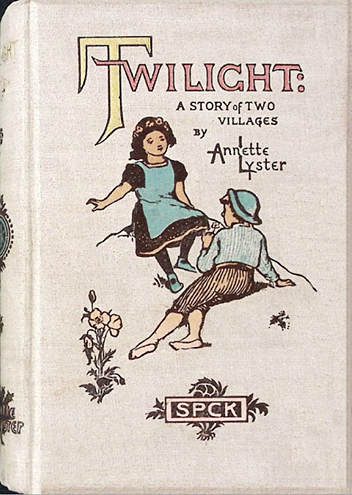
Title: Twilight
A story of two villages
Author: Annette Lyster
Illustrator: H. M. Paget
Release date: October 9, 2026 [eBook #79755]
Language: English
Original publication: London: Society for Promoting Christian Knowledge, 1893
Other information and formats: www.gutenberg.org/ebooks/79755
Transcriber's note: Unusual and inconsistent spelling is as printed.
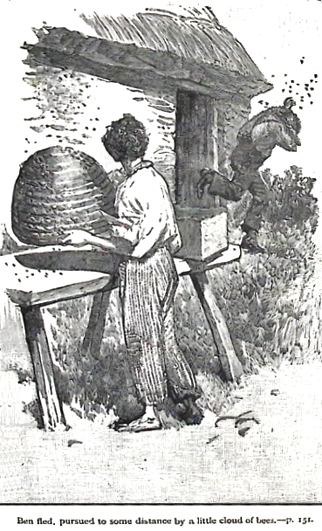
Ben fled, pursued to some distance
by a little cloud of bees.
A STORY OF TWO VILLAGES.
BY
ANNETTE LYSTER
AUTHOR OF
"ALONE IN CROWDS," "THE WHITE GIPSY," "DOROTHY THE DICTATOR,"
"A LEAL LIGHT HEART," "HATHERLEY'S HOMESPUNS," ETC. ETC.
Illustrated by H. M. Paget.
PUBLISHED UNDER THE DIRECTION OF THE GENERAL
LITERATURE COMMITTEE.
LONDON:
SOCIETY FOR PROMOTING CHRISTIAN KNOWLEDGE
NORTHUMBERLAND AVENUE, CHARING CROSS, W.C.;
43, QUEEN VICTORIA STREET, E.C.
BRIGHTON: 135, NORTH STREET.
NEW YORK: E. & J. B. YOUNG & CO.

CONTENTS.
CHAP.
II. THE COTTAGE NEAR THE MINER'S ROAD
XV. "WHAT WILL BECOME OF HER?"

TWILIGHT:
A STORY OF TWO VILLAGES.

GILES BRENT'S HOME-COMING.
IN the north of England there is a chain of hills, which in some places melt into Lancashire on the one side and Yorkshire on the other; further north, they skirt Westmoreland and divide Cumberland from Durham. But the place with which I have to do is in Yorkshire.
It is a little village which lies low on the mountain, just where a small stream rises, which runs along a kind of shallow valley. This valley does not run up into the mountain, like most of the others, but across it; the great slope comes down steeply, then there is an abrupt descent, at the foot of which lies a level space, and beyond that space there is a sudden rise, from the top of which the descent into the plain is unbroken. In this cleft, which was probably made by a great landslip long ago, stands the village, and the second hill hides it so completely that you might be within a mile of it, and never become aware of its existence; indeed, from below, the cleft is lost sight of, and the slope of the mountain seems unbroken.
The stream rises to the north of the village, runs its little course along the level space, and then turns towards the plain and makes its way down, to fall, by and by, into the Calder. I do not know that it ever had a name; the village is called Blackmead, and the people always call the stream "the Water," as if there were no other water in the world. It is indeed the only water they have, except what falls in the form of rain, of which they get a large share.
Blackmead, though a tiny place, has a history, and has had many misfortunes. Long ago it was a thriving little place, with a very hardy and industrious population, but some mysterious illness swept them all away, and the place was deserted for a long time.
Then some enterprising person discovered that there was coal in the ragged hill at the back of the plain, and forthwith a new village sprang up, and the coal was dug for, but it proved a terrible disappointment. There was but little, and what there was, was not very good—a light, glittering coal which burnt away very fast, and, like the Staffordshire coal, made no cinders, but burnt itself quite away in a wonderfully short space of time. One after another the mines were abandoned, and all the best and strongest of the new settlers left the place.
None remained but the sickly, the idle, and those who had some reason for keeping out of the way, for which the place offered great facilities. These managed to live, but in the poorest possible way; they became, as time went on, more and more ignorant and uncivilized. They had no church, no clergyman, no doctor, no schools. Yet somehow it was a place that took hold of the imagination, and became a haunting memory to any one who left it. It was seldom that this occurred, but a long time ago—in the year 1787—a boy named Giles Brent ran away from his home.
And on the very day on which my story opens, Giles Brent, his wife and child, having with them a donkey and cart, piled up with a couple of boxes and some plain deal furniture, were painfully ascending the rough, half-made road which followed the track of "the Water," to the village where Giles had spent his childhood, and where he confidently expected to become well and strong again.
This certainly was much to be desired, for Giles, who had been a soldier nearly ever since he ran off, having enlisted as a drummer, looked rather a forlorn object just now, as with his trusty crutch he slowly made his way along the rough road. He had served his country in many of the great battles of the Peninsula, escaping with but slight hurts, but at Waterloo he received two severe wounds. He had a bullet in his knee which refused to come out, and which had stiffened the joint, and had had another in his chest, which had injured his breathing. He had been in hospital for a long time, first at Brussels, and then at Plymouth, and had recently been discharged on account of his wounds, which made him no longer fit for service. Being disabled, and (as every one thought except himself) not likely to live long, he had been awarded a small pension.
Giles had left Blackmead a rosy urchin of thirteen, and had a distinct remembrance of the pure sweet air, the warm sun, and the pleasant life—so he deemed it now—of his boyhood's home: he had forgotten the trying winters, the frequent scarcity of food, and the other drawbacks, which had caused him to run away. He firmly believed that he would soon find his breathing quite easy, his knee far less painful, if not quite strong, and his health and appetite in a most flourishing condition. Giles believed all this, and Kate, his wife, believed him: believed also that her baby, the youngest and only survivor of a large family, would thrive amain, and grow up a "fine, likely man, same as his father," instead of getting croup and dying before he could walk, as all his little brothers and sisters had done.
Poor meek, quiet Kate! She had had her troubles while "following the drum," for in those by-gone days not much trouble was taken for the soldier's comfort, and still less for that of his wife and family. But she had had a tolerably steady, not unkind, husband, rather more sober, too, than many soldiers in those days—for hard drinking was the fashion in all ranks of life. Kate was a Plymouth woman, and rather above the class of an ordinary soldier's wife: but she never had grumbled, patiently doing her best, according to her light, to be a good wife and a good woman. If her light was dim, that was not exactly her fault.
Kate was driving the donkey now, carrying the baby tied up in her shawl, on her back; its wee red face was all that could be seen of it. Giles came behind, doing his utmost to keep up, but getting woefully worn out.
"Giles," said Kate, "are you sure you know the way? I thought you said there was a good road?"
"Well, my lass—I s'pose 'twas better in those days. I know I've run down it many a time, full speed."
"The rough road must hurt your knee, I'm afraid."
"So it do. But 'tis my breathing, Kate, that—beats me. I 'am' beat—and no mistake. There's no use denying it—I must rest a bit."
He turned aside and sat down on a big stone. Then, to Kate's dismay, if not much to her surprise, he slipped off the stone and lay on the grass.
"Indeed then—I'm beat," he muttered.
"O my man! My dear man!" cried Kate.
To unpin the shawl, lay it and the baby on the ground, get a tin can from the cart, and begin to scramble down the bank to the stream, was the work of a minute. She came back with some water.
Giles was quite himself, though he had hardly strength to swallow. However, after a few moments, he sat up a little better.
"Kate," he said, "I wish I had taken your advice and stayed a bit at that farm near Grassley. The people were mighty kind, and I should have been stronger maybe—but after all, I do long for the mountain air. You'll have to go on without me, for the truth is, I can't walk another step. But I've described the place to you often, and you'll easily find my brother's house. Indeed, I dare say any of them will help you, if you say you're my wife—Giles Brent, the son of Big Giles the carpenter."
"Have I far to go still?" asked Kate, as she promptly prepared to obey.
"I'm not sure. I don't find that I remember the places as well as I thought I did. The village ought to be round the corner yonder—" waving his hand vaguely, "but then I've thought so at the two last corners."
"Could you bear the cart, if I lifted out some of the things?"
"No, I couldn't," Giles said shortly. "You just tell Bob that I used to carry him long ago, and now he must come and help me. I wonder is it possible that old father's alive yet?"
"We shall soon know, I hope," answered Kate, as she finished tying and pinning her shawl, and took hold once more of the reins.
"You'll go faster without John Donkey," said Giles. "Tie him to yon bush: he'll stand. 'Tis what suits him. It's getting cold, Kate—make haste."
In the same quiet, quick way, Kate made the donkey fast to the bush, and set off at a great pace.
And Giles, being a philosopher in his way, got his back against the big stone, lighted his pipe, and prepared to wait with patience.
Kate trudged on bravely, but she still had a long way to go. What kind of vision did she see as she hurried along? She had heard the description of Blackmead so often, that as she drew near it, she almost fancied she could see it already.
Here she turned the corner—another stretch of rough road, but no village. Houses built of big stones; none of your foolish cob-walls here! The stream running along the side of the street, the blacksmith's forge the first thing you saw, a little way up the hill, with his cottage behind it. The furthest-off house, standing at the very end of the village, was the house where Giles's father had lived, and where doubtless his brother lived now. And high up, the great wide entrances into the mines, showing black against the reddish earth and grey rocks. She turned another corner now.
A few miserable stone hovels, in a very tumbledown condition, met her view. Kate stopped and gazed.
"Why, what a fool I am!" she said presently. "This never can be Blackmead! Street, indeed! Why these houses—to call them houses—look as if they had been thrown down here by accident. Oh, this is some wild bit of common where poor folk have settled. Though that's a forge, no doubt, and there's a stream. But the mines! Sure those holes up yonder can't be the mines Giles talks of! They look like big fox-holes!"
She stood looking about for a few moments, but then walked on, and was presently met by a set of children, boys and girls both, who came running from all directions, screaming to each other.
"A strange woman—a strange woman—come and see the fun."
"What's she got on her back?" said one imp, not addressing Kate, but asking the question of a tall boy who could see what the burthen was.
"A baby—ugly little beast. Where are you going?" the tall boy asked abruptly.
He spoke with the north-country "burr," with which Kate was familiar, as Giles had never lost it. She, on the contrary, had the soft sing-song Devonshire accent, but I shall make no attempt to reproduce either. Also I must warn you that in reporting what was said by these children and by the people of the place generally, I am rather giving a free translation than an exact copy; for really, between swearing and other varieties of bad language, a correct copy would be most unpleasant to read.
"I'm going to Blackmead, my boy. Is it far now?"
The wild-looking, unkempt, ragged set stared for a moment, then set up a shout of rough laughter, and rushed away—some home to tell this wonderful tale to their own people, some to the blacksmith's forge.
"Ben Marks! Ben Marks! Here's a mad woman coming along!"
The loud, quick-falling hammering ceased, and Ben Marks, the blacksmith, pushed back his matted hair with a black hand, which did not add to the dirt of his face, simply because that was impossible.
"What are you jawing about?" said he roughly.
"Here she comes! Hurray! Here's the mad body."
"Will you tell me, please," said Kate's soft, quiet voice, "is it much further to Blackmead?"
Marks stared rudely.
"You're not bound for Blackmead?" said he.
"Yes, I am. My husband's people live there."
"Not they!" he answered, shaking his head. "You're none of 'our' sort, I tell you. Why, woman, this is Blackmead."
Kate actually staggered, so great was the shock.
The young people laughed and shouted, but then suddenly got angry—and truly, Kate's very evident horror was not complimentary.
"And Blackmead is good enough for 'you,' with your ugly brat on your back," some of them called out.
"Get out of this, young ones," said Ben Marks, and to ensure obedience, he knocked down one or two of the boys. "Turn about, ma'am, and go back to where you came from; that's my advice. People like you—with shawls and bonnets and good shoes—won't like Blackmead."
"But—oh, sir, do listen to me,—" for Ben was lifting his hammer, and signing to his boy to blow the bellows,—"do let me speak a word, sir. My man, Giles Brent, was born here, and he's coming home. He's been a soldier for years and years, and he was wounded in the great battle of Waterloo, and is discharged—and his heart was all to come to Blackmead, and the sweet fresh air, and his brother Bob. But the road is steep, and he but weak, and I had to leave him and come on to get help."
Ben Marks, hammer in hand, listened to all this with a lowering face, and when Kate ceased to speak, he began to hammer, merely saying—
"Get help then."
Kate stood waiting. Surely the man could not mean to be so brutal. Surely he would just finish his job and then help her. The children had crept up to the door again soon, and with them there were several men and women now. They did not interfere, however; it did not do to interfere with Ben Marks. That hero left off hammering again, and looking at Kate, said—
"Clear out, now."
"Do you mean to say," asked Kate, "that you're not going to help me?"
"I do mean just that. Clear out. Why should I help you?" And he swore at her in a manner which Kate, though used to soldiers, had never heard equalled.
"Why should you help me?" she repeated. "Here's my man, from your own place—a brave soldier, hurt fighting for his country, and coming home expecting a welcome, and—"
"And more fool he, say I. A welcome! A crippled man with a wife and child, coming to help eat our food, that we seldom get enough of without his help. Welcome, indeed! And as for fighting—a fool for that too, say I. Who asked him to fight?—not me. Well then, why be I to help him because he fought? No one's the better for all the fighting that I can see; it never put a penny in my pocket I know. Clear out now, and let me work."
"My husband will be a burthen to none; he has a pension for his life," cried Kate indignantly.
"Oh, you blessed idiot, why didn't you say so before? What's this you said his name was?"
"Giles Brent. His father was a carpenter—is he alive still?"
"Dead before I came here. But Bob, his son, is alive; there's one of his girls out there. Look here, Jenny Brent, run up street and tell your father that a man that says he is his brother is coming back—a soldier with a pension: mind you say them words, Jenny, or I'll break your bones for you. Come, Tom, you and me can do what's needed. Now, ma'am, you promise me and my boy Tom Lucas a shilling apiece, and we'll fetch your man up to his brother's, in no time, so to speak."
"Very well," said Kate, looking round upon the dirty, wild-looking faces, and making up her mind that a night's shelter was all she would accept in Blackmead, if she could get away.
She set out, accompanied by Marks and his boy, who was a tall fellow enough, but not a bit more delightful to look at than his master. Their dress suggested that they had been robbing some scarecrow, and the little crowd that followed from curiosity were so scantily clothed that one would think that there were but few scarecrows to be robbed in the neighbourhood.
It was a fine spring day, but the sun had not much strength yet, and now, at five o'clock, it was very cold; a wild wind was rushing down the road, and poor Giles was nearly dead from the cold.
The sight of the donkey and cart, and the cart's contents, impressed the beholders mightily: a boy at once offered to drive the donkey, but Kate very prudently refused to be parted from her belongings. She got a big grey blanket out of a box, and showed Marks how to carry poor Giles in it. Then she herself drove the donkey, and soft-hearted as she was, she thumped poor John Donkey with all her might to make him keep up with "her man's" bearers.
These worthies mounted the hill quietly enough, but broke into a trot on the level ground. Giles groaned, but Marks only laughed. Kate banged the donkey, running along beside it: the baby woke,—he was a long-suffering infant, but there are limits to the patience of any baby, and he howled: the crowd shouted and ran: and in this fashion did Giles Brent return to the home he had left thirty years before.
*****
Bob Brent, not a whit better dressed or less dirty than the rest, was, however, a kind-hearted being, and he remembered Giles, and how he had cried when Giles ran away. He was standing now at the door of his abode, surrounded by his numerous family—a big, cross-looking woman, his wife; ten children, ranging from Jenny, aged fifteen, to a baby; a lean, noisy, and inquisitive pig, and a few hens.
There was an enclosed space before the door, with a shed on one side where Bob worked at his father's trade when he could get anything to do. Into this enclosure the crowd was rushing, until Kate, in her distress, attempting to drive the donkey through, got her cart stuck in the opening where no gate was, and thereby shut out the rest. For stones being plenty, the wall was high, and mortar being presumably scarce, it was not safe to climb.
"And be this my brother Giles?—You're welcome, Giles—I think he's dead, poor fellow. Jane, would you have know'd him? 'I' wouldn't."
"I wasn't born when he ran off," said Jane—"at least I don't remember it. Here's his missus."
"And what we're to do for them, I'm blest if I know!" added Bob, helplessly.
"Oh," cried Kate, hurrying up to him, "let us in for this one night—just this one. Giles is beat—dead beat, but he'll be himself to-morrow. Do, if you have a heart in you, send these people away, and let me see to Giles."
"Bless you, woman! They won't go for me," said Bob meekly.
"They'll go for me," said Ben the blacksmith. "Get out, every one of you. Clear out, now." With one mighty tug at the poor donkey, he dragged the cart through by main force; a wheel indeed came off, but still the gap was free. Then he charged among the people and drove them out, helter-skelter, came back to Kate, and said—"The two shillings.—I can mend the cart, if you like, to-morrow."
He departed, and cross-looking Jane seemed suddenly to awake from a trance.
"Come along in," she said. "There's a spark of fire, and we'll give him some hot spirits-and-water, 'twill bring him to. Get in, Bob; don't be standing about with your mouth wide-open—here, hold the baby. You," she continued to her children, "just make yourselves scarce; don't let me see one of you for the next two hours, 'cept Jenny. You stay, Jenny, I want you."
The young Brents went off; Giles was lifted into the house, and the donkey was put into the shed for the night. Poor John Donkey! Let us hope that he could eat wood-shavings, for he certainly got nothing else that unlucky night.


THE COTTAGE NEAR THE MINER'S ROAD.
KATE BRENT "had it in her heart," to use her own favourite expression, to contrive some way for Giles to travel, so that they might set out next day to return to "decent places and decent people." But poor Giles had caught a chill, and was far too ill to think of moving: indeed for some days Kate watched him, wondering sadly if she would return with only her baby, to the nearest town.
No doctor was to be had, except Ben Marks, who often boasted that he was the seventh son of a seventh son, and therefore "a doctor by nature." Ben came to see the sick man, and prescribed "spirits" to keep up his strength. Kate did not like giving her husband so much spirits, experience having taught her that it is easier to begin drinking than to leave off again, but she was too timid to set herself against what every one else thought. And it must be confessed that Giles took much more kindly to this medicine than to any other that could have been ordered.
And he recovered!—And as Marks proudly said, "What more could any doctor have done for him?"
In about three weeks Giles was on his feet again, and by that time it was summer, and the wild place was at its best. Quantities of ferns and wild flowers made it beautiful, and the air was sweet, healthful, and invigorating, when one got away from the village street. Giles said that his breathing was already better; the baby was growing apace, and looking rosy and well.
So when Giles announced in his masterful way that he had made up his mind to stay, Kate made but a faint effort to persuade him to change his mind. But she was very sorry, for she was really half afraid of the people.
One thing that influenced Giles very much was that he found himself quite a great man here. Discharged soldiers were very plentiful in most places just then, and curious to say, not very popular, but here he reigned alone. And whereas in his regiment he had been considered rather a dull fellow, and was often the butt of his comrades, here, his long-winded stories, his very superficial knowledge of foreign countries, and above all, his Waterloo medal, made him quite a personage. And Giles enjoyed all this, and fondly believed that it would last for ever. His pension too was much respected; he was the only man in Blackmead who had an income; and though I need not say it was very small, still it existed, and he had not to work for it.
"So you're going to live here?" Jane Brent said to her sister-in-law, as the two women sat in the wretched stone hut, each nursing her baby.
Jane was a singularly forbidding young woman to look at, big and awkward, with a swarthy skin (unless the darkness of it meant dirt, which was a question Kate often asked herself), and a most uncommon scowl. To judge by her face, she was a woman to be feared; yet really, beyond "smacking" her noisy children pretty freely, and generally when they least deserved it, she did no great damage, and, as she once said to Kate, "poor brats, that was all she could do for them."
Bob Brent was not exactly a fool, but he was not exactly a wise man either, and must have been a most provoking husband. But the worst Jane ever did, was to bid him shut his mouth; it seemed as if she could stand all the other signs and tokens of his folly, but that his trick of standing silent with his mouth wide-open, got upon her nerves; yet nerves were things that poor Jane knew nothing about.
"Ay, so I hear you mean to stay," she went on after a pause. "Well, and where d'ye mean to live? Giles is the eldest no doubt, but he's been thirty years away, and Bob ain't going to turn out for him. And there's not room for us all here: fifteen of us!—And I can't go on asking the neighbours to take some of us in much longer."
"Oh, Jane, we never thought of such a thing. Giles knows that the house is yours—and you've been more than kind. He was saying only last night that we'll have to build a house—houses he says are easy built, there's such a plenty of stones."
"Yes, indeed," Jane assented, "and no plenty of much else. How do you mean to live? Is the money he gets from the Duke enough to keep you comfortable all the year round?"
The opinion prevailed in Blackmead that Giles's pension was a personal mark of esteem from his late commanding officer.
"No," Kate said, "not real comfortable, as my man has a right to expect. But he has plans: Giles has a head on his shoulders. He means to have a bit of garden land—I suppose we may fence in a bit?—He thought so, because 'twas so when he was a boy."
"'Tis so; you may take as much as you like. Bob has a big garden, as you may see, and some fields up by the Fever-pits. Only for them we'd go hungry oftener than we do."
"Giles won't be able for more than a garden, even with my help. When our little Christopher grows up, indeed—" and here Kate, looking down at her child, fell into a meditation on the future deeds of the small being.
"Christopher!—Is that the brat's name? Why, woman, what made you give him such a mouthful of a name?"
"We look to call him Christie, you know. It was in my heart to call him Christopher because the name means 'Strong for God,' or something like that. The lady I was in service with once, told her children a story about it—I have forgot the story. But all my babies have been so weakly, I did hope the name might bring luck."
"See what 'tis to be a scholar!" said Jane, much impressed. "I dare say now you can read?"
"Yes, I can. But, Jane, my man has a plan I have not told you of yet. We got a present of a little money when he was discharged—from his old officers, such as lived to come back from Waterloo. And when we got to a town called Bradstone, Giles bought the donkey and cart. And when he is strong enough, he means to go regular to Bradstone and Grassley, and buy things to sell here; also to take messages and buy things for the folk here, if they like to employ him."
Jane scowled fiercely.
"I wish," she said, "that my Bob had wit enough to think of plans. We might all starve before he'd have a plan in his poor old head. But I don't think this plan will do. Except Ben Marks, none of us have any money, so how can we be buying things?—And he goes to Bradstone or Grassley for himself. He's not a Blackmead man, you know, but learned a trade down yonder, and I'd give my eyes to know what makes him stay here."
"Giles said he didn't remember the name of Marks," said Kate.
"No—he's here about ten years, more or less. But look here, Kate, I'll tell you something. There's a cottage up just at the turn to the mines, a little bit up the hills there. It belonged to my people, and they're all dead, and no one would live there since. But it was a well-built cottage, for I think my gran'fer was a mason once. And you could move in at once, for you'd be as well off as here, and you'd mend it up before winter."
"Oh, is there really? I do long to be—out of your way," cried Kate, just checking herself in time, having been about to say, "in a place that I can keep clean."
And perhaps Jane knew that, for she uttered a short, cold laugh, rather like a bark. Then she arose, and laying her baby on the bed, she opened the door and looked out.
"Bob! I see you, Bob—no use bobbing down your head. And I don't want water this time—yes there you are with your mouth wide-open as usual—shut it, do. Come here—I want to speak to you."
She went forward to meet him at the gate; he had actually put up a rickety gate to keep John Donkey in the enclosure. Jane whispered to him for some time, Bob looking very sheepish and unwilling.
"I couldn't do it, Jane. If anything came of it, I'd be to blame."
"Do as I tell you," she said, "for if we don't get 'em out of this, we'll be eaten out of house and home. And I'm tired of seeing Kate looking at the dirt as if it would eat her. Where is Giles?"
"Out yon, with me."
"Well then," said Jane, raising her voice, "Giles! Come here, please. Here's Bob will show you the way to my grannie's cottage, up yonder; Kate thinks it will suit her and you."
"She means, Giles," said Kate, coming out, "that she has told me of this cottage, and that perhaps it would do for us. Could you get so far, do you think?"
"Ay, surely. My knee is a good bit better. Come away, my lass; come, Bob."
The cottage was some way off, and out of sight, owing to some low rocks. Kate liked it all the better for that. It consisted of but one room, but it was a large room, compared to those in the village; there was a chimney, a little yard in front, and at the back a garden-plot, the stone fencing of which was all there, though it had almost entirely fallen down. At the back of the garden (the house faced towards the village) the hill rose sharply, and to the right could still be traced the rough road which led to the mines.
"I like this," said Kate, looking about her. "I could get it very nice, and so quiet, Giles."
"Yes, and not too far neither. I think I like it too."
"You won't like it," said Bob. "Come down, and we'll build for you close to us. Don't stay here."
"Why not?"
"Jane 'll be angry—but—I wouldn't live here not to be King of England!"—And then Bob opened his mouth so surprisingly, that Kate felt afraid he would never be able to close it again.
"Why not?" said Giles again.
"Ghosts," said Bob.
"What ghosts, Bob? I know the fever-pits are up yonder, but I think 'them' ghosts must be worn out by now."
"Maybe—I don't know about that. These is new ghosts. 'Twas after you ran away."
"Well, go on, Bob. What was after I went away?"
"That the big old mine fell in."
"Well—but it was given up before my time—I remember that."
"It was," Bob admitted with a sigh—the trouble of all this remembering and talking was almost too much for him. "But old Parry and some more took it into their heads, one hard winter, to go looking for any coal that might be left. And they got some. No doubt about it."
"Get 'on,' Bob," cried Giles, when again the narrative ceased, and Bob stood goggling his eyes at him, with wide-open mouth.
"They got some. No doubt. But one day, a lot were in the mine. There came a noise like thunder, only worse. The mine had fallen in. Every mortal was killed; at least I hope so, for they were surely buried; not one ever seen again."
Bob ceased again, but after a moment or so he said loudly, "I would not live here myself to be King of England, and Jane may say what she likes. I've told you all."
Giles turned and looked up towards the mines. Some attempt had been made to level a road, and to produce a sloping ascent; which followed the form of the valley, climbing gradually up to the mines from a spot not far from where he now stood. But stones and earth had fallen here and there on the road, and in other places the road itself had slipped down into the valley; it was still to be traced by the eye, but looked as wild and rough as its surroundings.
The face of the hill, nearly precipitous, was covered with ferns, grass, and tufts of ling and heather not yet in bloom. Long wreaths of wild roses and ivy hung down over the black openings cut in the face of the hill, from each of which a river of stones seemed to have flowed: really, these stones had been thrown out as the work went on, large stones and small together forming these curious-looking cascades, which reached from the opening to the level of the road, and sometimes far beyond.
These cascades had been bare and grey and ragged when Giles saw them in his boyhood; now they had settled down into comparative smoothness, and the exquisite greenery of the mountain was gradually encroaching on them. Ferns waved above them. Briars flung strong thorny rods across them, binding them down and covering them with lovely pink-and-white dog-roses. Blackberry briars too: enormous blackberries ripened there every autumn, and no one gathered them, for the people would not go near the mines on any account. Ghosts were at least as plenty as blackberries, according to their belief.
Fearful tales were told of the ghosts that had been seen there, and one poor woman had been killed by falling into the valley from the miner's road, where she had gone to pick up sticks: of course it was said that she had been trying to escape from some terrible sight. Since that time, now twenty years ago or more, not all the beauty of the flowers, nor the mingling of grey rock, dark earth, and green ferns; the harebells, the heather, the ling, all in their season; no, nor even the blackberries, could tempt the children from the cottages below to climb the Mine hill. There were plenty of flowers and blackberries to be had, without seeing ghosts.
"Bob, did you ever see one, yourself?" asked Giles.
And Bob shivered at the very idea.
"No! I take precious good care I don't!"
"Them that built this house, did they live here after the mine fell in?"
"They wer' mostly dead. There was just Jane and her grannie, an old, old woman. She shut door and window soon as the dusk fell, and if Jane stayed out late, she had to stay down in the village all night. Grannie wouldn't open, I promise you. She was a fearful old woman."
By which he meant that she was afraid, not that she inspired fear.
"Giles," whispered Kate, "that's all foolish talk. God will take care of us. It would be very quiet here, and we could move in at once and get it in order by degrees. They want us to go, I can see."
"Bob, was the mine ever cleared, and the dead buried?"
"No; the mine buried 'em, I tell you."
"Ah well! It's not likely a ghost can walk that's buried deep in a mine. Anyhow, I'm not afraid, and neither is Kate. I've not faced Irish croppies and French frogs to be scared by ghosts. Get some sticks together, Kate, to light a fire. I'll fetch John Donkey with the sticks of furniture and some turf: you'll let me have some, Bob, till I can get some myself and pay you back."
For here, where once coal was found, the people now burned turf, or peat, cut from the mountainside some way off. With dried heather mixed with it, this made a tolerable fire, though Ben Marks of course had to get coal for his forge.
Before night, the flitting was accomplished. The rough stone walls were thick; the roof, formed of long slabs of stone, was almost water-tight; and as it was easy to get lime, Giles soon had plenty of mortar, and plastered the one large room which formed the original building, making it very warm and snug. Kate whitewashed it, and took a great pride in keeping her walls as white as snow.
To build a second room, Giles required help, but this was easily got as he could pay for it, and half the men spent their time in idleness. Their little gardens and fields could not occupy them long, and with their very simple style of gardening and farming, did not occupy them two days in the week, except at harvest-time. Some of them had cows and others had goats. But these fed on the sweet mountain grass all the summer, and were half-starved all the winter, as all the owners did for them was to drive them in, morning and evening, to be milked. The driving in was generally done by the children, and the driving out the creatures did for themselves, running off in all haste up the track that led to the Brents' cottage, and thence to their feeding-grounds.
Giles built a second room, and a shed for his donkey, cow, and hens. Kate understood the management of a cow, and was never without milk. They restored the fence of the garden and the little front-yard; and then they considered themselves satisfactorily settled for the rest of their lives.
It never seemed to strike them that it was a pity that there was no school for the boy. Giles had "no learning" himself, and did not care about it; Kate, who could both read and write, and who was in a very dim and ignorant way a God-fearing woman, had unfortunately no habit of looking forward, but was content to let the future take care of itself. Giles was getting stronger, and her babies having all died while under a year old, the poor soul never thought about little Christopher except as a baby. It was very sad that the fact that there was no Church, nor any religious teaching within reach, made no difference to either husband or wife: I mean, had no influence on their plans. For alas! the absence of all religious privileges, all religious teaching, could not fail to make a sad difference to all concerned.
When his house and garden was in tolerable order, Giles, who was now much stronger, and free from pain in the stiff knee, began to see what could be done about his plan of setting up as a kind of carrier, or hawker; a little of both, indeed. He began to make regular weekly journeys to Grassley, and set up a trade in a very small way.
Kate went with him once, to lay in a store of wool for knitting stockings, comforters, mittens, and vests, which Giles could always sell in Grassley: some things, indeed, sold in Blackmead, or were given in exchange for things that Kate wanted. She saved up her earnings, and once again made the journey to Grassley to purchase a "skep" of bees, for in her girlhood she had helped her mother in the task of bee-keeping. Heather honey is always good, and Kate made a good deal of money by her bees.
So for a time they lived in tolerable comfort. If Giles did not make a fortune by his business, he made something, and the occupation was good for him. He always left Blackmead on Tuesday, and returned on Wednesday. And as he was perfectly honest, and kept sober while "on duty," as he said himself, he gave great satisfaction to all who were able to employ him. But alas! he did not keep sober on the other five days of the week. He would work in his garden in the morning, but in the afternoon he might generally be seen at the dirty little public-house, or with Ben Marks in the forge; and wherever he was, you might be sure that he was drinking ale, if nothing stronger. Not very much, for he could not afford it, but enough to make him more stupid in the evening than in the morning: silent, and sleepy, and only able to limp home and go to bed.
When summer and autumn had passed away, and the severe cold began to be felt, the roads were often impassable for John Donkey and his cart; and so Giles had more time for sitting with his admiring friends, laying down the law, and telling long stories over and over again. But his popularity began to fail. There was a great deal of miserable want in the place, and certainly Giles could not have done much to help the sufferers, but, he did nothing.
The people very soon discovered that he had no idea of helping any one. Even his brother was refused "just a small loan to tide over the hard weather." Giles said that he had only enough to live on, with the very little a poor disabled soldier could earn; and that if Bob had worked and made his family work, during the summer, half as hard as Kate and he had worked, they would not be wanting loans now.
Perhaps this was true, but it was none the less a very selfish disposition which made Giles thoroughly enjoy the comparative comfort of his home, and his sufficient food, and never give a thought to the very real privations of his neighbours.
"We paid Bob and Jane well for their kindness when we first came," Giles said, "and we paid the others when they worked for us; and they just wasted the money!—And as to sharing the turf with them, Kate, I won't hear of it, so say no more. You and I cut that turf, and Bob could turn out six strong, to cut for himself, and yet he didn't get in half enough. Why are you and the boy to freeze by and by, that they may have fire without working for it?"
Kate, poor woman, was so entirely wrapped up in her husband and child, that she never dreamed of disputing these moral remarks, though they did not make her quite easy in her mind. But little Christie grew and flourished, and Giles seemed quite sure that he was right; and they were an idle, unthrifty set, for sure. So she stayed at home, not to see the suffering that she could not help pitying, and could not relieve. Giles stayed at home too a good deal.
But it is easy to imagine that the Brents ceased to be popular; and indeed, after a time, their only friend was Ben Marks, who was better off than the rest, and even more selfish than Giles himself. Moreover, he was more intelligent than the others, and Giles's stories of Ireland, where he had served in '98; of the lines of Torres Vedras, the battles and sieges in Spain, and finally of Waterloo, were interesting to him even when no longer new, and he was never tired of asking questions.
About a year after the Brents came to the village, Marks married. The bride was not a Blackmead girl, but a young gipsy—one of a small caravanful that he fell in with at Grassley. A handsome, black-eyed girl—and Ben was far from kind to her.
She only lived a short time, and when she died, Ben brought the only child, a baby-girl, to Kate Brent, and begged her to rear it, as it was the little creature's only chance. As Marks could pay for the service, Giles made no objection, and so little dark-eyed Hessie shared everything with blue-eyed Christie, just two years her senior.
The children were as unlike each other as could well be. Christie had the pink-and-white complexion that goes with red hair, and the bluest of blue eyes, also a curly mop of reddish-brown hair; while Hessie was very dark, and had hair and eyes as nearly black as possible.


TURF AND COAL.
NOTHING very particular happened for a long time. Kate worked away, and kept things going as well as she could. But bad habits grew upon poor Giles, and after some years, he practically gave up his carrying business, though he always said he meant to go as usual when he felt able for it. After this, Kate herself made the journey to Grassley when she had eggs, honey, or anything else to dispose of, and Giles went only when he had to apply for his pension.
Giles had had a rather severe illness one winter, but the effects wore off, and there really was nothing to prevent his renewing his little trade when the warm weather came again. But nothing grows on people more rapidly than selfishness, if indulged in. And Giles, finding that Kate could manage without his help, declared himself too weak for anything but a little light work in the garden, and teaching Christie to weed and dig. For some few summers he helped in cutting turf, but finding that Christie could drive John Donkey, and help his mother a little in the cutting, he found himself too weak for that, too.
Poor Kate, being one of those weak, uncomplaining women who believe all that is said to them by one they love, and who will work till they drop, toiled away without a murmur. But work as she might, she could not get as much turf as when Giles helped her. So when winter came—and it was an unusually severe winter—she tried to husband her fuel, and Giles grumbled, and even said that she must have been lazy in summer.
"No indeed, Giles," she said, "nor Christie neither; we did all we could. But it was not as when you could work, my poor man. Sit in the corner away from the door, dear, and let me wrap my shawl round you—so. 'Tis hard for you to be cold, I know. I'll put on a bit more."
"Ay, lass, do. And here, Christie, run you away to the Red Dog and get me sixpence-worth of gin: here's the sixpence. Give him the bottle, Kate."
Kate sighed, but got the bottle. Christie, throwing aside the basket he was mending, took up his hat to go.
"Would you mind, Giles, if I went instead of Christie?"
Giles turned the matter over in his mind. In some ways it would be better, for once Christie had stopped to play with Hessie Marks, who lived at home with her father now. And once, a boy had hit Christie and broken the bottle. But then if Kate went, she would want her shawl—not that she would ask for it, but he could hardly let her go without, as the north wind was sweeping along the valley, bringing with it little showers of fine, dry snow.
"No, no," he said, "let Christie go. He'll be quicker than you, my lass. Now, Christie, run every step of the way. Jam the cork tight, and make haste, for 'tis my belief I am in for another attack on my chest if I don't quickly have summat to warm me."
Christie, now a fine lad, tall and strong for his years, took the bottle and was ready to start, when his mother, opening the door, looked out and said—
"'Tis fine just now, and I haven't been paid by Ben Marks for the stockings I knit him, so I may as well go and get the money, for I want it. I'll not be long."
Snatching the bottle from the boy, she drew the small kerchief she wore up over her head, and was gone before either husband or son could speak.
"She's going without the money!" cried Christie, running to the door.
"Halt there!" said Giles. "Don't open that door again, unless you want to give me my death. Your mother will be getting money from Ben Marks. Give me the sixpence. The foolish woman, she's run off without her shawl. Women are mighty inconsiderate. Christie, throw on another turf. There's no sense in freezing now to save for another time, because we may not have such cold again."
"Mother won't be pleased," said Christie. "Couldn't we wait till she comes back?"
"Do as I bid you, Christie. The articles of war is clear against argufying or answering back your superior officer; and I'm your superior officer, likewise hers; so do as I say. Yes—now that's something like a fire. But turf, after all, is but a peggling kind of fuel, no great pleasure in burning it. Not like coal, as blazes and crackles so pleasant, as if it enjoyed itself. Ah, Christie, if I'd realized that the mines here were done for, I would hardly have come back to Blackmead. Why, let me see—you might be earning good money now if the mines were working. I did, when I was no older than you be."
"Tell me about the mines, father," said Christie, gleefully.
It was not often that Giles was conversational at home, and Christie, seating himself on a three-legged stool close to his knee, prepared to make the most of the opportunity. As to Giles, he kept talking to keep from thinking of poor Kate, in her worn dress and little woollen kerchief, facing the wind that was howling round the house.
"Was it hard work, father?"
"Ay was it. My father was one who let none of his family eat the bread of idleness. 'Twas in mine No. 2, not the one as fell in, that I worked. It was the best of them, I believe, though that's not saying 'twas good, for I believe the owners lost heaps of money on them. I didn't much mind working my spell, but I did think it hard to be made get water from the stream for old Auntie Betty, the moment I got home."
"Who was Auntie Betty, father?"
"My father's sister; she was a cross old thing. She lived with him 'cause my mother was dead."
"And she made you draw the water alone? Mother and me do it together."
"Ay, ay. Your mother's another sort altogether from Aunt Betty. I wouldn't do it at last, and father beat me, and I ran away."
"Where to, father?—And was it pleasant?" asked the boy, highly interested.
Giles began to remember that perhaps the joys of running away were better kept in the background, lest Christie might some day think of enjoying them in his turn. His answer was—
"Christie, I have given you a touch of the rod once in a way, but I never did beat you as father beat me."
Christie looked puzzled for a moment. Then his face cleared, and he put his hand on his father's knee.
"You're very good to me, daddy, and I love you. I would never think to run away. And there's mother too."
"Of course you wouldn't run away!—What put 'that' into your head, child?" said Giles, much put out by his son's quickness. "Father nearly broke every bone in my body before I ever thought of such a thing. And you'll be your mother's only hope when I go off; and remember this, Christie,—a man can't live for ever with a Waterloo bullet in his knee."
Christie thought a bit, and then asked—
"Do men ever live for ever, father?"
"Not they, but they live quite long enough. Your mother's a long time away. I doubt I'm getting weak for the want of that gin. Ah me! When I was a boy, there used to be plenty of coal here to keep one warm. We never used turf then except for kindling. 'Twasn't good coal, but 'twas better than turf. Ay—and when it was brought to the mouth of the mine, and along the road, bits would be dropped here and there, and the women would come and gather 'em up. And what was dropped in the workings may be there still for all I know. Pity, now, we couldn't get it."
"But the big mine's all filled up, father. The top fell in, and there's a hollow in the hill, that sometimes is full of water, just over it."
"Ay, ay, but there was three or four openings. There might even be . . . I declare, some day I'll go and see."
"Do, father, and take me with you! Oh, do!"
"Yes, but not just now; and mind me, boy, you're not to go alone. Promise me that."
Christie promised readily. Though his parents kept him quite apart from the other boys, letting Hessie Marks come up the valley to play with him, but encouraging no one else—still Christie had heard about the ghosts and had no wish to defy them alone, though he would go anywhere with his father.
"But when shall we go, father?"
"When I get strong," Giles answered.
Very soon after this remark, Kate came in, blue with cold, and scarcely able to open her half-frozen hand to put the bottle on the table.
"Well, now, Kate!—To think you'd run off without shawl or bonnet! Ah, dear me, but women are inconsiderate! Get me a cup, Christie. Sit close by the fire, Kate, and warm yourself. Here, lass—I must give you a little drop of this to bring you to."
He held out the cup, but Kate, being a woman, and inconsiderate, would take none of the contents.
"'Twas for you I brought it, Giles, dear man!—It will do you good. And we'll have a better fire to-morrow. Ben Marks has a good store of coal, and he's promised to sell me a bag now and then. I'll have to knit all day to pay him."
"Teach me to knit," said Giles, now in high good temper; "'twould be nice quiet work for me, Kate."
"'Twould look well, then, to see a soldier as has a Waterloo medal, and a pension moreover, knitting stockings!" cried Kate, with a laugh. "No, my dear man, Christie and me will manage somehow, and, come summer, maybe you'll be stronger, and then we'll have a good store of turf."
"Or, maybe, I'll be under the sod, Kate. A man can't live for ever with a bullet in his knee, and another in his box that ran through his lungs. Don't cry, old lass—you're a good lass. There! I do feel better now, and I'll go to bed. Best to go while I'm warm."
Kate bought more than one bag of coals from Ben Marks that winter, and very hard she found it to pay for them. Of course she had to stint in other things—but she contrived that the stress should fall principally on herself—to keep up good fires for her "poor good man."
When the turf season came round, Giles found strength enough to go out with his wife and son, and once again they had a respectable stack of peats in the yard. Turf to burn and potatoes to eat, Giles contrived to secure that year, but he did very little more, and Kate found it hard to pay her way.
Christie, playing on the mountain slopes with little Hessie, seldom had a new garment now. Kate patched and darned, and cut up things of her own, to make him warm; and although the boy throve on his hard fare, and little heeded the shabbiness of his clothing, his poor patient mother was gradually worn out.
It is time now to speak more particularly of Hessie Marks, Christie's only friend and constant companion, whom he loved with all the strength of a very loving heart. Whether she loved him or not, it was not easy to know. She loved to rule, and she ruled him most completely; and she found no other child in Blackmead as ready to give her her own way. She was a most lovely child, her brown skin smooth and soft, her checks touched with deep crimson, her lips as red as coral, her hair raven-black, her eyes dark, long shaped, and brilliant, with long black lashes. Christie thought her the most beautiful and precious thing in the world, and even her rough, selfish father was fond and proud of the pretty creature.
But he was not careful of her, as Christie's mother was of him. He liked her to be with Christie, but he took no trouble to keep her from playing with all the Blackmead children; and he kept her living at home, though he knew that she should have been safer and happier at the Brents' cottage. I do not suppose poor Hessie was naturally worse than others, but the truth is that she was an extremely naughty imp; and Christie little knew what an active part she took in the evil doings she reported to him as being perpetrated by "those 'bad' boys" in the village.
In truth, the poor child seemed to live two lives—one, not a whit better than that of the untaught herd of children who were a very real pest in the village, the other innocent enough, playing about with Christie and listening to his stories about the mines and father's great doings as a soldier, making friends with every bird and beast, and delighting specially in the flowers.
A favourite resort of hers—Christie was not so fond of it—was what every one called the Fever-pit, though it was really not a pit, but an immense irregularly shaped mound, on the slope of the mountain, much higher than the village, and at the back of the Brents' cottage. Here, tradition said, the victims of the terrible fever which had laid Blackmead waste, had all been buried: the last funeral being that of the devoted clergyman who had worked among his stricken flock until himself struck down. The very site of the church in which this good man had ministered was now forgotten. The mound was the boundary, on one side, of a field belonging to Bob Brent, and on this mount grew the most beautiful wild roses, the reddest poppies, and the greenest fern to be found anywhere. Hessie loved going there; Christie objected to "jumping about on the poor dead folk," but he had to do as Hessie wished.
One day the pair were very busy gathering poppies and making garlands for the decoration of Hessie's small person: she was already crowned with a wreath of the brilliant red flower, neatly tied to a long fern-frond; Christie sat on the top of the mound, industriously making more wreaths for her neck, her waist, her arms, and anywhere else that a wreath could go. He worked away, while she looked on and gave her orders.
"Not so thick, Christie. Don't crowd them so. That will be long enough, I think."
"Get some of the blue things out of Uncle Bob's barley. Mind now, don't go in on the crop, or we sha'n't be allowed to play here."
"As if I'd mind Bob Brent's talking!" Hessie cried. "But I won't have any blue. I don't fancy them with the red. We'll come again to-morrow, and I'll have blue garlands."
"To-morrow I can't come, Hessie. Mother must drive to Grassley with her honey, and I must stay with father."
"What for? Daddy Giles could go himself if he liked, or do without you at home. He's just lazy!—that's what people say."
Christie got very red. "People tell lies, then, and when I'm big enough, I'll thrash 'em. Tell them so, Hessie. And indeed you oughtn't to let folk talk so to you about father, who's so good to you always."
"Well, I hit Jem Brent, your cousin, right in the eye for saying it, and I tried to hit them all," said Hessie, who had a very decided talent for fiction.
But Christie believed, as she expected.
"You did right, Hessie. I'll remember that to Jem Brent."
"Don't be silly; you're not half his size, Christie."
"But I'm growing, and he will grow no more, most likely. Oh, I'll come up with him, and then you'll see. But, Hessie, what were you doing with Jem Brent and all that lot? They're not—"
"Well there now!—They come about the forge and begin talking—that's all," said Hessie.
Her last exploit in the village had been to help Jem Brent to rob the Widow Kirby of some eggs. The widow kept a little shop—perhaps the smallest thing in the shop line ever known: she had a few eggs for sale. Jane Brent's hens were not laying, and Jem, her son, desired eggs. He wanted a small and active child to help him, and found Hessie more than willing to oblige him. He put her in through a very small window, and she handed the eggs to him. And Jem had, in the course of conversation, given his opinion about his uncle's laziness, but if Hessie hit him in the eye, he took it in a meeker fashion than was natural to him.
"That's enough now, Christie. I'll put them on now, and you'll see how pretty they'll look. Bother them, they don't last any time!—Some of these are withery already. When I'm a woman, I'll have real flowers, not weeds like these."
"When you're a woman, you won't care for dressing up in garlands, Hessie; you'll have something else to do."
"I won't do it then," remarked Hessie, twisting about to see the effect of a wreath that hung down her scanty skirt at the back.
"Oh, yes, you will. You know you're to be my wife."
"Oh, yes—but you may do all the work," was the reply.
Christie shook his head.
"You'll be wiser then, like mother," said he.
At this, Hessie laughed derisively.


THE FEVER MOUND.
AS I have said, Giles Brent roused himself that summer to cut plenty of turf, so that next winter fuel was plentiful. Then came summer again, and I am sorry to say that Giles had a relapse into laziness, talked of his "weakness," and put off going out for turf from day to day.
In truth, his habit of perpetual indulgence in ale and gin had now gained a terrible mastery over him, as such habits always do. He was rendered stupid and forgetful too, and the memory of his sufferings during that cold winter seemed to pass away. Like all who take more stimulant than is good for them, he also grew more selfish, and if he thought about the long cold winter evenings, he remembered that Kate had got coal from Marks; and no doubt she could get it again.
It was very sad to see how this poor fellow went on from one stage of selfish idleness to another. He had once been a kind husband, if a little masterful; now he let Kate slave and toil and run his errands, while he sat by the fire or sunned himself at the door, and dozed and drank, or held forth about Waterloo to any one who would listen. It would have been well for him if his poor patient Kate had been a little less patient, had admired and believed in him a little less. A different kind of woman might have roused him. I think she would have been perfectly justified in letting him feel the touch of scarcity, instead of bearing it herself, and keeping him in comfort to the very utmost of her power.
She even made the boy work hard, to help her. Christie had learned to knit, and had found out how to make baskets of the rushes that grew by "the Water," but their joint earnings were small, and Giles now drank every penny of his pension. So that winter was one of considerable privation; and then the summer came again.
One day, Giles, sitting in the sunshine at the door, heard Hessie Marks talking to Christie; the boy was sitting on the low stone fence, knitting away fast.
"Put it away when I tell you, and come up to the fever-pits. I want to go."
"I can't indeed, Hessie. Mother and I are going to cut turf. Come down with us—you shall ride in the cart."
"No, I will 'not.' It's too bad, Christie! Not once since the flowers came, have you come with me to play. I'll just go and ask some one else to go with me."
"Oh, Hessie, don't do that! I'll go the very first day I can. But we 'must' get turf, coal is so dear—and mother and I do cut it so slowly."
"I'll be bound you do," said naughty Hessie. "What could you expect of a boy that knits! Woman's work, knitting is. Put it by, Christie, or I'll go away this moment."
"No, don't, now. I must get on with it. I don't care if it is woman's work, as long as it helps mother. Don't ye be unkind to me."
"But I will, if you're unkind to me. Promise faithful, now, that you'll come to-morrow. I want badly to go up to the fever-pits, because your Uncle Bob is going to level it down, and put the earth all over his fields."
"Level it down!" cried Christie. "Why—there's people buried in it!"
"Not in the heap, but in great pits below—great deep pits. And I want to go there again, Christie, before he does it."
"Yes—and so we will; we'll go to-morrow. I'll tell mother why, and she'll let me go, I know."
"Mind she does, now. If you don't come to-morrow, I'll never marry you, Christie."
"Oh, you must, you've promised. A promise can't be broke, Hessie."
"Indeed then it can," said Hessie, "quite easy."
"I'll ask father," cried Christie, springing up; "come here, Hessie. Father, Hessie promised years ago that she'd marry me when we're older. Now, mustn't her promise be kept?"
Giles laughed, drew the pretty little girl to him, and kissed her.
"Course it must be kept," he said, "and I'll say for you, Christie, you show good taste. I'll be very glad when the day comes. You must keep your promise, Hessie."
Hessie nodded. "I'll do just as I like about that," said she.
Just then Kate called from the house—
"Christie, get John Donkey ready now. I'm just coming."
Hessie darted away towards the village, and very soon the turf expedition was ready.
"Now, Giles, you won't sit here too long, there's a dear man. When the sun leaves, you go in and sit in the house. I've left your bit of bread and cheese on the table, and when I come home, I'll make stirabout for supper. If you 'can' manage to keep the fire alive, Giles, it would be a comfort."
"I can do that much, my lass. Ah then, 'tis hard to be so weak!—for I'm not to say an old man yet. Not much above fifty, I do think. 'Tis hard to see you go turf-cutting, without me. If I had the right use of my leg, I'd try if there's any coal left in the old workings. Even a little lump would be worth having. Christie, you and I will go some day."
By this time Christie had heard this speech so often that it failed to excite him, so he only said, dutifully—
"I'd like it well, father."
Kate and her son worked hard, and cut what made a very light load for John Donkey. They spread the fresh sods on the slope at the back of the house, to dry in the sun, and then re-lighted the fire and had some supper. Giles had gone down to the village.
"Now, Christie, you go to bed. I'll stay and keep the stirabout warm for father. I couldn't sleep till I know he's safe home."
Christie was sound asleep before his father came, heavy and cross and sleepy: he said he wanted no stirabout, but Kate must give him some pence next day, for he had got a weak turn while sitting there alone, and had actually to drag himself down to the Red Dog, or he'd have been ill, and he had no money with him. Marks had helped him home. Marks told him that Bob was talking of levelling the great mound up yonder, and spreading the fresh earth over his fields, they were some of them so bad that nothing would grow in them. Giles talked away, and Kate scarcely heard, so tired was she.
Next day, Hessie came dancing up the valley, and found Christie ready for her. On this she renewed her promise to be his wife "some time or other," and they went off together, very happy. They reached the mound and began to get their flowers; this time it was dog-roses, with white stellaria mingled with them.
Hessie was in high good-humour, and made her slave very happy.
And they were sitting side by side making garlands, when they heard rough voices and the jingling of a cart. Looking up, they saw Bob Brent, his sons and daughters, and his wife Jane; also Ben Marks, and with them poor, hard-worked John Donkey, with all the younger Brents in the cart. Giles had actually lent the donkey and cart to help in carrying the mould.
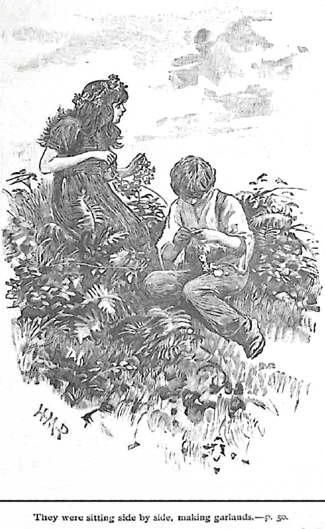
They were sitting side by side,
making garlands.
"Oh, Hessie, I'm afraid we've got our last flowers off the poor old mound! Suppose we creep down the other side, and run off to some other place?"
"Not I," said Hessie, "if they're going to dig, I want to see the fun. Suppose they find men's bones?—They may, you know, though father says they all lie in deep pits. Oh, what fun! Father, father, are you going to help?"
Forgetting all her finery—for she was all decked out in flowers by this time—Hessie ran forward along the top of the mound. And really, between her beauty and her garlands, and her dancing step, the child was a picture to look at.
Jane Brent said—
"Ben, your little lass is a beauty. Why don't you marry, and have some one to take care of her?"
"She wants no better care than she gets," Ben answered, gruffly.
"Is yon Ben's lass?" asked Bob, "I truly thought as 'twas a fairy," which was a tremendous effort of imagination for Bob, and made his family shout with laughter.
Christie now made his appearance, and he and Hessie having scrambled down to join the others, the demolishing of the poor mound began. Ben Marks, saying that digging was not in his way, sat down and looked on. Hessie stayed with him, but Christie was pressed into his uncle's service.
The lovely rose-briars were cut and flung aside; then a big patch of grass was stripped off the sloping bank next the fields, and the rich dark earth, lying unused so long, was thrown into the cart, or into baskets, and carried off. But it was slow work, and one day would not finish it.
Some time had passed. Christie and his cousin Jem were taking a turn at digging, and Christie was working away manfully, when he heard his mother's voice calling him.
"I'm here, mother, in the hole—O, Jem, what's this?"
For they had come now to great stones, laid on each other with some attempt at regularity. A great shout arose from those that could see, and Ben Marks, desiring Hessie to stay where she was, ran up to see what was happening. Every one was shouting, and Kate could not make herself heard. She stood panting and holding Hessie by the hand, until the child said—
"I wonder now, have they found a man's bones?"
"Oh, Hessie! Oh, perhaps they have. Stay here child; I'll come back in a moment."
With most unusual roughness, Kate forced her way through the younger Brents, who were crowding round the hole, and struggled almost fiercely with the few who were closely packed within.
"Christie, Christie!" she screamed. "Come out, come out. Bob, listen to me!"
"Why, Kate, whatever 's the matter with you?" inquired her sister-in-law. "See, we've come to a lot of stones. They must have closed the pit with them, and then shovelled on the earth."
Kate, looking over the speaker's shoulder, saw the stones. They had now cleared away just enough to show that these stones probably formed part of a circle of eight or ten feet in diameter. And there was Christie, putting forth all his small powers to help his cousin Jem, who was bent upon dislodging one of the great stones.
"Christie," Kate cried, "come here—come out of this,—all of you come out."
She made a desperate push, grasped Christie by the arm, and began to drag him away.
"If you value your lives, come out," she cried.
And the whole party, alarmed by her manner, began to retreat hastily.
"What 'is' the matter?" cried Ben Marks, stopping them.
Kate held Christie fast; she was trembling all over, both from excitement and the haste in which she had come.
"Giles says—he got up after you left him, Bob, and he says to me,—
"'I hope no harm may come of Bob's piece of work, but since he went, I've remembered a thing. I mind that somewhere in Spain, just before our soldiers went there, the people dug up a field where many that died in a plague lay buried, and all the men that did the work got some fearful illness and died.'
"And I knew Christie and Hessie were here—so I ran out."
"Indeed, I suppose," said Jane, "'twould be long before you'd have run to save us. Bob, come away at once. If no harm happens, we can finish another time. Where's Ben Marks?"
"He cotched up Hessie and run, soon as he understood," said Jem, with a grin. "He's halfway home by this."
"Come, mother—let's get home," said Christie.
And in a few minutes, the poor disfigured mound was deserted.
Of course, I cannot positively affirm what followed was the consequence of that day's work. But in about ten days Bob Brent, Ben Marks, and poor Kate were down in a very bad kind of fever. Every one expected that Jem and Christie, who had actually loosened one of the stones, would be ill too, but they escaped altogether. As to Kate, she had been of late overworked and underfed, and she had run herself out of breath and was very hot—just in the condition to catch anything.
Kate was very ill. For many days she knew no one, not even Giles or Christie. After the first week, no one came near the place, for they were afraid of infection, and Jane, who had been really kind, had enough to do with her own poor Bob—Bob, who would never vex her again by standing about with his mouth open, for he died after three weeks' illness.
It was Christie who brought the news of his uncle's death to the cottage. He had run down to Widow Kirby's shop to buy a candle, and Giles sat beside his wife, whom indeed he had not left since her illness began.
Poor Giles, he was very miserable. In some dull, vague way, he felt he was to blame for what had happened. Had he only warned Bob in time, the mound might never have been opened. He had been too stupid, both on the evening when Marks told him of the plan, and in the morning when Bob came to ask for the cart, to remember the story he had heard in Spain.
And besides this, he had a terrible fear that Kate was dying. And with that fear, his love for her, long lost in the overgrowth of bad habits and selfishness, struggled up to the light again. And he thought of her patient, gentle ways, her hard work, her untiring devotion; he looked at her, so thin, so worn, so old-looking, and remembered that she could not yet be forty years old, and what a pretty pink-and-white lass she had been when he fell in love with her in Plymouth, where all the girls are pretty pink-and-white creatures, and Kate had been one of the prettiest.
He had promised her mother to be a good husband to her: how had he kept his promise? At first, tolerably well, and he had never been actively unkind to her. He had seldom said an angry word, and had never raised his hand to her. But all this failed to comfort him now. He had refused her request that they should live in Plymouth, though they were there when he got his discharge.
Kate had sisters living there, and wished to be near them. Yet how cheerfully she had obeyed him!—and he had brought her to this desolate place, and even when its real condition forced itself on his notice, he had stayed there to please himself. I do not say that Giles put all this into these, or any words, or even that he thought it all at once, but by degrees these things got into his mind, and on this day, while Christie was away, he had some very bitter moments.
"Kate, my woman," he said, while giving her a little water, "tell me true; you know 'tis all my fault,—can you forgive me, Kate?"
"They won't swarm yet a bit," said poor Kate, whose wandering wits were with her bees.
"Father," said Christie softly, looking in, "come here a moment. Oh, father, Uncle Bob is dead, and Auntie Jane is down with the fever!"
Giles made his way to a chair, dropped his crutch, and nearly fell.
"Bob dead," he muttered, "and my fault. Thirteen of them,—fatherless,—not that Bob counted for much—poor Bob. And Jane Christie, boy, 'tis awful. And I wasn't very kind to Bob. I thought I was right, but it looks otherwise now.—How's Marks?"
"Better. And I've got the candles, but Widow Kirby would hardly let me in. They're all frightened to death. Oh, father, if we had a little money and could get medicine for mother!"
Giles groaned. Too well he knew that there was no money, and why. There were some stockings ready for sale, but no one in the village would touch them. His pension was all spent, and there would be no more due to him for a month or more. From his experience in hospital, Giles knew what medicine would be given in such cases as these, but he could not get it without money.
"I hear her moving, Christie," he said; "go to her."
Christie went; and Giles sat thinking deeply. Suppose he went to Grassley and sold John Donkey; poor old John, he would not bring much, for he was getting old. And suppose him sold, it was doubtful if what Giles wanted could be got in Grassley, and without John Donkey, how could he get to Bradstone and back again? Even if he did not break down altogether, it would take him several days.
What else was there that he could sell? Nothing! Nothing! Stay, there was his Waterloo medal, the very pride and glory of his life, his one most cherished possession. Could he part with it? It was there in Kate's box, kept in a tiny brass box bought for it, and brightened up by many rubbings with an old glove. With it was a queer-looking thing, the bullet that had, as Giles often asserted, gone in by his chest and come through his lungs, and been taken out by the surgeons "just under my left shoulder."
These treasures were often shown as a choice favour to admiring visitors; that is, when visitors used to come, for of late the Brents had been left much to themselves. Ah, he could "not" sell that medal! Yes, he would—for Kate's sake, and to try if poor Jane's life could be saved: for he would bring medicine for her also.
He rose, hobbled over to Kate's box and took out his treasure. A doubt of its money value never crossed the poor fellow's mind; it must be very valuable. It shone beautifully indeed, but of course these medals are not of much intrinsic value. Giles wrapped the medal up in the old glove, and put the brass box with the bullet for its only treasure back into its place. When Christie came back, Giles said to him—
"Christie, turn out early to-morrow and have John Donkey ready for me. I've thought of a way to get some money, and I must go, for medicine for your mother we must have. You must do the best you can while I'm away. I won't lose a minute."
Poor little Christie! A terrible dread took possession of him, and without thinking, he cried out—
"Father, you'll get some drink, and you'll be lost and never come home any more!"
Giles took hold of his son and shook him, but not roughly.
"You young rascal, be respectful to your superior officers. No, Christie, not with my poor lass lying there. Do you see this?"
"Why, father, 'tis your medal!"
"So 'tis, and the thing I think most of in the world. Well now, I do swear on this medal, that I'll give up drink altogether. I've been thinking, and I mean it. Nothing comes of it but mischief."
"'Twill be joyful news for mother, when she gets better," whispered Christie.
"It will, Christie,—and yet I'd lay my life that your mother never spoke to you in the way of blame to me."
"She never did," said Christie, getting very red.
"Not she. Your mother's the best woman and the best wife ever man had. I may have seemed—careless; but I know this, and I'll prove that I do."


THE MEDAL.
IT was barely daylight when Giles Brent left his cottage, and drove quietly through the village and down the rough road into the more level country below, and along sundry lanes and country roads until he reached Grassley. Here he and Kate were well-known, having sold honey and knitted goods in the village for a long time.
It was about six o'clock when he drove up to the door of a farmhouse, where he had often had dealings, and asked the mistress—Mrs. Smiles—for a drink of milk; for his meal at starting had been of the lightest. He was warmly welcomed, and huge slices of bread and cold meat were added to the milk.
"It's long since we saw you, Sergeant," said Mrs. Smiles.
Giles had never been even a corporal, but the Grassley people had promoted him. "I hope Mrs. Brent, decent woman, is well?"
"Truly she is much otherwise, ma'am. She's very ill, and things are bad with us at Blackmead. There's a deal of illness."
"And what brings you out, Sergeant?—for I don't see that you have much to sell."
"Nothing that you'd want, ma'am, unless this half-dozen pair of wool stockings, the last she and the boy got done. Here they be."
"They suit my goodman as no other stockings ever did. I suppose the price is as usual?"
"Yes, ma'am. Keep the money for me, and I'll call on the way back. I won't delay you, for Bradstone's a long way off, and John Donkey not very fast."
"You'll never get there and back—why, 'tis ten miles from this! What do you want at Bradstone?"
Giles explained: he even treated her to a sight of his medal.
"Indeed, Sergeant, I'm sorry you must sell it, but you're right to go to Bradstone, a big town is your best chance. No one here would buy it. Wait just one moment, while I speak to my man."
She came back very soon, to say, "Look here, Sergeant, you'd find it very slow doing twenty mile with that poor old beast. And my man will lend you the spring-cart and pony. He's a good pony to go, and if you make haste, you can be back here by two or three o'clock, and we'll feed the donkey and have him fresh for you. I'm so sorry for Mrs. Brent,—we'd like to help."
Giles accepted most gratefully, and was soon spinning along the road at a pace very different from that of poor John Donkey.
He reached Bradstone without further adventure, and following the directions given him by kind Mrs. Smiles, drove to a small, respectable inn, where he found that the pony was well-known. Having seen the pony fed, Giles took his faithful crutch and set out in search of a jeweller's shop.
Bradstone is a large town, and was then a very thriving one; there were good shops and plenty of them. Giles made his way into one, in the window of which he saw watches and gold trinkets for sale. Stumping up to the counter, he said to a young assistant who gazed at him in surprise—
"I wish to speak to the master of this shop."
"He is engaged. What do you want? I can serve you as well as he could."
"Well, I don't know. 'Tis something I have to sell, d'ye see?"
"Mr. Jacob never buys things in that way. He does not sell second-hand articles."
"He'll buy this!" said poor Giles, proudly.
And taking the medal out of his pocket, he laid it down before the youth.
"Oh—a medal!—not in our line at all," and the speaker turned away to conceal a smile. "You need not wait—we would not take a present of it."
"Do you know what it is?" said Giles angrily.
"Oh yes—a Waterloo medal. All very well, but not in our line at all. Here, George!"
A stout-looking young man came at the call, and the shopman went to serve a lady who had just come in.
"You'd best step outside," said George. "You see the shop's full."
Giles got out, somehow, with his precious medal in his hand. He felt quite stunned and stupid. Having walked along the street for some time, he recovered his senses enough to put the medal in his pocket, and look out for another shop.
But it was the same story over again: they wanted nothing of the kind.
Almost brokenhearted, Giles went limping back to the inn; he was faint with hunger, and possessed just four-pence. Well, Giles was no great hero, yet I think he deserves some credit for keeping his vow that day. He absolutely longed for some beer, but he only bought a pennyworth of bread and drank water. Indeed he was so full of grief and disappointment that he scarcely knew what he was eating or drinking.
Having considered the matter, he went to the little parlour where the landlord was to be found, and asked his advice. The good fortune of having come in Farmer Smiles's spring-cart was now of service to him; for the landlord would hardly have listened to him had he come driving John Donkey.
"Is it that they doubt I stole it?" said Giles, when he had told his story, displaying the medal on the palm of his hand. "I earned it hard enough, and I did never think to sell it."
The landlord was rather a kind-hearted man. He could not bring himself to say more than—
"You see—it is of value to you, very naturally, but I'm afraid it is not of much real value."
"Not of value!" cried Giles. "Well, that beats me. I know this—nothing but the sight of my wife, ill and in want, could make me sell it. A many fine lads died in the battle where that was won—many, that never got the medal at all.—Man, what am I to do?" he said despairingly.
"Well, your best chance is, to pawn it. There's a pawn-shop at the other side of this street, nearly opposite our gate. You might see what they offer, and by and by you can pay up and get it back again."
Giles thanked him, and leaning rather heavily on his crutch, for disappointment was making him feel very tired, he stumped off to the pawnbroker's at the other side of the street. In two minutes more, he came out, crimson in the face, and though for a soldier of these days he was no swearer, he was now using very strong language, to say the least of it.
He flourished his crutch angrily, and the words, "Half-a-crown—half-a-crown! And to get some one to speak for me that it is my own!" might be heard, but not those words only; for truly, had half the misfortunes he wished the unlucky young man in the office come upon him, the poor fellow would have had a very bad time of it.
Several men, stable-helpers; grooms, and so forth, crowded round the angry man as he hobbled about, nearly getting a fall because he made no use of his crutch, save to flourish it over his head. They were endeavouring to find out what had enraged him, when a young gentleman, whose post-chaise had just begin driven into the yard to get fresh horses put to, came among them.
"What is the matter here? Some one said it was a soldier—which is he?"
The speaker was one who spoke as if accustomed to be obeyed; the men fell back, and one pushed Giles forward. The moment he saw the young man, Giles knew that he was a soldier. Up went his hand to his cap, and his wrath cooled down in a wonderful hurry as he made his military salute.
"Yes, a soldier no doubt. What's the matter with you, my man? Any one been bullying you? I am a soldier, and a soldier's son, and—tell me what is wrong."
"He's drunk, Captain!" cried some one.
"No, he is not," said the young officer, after another keen look at Giles.
"Shame on whoever said it," Giles put in, having by this time got breath enough to speak. "I'm as sober as any man in Bradstone this day. But I was very angry, no doubt. Look at this, sir."
"A Waterloo medal!" He took off his hat. "I envy you, soldier. I wish I may live to show as well-earned a medal. What regiment, my man?"
Giles told him.
"What was the name of your Colonel?"
"Colonel Pierce Piercy, sir. 'Twas just as he was killed that I got 'my' discharge, as one may say. A bullet in my knee, and 'tis there still."
"You are right—that was his name, and I am his son. Come into the house with me, and tell me what is wrong with you."
Giles followed him, and was led into a private room.
"Now, my man, I have only five minutes to spare. Sit down—tell me what made you so angry."
Giles explained at some length, but not very lucidly.
While he was speaking, a waiter looked in to say, "Chaise ready, Captain."
"Coming. And I must go, Brent, for I have no time to lose. I'm on my way to join my regiment after a month's leave,—we're going to India. Don't sell your medal, it would be a pity, for no one would give you much for it. It's valuable to you, because you fought for it, and to me, because I'm a soldier, but these fellows would only give you the price of the silver in it. I will give you what I can spare, for my brave old father's sake."
He opened his pocket-book, and after a moment's consideration, took out three bright guineas.
"I'm not rich," he said, "but this will help you over the pinch; and as you have a pension, you will be all right presently. Good-bye, Brent; get home as quick as you can."
Giles clasped the hand held out to him, and tried to speak, but no words would come. Then he heard the post-chaise dashing off down the street. And I hope that good fortune attended on that kind-hearted young soldier, and that he lived to wear medals with many clasps. He must have passed away by this time; and it matters more to him now, that he was ready to deny himself something to help an old soldier in distress, than that he distinguished himself on many a hard-fought field.
Giles went at once to a chemist's shop and bought some medicines. Fortunately, perhaps, he could not make the man understand what drugs he wanted, so was obliged to tell the nature of Kate's illness, and take what the man recommended. He carried off two big bottles of medicine to be given while the fever lasted, and two big bottles of some tonic mixture to be given during recovery. He also bought oatmeal, flour, and a little bread; then getting the spring-cart and pony, he drove back to Grassley.
In the morning he would have refused three guineas for his medal, and would have laughed at the offer. But now, the three guineas seemed like riches compared to the beggarly half-crown offered him at the pawn-shop; and, as he said to himself, he had the medal safe as well, and he had really been very sorry to part with it. He made up his mind to tell the story of that day to no one, for he had always vaunted the value of his beloved medal, and he had no hope that Blackmead would respect it as much if the facts of the case transpired.
Mrs. Smiles gave him another good meal, and a big piece of bacon to take home with him; and John Donkey conducted himself like a foolish young colt, owing to having partaken of oats, to which he was not accustomed. They seemed to have gone to his head.
In due time Giles reached home. Kate seemed no worse; Christie and his father gave her some of the medicine at once, and then Giles sent the boy with the two bottles he had brought for Jane. Her daughters seemed more surprised than grateful, but the medicine probably saved poor Jane's life, for she began to amend in a day or so. And Kate also took a turn for the better, though not quite so soon as did Jane.
The next journey made by John Donkey, he carried poor Bob Brent, in a rough coffin made by his own sons, to be buried in the little churchyard in Grassley. This was their parish church, though they never went there except on great occasions, such as a funeral or a marriage. I suspect that Christie Brent was the only baptized child in Blackmead.
Kate recovered very slowly. Jane was well and had come to see her, before she was able to leave her bed. And that Jane was alive, showed that she had a fine vigorous constitution, for when the fever left her, and her girls began to give her small doses of the tonic, as Christie had carefully instructed them to do, Jane found it so reviving that she insisted upon taking it in huge doses; she finished the bottle in no time, and had a fearful headache for some days. The only wonder was that it did not bring back the fever.
It was long since Kate had been as happy as she was now, for a time Giles stayed at home, worked in the garden, sat and watched beside her, and even tried to help Christie in attending to the bees. Now the bees never stung Christie. I know not why. It is very provoking to one who has to put on all sorts of defensive armour, in order to handle bees safely, to see a boy like Christie tumble the creatures about with bare hands and uncovered face, but I have really seen it myself.
However, the bees had not the same forbearance when Giles was concerned, and a piece of sacking over his head proved unavailing: he got well stung, and roared frightfully. Christie had to manage alone, but he could do so very well, and the honey was particularly good and plentiful that year.
So the Brents got through the summer and autumn very well. Christie even cut and stored some turf—not much, as you may easily imagine. Giles intended to go too, later in the year; they could not both leave Kate, she was so weak.
But a terrible misfortune overtook them. John Donkey died. He had been looking quite well and brisk, but one morning Christie found him dead in the shed, and raised such a howl that he frightened his mother nearly out of her senses.
This was a crushing misfortune. The only way now of bringing home turf was in a basket on Christie's back; for owing to his lameness Giles could not carry a load any distance. And the journeys to Grassley were impossible. Poor Kate sat and cried, and Giles, feeling desperate, went off to the Red Dog in spite of his vow.
He was very much ashamed of himself next day. He went out to work in the garden, but feeling shaky and miserable, he came in and sat down in the kitchen. Kate was lying on her bed in the inner room, and neither she nor Christie, who was with her, heard him come in. They were talking, and Giles could hear what they said.
"Oh, Christie, dear, what's the use of asking me to hope any more? It do seem to me as if God was angry with us. First the fever, and now poor John Donkey,—and your dear father so kind and good, but—I know he's lost heart, and no wonder, my poor man."
"Mother, you got well of the fever. And what matter about John Donkey, compared with that?"
"How are we to get firing, Christie?—Just tell me that. I shall see your father and you shivering all the winter, only able to light a morsel of fire to cook a bit—if we have a bit to cook."
"Well, but so we shall, mother. There's father's pension."
"And I just ask, how's he to get his pension? Do you think he could tramp every mile of the way, down to Mr. Clough the magistrate, to get his paper signed?"
"We'll manage somehow. Now, mother dear, don't ye cry. You'll be ill again, and then what's to become of us?"
"If I could die, there 'd be the more for you to eat," sobbed Kate.
On which Christie fairly began to scold, though he was as good and as gentle a boy as one could wish to see.
"To say the like of 'that,' mother, when you know well that father and me would rather have a scrap of bread and a drink of water, with you here, than bacon every day for breakfast, without you? I call it wicked, I do, mother. And where was the use of teaching me that God cares for us, if you think He'll leave us to starve and freeze?—Just tell me that now."
"Christie, I'm afraid God is angry with us. You know, we never get to church—we never mind Sunday, nor anything—and I was well taught. I have done wrong. I am just afraid."
"I don't believe you've done wrong, mother. How could you go to church when there's no church to go to?"
"That's true, for sure. Come, my boy, get the Bible and read me a bit, as you did when I was ill. Read me the bit about the lilies and the fowls of the air."
This being a favourite "bit," Christie found it easily, and read it fairly well.
"There's a bit I like better though," said he; and turning over a few leaves, he read—
"Come unto Me, all ye that labour and are heavy laden, and I will give
you rest."
Oh, if any merry boys and girls who never knew what it is to be heavy laden, should read this, I ask them to give a thought to the children who, like little Christie Brent, can enter into the meaning of these words, even a little. Think of feeling "heavy laden" at eleven years old!
"That 'does' soothe one," said Kate, "and I'll try to take no thought for to-morrow. Only—the want of fuel is very trying, Christie."
She fell asleep presently, and Christie stole out into the other room.
"I did not know you were here, father," said he.
Giles only nodded, and Christie went out into the garden, where he could always find something to do. Giles sat thinking for some time.
"'Twould be the death of Kate to be without fire, come snow and frost," he muttered; "and a morsel of coal would be worth much. I don't believe in them ghosts, but I'll go alone first and just see how things be, and then the boy can come and bring a basket. I'm sure I can do that much alone, with my good crutch, and taking my time. It would set Kate's mind at rest, if I found even a little. My poor lass, if God is angry, 'tis with me, not you; for I it was that brought you here and kept you here, against your will—I knew you didn't like it."
During the evening, he said to Kate—
"My woman, you read the Bible sometimes. Tell me this now; when a man has done wrong, what's he to do to get forgiveness?"
Kate thought a moment and then said—
"He must confess that he has sinned, Giles; and give it up, and ask for pardon, for Jesus Christ's sake."
"Ay—I thought 'twas so. Well, Kate, I have sinned. I've been a sinful man. I do see that now. I can't put right words to it, but—"
He paused so long, that Christie said—
"There's a prayer in the Bible, father, that says,—
"'God be merciful to me, a sinner.'"
"That's the very prayer for me, boy. 'Tis short, and easy said. I shan't forget it."


BY "THE WATER."
HESSIE MARKS came to the cottage next day for the first time since she and Christie paid their last visit to the poor old mound over the fever-pits. Her father's illness had brought out a gentler side of Hessie's wild disposition than any one but Christie had credited her with. She had hardly left his side during his whole illness, and if she could not actually do much for him, she at least made the woman he had engaged to nurse him do her work carefully.
The said woman declared that "Marks's Hessie was a real vixen."
But Marks lived, though very ill indeed. He was much better now, however, and had sent Hessie out, telling her to go to Christie Brent and get some fresh air, but on no account to go near the mound.
"And indeed, Christie, no one would care to go there now. I looked back as father carried me off, and all the pretty roses and ferns were cut and trampled down. 'Twill be years before the mound is pretty again. But father paid some men to go and fill up the great hole they had made in the bank. Where shall we go, Christie?"
"Indeed, Hessie, I must take a creel and get what turf I can carry. Did you not hear that poor John Donkey is dead? Yes, indeed, I knew you were fond of poor John. I found him dead in the shed yonder, yesterday morning; and I'll show you where father and I buried him. What we're to do for turf, I don't know."
"'Tis dreadful!" said Hessie, half crying. "And Mammy Brent so ill too. But don't fret, Christie, I'll help you all I can to get turf. Come along quick; give me a creel too," and the bright-looking little creature threw her arms round the boy and bestowed on him a hearty kiss.
"I'll just go and tell father that we're off," said Christie, much cheered and comforted, "and see if mother wants anything."
Hessie sat down on the low wall and waited.
"Father, you'll be about here, won't you, to see after mother, for I'm going to cut turf?"
"Ay, ay, child," Giles answered absently. "I'm not going far. By and by, if all else fails, I must see about borrowing a donkey, but— Yes, I'll see after mother, Christie; so off you go, quick step. Eyes right—march!"
Christie laughed, and said—
"We'll not be back very soon, for Hessie will want to get flowers."
The pair then set off, each carrying what they called a creel—a tall, round basket, carried on the back by means of a rope which passed over the shoulders, and a second which was fastened round the waist. Hessie insisted on having a creel as large as Christie's, and declared that she meant to carry it back quite full; at which Christie privately laughed. He carried a spade as well as his creel.
It was a good way to the boggy place where good turf could be procured. Arrived there, Christie set to work to cut out brick-shaped pieces, which Hessie carried to the baskets. She kept up such a gay chatter, that Christie never thought of reckoning how many he cut, till Hessie said triumphantly—
"There! The creels are full—look!"
"Oh, Hessie, you should have stopped me. We never can carry all that, and some one will just walk off with what we leave."
"Yes, we can carry it. Don't be lazy, Christie. Turf is not so very heavy."
"Even if 'twas dry, neither you nor I could carry those baskets. And 'tis twice as heavy when 'tis wet. Well—just try, then. There's nothing like trying."
Hessie tried, and her countenance fell.
"Could we carry one between us, and then come back for the other, Christie?"
"I doubt not; and if we did, what about the flowers?"
"Never mind the flowers. I hate to be beaten."
"Well, let us try."
They could lift the basket, but it was plainly impossible that they should carry it far.
"Well, now, 'tis a bother," Hessie said petulantly. "But if we pile them up neatly and come for them to-morrow, we shall find them here all right, most likely. I think we've a load here that poor old John Donkey would have found too heavy."
"Why, we haven't half a load for John Donkey, child. Father and mother used to cut for ever so long, and I carried it, and—"
"Oh, hold your tongue. I don't believe John could have carried all this, and I won't believe it."
"Where's the use of that?" asked Christie. "Do you know, father says that if we could dig deep holes in the marshy places, we'd get better turf. He saw them getting it in Ireland. Come, Hessie, we've put out enough."
"Too much, you've nearly emptied my creel. I'm as strong as 'you,' I expect. Put them in again, now—make it the same as yours."
Christie obeyed with a laugh. Then they left the creels, and made a great search for flowers. Curious orchis, queer little cotton-ball plant, bog-bean, purple loose-strife, and stunted rushes with black heads; the place was not wet enough for really fine bulrushes. Then, higher up, they got stellaria and a few blackberries. These were eaten; and the flowers being placed on the top of the baskets, they set out for home—a picturesque couple, with their flower-crowned burthen on their backs.
Hessie found her basket very heavy—dreadfully heavy, in fact. How Christie tramped along under his she could not tell, but she had a pain in her side, and the ropes hurt her. Still, pride lent her strength for some time, but at last Christie became aware that she had fallen behind. He looked back, laughed softly, and then went on slowly.
Hessie had contrived to slip the creel off, and was lifting out a lot of the turf, which she concealed under a bush of gorse. Soon he heard her call—
"Christie, wait a bit. There's something wrong with my ropes."
"So there is, indeed," said Christie, as he set them right. "Why, you're a wonder, Hessie, to carry all that turf."
Hessie maintained a discreet silence. Not that a fib would have hurt her conscience, but that she knew that he must find her out when they came to unload.
"Here we are at last," said Christie, whose load had been no sham. "We'll just spread it out here to dry. Why, Hessie, your creel feels . . . Eh—what's that?"
"What a queer noise! Why, 'tis Mammy Kate calling us, Christie—look; there's something gone wrong. Oh, I'm feared father is bad again."
Turf, creels, and flowers were abandoned, and they raced on to the cottage. It was now six o'clock, and the children were hungry and tired.
Kate was standing just outside the garden-fence, looking very pale and downcast.
"What's the matter, mother?"
"Is father bad again?" asked the two children, both speaking.
"No, Hessie—no, dear. Christie, come here. Run you in, Hessie; I'll be with you in a moment. Christie, dear, run to the—the village: I don't know why, but I'm getting frightened about father. I'd have gone myself, only really I couldn't walk so far."
"Why, is father not with you? He said he would stay."
"About an hour after you went off, he came in, and says he,—
"'Give me a crust and a drink of milk, for I've something I mean to do; I've hoed the potato patch and need do no more till afternoon, when I'll set some winter cabbage, so now's my time to go.'
"And he kissed me, my dear man did, just as when I was a young lass, and he says, 'Cheer up, Kate, my woman, maybe I'll bring home good news.'
"So he went out and I looked after him, and he went towards the village, stumping along with the old crutch, hearty—more hearty than I've seen him for a long time. But—he has never come back."
"Well, but nothing can have happened to him, mother. I'll tell you what it is: he's gone to try and borrow a donkey—he said something about it this morning."
"Christie, there's a weight on my heart. I tell myself I'm a fool, but I'm dreadful frightened. Maybe he's taken sick for the fever; maybe he's got a fall. Run you to the village, dear, and see if he's at Marks's, or—the Red Dog."
"I'll go and see. Mother, give Hessie something to eat, she's tired."
The boy turned away and set out on his errand without a murmur, though he was tired and hungry too.
"Poor mother!—She's very weak yet, and so she's full of fears and notions. Father's safe enough, no doubt. I hope he got a loan of a donkey."
He walked, not ran—for he was very tired—to his Aunt Jane's house first, for since the affair about the medicine, Giles and Jane had been very good friends. However, he was not there, nor had they seen him that day. Neither was he with Ben Marks; neither was he at the Red Dog: no one had seen him in the village.
Christie went home, fully expecting to find his father there; but no. Kate was there, and Hessie—no one else.
Christie was beginning to feel puzzled and frightened, but he found that his mother was easier in her mind when certain that Giles had not gone to the Red Dog. Hessie ran off home.
Christie had some food, and Kate made a poor pretence of having some too; and then they sat and waited. The light faded; the soft grey night fell over the world; the moon rose, bathing everything in her pure cold light. And still those two sat and waited, and still Kate kept some supper hot for "her poor good man." And still Giles did not come; the sound of the crutch, so familiar to both, never gladdened their ears.
"Time do seem so long when one's waiting," said Christie at last, in answer to a restless moan from Kate.
"Yes, but it is long—see how high the moon is! 'Tis very late, Christie; I'm sore frightened."
"Mother, I'll go and rouse them at Aunt Jane's, and get some one to help me, and we'll search. He must have got a fall. You keep the fire good, for he'll be tired and cold."
Kate made no answer; she seemed stupefied.
Christie ran to Jane Brent's house, awoke them with some difficulty, and told his story.
"Giles out!—And was not down in the village! What can have happened him? Robert and Jem, go you with Christie; you'd best go to the Red Dog and rouse some one up to help you. Maybe he's there after all; he might have told them not to mention it. I'll dress and go up to poor Kate; she's weak yet."
Giles was not, and positively had not been, at the Red Dog. But the landlord and one or two men who were sleeping there, came with the boys, and they began a regular search for him, shouting, listening, looking everywhere. The moon paled, the sweet flush of dawn stole into the sky, the sun rose, and still Giles was not found.
"Christie, where did any of you see him last?" said a man all muffled up in a comforter, and walking very feebly. It was Ben Marks, who had heard the shouting and come out to inquire into the cause.
"Just a bit down the track, as if going to the village," said Christie, too anxious to be surprised at Ben's appearance.
"Come to that place, then," said Marks. "There's not one of you blessed with an ounce of sense."
They soon stood at the place. Ben looked about.
"Now," said he, "these hawthorn-bushes would hide him from Kate, so most likely, when he reached them, she went in. He didn't go to his brother's; he didn't go to the village. Then he went either this way or that; and he left the track before he came to Bob's house, or some of the children would have seen him. There's nothing to take him up the bank here," pointing to the left, "and so, 'tis my belief he went down to the Water. Saw his cow drinking, and wanted to look at her, maybe. If he did this, we'll find footsteps, for the ground is soft near the Water."
"You've got a head, Ben!" said the landlord, as they all pushed through the half-grown hawthorn-bushes, and got into the grassy strip of land through which the stream ran.
And sure enough, they soon found Giles's footprints; there was no mistaking them,—a long step and a short one, turns about, and the mark of the crutch. They led down to the water, and it seemed as if he must have walked into the stream. Of course, in the water no foot could leave a mark, and on the other side the cows had their drinking-place, and the ground was trampled into mud by their feet.
"What's that?" said Jem Brent suddenly—"Under the stone—the one with tall grass a-top."
Christie splashed into the stream, without delay. He reached the stone, and raised a terrified, piteous cry.
"'Tis his hat!—Father's old hat! Oh, what has become of him? Sure, he couldn't be drowned here, there's no depth of water."
"A very little water will drown a man who falls in face foremost and can't get up," said Ben Marks; "and he was a helpless man, with his stiff knee. But there's no water here to hide him, or to carry him down stream."
However, they searched a long way down the stream, but found nothing. Every man in Blackmead was out by this time, and they all helped. But they did not find Giles Brent, alive or dead. No man ever saw him again.
Christie went home, more dead than alive. It was nearly noon by that time.
Jane met him at the door.
"Are they giving up?" she said. "We heard they were searching along the Water,—why did you do that?"
Christie held up the battered old hat, still wet and dripping.
"He went down to the Water. We found footsteps and that. We searched well."
"And who's to tell your mother?" asked Jane, scowling until her black brows met. "Not me, Christie; I couldn't do it. She's half dead with fear and fretting. I left her lying on her bed."
"And the window open!—There's no need to tell her now—" And Christie rushed into the cottage.
Poor Kate had heard; there was no need to tell her anything. She had risen, and met her boy at the door of the inner room. She let him put his arms round her, and hold her close for a moment, but then slipped away and began hurrying about the kitchen, getting some food for him.
"Don't mind that, mother; I couldn't eat. I'm—I'm tired out."
"Eat, boy, eat. See, I'll take some myself. You and I have got to find him, alive or dead. 'Tis all very well for 'them' to give up searching; 'they' don't love him as we do. They're jealous of him, because he's such a fine man: brave he is, and clever, and good. Even if he's dead, I must find him. How could we live, Christie, and never find him? And he's 'somewhere'—'tis only to keep on looking. Eat, Christie—I'll be ready when you are."
In her agony, the poor soul never saw that Christie was almost unable to stir. He could not eat, but he drank the milk she gave him, and then Kate took his hand and led him out. Jane followed them, and saw that they went to the Water.
She went home, meaning to return presently.
In about two hours, she came to the cottage again.
She found Kate sitting by the fire, which was just out; her fact was white as paper, and her eyes glassy.
"You found nothing, Kate?"
"No."
"Where's Christie?"
"I don't know."
"Bless me, woman, you don't mean that 'he's' lost too?"
Kate seemed to try to collect herself. She said—
"I brought him home."
No more could be got from her, so Jane went in search of the boy. She found him lying on his bed in his damp clothes, so sound asleep that she could not awake him.
"And after all, why should I?" she said, desisting. "The boy's half dead; he was a-foot all night."
She tried to get Kate to lie down, and after a while succeeded.
"Now," she said, "close your eyes, Kate, and try to sleep. You'll be more yourself after that."
She waited awhile in the kitchen, and then, seeing that mother and son were both asleep, she went home to attend to her own affairs.
Late in the day Christie awoke. For some time he could not remember where he was, or what had happened. When memory came back, the boy stole out into the kitchen, and burst into tears; the first tears shed for poor Giles Brent, but not the last. Many a better man has been less truly mourned for. For though Kate never cried,—no, not a tear,—there could be no doubt that she mourned.
When Christie had prepared a meal, to the best of his ability, he woke his mother with some difficulty. She rose, came to the kitchen, and took some food.
"You're rested, Christie?" she asked.
For they had only come home when poor Christie nearly fainted from weariness and hunger, and how his mother got him home was a wonder to him when he came to think of it.
"Yes, mother, quite," he said.
"Then we may go back to the Water," she answered, getting up.
And back to the Water they went, up and down the banks all that evening. All the next day, and the next; searching every little set of bushes, looking under every shelving rock, going down the pass and following the stream till it was lost in the river.
By that time, Christie had begun to see that his mother's mind was weakened by the shock, and he gave up trying to convince her that no full-grown man, nor even a child, could have been swept along by so tiny a flow of water.
"Mother," he said, "come home. We've searched the Water well—wherever father is, he is not here. Perhaps he may come home and find no one there, no fire, and not a bit to eat. Let's go home and keep things comfortable for him."
Kate let him take her home, but nothing could convince her that she would not yet find her "poor good man" in or near the stream. As long as she had strength to do it, she went every day to the Water, just where Giles had left the print of his feet and of his crutch. She seldom spoke, and never seemed to be anxious as to how she and Christie were to live. She did a little household work, by fits and starts, but except to go to the Water, she never left the house. If they were not both to starve, it was very plain that poor Christie must work for her and himself.


A HARD STRUGGLE.
THE small stock of provisions which had been in Kate's possession when her great affliction fell upon her, was fast vanishing. The garden gave them something, and so did the hens, but bread they had none, and the oatmeal was running low. Christie wondered whether his mother perceived the state of affairs. After a while he spoke to her about it.
"Mother, have you any money?—Shall I get some flour for you?"
"Money—flour? Oh, Christie, never mind; we must find 'him' first."
"But soon there'll be no oatmeal. What shall we do then?"
"I don't know, dear. My poor good man would have known what to do."
After several unsuccessful attempts, Christie perceived that he must act for himself. The poor fellow had been kept so strictly hitherto by both father and mother (by the latter, for his own sake, to keep him from bad company), that it was really an addition to his suffering that there was no one to give him orders.
However, he roused himself from his grief, and set to work. Had he been in any place where work was to be had, he would have done well, for he was very industrious, and clever in many handiworks. He could make and mend baskets, he could manage bees as well as his mother did, and he had some skill as a gardener. But Christie knew no place save Blackmead, which he had never left since his mother carried him up the steep road on her back, a little red-faced baby. His only idea was to do the best he could in garden and house; to get some turf; to coax mother to knit again; he never dreamed of asking for help, or of leaving Blackmead.
He worked away—worked early and late. The landlord of the Red Dog had lately set up a cart and a stubby little pony to draw it, in the hope of succeeding to poor Giles Brent's little business; and to him Christie was obliged to confide the sale of his honey and his knitted goods. And somehow they did not bring in as much as he expected; the landlord said that prices were bad that year.
And Kate, once always busy, did not now work steadily at her knitting. She often let it fall from her hands, and sat staring before her, doing nothing.
Hessie came pretty often, and her presence seemed to brighten up poor Kate's wits; she would knit away and let the child talk to her.
One day, when winter had just set in, Hessie ran in at about twelve o'clock, when Christie was just getting what he called his dinner.
"Christie, Christie, make haste and come with me. Father's dismissed Billy Kirby, and if you offer for the place, I'm sure he'll take you. 'Tis the bellows, you know—not hard work, and three shillings a week."
In these days of high wages, few will understand what three shillings a week meant to Christie! He jumped up.
"'Tis very kind of you to let me know, Hessie. Will you stay here till I come back? Oh, never mind my dinner; if I delay some one else may offer."
"Yes, or Billy may come back as he did before. Let's run, Christie; I'll go with you. Father will listen to me."
It did not occur to either of them to look at the affair from Billy Kirby's point of view. Yet Billy was the son of a widow too, but it must be confessed that he was a very lazy son.
The pair ran all the way, and found Ben Marks smoking his pipe at the wide, low door of his tumbledown forge. He had no one to blow the bellows for him, and was not perhaps very sorry to be idle. Ben could work hard, but he much preferred to be idle.
"Here, father, I've brought you a new boy, and a much better boy than Billy Kirby, or Tommy Perkins, or any of them."
"Yes, Ben, if you'll take me, I'll work hard for you," said Christie, eagerly.
Marks took his pipe from his mouth and abused Billy Kirby, swearing at him heartily for some minutes. Christie made out that his eldest cousin, Robert Brent, had left some tools to be mended, and that by Billy's running off, the fire had gone out, and the work come to a standstill.
Christie whipped off his ragged jacket and began lighting the fire; he had it lighted before Marks was quite done with Billy Kirby. When at last he saw what the boy had done, he said—
"'Tis one thing to be too idle and another to be poor and busy. I haven't hired you yet. And I didn't mean to light up again to-day."
"Father wanted a play, like Billy," said Hessie, laughing.
"However, as the fire's alight—" and here he thrust a bar of iron into the fire—"I may as well do Robert's tools. But I've not hired you, mind."
"But you will, father?" said Hessie.
"I'm expecting Billy's mother every moment, to beg me to take him back."
"Then you'd better hire Christie at once, and see what she'll look like when you tell her," cried Hessie, dancing about. "I tell you this, if Billy comes back, I'll scratch his eyes out. I hate him; I want Christie."
Ben laughed, and presently took a shilling out of his pocket and presented it to Christie.
"There you are, boy," said he. "I dare say 'tis the best thing I can do: Billy's a lazy young rascal."
So Christie blew the bellows, and the big hammer clanged away. Hessie stood by the door, looking out. At the sound of the hammer, a couple of boys came up.
"Who's blowing?" said one of them.
"Not you," said Hessie, "nor yet Billy Kirby. A better than both of you put together; and father's hired him for good."
The boys departed, and Hessie ran after them.
"Are you going to tell Billy?" she inquired. "Oh then, I'll go with you, for I do want to see his face when he hears it."
Whether it was that Billy's platter face failed to do justice to his feelings; or, that he did not greatly regret the loss of his place; or, again, that his face was masked by a crust of dirt and coal-ashes, certain it is that Hessie was disappointed. She turned to go home, but Billy called after her,—
"Just tell Christie Brent to look out for himself on his way home, that's all."
"How do you know that ''tis' Christie?" she called back to him.
"Saw you fetchin' him," was the answer.
Hessie ran home, and searched about the house for a stout stick which her father had used while he was still weak after his illness. This she carried to the forge, where she found Christie putting on his jacket, the tools being all mended in a rough way. Ben could do good blacksmith's work when he liked, but—he seldom liked.
"Are you going, Christie?"
"He's going," said Ben, "I'll do no more work to-day. Not if the king wanted his crown mended. Come to-morrow, about ten, boy. I've not much to do—no use getting up too early."
"Here's a stick, Christie; take it with you, and if you meet Billy Kirby, crack his head for him before he can give you any talk."
"I don't want a stick, Hessie. Poor father taught me how to use my fists, so I do hope that Billy 'll be civil, for I don't want to hurt him. Thank you, Ben, for hiring me, the money 'll be a grand help."
"Your father taught you, did you say? Well! He was a man. I'd give a deal to know what became of him. But I have a notion, too."
"Have you? Tell me what 'tis, and maybe I may get mother to give up searching."
"Does she keep on still? Why, poor soul, her brain must be turned. Well—once on a time heard, from a gipsy man that was cousin to Hessie's mother, that in some boggy place they were passing over, a fine tall lad seemed to stick in the mud, and he began calling out for help, and they laughed, thinking he was only making fun. But at last they saw it was no fun, and they went back, and he had sunk over the waist, and the ground began sucking at them too, and before they could get a rope, the lad was gone, clean and completely gone!—Not so much as a mark left in the black mud, or slush, or whatever you may call it. Now, that's what happened to poor old Giles, you take my word for it—there, where the cattle drink."
"I don't know," Christie said, the tears in his eyes. "Why don't the cattle sink?—And where's his crutch?—Would that sink too?"
Ben was highly displeased at hearing his theory questioned, and that by his own hired boy. He merely said—
"That's what happened, take my word for it."
And when Christie had time to think, he was more inclined to agree. It seemed the only solution of the difficulty.
But it was not on the way home that he reconsidered the matter. For he had not gone twenty yards when he was suddenly surrounded by a mob of boys of all sorts and sizes, apparently all in a passion.
"You, Christie Brent, that comes turning folks out of their place, stop a moment," said Billy Kirby, coming close to him.
"I didn't turn you out, Billy. You went off of yourself."
Here Billy, relying on his superior size and weight, forgot himself so far as to give his enemy a slap on the face with his open hand, knowing no better. In another moment, Billy lay on his back; he had a singing in his ears, and a dazzle in his eyes, and being on the ground, he—stayed there.
"Get out of my way," said Christie, quietly. "I don't want to fight."
Curious to say, neither did they. They looked at prostrate Billy, and at Christie's clenched fists, and felt much calmer than before. But a boy who was well behind the others called out—
"Old Nick flew off with your father, Christie Brent."
In less time than I can tell it in, Christie was among them. Right and left he struck: some fell, some struck at him awkwardly, some ran away—all yelled, when a big rough voice called out—
"Stop that, you young fools, or I'll make you dance to another tune. I won't have my hired boy set on—" and there was Ben Marks, with Hessie half hid behind him.
"Get up, Billy Kirby," and Ben gave him a kick, but Billy did not move.
The boys had all fled, save Billy.
Christie came up, flushed and excited.
"Get up, Billy," said he. "I know you're not really hurt."
Billy still lay motionless.
Hessie stooped over him: Billy uttered a piercing yell, scrambled up, and fled.
"I stuck a pin in him," said Hessie, dancing for glee, "a big pin! I left it in him—just to make him a bit lively."
Christie was not again annoyed by Billy, nor did any of the boys molest him as he came and went. But they had never liked him, always saying that he thought himself too good for "their" company; and they disliked him more now.
Sometimes Hessie coaxed him to stay for a game of play when his work was done, and then the boy was shocked at the language he heard the others use, and at the idle, mischievous, dishonest tricks that they were always playing. He spoke his mind more than once, and he did all he could to get Hessie to give up all friendship with them, but Hessie would not do this, and was indeed very angry with him.
"You won't play with me yourself now, Christie, and you want me to quarrel with every one else," she said.
Indeed, Christie had little time for play in these days. He had sometimes six hours' work each day for Marks, sometimes less, for Ben never worked if he could find an excuse for being idle. But the garden, and the bees, and the turf, and the care of his mother, whose mind seemed to get weaker every day, kept Christie hard at work from morning till night. Even in the winter, he found plenty to do, for the days were short, and he could not afford candles; and when the long days came again, the amount of work he contrived to get through was simply amazing.
All this did not tend to make him popular. His constant industry was a silent reproach to the rest; and though he now held his tongue and kept aloof, they knew what he thought of them. To a great extent, he lost his influence over Hessie Marks. The boy was not to blame for this, for he had to care for his helpless mother; but it was a pity, for Hessie would have companions of some kind, and those she had now were very bad ones.
During that summer the Brents got on somehow. The potatoes were planted, the bees seen to; as long as there was a glimmer of light Christie used it for knitting, and when Kate saw him at work she would do a little too. But getting turf was the great difficulty; for though he could get a great deal done at home, he seldom had a day to himself, and by the time he reached the turf-cutting, it was generally time to think of going home again.
"I must take some of my wages in coal," thought he.
But alas! coal was dear that year, and Ben laid in but a scant supply. And when the cold weather came, and Christie made his request, Ben refused to let him have any. Christie tried to speak of his mother, but Ben swore at him, and threatened to dismiss him if he said another word about the matter.
If the truth must be told, Ben would not have been sorry to be rid of the boy; in common with his neighbours, he did not like him. Poor Christie's life was a reproach to him, as well as to others, and his quiet, silent ways, Ben thought, showed that he despised his master.
Perhaps, indeed, Christie did despise him; he certainly felt surprised when Ben told him to let the fire out, as he meant to work no more, when a job was perhaps half done. Then, too, although the lazy, selfish fellow would take no trouble to keep his pretty Bessie out of bad company, he felt angry that Christie was no longer ready to take her off his hands, and provide innocent amusement for her.
Before December was over, Christie's little store of turf was gone! He used it sparingly too; but Kate, poor soul, once so patient, so uncomplaining, was now so sadly changed that if Giles had come back, he would have been sorely amazed. She was chilly, and would watch her opportunity and pile on a big fire; or if prevented, would sit down and cry. And when she did that, Christie got reckless! The turf was piled up with eager hands, and—poor Christie! he even broke up John Donkey's cart, and burned it too! He went to his aunt and begged hard for a little turf—not as a gift, he would pay for it. But Jane had not too much for herself, and her sons would not let her part with a single turf, saying they remembered well when Giles had refused to lend them any.
One day,—it was an idle day at the forge, and it was now February, and bitterly cold,—Christie was driven nearly wild by his poor mother's complaints. The only fuel he now had was dry ling and heath, and such gorse as he could contrive to cut. It was impossible to cut turf, even if wet turf was of much use, for the ground was frozen. Kate was sitting shivering by the fire, such as it was, and crying weakly, poor soul; and he could do nothing, for he had wrapped her up in everything he could lay hands on, and still she was cold. He took the old bill-hook with which he cut the gorse, and went out in despair at last. Of all things, gorse is about the hardest to cut, as it is fibrous, and very hard (of course I mean thick stems, such as he wanted), and he had already cut all the good-sized pieces that grew near the cottage. He looked round hopelessly, and at last said—
"Ghosts or no ghosts, I'll go up the Miner's Road!" And then he hesitated, and looked again, thinking—"I see heaps of big bushes there, for no one ever goes near it. I may even find some wood under the big thorn-trees. Jem says there certainly are ghosts, and his mother saw them when she lived there. 'We' never saw any; and if I do now, I can't help it. I 'must' get fuel."
So up the Miner's Road he took his way, for the first time since he was a child of four or five, and having wandered in that direction, had been soundly whipped by his father for so doing. Not, as he thought, on account of the ghosts, but Giles feared that the child might get into one of the old mines and be lost.
Christie went up the rough ascent bravely, and was rewarded for so doing; for he found a lot of dry wood under the hawthorns, broken off in many a storm. These he cut up into short pieces, collecting every morsel with jealous care; and in searching about he found a little black stone. It had rolled—oh, how many years ago!—into a sheltered hole, and when he picked it up, he thought it was a piece of coal.
All at once his poor lost father's talk about the coal that used to be dropped from the trollies that brought it down the hill, came back to his memory, and he stood there a long time with the bit of stone in his hand, thinking. Then he pulled a piece of cord out of his pocket, and tied up his sticks; gathered a lot of the withered heather that grew in the crevices of the grey rocks, and laid this treasure on the sticks. This done, he began to scramble up higher—till he found himself unexpectedly at the wide, low opening of the nearest mine.
Here he stood again, thinking. What had he ever heard about the mines? He had often had a talk, long ago, with old Luke Martin, who had been a miner till disabled by an accident, and who used to come to the cottage sometimes to see Giles. He remembered that Luke told him that this, the lowest mine, had never been worth anything, and had been abandoned for those that lay beyond it.
Stooping to look in under the curtain of ivy, briars, and brambles that hung over the hole, he fancied that he saw a pale gleam of daylight far within,—that is, if the strange appearance were not a ghost! Christie took a hasty step in flight, but stopped with a laugh, and went up the road still further. Road indeed was now no name for it: it more resembled the bed of a stream, or a roughly-made flight of shallow stone steps; the original surface of the road was completely gone.
He reached a higher opening, over which the ivy hung very thickly; he stooped and looked in. Dark everywhere! He crept in under the curtain and tried to make out what kind of place he was in; but save the very entrance, he could see nothing. So he crept out, clambered down the grey cascade of stones at which he had looked so often from below, and set out for home.
He built up a fine fire. Kate crept nearer, and looked up at him with a faint smile. With a beating heart, he drew the bit of black stone from his pocket, and laid it among the burning wood. At first he was disappointed, for it lay there just as any stone might do. It had been too long exposed to the weather to burn well—but it did burn, after a time. Christie watched it; it smoked, then the flames licked it greedily, then it moved a little, and a crackle—a very tiny little crackle—came from it, and very soon it was all red. It was certainly coal. Father had been quite right. And if there was any coal left in the old workings, Christie determined to have it, "ghosts or no ghosts," as he said himself.


IN THE MINE.
CHRISTIE lay awake half that night, so excited was he by his new plans. These he thought over again and again, mentally making a list of things that he must take with him. Next day Ben paid him his wages, and, as it happened, sent him home rather early, saying there was no use in doing more that day.
"Ben," said Christie, "will you give me a little bit of tinder? We have none made, and I want a bit badly."
Ben grumbled and swore, of course, but he gave the tinder.
And Christie went off to the Widow Kirby's wretched little shop, where he bought a dip candle. The widow gave such small measure, and kept such very ancient and inferior goods, that even though he had to pay for the carriage, and was well aware that he was cheated on every purchase, Christie found it better to get the landlord to buy oatmeal for him. Flour to make bread was a luxury not to be thought of now.
"You're growing rich, I suppose," said the Widow Kirby, spitefully—you must remember that she was Billy's mother. "I thought you'd given up using candles! You never buy from me now—got too grand, now you've got Billy's place!"
"I have to buy where I get things cheapest, ma'am. I wanted this candle particular."
And he carried it off carefully.
The next purchaser Widow Kirby saw in her shop was Hessie Marks, who found her still abusing poor Christie for his impudence.
"Why, what did he say?" asked Hessie.
"Said my goods was dear!—much 'he' knows—and he wanted a candle particular—" here she tossed her head. "I'd 'particular' him—putting my Billy out of his place."
"Why, Billy ran off, and father had warned him he'd not take him back if he did that again. Billy's as idle as—myself," added Hessie, laughing. "I know you were going to say that, Widow Kirby. Give me the salt and let me go."
"There's no respectuousness left in the world," said Mrs. Kirby, grandly.
At which Hessie laughed again as she ran off with her paper of salt. She took it home, and then said to herself—
"I 'must' know what Christie wants with tinder and a candle"—and away she flew to the lonely cottage.
She found Christie in the kitchen, very busy packing up a heap of miscellaneous articles in a basket. Among these she saw the candle and Kate's tinder-box. Kate was sitting by the fire, which was a fairly good one, and the poor thing was knitting and watching her son, but she had asked no question about his proceedings.
"Why, Hessie, have you come to see mother?—Mother, here's Hessie."
Kate looked up and smiled: took the girl's little brown hand and stroked it gently.
"Little Hessie," she said.
And after a moment she dropped the little hand,—her knitting fell to the floor, and she turned her eyes upon the fire, staring at it and warming her hands.
"How cold she is!" whispered Hessie.
"Always," Christie answered, "and fire is all the poor thing cares for. What she eats would hardly keep a sparrow."
He spoke in his usual voice, and his mother took no notice.
"Does she never listen to you, Christie?"
"I can get her to, sometimes." He went over and laid his hand on her shoulder, saying, "Mother dear, have you no word for Hessie?"
"Hessie? Oh yes; you're kindly welcome, dear."
"I'd rather you'd cry, or hit me, than smile like that," cried Hessie, impetuously. "Oh, Mammie Kate, what's come over you?"
"I'm very tired, dear; and cold.—Christie, take her away, dear."
And again her eyes sought the fire.
"Oh, Christie, surely she's much worse than when I was here last."
"Yes. You know that's some time ago. The weather kept you at home."
"And does she never talk of herself, Christie?"
"Every morning she says, 'Is this the day we are to go down to the Water?'
"And I say, 'No, mother, not to-day.'
"And every night she says, 'We'll search by the Water to-morrow, Christie, you and me'—and I don't contradict.
"Ah, Hessie, 'tis a sad change."
Hessie had a great dislike to be seen crying. She rubbed her eyes, and shook her head until her black hair danced, and then said—
"What are you up to, that you wanted a candle and a lot of tinder?"
"Sit here in the window, and I'll tell you. Only, Hessie, you must promise, true and sincere, to keep my secret."
"Secret! Oh, what fun! Yes, I promise—I'll swear if you like."
"No, no!—You'll not break your word to me, I know."
"Well, I won't, indeed," said Hessie, more seriously. "Go on now—what's the secret?"
In reply, Christie told her his whole story, and how he meant to go into the second mine, and see if he could find any pieces of coal.
"Come along," the girl cried, springing up—"I'll go too. Ghosts won't appear to two—at least I think not; besides, they can't hurt us, they're nothing but shadows. Come,—show me the way. Oh, Christie, what fun!"
Christie was by no means sorry to have a companion, if the truth must be told. He looked out at the sun, and decided that they had still two hours of daylight—that is, of light sufficient for their purpose. He accordingly made up the fire, and the pair set off. How many a pleasant day's rambling came back to their minds as they did so!
"We never get a day's play now, Christie."
"Indeed I've no time for play, that's sure. 'Tis as much as I can do—take care, that stone's loose—to keep mother alive."
"I hope no one will see us," said Hessie, after a short silence. "I can see them."
"Yes, but see how small they look," Christie answered, "and these bushes and things hide us a good deal. Now, here's the first opening. I'm not going in here; old Luke Martin that's dead years ago said it never was any good. It is the next that I mean to try."
And they soon reached the second opening, and paused at the foot of the stone river to take breath.
Poor children!—of the real dangers of their rash undertaking they were perfectly ignorant. Neither of them was quite free from a fear of ghosts. But of the foul air which might smother them if they ventured far in, of the gases that might explode if they carried in a naked light, and blow them to pieces or bury them in the falling roof, of a hundred other real perils, they knew nothing. They mounted the steep ascent, and dived in under the ivy at once, to lessen the chance of being seen. There was just light enough, inside, for them to arrange matters, and light their candle.
"Now look here, Hessie. See, I've got a ball of cord; I found it in poor father's box when I was searching for our old lantern. See now, I'll tie the end here, to this thick branch of the ivy. Now if you carry the ball, and let it out no faster than we walk, then if our candle blows out, we can find our way back by the cord."
"Why, that's real clever!" cried Hessie.
"It's out of a story mother used to tell us; don't you remember it? Sit down now, while I light the candle."
This somewhat tedious operation over, he stuck the end of the candle into the mouth of a bottle; the very bottle he had often carried to the Red Dog to be filled. Then taking Hessie by the hand, he said—
"Come now, we must not waste the candle."
Hessie began something saucy about Widow Kirby's candles, but the words died on her lips as they advanced into the thick blackness.
They saw they were in a narrow passage, cut through the earth and the intermingled rocks. Christie went first, holding the light aloft; Hessie followed, letting the ball of cord unwind. They knew afterwards that they had not gone very far, but it seemed to them a long way then, and Hessie's breath came in quick gasps, she was so excited. Not a word did either speak; slowly, steadily, did Christie advance.
Suddenly, he shouted—
"Hessie, there's a heap of coal yonder—I see it plain."
Hessie raised her eyes from her ball of cord, just as the boy was about to spring forward to seize the prize. But she saw something that he did not see. With a wild yell of terror, she flung herself upon him, dragging him back, and indeed dragging him down, for in the struggle they both fell. The candle was shaken out of the bottle and extinguished; they were in utter darkness. And Hessie continued to cling to Christie and to scream like one demented.
"For any sake, hold your tongue, Hessie—what frightened you?—let me go. I must find the candle. Was it—a ghost you saw?"
"No, I won't let you go. Be quiet, Christie; lie still, I tell you. I—I'll tell you in a minute.—Oh, I'm half dead with fright."
"Well, I'll lie quiet for a bit, but 'I' saw nothing. Let me find the candle, do."
In her terror, the child actually shook and struck him, crying—
"Be quiet, I tell you, or you'll never get out of this again. You'd have been in, one step more. Oh, Christie, dear Christie, I was only just in time. Right before you, there's a great black hole, and I think 'tis full of water. You were in, the very next step."
"Are you sure, Hessie? I saw some coal laid in a heap, but I saw no hole, nor no water."
"'I' saw it—right across the whole passage. We can never pass it. Oh, Christie, if you love me, let's go away."
"Let me get the candle."
But Hessie stuck to him, cuffing and scolding him.
"I tell you, you're very near it," she said; "if I let you go, you'll be over the edge yet."
By this time, Christie quite believed that she had seen a hole, and of course he had no desire to fall into it.
"Now listen to me, Hessie dear. It won't be easy to get back in the dark, because 'tis very rough underfoot. I won't go forward a bit—not an inch, but let go my arms, and let me feel about for the candle."
She let him go, but kept a hand on his shoulder.
Christie felt all round.
"I can't find it," he said. "We'd better get out, for you're shaking all over; I can come again. Give me the cord, Hessie."
"Oh, Christie, we're altogether lost now! I've dropped the ball. I forgot all about it."
"We 'must' find either the cord or the candle," Christie said, and began a more vigorous search.
Hessie kept crying out—
"You'll fall in!—You'll be over the edge!—Sit down again, Christie, 'do' sit down."
"Don't be a fool," the boy said at last; "do you want to sit here for ever? No one would dream of looking here for us; we might shout for ever and no one would hear us. I'd as soon fall into the hole as be starved sitting here. If you hear me fall in, Hessie, you creep away as well as you can, keeping away from the sound; for I declare I don't know this minute which way I'm turned."
Hessie sat quiet then, only whimpering a little when she heard him moving.
Presently he spoke again.
"I can't find anything—neither candle nor cord. But, Hessie, you're right enough. I've found the hole. I'm lying on the ground now, and I've put my arm in as far as it will reach; there's no water, I think. But there's a hole, no doubt of that. Come and feel."
"That I won't," said Hessie, with decision. "Come away, Christie; do come away."
Christie began creeping back to her, as he thought, but presently his head came bump against the side of the passage.
"I don't know how we're ever to get out," he said, rubbing his head, "unless we can get hold of the cord."
"Have you got the tinder-box? Make a spark of light, and maybe I may see the cord."
"That's true. I have the box; but mind, I have so little tinder that if I strike a light now, I mayn't be able to light the candle even if we find it."
"That can't be helped. Light it quickly; 'tis dreadful here, and 'so' cold."
Christie worked away; a tiny red glow came from the box.
Hessie gave a shrill cry of relief.
"I have it!—the cord. Oh, come quick!"
"Gently—gently now. Don't pull; if it gets pulled off the ivy, it won't guide us. Let me have it. Put your hands on my shoulders—so. I wish you'd got the candle too."
They stole along, very cautiously; soon they saw the welcome grey streak of the fast-fading daylight. A moment more, and they stood outside the ivy curtain.
Christie took off his shabby hat. "Thanks be to God, we're safe," he said, reverently.
But Hessie, poor child, was in a very different mood. The relief from such deadly terror seemed to set her a little beside herself. She laughed, she cried, she danced on the sliding, unsteady stones; finally, she turned on Christie and abused him heartily for bringing her into such danger, "worse than ghosts," as she indignantly affirmed.
"Come, come, let's get away home," said Christie, peaceably. "I've had the worse of it, anyhow. You cuffed and scratched me; I lost my candle, and got a good thump on the top of my head. Come, Hessie, you're none the worse of it—and mind you keep your promise and tell no one."
"I'll keep my promise, but I'll never come near you again, Christie Brent. You and your mother just make me wretched, and then you try to lose me in a mine full of ghosts."
With this, she turned and walked on before him in the grey dimness. When they reached the cottage, she set out at a run, without saying good-bye.
Christie went home, got some supper, persuaded his mother to go to bed, and then sat down to think over the events of the evening.
He had certainly seen something that looked like a few lumps of coal thrown together, just before Hessie flew at him. Whatever it was, he thought it must be at the other side of the hole. Had he been alone, he would certainly have fallen in, for he saw only the prize, not the yawning hole. Poor father! He told him not to go alone, but things were very different now. Father always said there might be a little coal there—always meant to go and see.
All in a moment, there came to the boy a thought which turned him white and cold. It was so vivid, that he often wondered afterwards if he had actually heard a voice say—
"Father went up to the mines, and fell into that hole."
"No, no!" Christie cried aloud. "He went down to the village—he went to the Water."
Yes; but he might have gone down the track because mother stood watching him, and he would not have her know that he was going to the mines. He could have crossed the Water and got up to the Miner's Road above the cottage quite easily. Many little things seemed to confirm this idea; and there were many words coming back to him now, which he had barely noticed when spoken, but which seemed significant now. Father had certainly had some plan in his head that day, for he sat thinking and thinking. He had said that if all else failed, he must try to borrow a donkey. Now there were but two donkeys which he could borrow, and if father had been on his way to ask for either of them, there was nothing to take him down to the Water.
What was to be done? Christie had determined to speak next day to Hessie, and get her to go with him again. But now he would go alone. Perhaps, after all, the hole was not deep; perhaps he could climb down, even if it were deep, and satisfy his mind. Be it noticed that all dread of ghosts vanished from his thoughts, and I really believe he forgot all about them. Once having imagined this dreadful thing, he must know, once for all, whether it were true or false. If he found any trace of poor father, farewell to all dim hopes that he might yet return; that joy might brim back poor mother's wandering wits; and that once again the little cottage might be a happy home.
Should he tell mother? This he left to be decided when he knew more.
It was very late when Christie crept into the inner room and went to bed. He was too tired not to sleep, but he dreamt that he and Hessie fell into the hole—which he saw in his dream, though he had not seen it in reality. They found father alive and well at the bottom of it, which, curious to say, looked exactly like Widow Kirby's shop.


GILES'S CRUTCH.
HESSIE MARKS was quite prepared to forgive Christie next day, and even to go again to the mines with him. Indeed, she perfectly longed to go. And when the day passed, and he said not a word to her about their adventure, she became exceedingly angry. He looked so very grave and sad, too, that she took it into her feather-pate that he had been so badly frightened that he would never go again; and she wanted to go, and knew that she had not the courage to go by herself.
When she saw him actually shutting up the forge and preparing to go home, she felt obliged to go a few steps with him in order to let him know her opinion of him.
"I suppose," said she, "you don't want my company this evening?"
"No," said Christie, "I'm bound to say I don't."
"If I was a boy, I wouldn't be a coward!" she remarked impressively.
"If I was a girl, I wouldn't cuff and scratch folk," answered Christie, who wanted only to get rid of her.
"Take that," said the little vixen, springing at him, and dealing him a sounding box on the ear. "I saved your life, you ugly lump, and this is all my thanks for it."
"You did indeed, Hessie—I know you did. But be careful—don't talk about it here."
"And you never mean to try again?"
"Oh—I don't say that." And Christie nodded and left her.
The idea that he would go without her fortunately did not enter her head. And as she went home with her nose in the air at once, she failed to see him go into Widow Kirby's shop, where he bought another candle.
When Christie got home, he searched about for some rags to make tinder of, and made a small supply. Then he got out poor John Donkey's harness and fastened it all together, so as to form one long strap, to which he carefully knotted the rope he had used as reins. Going out into the shed, he passed this over a beam and tried if it would bear his weight. Then he looked about for a long wooden peg, sometimes used for tethering old John or the cow; finally, he possessed himself of his father's hammer. Having packed his basket, he proceeded to make his mother as comfortable as he could; and now he was ready to set off.
Poor Kate!—When he kissed her, she little knew how likely it was that he might never come back to her again; for what would have happened had he carried out his present plan, I should not like to prophesy. His idea was, to drive the peg into the ground, fasten the harness to it, and descend into the hole, if it proved deep, with the assistance of the rope thus secured. And the whole affair, leather and rope alike, was very old.
On the way up, he kept behind the trees and bushes, stooping so as to be hidden by the big stones piled beside the road, when there was nothing else to conceal him, for he did not want Hessie to follow him, and he knew that she had the eyes of a hawk. He reached the mine without adventure, entered quickly, lighted his candle, fastened the cord to the ivy, and set forward, slowly and cautiously, but without any hesitation. Soon he saw the hole: wide, ragged, black, and on the edge lay his missing candle. He picked it up, put the ball of cord into his pocket, and standing on the jagged brink, raised his light to examine the interior of the hole.
Alas! There was no scrambling down. Hessie had been right, the hole was nearly full of water—so nearly full that he wondered how he had failed to touch it when he stretched his arm down.
Another curious thing caught his attention. The ground was damp. It had not been damp the day before. Christie was thoroughly puzzled; long afterwards the whole mystery was explained to him. The whole hill, hereabouts, was honeycombed with caves, and although the opening by which he had entered was made by the miners, they had soon penetrated into this small cavern, with the deep water-hole in it. And sometimes the water rose, though never much higher than the top of the hole; sometimes it sank, so as to be nearly out of sight, and this seemed to the original discoverers, as it seemed to Christie, very much more wonderful than it really was. For the fact was, that the overflow was occasioned by the melting of the snow in the hills, or by the abundance of rain.
And now, as his eyes grew accustomed to the lights and shadows, Christie saw another thing that had escaped Hessie. The cavern was wider than the passage, and wider than the water-hole, so that one could pass round the hole to where the heap that he had fancied was coal, lay. By this time, in the wonder and interest of his position, his thoughts had passed away from his idea about his father; and he went round the hole, and found, in good truth, a little heap of coal. Not perhaps more than a stone in weight, but a wonderful prize for him. He gathered it up carefully into his basket, wondering how long it had lain there, why it had been left, and why no one had ever looked in before and seen it.
He made no further search, for he could scarcely have carried more down that rough and difficult road, with the other things in his basket; besides, his candle was getting short, and he did not want to light the second. At the other side of the hole he stopped, to take a last look in.
The water had fallen a little more, and—there was something in it.
With a smothered cry, the lad set down his basket, and put the candle down beside the hole. He took the rope, and making a loop on it, began to try to get hold of whatever this black object was. His first efforts failed; his hands shook, and his attempts were hurried. His candle was nearly done, but he lighted the other, and steadying his nerves by a silent prayer for help, he began to try again.
With pale face and frightened eyes, he tried again and again; and at last, the loop caught. Christie stopped again to wipe the cold moisture from his face, and to draw a deep breath. Then he pulled; there was a moment's resistance,—and then—on the rough ground beside him lay his father's trusty old crutch.
The boy threw himself down beside it, and wept aloud.
"Oh, father, poor father!—then I was right. You came here to get the coal,—you saw the heap as I did, but there was no one to pull you back! Oh, dear father!—to think you're down there in the black water, not even buried like Uncle Bob."
How long he lay thus Christie did not know, but he very fortunately happened to look up presently, and he saw that his second candle was all but burnt out. He sprang up, seized his basket and the crutch, and ran out. It was very dark, and he hurried home, lest his mother should get frightened. He put the crutch in the shed, and carried the basket with the coal into the house.
He need not have feared for his mother; for she was sitting by the fire, and only said that it was getting cold. He put on a few of his precious bits of coal; in a few moments there was a gay, crackling sound, and a flame soon leaped up, making the room quite light. Kate laughed aloud and said—
"That will please Giles when he comes home. Giles loves a coal fire."
And neither she, nor even Christie, ever knew that those lumps of coal had been collected by poor Giles himself!
You must remember that Giles had once worked in that mine, and so he was aware of the pool. He had passed it safely, and gone some way down the working or gallery in which he had worked as a boy, and down which Christie had only taken a hurried look. Giles had a small lantern with him—for which Christie had searched more than once since then; he had found a few pieces of coal lying here and there, and had gathered them into a heap, meaning to bring Christie with a basket next day. The stifling feel of the air had warned him to turn back, for he had hoped to examine more thoroughly; and he was leaving the place, when some big white object, probably an owl, flew past him with a wild cry, almost touching him. Giles unconsciously stepped back—
"Father won't come back," said poor Christie, his lips quivering.
"Not to-night. He and John Donkey will get back to-morrow."
"No, mother. Listen, dear mother. Father can never come back, because—"
"He 'will,'" interrupted Kate, half angrily. "He's my dear good man—I won't have you say that."
"Well, it's of no use," the boy said. "I 'can't' tell her, nor she couldn't understand."
From that day Kate never spoke again of going to the Water to search—never seemed unhappy or anxious. Always, Giles and John Donkey would get back to-morrow.
Christie found it a great relief, and did not know that it plainly showed that her mind was utterly gone.
At all events, she never could be told of the finding of the crutch. Christie wondered if he ought to tell any one else—Aunt Jane or Ben Marks. But he knew what would happen if he did so. All Blackmead would visit the mine; the people would perhaps insist on an attempt to find poor Giles's body; and from that Christie shrank with a perfect horror. Moreover, they would insist upon enlightening poor Kate, and he believed that the very sight of that well-known crutch would kill her; last, but not least, any chance of his getting any more coal for her would utterly vanish.
For all these reasons, Christie made up his mind to keep his secret. At first this was a dreadful burden to him, and he often felt that he must tell Hessie, at least. But after a time, it would have required a great effort to speak of it at all.
So, one morning, very early, Christie buried the poor old crutch in the garden. He could see by the jagged, roughened look of the end of it, that it had been jammed in between two stones, and the iron ferule was probably sticking there still, for it was freshly wrenched off.
Into that mine he felt that he could never go again, and indeed this was very fortunate, for it would have been in every way dangerous, particularly as he would have carried a naked light.
But after a few days, when he had a little recovered from the shock, he examined the lower one. Now this mine had more than one opening, because it lay under a sharp slope of the hill, and the coal here had been very near the surface, though not quite near enough to be dug out with a trowel, as I have known it to be done in another part of Yorkshire.
The mine too was not quite dark; there were several cracks in the roof through which he could see the green of the heather, or of a fern. Being thus ventilated, it was perfectly free from foul air; bats, owls, and even foxes haunted it, but nothing that could injure the boy, or frighten him for more than a passing moment. It had been the first coal discovered, and the better veins had been reached before this was quite worked out; so here Christie found what seemed to him an abundance of coal, though he found the work very hard. It was not first-rate coal, but it was very precious to him for his mother's sake; and the fact that there was very little of it did not matter to Christie, as things turned out. He had all the comfort of believing that he had an inexhaustible supply, and it outlasted his need of it.
One evening in summer, Christie was at his usual work in the old mine, laboriously, with spade and hammer and an old axe, digging out or chipping off bits of coal, some large and some small. The vein had grown smaller and smaller as he followed it up, and in fact he was very near to the end of it. It had dipped a little, and he had had to dig a trench of about two feet deep to reach it. In this trench he stood hammering in a wooden wedge between two pieces of coal, so as either to break or dislodge them, when suddenly something sprang on his back, and a voice—a dreadful hollow, roaring voice—cried in his ear—
"I'm a ghost! I've got you at last!"
"That's Hessie," he said, laughing. "I knew these few days that you were watching me."
Hessie pulled his hair well for him.
"You nasty, unkind boy," she said, "to be coming here and getting heaps of coal, and never to tell me. And I like coming here so much."
"Well, you see, I'm mortal afraid of my secret being found out; and though I know you won't tell, yet if you were always coming here with me, folk would begin to wonder what you were at; maybe even might follow you."
"They may follow me as much as they like, I mean to come often. Upon my word, any one would think you owned the mines. Any one has as much right to the coal as you have, and father 'll like some, I know. You've been very unkind to me lately, not seeming to care that I wasn't friends with you, and I won't be friends now. Just dig and hammer away while you have it all to yourself, and I advise you to keep out of the way of other folks when they know what a grab-all you are; for they 'll be apt to give you what you deserve."
Christie went on hammering for a few minutes, then scrambled out of the trench and put on his jacket.
"Hessie," he said; "I 'have' cared that you are not friends, but I've had so much on my mind that I had no heart to fight it out with you. What has turned you against me, Hessie?"
"Just your own mean ways," she answered promptly.
"I'm 'not' mean. I'm only a boy, and I've got to support my mother, who's getting every day less able to do for herself. And she's never happy without a blazing fire—ay, even now, this hot weather. You don't know what 'tis to have that fire always on my mind. I'm saying all this just to try and put myself right with you, Hessie, if I'm not just the same that I used to be. I've heavy troubles; heavier than you know of. I'm not saying it for fear of your telling folks of me, because I know you won't do that. I know your bark's worse than your bite."
"I'll tell father to-night," she said saucily.
"Not you. I'm not afraid of you."
"I believe you're not afraid of anything," she said, admiringly. "I thought I'd scare the wits out of you, pretending to be a ghost. I wonder how many of the other boys would come up here alone, day after day,—but I needn't wonder, because I know they'd rather be flogged than come halfway. Did you ever go to the mine with the hole again?"
"Once."
"Is there no coal there?"
"I don't know. There's enough here for me. See, I have enough now to fill the basket twice. I'll carry half down now, and come for the rest to-morrow evening. Only for this coal, mother would have died of that last snow. Come, let us go down."
They went quite amicably together to the cottage.
"Come in and see my mother. When I've put on the pot of stirabout, I'll go a bit up the moor with you, and show you the cunningest nest you ever saw, full of little wee birds—wrens, I think."
This was an offer sure to be accepted, for Hessie loved the little birds dearly.
Kate took no notice of her. Christie got the pot ready and set it on the fire; he put the stick into her passive hand, and said—
"Won't you stir for me, mother?" and waited to see that she began to do so.
"That's all right now," he said; "come along, Hessie."
The nest was worth seeing. Christie had passed it many a time before he became aware of its existence, though it was on a level with his head, and quite close to him as he went up for his cow. There was a rock on one side of the path worn by his feet, and it was thickly coated with moss. One day Mrs. Wren was rash enough to pop in through her tiny doorway under his very eyes, and he, of course, examined the place. He found that the birds had pushed a little patch of the moss out from the rock so as to form a kind of pocket, which they had lined softly, and in which they were rearing a thriving family of nine little half-naked things, each no bigger than a humble-bee.
Hessie was greatly delighted, and so far mollified that she said to Christie—
"Well, good-bye. I shan't tell any one about the coal; make your mind easy."
"My mind is not uneasy," he said, laughing. "Good-bye, Hessie. This has been like the pleasant old days, hasn't it? Don't you just wish we could be small children always?"
"No," said Hessie, vigorously. "I want to be big enough to give your cousin Jenny Brent a right good shaking. She thinks to get father to marry her, and I won't have it. I hate her like poison."
"No, you don't. 'Tis not right to hate any one."
"Can't help that; I do hate her, and she's as ugly as the—"
"Hush!" the boy said, putting his hands over his ears. "Hessie, it do hurt me when you say bad words."
"Oh, get out of that," the girl said angrily. "I shall talk just as I like. Good-night."
It was but a short time after this that Jane Brent came to see Kate, which she had quite given up doing for a long time; for, as she said, it was no pleasure to her and no good to poor Kate, and the boy took right good care of her. Christie was out, and she walked in, complaining of the heat, to find Kate sitting close to a good fire. Jane tried to get her sister-in-law to talk, but without success.
"Ah, you poor soul!" she said. "You was ever soft. My man was better to me than yours to you, yet I didn't fret myself silly for him, though I miss him a deal more than I expected. Dear heart, her hands are cold, and she wasting, as one may say, before a fire fit for winter. Such a waste of fuel! Bless me! 'Tis coal too, I declare! Where does the boy get it? Takes part of his wages in coal, I suppose. Don't you find yourself a deal too hot, Kate?"
This question seemed to rouse Kate.
"'Tis cold," she said, "very cold, and Giles loves a coal fire. Giles and John Donkey will get home to-morrow."
"'Tis just lamentable," said Jane, with a frown that would have frightened a stranger, it was so fierce. "The best man that ever lived isn't worth losing your wits for, but then, it was the way she lost him. 'Tis a comfort to know my poor Bob lies decent in a proper churchyard."
Finding herself getting dismal, Jane went home.
"Jenny," said she to her eldest girl, "I do declare it would be the death of me if I had to be much with poor Kate up there."
"Why do you go at all, if you don't like it?" asked Jenny.
"A body must be neighbourly; and I'll tell you one thing—I have thirteen children," said Jane, impressively, "and Kate has but one. Yet, suppose I was wandering in my wits, and not able to do a thing for myself, would you, all thirteen of you together, keep me as Christie keeps his mother? I will not say that the place is as particular as when she was about; but 'tis wonderful clean—far more so than this; and a mug of milk beside her, and a grand fire, and—"
"A fire, mother! Is it to-day? Why, 'tis roasting hot."
"Kate's always cold, poor soul; and he has a 'nice' fire—a 'coal' fire, mind you; and a little basket of coals and sticks ready to her hand."
"Why, how does he get coal?"
"He must get Marks to pay him partly in coal. Jenny, mind this, now, don't mention this to Marks at all. Indeed, 'twould be far better if you kept at home and not go running after Marks, for he's a bad fellow, and he led Hessie's mother the life of a dog, as I well remember. But about Christie,—don't speak about the coal to Marks. If it is so, that the boy does take a few lumps of coal, 'tis for his mother, and it won't be for long, for Kate's a dying woman."
Jenny made no reply. She was now a grown-up woman, and she had made up her mind to marry Ben Marks, who was very much better off than any one else in Blackmead. Indeed, why he stayed in Blackmead was a mystery to the few who thought about it; but the truth is, that Ben had a history, and not a particularly creditable one, and for reasons of his own preferred solitude. I say solitude, for he kept himself somewhat apart from the rest, and even when he joined them never seemed to be one of them. Giles Brent had been the only person whose company Ben sought; and every one prophesied that Jenny would "make nothing by her endeavours"; and very little progress had she made, as yet, but she was persevering.
Late that evening Jenny went to the village, and presently found herself passing the forge. Christie had gone home, of course, and Hessie had gone with him. Marks was in the forge smoking, and Jenny went up to the broad, low, unglazed window, and began a conversation. That is, she began to talk, and Ben looked at her in a sulky way, and wished she would leave him to smoke in peace. Jenny tried many subjects without getting an articulate answer. At last she seated herself on the window-ledge and looked at the fire, where a few cinders were still alight.
"You must burn a pretty lot of coal here, Ben?"
Ben grunted.
"It must cost a lot of money."
No answer. Jenny was in despair. Hessie was generally at home when she "happened" to pass the forge, and Hessie made fun of her, and was very much in the way. It was too bad that Ben should be in such a sulky mood on this one lucky day when Hessie was absent. Poor foolish Jenny had little idea that Ben only talked to her to tease Hessie, and sharpen her tongue for Jenny's benefit.
"You're none too civil to-night, Ben Marks; and yet I came partly to do you a service. I'll keep it to myself, though; for small thanks shall I get from any one. But it do seem unneighbourly to go without a word of warning. You're a man that would not like to be cheated."
Ben took the pipe from his lips and turned towards her.
"Who's cheating me?" he said.
Jenny pursed up her lips and nodded her head many times.
"You won't tell any one 'twas me told you, Ben?"
"You've told me nothing," growled Ben.
"But I will; and mother would be angry if it came to her ears. She'll say 'he's' my cousin, and 'you're' nothing to me. But—you see, I do think a heap of you, Ben."
"Christie Brent's not cheating me. He's a fool, and a conceited jackass; but he's honest, or I'd have rid myself of him long ago."
"He's honest, is he?" said Jenny, with a laugh.
"The only honest boy of all I've had in Blackmead; your brother Jem being one."
"Well, Ben, you keep the key of your yard, where you keep the coal, in your own pocket from this time; and then maybe 'honest' Christie will burn turf like the rest of us."
Marks stared at her; then walked to the door and opened it.
"Where are you going?" asked Jenny.
"To see for myself."
"Well—but mind, you're not to tell. Go up as if by accident. He does not take his pay in coal, then?"
"No. I'll not mention you."
Ben strode along, with Jenny half running beside him, till they reached her home. Here they parted, without a word from Ben, who did not even nod his head when she said good-night.
Christie and Hessie were coming down the hill as Ben reached the cottage. He stood at the gate waiting for them.
"Why, father, what brings you here? We've been to see the nest I told you of, again."
Ben made no answer, but walked on to the house. They followed. Ben looked at the fire.
Kate half rose from her seat, saying—
"Is it Giles?"
"No, ma'am, 'tis me, Ben Marks. Christie Brent, there's your week's wages. I don't want you any more. If you weren't poor old Giles's son, I'd give you a flogging you wouldn't forget in a month."
"What for?—What is wrong?" said Christie. "There's nothing that I can't make plain in a moment."
"Oh, 'tis plain enough!—Come, Hessie. Mind now, you're to drop him this moment. You're never to speak to Christie Brent again. Nice ways you learn of him. Get home, you monkey."
Christie knew, by the way in which Ben looked at the fire, that in some way the coal was the cause of anger. But he thought that Hessie had let the secret escape her, and that Ben was angry because he had not been offered a share. He never perceived that Ben was accusing him of theft. Neither did Hessie, who, seeing that her father was very angry, ran off home at full speed. Ben followed her more slowly. Christie sat down in silence, and brave as he was, he was nearly in despair.
Marks tramped home, and at once called Hessie to him.
"Girl," he said, "did you know of this?"
"Yes, I did. Christie asked me to keep it secret."
"Well then, I'm just going to give you a proper beating. You ungrateful little brat! Gets your own way in all things, and then lets your father be robbed under your very eyes."
He took up a stick as he spoke.
Hessie was terrified, for he had never struck her before.
"Robbed!" she cried. "Does the old mines belong to you? I didn't know it! I didn't, father. Oh, don't beat me! Christie never knew it either."
"The old mines!—What are you talking about?"
"Why, I do believe you thought he took the coal out of the yard here?"
"So he does—and you've helped him."
"He got it in the old mines, father, he did indeed. I'll tell you all about it if you only won't beat me."
The girl's face was full of terror. Ben flung away the stick; and she, with tears and sobs, told the whole story, as far as she knew it.
"And you won't tell his secret, father?—For every one would go and get what they could, and leave none for Christie to get for poor Mammie Kate. Besides, they might be angry."
"So they would!—Young covetous, all for himself. Why on earth didn't the young fool tell me this story himself?"
"He would, if he had known what you meant. Why, I thought you knew where he got the coal, and that you were angry because he didn't share with you; and, I'm sure, so did he."
"Oh, I see. A pair of fools you were."
"But, father, may I run back and tell Christie how it really is, and that he may come to the forge to-morrow?"
"No. If he comes to me to-morrow, I'll forgive him."
"What for, father?" said Hessie.
"Being a fool," Ben answered, with a laugh. "If he's too proud to do that, he may stay away. Boys are plenty, and I don't care for him."
"Who told you that Christie had coal?" Hessie asked next.
"Never mind."
"If I guess, will you tell me?"
"No, I will not. Guess, Hessie."
"'Twas Jenny Brent, then!—I know it was. It was just like her. I suppose she went prying in the cottage while Christie was out, and saw the fire. Then she thought she had a fine story for you, to make you talk to her. Oh, that's Jenny."
Ben roared with laughter, but would not answer.
Hessie soon went up to her little room over the kitchen, but instead of going to bed, she waited till her father was asleep, and then ran like a deer up the valley to the lonely cottage. She went to the window of the bedroom, and tapped at it.
"Christie, Christie, come here for a moment."
"Coming," said Christie.
And in a few moments, he joined her at the door. There was a bright moon, and she could see that he looked grave and—angry, she called it.
"So," said he, "you didn't keep my secret."
Hessie stood silent before him.
"Well, well," he said, "I'm sure you didn't mean it, Hessie."
"Christie, I despise you!" was her answer. "I didn't tell your secret. Father thought you were stealing his coal, and that I was helping you; and he took a stick to beat me, but I found out his mistake, and then I had to tell him how you really got the coal. And if you come to him and tell him about the mines to-morrow, he'll take you back, and if you don't come, he'll get another boy, and I don't care now which you do, so settle that for yourself. I slipped out when he was asleep, to come and tell you this, for he would not let me do it when I asked him. And 'you' were thinking this of me. I've done with you, Christie. Never look at me nor speak to me any more. You may tumble into the water-hole, or starve, or get lost like your father, and I shan't care. I've just done with you. I despise you; and that's my last word."
She flew down the path, and Christie after her.
But she was fleet of foot, and he was very tired, so he gave up the chase.
"I'll talk to her to-morrow. Poor Hessie, 'twas a shame to think it of her. But as to working for Ben Marks any more, 'that' I won't! To think me a thief! He may blow his old bellows himself if he likes, for I shan't."
Full of indignation, he went back to bed.
Hessie reached home safely, and cried herself to sleep.


LEFT ALONE.
BUT the morning light brought wiser counsel to poor young Christie, and he set out for the forge at his usual hour. On his way, he met his cousin Jenny.
"Where are you going, Christie?"
"To my work, I hope."
"Ben Marks seemed in a rage with you yesterday, Christie. I saw him going up to your place, and I thought he seemed displeased. What was it all about?"
"I expect," said Christie, "some one had been making mischief; and if 'twas you, Jenny, you might be ashamed of yourself. I never did you any harm."
"Me!" cried Jenny, lifting up the voice of injured innocence. "How should 'I' know whether you burn coal or peat?"
"I don't know how you knew it," Christie said with an unwilling laugh, "but 'twas you, that's plain enough. Ah, well, you've done me a mischief, whatever way it ends. Is there any use in asking you not to talk about it to any one else?"
"I won't, Christie, if you won't tell mother what—what you think I did."
"Very well—that's a bargain. But I can't help wondering at you. I never did you any harm, and I'm very sure mother never did."
Jenny went home, and I really think she was a little ashamed of herself, but it did not last long.
Christie hurried on to the forge; Ben was lounging in the window.
"Ben," said the boy, "did you mean yesterday that you thought I stole your coal? I did not. I got it up yonder; and if you look at this bit I've brought, you'll see that it's not the same kind of coal at all."
Ben examined the coal.
"That's true," he said, "'tis none of my coal. Hessie told me about it too. Well—I suppose you must stay at your work, then. For poor old Giles's sake, I must put up with you."
"What have I done, that you should say that?"
"Nothing. 'Tis yourself, not your doings, that I dislike."
Christie reddened angrily, but the thought of his mother kept him silent. With a sigh, he said quietly—
"You keep me for father's sake, and I stay for my mother's. And I must ask one thing, Ben. While mother lives, will you keep my secret about the coal?"
"I don't mean to say a word about it. But how you ever had the courage to go into them mines, knowing what is said of them, I can't think. And 'tis not a right kind of courage. I do believe the devil himself must help you. And mind now, Hessie's to go there no more. I forbid it altogether."
"Very well, I'll never take her. But she knows the way as well as I do."
"I'll settle that: light the fire now."
All that day Christie watched for a word with Hessie, and failed to secure it.
Hessie hardly came near the forge, and when she did come, behaved as if she did not see him at all. From that time she avoided him—never came up to the cottage, never looked at him nor spoke to him.
So matters went on for a few weeks. Christie was straining every nerve to get in a little store of coal, lest his secret, now no longer in his own keeping, should leak out. This he feared; the misfortune that was drawing nearer every day he never foresaw. For very soon he would dig out the very last lump of coal; had he known this, he would indeed have been in despair.
Now Jenny Brent, not knowing exactly what had happened on the evening that Marks went up to the cottage, thought it prudent to keep out of his way for a time. But after a time, she ventured again to the forge, having seen Christie pass on his way home.
He was later than usual: for seeing Hessie playing a kind of hockey with a herd of noisy girls and rough lads, he had joined the game when he left work, hoping to get a few words with her. He did not succeed in this, and after a while went home.
Ben Marks had been taking a good deal of beer during the day, and was stupidly talkative, when Jenny came peeping in through the wide window. She was in full possession of her senses, and wanted greatly to know how Christie had appeased his master. And under the circumstances, it is not surprising that she soon did know. She was still at the window when Hessie ran up.
"What brings you here?" the girl said to her.
"Why, Hessie, I just happened to be passing, and got into a talk with your father. And so Christie has been finding heaps of coal in the old mines, and you helping him!"
"Father, you've been and told her."
"Why shouldn't he tell me? No one will touch you, because you're 'his' daughter, but my word, Christie will hear of it. The little miser,—just like his father, who wouldn't give his own brother a sod of peat."
"Jenny, don't tell," Hessie said eagerly; "he's your own cousin,—don't get him into mischief."
Jenny only laughed and walked off.
Ben could have silenced her, but he had fallen asleep, and Hessie could not rouse him.
Next morning, Christie, coming down to his work, was met by a rabble of men and big boys, who attacked him savagely, with shouts of, "You young rascal! Getting all the coal for yourself, and never giving one of us a chance. We'll teach you to be neighbourly."
In a moment, the lad was knocked down, and blows and kicks rained upon him as he lay on the ground.
But Hessie had been watching, and now she actually drove her father into going to the rescue, by the sheer force of her indignation.
"You must, father; he'll be killed, and 'twas you told his secret. You 'must' go, father—you must, you must."
And he had to go. By this time, there were so many engaged in the fray that even the formidable blacksmith had some difficulty in rescuing poor Christie. Ben lost his temper, struck right and left with a heavy stick which Hessie had thrust into his hand, at last got hold of Christie, and dragged him to his feet.
Poor Christie!—he was a lamentable object. He had a terrible cut on the head, his clothes were rent to tatters, his hat gone, and one arm hung powerless by his side. Ben made a rush through the crowd, pulling the boy with him. He reached the forge, where he possessed himself of an iron bar, with which he promised to brain any one who came too near. The few who had followed ran off, and Ben proceeded to examine Christie.
"There's no bones broke," he said, "and you've got what you deserve, to my mind. You'll do no work for a day or two—so go home. I'll see if Hessie has a bit of rag to tie up your head."
Hessie had some rag, and came with it to the forge.
"Was it you brought help?" Christie said, trying to collect his senses.
"Maybe 'twas I told your secret," said Hessie, with a toss of her black mop of hair. "You're a nice sight for poor Mammie Kate—you, the good boy, that never gets into mischief."
Christie was really not quite himself yet, but at his mother's name, he started and said—
"I was going to ask if I might stop away to-day. Mother seems poorly. She took a weak turn in the night."
"The neighbours have given you a holiday," said Ben. "You'll not work with that arm for some time, though 'tis only a blow on the elbow. Go home, and if you never come back, I shan't fret."
"They'll set on him again," whispered Hessie. "Go a bit of the way with him, father, while I light the fire; and I'll blow for you when you come back."
Ben nodded, and followed Christie, who limped along, hardly knowing what he was about. No one molested them.
But at the corner of Jane Brent's cottage stood Jenny, in a wonderful state of curiosity. It was so seldom that anything exciting took place in Blackmead, and Jenny had an uncomfortably active mind.
"Laws, Christie! What's been done to you?" she cried shrilly.
And at the sound of her voice, her mother came to the door of the cottage.
"'Tis your doing, Jenny," said the boy slowly. "You'll be sorry for it yet." And he passed on.
"Jenny Brent," said Ben, "I've a notion that you were up at the forge yesterday evening?"
"I was, Ben. Do tell me—"
"Wait a bit, young woman. I think you got that story about the coal out of me, I being not quite sober."
"Well, Ben—but he deserved it."
"Very like, very like. But he's your cousin, and his mother's dying, and moreover I don't choose to be made a tool of. You don't come to the forge any more, Jenny. I don't want you there. I can do without you; and if you come, I'll let Hessie have a stick, and go at you."
Ben turned to go home, and Jenny, beginning to cry, wheeled round to enter the house, when suddenly she found herself in her mother's clutches.
"I'll give you reason to cry," Jane said furiously. "All this mischief is your doing, and I bid you never to mention it."
Having given her daughter a hearty shaking, Jane armed herself with a singularly blunt pair of scissors, and with these she docked Jenny's hair, of which the girl was very vain. Jenny was helpless and dizzy, and before she could be certain as to what her mother was at, her head was cropped like that of a convict. After this, she was desired to go to bed, and there she was kept all day, without food. It was not often that Jane administered justice, but when she did, she never tempered it with mercy. Jenny was too frightened even to complain; and when the others came home, they one and all shouted with laughter at her appearance.
"Jenny, you're a beauty now, and no mistake!" said Jem.
"She's a sneak, and one that has no natural feeling," said her mother. "She hasn't got all that's owing to her yet. And a disgrace, besides. Ben Marks told her in my hearing to come near the forge no more, on account of her conduct. Isn't that a nice thing, boys?"
It was very late that evening when Christie, pale and weak, with his head tied up and his left arm quite useless, came to his aunt's door.
"Aunt Jane, come to mother; she's very bad. And my arm won't do a thing. I can't so much as lift her."
"Did she get a fright, do you think, to see you like that?"
"No, she didn't notice. Oh, come quick, please."
Jane went with him, and stayed until, towards morning, poor Kate passed quietly away.
Christie stood by his mother's side to the last. Then he went out into the kitchen, and sat down, with his head on the little table.
"Oh, mother, how could you go and leave me alone? But she's better off. I wouldn't ask to keep her. Only I do wish I was dead too, for—I've lost everything."
"The poor child!" muttered Jane.
She dragged his bed out into the kitchen, and arranged it comfortably.
"Now look here, Christie," she said, in a threatening, bullying voice, "you go to bed this minute. I'll stay till morning. Don't you fret about a coffin, my boys shall make one for you. Landlord will lend his pony, and we'll bury the poor soul decent."
"I'll work it out in the fields," Christie said faintly. "Yes, I'll go to bed; for I'm dead beat—dead beat."
He was asleep in a few minutes, and Jane sat over the fire, scowling heavily, and crying a little sometimes—for in spite of herself she was fond of poor gentle Kate.
Robert and Jem obeyed their mother for once, and made a coffin; when it was ready, they carried it up to the cottage.
Christie thanked them, and they told him that their mother was coming up to help them.
"And how's your arm, Christie?"
"'Tis better. I began to think Ben was wrong, and that 'twas broken, but he was right. I shall be all right in a day or two."
"And get back to the forge?" asked Jem.
"No. I'm not going back, except just till Ben gets some one else. I had sooner starve. I did it for—her sake, but Ben has said things I can't forget."
"You 'will' starve, Christie. You'd better stay."
"Why should I starve? There's the garden, and the cow, and the hens, and the bees. Anyhow I'd sooner starve than—Here's Aunt Jane."
"And our Jenny. Well, Jenny, you are a show."
"Let her be, boys," said the mother, who by this time was sorry enough for what she had done.
Christie never seemed to notice the girl, but watched with misty eyes while they placed his mother in her poor coffin. Robert was about to nail it down, when Christie cried suddenly—
"Stop!—Wait one minute."
He went out, and they waited wondering. Nor was their wonder lessened when Christie returned, carrying a long stick. He came up to the coffin. It was his father's old crutch—they all knew that in a moment.
"I took it up this morning, for I knew she'd like to have it," the boy said, as he laid it gently in the coffin.
They looked at each other; they were puzzled, but not being very quick, they did not see at once how very extraordinary it was that Christie should have that crutch in his possession.
"Poor mother! She never knew—she couldn't have understood. But I know she'd like to have it."
Kate Brent was carried down to the churchyard in Grassley next day, Robert and Jem going with Christie, who indeed could hardly have walked so far without their help. They came back in the cart, and Christie got back to his desolate home early. Being very tired, he slept soundly, and felt far less stiff next day. He went down to the village at his usual time, and no one molested him; in the heaviness of his heart, he had forgotten to be afraid.
Ben was not in the forge. Christie opened the door, lighted the fire, and set everything in order.
Presently Ben appeared.
"You here!" said he. "I didn't think you'd be able to work yet."
"I think I can. My arm is better, and it is my left arm, you see. How soon could you suit yourself with another boy, Ben? I'll work for you till you get one."
Ben looked rather surprised.
"What's the meaning of that?" he asked.
"I don't want to work for you any longer."
"It is only for your father's sake that I kept you so long."
"It was only for my mother's sake I stayed," Christie answered, quickly.
"You'll starve, you know."
"I don't intend to. I've served you honestly; I've worked hard for you. I'd serve you at the same wages still; only I cannot bring myself to put up with the way you speak to me. If I was a dog, you might be civiller."
"This is the thanks I get for taking you—"
"There's no thanks needed, either way," interrupted Christie. "You paid me to do work, and I did it; and I did more work than any boy you ever had, since I can remember. So we're quits, Ben. I only held on for her sake."
In a day or two, as Ben did not seem to be looking out for a boy, Christie reminded him that he wished to leave.
Ben had rather hoped that, having eased his mind by speaking out, the boy would settle down again, particularly as he took care to be civil to him. Now that Christie refused to stay, Ben began to contrast him favourably with Billy Kirby and Co., and to wish to keep him; moreover, he actually liked him better since he had shown a "spunk of spirit." Meekness was a virtue not much appreciated at Blackmead.
Hessie, too, who had cried heartily for "Mammie Kate," fully expected that Christie would come and make up their quarrel, and that then he would remain with her father. But days passed and Christie did not go to her, so she got angry, and pretended not to see him when they met by accident.
"I'll have one by the day after to-morrow," Ben said in reply to Christie's reminder. "It won't kill you to wait till then."
That evening he went to the Kirbys' to see if Billy could be had for the present. Billy was at home, and consented to give the forge another trial.
"Now that Christie's no longer your boy, I suppose you won't come out at us, if we hoot him a bit?" inquired the industrious youth, yawning widely.
"Not I," said Ben; "I hate the fellow."
So next evening, when, with his last wages in his pocket, Christie was going home, he was set on by a little tribe of small boys, headed by big Billy Kirby, armed with a stout stick. Billy had every reason, presently, to wish that he had left that stick at home; for Christie, taking no notice of the smaller boys, fell upon Billy—took the stick from him, and gave him a very satisfactory thrashing with it. In fact Billy could not begin work next day.
Poor, poor Christie!—as he walked on that evening towards home, he felt very bitter and very wretched.
"Why am I to be run after as if I was a mad dog?" he muttered. "I've never hurt one of them, only Billy, and he began it. I've been honest. I speak the truth. I don't swear. I've worked hard for mother. I've said my prayers always, and read a bit of Bible at times. There's Billy—never would help his mother, not so much as to drive home her goat for her. There's Jem Brent never does a stroke of work since Uncle Bob died, except in harvest. There's Jack Lucas knocked his mother down and leathered his sister; and they all swear, and lie, and steal, and fight half the day. I don't understand it,—I don't! Seems to me I might as well be wicked.—Well, I may starve, no doubt, but I'll ask none of them for so much as a mouthful of stirabout. I've done with them. I'll never go into the village again; just keep to myself and starve, if I must."
That night, as he sat eating his supper of potatoes and milk, his Aunt Jane surprised him by walking in. She looked more frowning and savage than usual,—which indeed only meant that she had a task before her which she did not enjoy.
"Well, Christie, so you've given up your place."
"Yes; I couldn't stay."
"You can't stay here alone, child."
"I can. And I will."
Jane looked curiously at him.
The boy was changed somehow, and spoke in a changed tone.
"I do hear you've half killed Billy Kirby."
"I gave him no more than he deserved."
"Christie, 'tis not natural for a lad like you to want to live here alone; that's what they say."
"I don't care what they say. I'll trouble no one. If I ask you, Aunt Jane, to do something for me, I'll pay by work. I'm a good gardener, better than your boys, and I'll keep your garden going as it used to be when poor Uncle Bob worked it, if you'll pay me in oatmeal and salt. Give me what you think fair; I'll make it do."
"I'd do more than that for you, if—" Then in a different tone, and looking at him in a strange, half-frightened way, she said, "Christie, tell me,—how did you get your father's crutch?"
Christie started and shuddered.
"I can't tell you that," he said. "I never told mother; I tried once, but I saw 'twould kill her. Don't ask me,—don't make me speak of it—I never can sleep when I have to think of it."
Jane stared at him.
"Christie," she said, "we was slow to put it together so as to see the meaning of it,—but this is how it is: and I stood up for you when the rest thought the worst of you. I said you'd always been a good boy, and that I was sure, from your ways with your mother, that you knew nothing of it, however you came by the crutch. For, as they say, Giles had the crutch with him that day. There was the marks in the mud, you know. Perhaps, though, he had two?"
"No, only one that ever I saw. I'm—stupid, I suppose, for I don't take your meaning."
"Well—see here. Your father had the crutch the day he disappeared, and now you have it! And yet you helped to search for him as if you'd seen him no later than Kate did, poor soul. And—well, you 'are' stupid, Christie; but yet, I don't think you did it."
"Did what?"
"Made away with him—with your father."
Christie burst into a wild laugh, which had as much anger as anything else in it. When he could speak, he said—
"Let them think what they like. I was up the mountain all that day with Hessie Marks, getting turf. Hessie knows that. I left him there with mother, and he worked in the garden after I went. You can ask Hessie, if you like."
"But the crutch, boy. Did you find it down by the Water when you were searching with Kate, and hide it from her?"
"They may think that, or anything else they like. I'll never tell any one a word about it—never. Any fool can see that I had nothing to say to poor father's death, and the rest is my own affair. As sure as I stand here, I'll never tell another word."
With this, Jane had to be contented, or at least to go home; for Christie, till lately so docile, was not to be persuaded now.
"They all hate me for nothing; I never hurt one of them. They may think what they like about it. I've come to hate them, and I don't care what they think. Hessie knows I was all that day with her; and besides, I was a little fellow then, and—and loved father well. I never will tell how I got the crutch."
Jane told her sons and daughter that Christie had been all that day with Hessie Marks, getting turf. She also said that it was her belief that he found the crutch near the Water, and kept it from his mother, out of kindness. But they made her confess that Christie had not said this, and so they persisted in thinking his possession of the crutch a very suspicious circumstance.


FLIGHT.
SOME time passed away quietly enough after this visit from Jane Brent to the cottage. Several things combined to make a kind of pause among the Blackmead people before they further molested Christie. This they were very well inclined to do, opportunity permitting; for the boy had been kept so much apart, and had been brought up so differently from their system, that he had never been popular at any time. The anger about the coal was very great. Of late, too, Christie had become more disliked than before; his endeavours to keep Hessie Marks from playing with the rough boys and screaming girls of the village was resented both by the boys and girls themselves, and by their parents. Hessie had added to this feeling by repeating what Christie said to her, which she sometimes did when annoyed with him herself. Then, he had contrived to remain in Ben Marks' employment quite six times as long as any other boy had ever done; this was another offence. They missed the excitement of wondering how long the new boy would stay, and who would be the next. There was much monotony in seeing Christie coming regularly to his work for so long a time.
Had the boy come down into the village, he would certainly have been set upon and ill-used. But it was not so tempting to go up to the lonely cottage, from which Giles had disappeared so strangely, and where Kate had died so recently, in order to ill-use their son.
Moreover, some cautious folks hinted that whatever Ben Marks might have said to Billy Kirby in a moment of anger, he might resent the ill-treatment of his old friend's son. And the very handsome thrashing which Christie had bestowed upon Billy had made a difference in the general opinion concerning his probable behaviour. Giles had been a soldier, mind you!—and though no one had ever seen him with a weapon of any kind in his possession, yet it was so very likely that his old sword or bayonet (pronounced "bagnet") was stowed away safely in the cottage. The lad who had "turned so savage" on Billy Kirby was capable of using the sword or "bagnet,"—they had but dim ideas as to the equipment of a British soldier.
Lastly, Jane Brent had, to a certain extent, taken him under her protection, and Jane was a formidable-looking foe, and had sons who sometimes attended to her wishes.
But if they did not act, they talked; and there was great talk about getting coal, and of forcing Christie to show them the best places and the best way of working. But the weather was warm now; perhaps the bitter pinch of cold might give them courage, or make the ghosts keep quiet. So in spite of all the talk, no one ventured up to the mines.
Thus, as I have said, there was a pause. And Christie lived alone in his cottage, seeing after the garden, and the bees, and the cow, and spending long hours alone on the hillside. It was an unwholesome life for any one; particularly unwholesome for a mere boy, who had just lost his mother, and had been unkindly treated by his neighbours. He had no one to care for now, nothing to do but to provide for his own few wants, and to brood over his misfortunes.
And he did brood over them. His father's dreadful death, his mother's long sufferings, Hessie's desertion, Ben Marks' unkindness, and finally the suspicions his cousins had entertained about him. He sometimes read the Bible, as he had done of old to his mother; not, as of old, to choose out some comforting words of cheer and hope, but to spell through the threatenings in the Old Testament, and take a kind of pleasure in imagining that all these woes would fall on his enemies. And his enemies were every one, except Aunt Jane and Hessie. Poor Christie!—he could understand but little of his one book, and except to read, he had learned nothing. Kate had taught him that much. He had always been a gentle and quiet boy, but there were very bitter and evil thoughts in his mind now. Even Hessie had deserted him; well—he would just forget that he had ever been fond of her.
I wonder what would have become of Christie if this state of things had lasted long. Perhaps in time he might have remembered that his father had run away and become a soldier, and bethought himself of following that example. Just now he was too much stunned by his sorrow to think of it. Had he stayed there till winter, he might easily have died of hardship and privation. But a change was coming.
For some time the young Brents obeyed their mother, and said nothing about Giles's crutch, and Christie's refusal to account for his possession of it. Jenny was afraid of being laughed at for her cropped head, and kept at home, and the young men were not great talkers. But Jenny hated poor Christie in a very lively manner, as she laid the blame of her cropped head upon his innocent shoulders. As soon as her head was sufficiently clothed with short curls to look respectable, Jenny began to feel, as it were, restored to society. And she at once confided to all and sundry the whole story of the crutch being produced by Christie, and laid in his mother's coffin, and all the surmises and suspicions that had arisen in their minds.
At first this story was received as an amusing fiction, Jenny being by no means famed for accuracy. But it was listened to, and repeated, and finally half believed. The young Brents were questioned, and did not deny the story; they added, indeed, that Christie had been with Hessie Marks all the day on which Giles disappeared, but it was plain that, for some reason, they were not satisfied by that statement. Every one in Blackmead was talking about Giles's crutch now, and a few really believed in Christie's guilt.
Still, they were so ignorant and so lawless that no idea of having the matter properly inquired into ever entered their heads; and all would most likely have ended in talk, but that just then Billy Kirby gave up his place with Marks, declaring that since Christie Brent half murdered him with a big stick, his bones seemed to have no strength in them. To prove this true, he took to limping about with a stick, and complained perpetually of the most dreadful pains and aches. There was nothing ailing him, I may observe, but laziness. Ben Marks insisted on his working as Christie had worked, and Billy did not like it. But his mother believed him, or said she did; and she went about asking how many people Christie Brent was to be allowed to murder, before anything was done to teach him better?
Ben Marks heard all that was being said, and knew very well that it was all nonsense. He thought it a good opportunity for getting Christie back; a little experience of Billy had made him value the hard-working boy more highly. He went up to the cottage, found Christie working in the garden, and offered to take him back. Christie, looking at him with a face so sullen that Ben hardly knew it, replied—
"I will 'not' go back to you. I'll starve first."
"Christie," said Ben, "don't you be a fool. You can't live here. You're not safe either, for the folk yonder hate you. Now if you're working with me, I'll protect you."
"If I was starving this moment, I wouldn't take a crust from you, nor your protection either. I'll protect myself. Now you'd better go, for I'm about opening a hive, and you'll get stung."
Ben still stood by the wall, arguing the matter. Christie got an old box, and having passed a string under a hive, proceeded to turn it upside down, placing it in the box, and lifting out some honeycomb. The laces made a frightful commotion, buzzing round him, and behaving as if they would sting him to death, but they did not sting him.
After a while, however, they became aware of Ben Marks, and not being gifted with much common sense, they felt that it would be a relief to sting him. Ben got two or three bad stings, and fled, pursued to some distance by a little cloud of bees. He went home in an awful passion, and cursing Christie with great heartiness. Christie laughed when he saw him run; and if poor Kate had heard that laugh, she would never have known it for his.
It was early in August now, and there was a moon. Christie had eaten his evening meal, and sat in the window to use the last lingering daylight in reading; for he somehow felt as if his mother might be vexed unless he daily read a few verses. He was spelling out the chapter about Korah, Dathan, and Abiram, and picturing the scene as occurring in Blackmead, when he heard a light flying footstep, and in a moment the door opened, and Hessie Marks ran in.
She was but half dressed; her feet were bare, her hair streaming over her shoulders, her eyes blazing with excitement and fear.
"Christie, are you here? I see you now!"
She flew towards him, and flung her arms round his neck.
"Hold me, Christie. I've run so fast—I can hardly stand."
Christie placed her on the seat under the window. "Has the earth opened and swallowed them alive?" he said, while the girl panted for breath.
"What do you mean?"
"It will one day," Christie said triumphantly, "swallow every one of them, it will!—but you'll escape, Hessie. They're too cruel and wicked to come to any better end."
Hessie shivered; she did not like her old comrade in his new character of a prophet.
"There's no time for talking nonsense, Christie. I've come to warn you—to save you;—for I 'do' love you, Christie, though I've been bad to you. And you must run away, like your father, only you must never come back. Run—run off this moment, for I'm afraid I hadn't much of a start."
"Who's coming?" said Christie.
"Every one! They say you killed your father, and nearly killed Billy Kirby, and that you have something wrong about you, because ghosts don't scare you and bees don't sting you—and a lot more nonsense. And father won't protect you—he even locked me up to keep me from warning you. He took away my shoes and my frock. And, Christie, they'll kill you! They want to make you confess—something about Daddy Giles's crutch; I couldn't understand what. But you'll be killed, if you're here when they come."
"And you crept out, and came to warn me. Hessie, that goes warm to my heart. Oh, if you had only not deserted me, I should never have been so miserable. But now, what will become of you if I run off? They'd be angry with you. Let them kill me—I'm none so keen to live. Go home, Hessie, and tell them if you meet them that I—"
"Don't be a fool," interrupted Hessie, "I can get home easy, and no one will ever know I was here. If you don't run this very moment, I'll just stay here too, and they'll kill us both. I will, Christie."
She sprang up, and began rummaging the old box, in which she knew he kept his few clothes. She tied up a shirt or two, and some other things, in a handkerchief. Christie, after a moment's thought, got the little box with his father's medal and precious bullet in it, and put it into the bundle, also his little old Bible.
"That's right, Christie—you mean to go! You must go up to the turf-holes, there's good places to hide there,—rocks and bushes, plenty. Then you can steal away down the village when 'tis dark."
Christie went into the inner room and brought out a thin old shawl, once pale blue, but now, from many washings, dingy white. He wrapped it round Hessie, saying—
"You're cold, dear. I need not come down into the village at all, but get right down the side of the mountain. I've little heart to go, but when you want to save me, I will go, and—"
Hessie put her hand over his lips. Her quick ears had caught a sound.
"They're coming!" she whispered. "Go, Christie—never fear for me. I'll run up the Miner's Road and get down by the Water. I know I can—I have done it before."
She dragged him to the door and shut it softly when they were both out. She kissed him, and then shook him, to rouse him up, as he was gazing sadly round on the familiar scene.
"Go!" she said, pointing up the track. "Be off at once—good-bye, Christie, good-bye."
Christie kissed her hastily, and took to his heels.
Hessie, as she had planned, ran up the Miner's Road, but not very far. She could not resist the temptation to hide behind some bushes, to see, first if her father were present; secondly, what they would all do when they found that their victim was not there.
Presently they came. To Hessie, there seemed to be quite a crowd,—really, there were about twenty men and boys, a few children, and a sprinkling of women—Widow Kirby being one.
They called Christie to come out, and waited for some time, seeming afraid to go near the door. But the widow went and opened it, and then several of them ran in, shouting to the rest that he was not to be found. Then they held a noisy consultation. Ben Marks was not there, which rejoiced his daughter for many reasons. He would probably have divined that the boy would take to the open hillside rather than go up to the mines, which she perceived was the general idea.
The consultation ended in a movement that Hessie never expected. She felt quite sure that not one of them would venture up the Miner's Road in the pale uncertain moonlight, and at such a likely hour for ghosts. She did not know what the sense of numbers and excitement, to say nothing of the fear that Ben Marks would laugh at them, would do. Before she could believe that they meant to come, they were coming; and in silent terror, the girl turned and fled.
She kept sufficiently in advance not to be seen, but when she reached the place where she had meant to descend, she knew that she had not time; they would come up too soon and must see her. She flew on, up the broken, sheltered path—she came upon the first opening. Should she run in? No, they would search it, for it was easy of access. She would run on, and perhaps while they were all in this mine, she might be able to creep back and escape.
But she forgot that none of them knew the place as well as she did. In the dim light, they missed the opening, and when Hessie reached the mine with the water-hole in it, they were still after her.
"They'll throw me into the pool," the girl thought with a sick feeling of horror, "and father will never know. Oh, I am so frightened! But I've one chance left! I'll frighten them."
She climbed up carefully and silently, and darted in under the ivy.
Up came the leaders of the rabble.
"Ay—here's the opening. He's hiding in here; wait a moment for the rest."
But they did not wait for all. When a few more had come up, they clambered up the stone cascade—stopped to strike a light, and set fire to a great piece of dry gorse, to light them. They stooped under the ivy—they entered. Three of them were inside—four, five.
Then a white figure came into the passage, appearing very far off in the uncertain, wavering light. It advanced, noiseless and slow; then it paused, and uttered a moaning cry that froze their very hearts with fear. Poor Hessie!—It was well for her that she had nearly lost her voice from fear, for a good loud roar, such as she meant to raise, would not have sounded half so ghostly.
Out they rushed!—They yelled, "The ghosts, the ghosts!"—They fell upon those who impeded their flight—They fought and screamed, until all had rolled, scrambled, or jumped back into the road. Then with wild cries, they ran as hard as they could, and those who were still coming up were borne away in the general rout; I must confess they made no great resistance.
Poor Hessie!—She laughed and cried and glanced behind to make sure that nothing of a really ghostly nature was following her.
"It was the white shawl that did it," she said to herself; "poor Christie—only for Mammie Kate's shawl, they'd have known me."
She stole out cautiously; the coast was clear—and going quietly down by the short cut to the Water, she reached home safely, some time before the valiant men of Blackmead arrived in the village.
Hessie never confessed to her father that she had contrived to warn Christie in spite of him, but Ben knew very well that she had. Indeed the girl was lame for weeks from a cut on her foot, for which she failed to account satisfactorily. But he held his tongue, and was rather glad on the whole.
And the other Brents took possession of the cow and the hens at once, and by degrees of almost everything else in the house. And the bees filled their hives to overflowing, and had a jolly winter of it. The garden ran wild, the cottage utterly lost its air of homely comfort, and looked desolate and grim. The three who had come up the road to Blackmead on that wild windy day, now fourteen years ago, were gone. Giles and his faithful Kate were dead, and Christie was seen no more, nor did any one know what had become of him.


KINGSFIELD.
FOUR or five days after his escape from Blackmead, Christie Brent, shoeless and jacketless (he had given his jacket to a travelling tinker for a piece of bread, and his shoes had gone to pieces), drew near to a village, very unlike that in which his childhood had been passed.
In his perfect ignorance of the ways of the world, he had wandered about, going to lonely cottages to ask for employment. Sometimes they gave him some food, but more often drove him away with threats, for tramps are never welcome in lonely places. He had failed to find the only road he knew, that to Grassley, which he had travelled over once, on the occasion of his mother's funeral. Kind Mrs. Smiles, therefore, had no chance of befriending him, which she would gladly have done. He had seen the town of Bradstone in the distance, but turned away from it, feeling frightened at the notion of entering so large a place as it seemed to him. That was on the day before he saw Kingsfield, from the top of a little hill up which he had found it hard to climb, he was so hungry and weary.
It was a very fair scene on which his eyes rested. The road was bordered on one side by park palings, a great belt of fine trees hid the park and the deer, but were themselves a wonder to the boy who had never seen big trees till now. On the other side were large fields of golden wheat, nearly ready for the sickle. Before him lay scattered cottages, and a few pretty houses of the better class, each with a garden or a smooth green lawn before it. All was in nice order—all was green and fresh,—the trees showing barely a touch of autumn here and there. Some way further on there was a church, one of those little ancient churches of which so many survive in Yorkshire, and indeed in many parts of England. With its low square tower and its rich mantle of ivy, the peaceful churchyard round it beautifully kept, and some pigeons flying in and out of the belfry, it added very much to the beauty of the scene.
In the midst of his weariness, all this dawned upon poor Christie. It was not so much the beauty as the peacefulness of it that made him clasp his hands, and stand gazing, his lips moving a little, though no sound came from them. But the words that were not heard were these:
"Heaven must be like this. I should like to be here. Oh, surely some one must have work that I can do. I can reap and bind—did any one ever see such wheat? I'll go up to the first house, and ask for work; and I'll go to every house and cottage, and if they won't have me—well, I may soon die perhaps, for no one can live like this."
And thus thinking, he went to the gate of the first house—a rather formal-looking building, made lovely by climbing roses and traveller's joy. There was a smooth lawn in front, and a trim gravelled approach; on one side of the house a big gate, by which you entered a yard, on the other a wall with a small gate, and plenty of climbing plants trained with great neatness.
Inside this house a gentleman, a lady, and a young girl, their daughter, were rising from the dinner-table; it was nearly two o'clock. They were concluding a discussion on a subject which they had discussed perhaps a hundred times already; for they were quiet folk, slow to make changes, and everything had to be talked over very often and at great length.
The gentleman was almost an old man, but hale and hearty; a short stout man with a round, fresh-coloured face, kindly eyes twinkling through his spectacles, white hair, and a very plain and formal suit of dark-brown cloth, cut in a roomy and comfortable, but by no means fashionable style. This was Mr. Arkwright, once a great manufacturer in Leeds, but now retired, content with the modest fortune he had acquired by honest hard work, and determined to secure a time of peace and happiness before he was too old to enjoy life. So I think we may say that he was a wise man; and his plan must have worked well, for he looked as if he enjoyed everything heartily.
Mrs. Arkwright was much younger than her husband; she was about five-and-forty, and had once been very pretty; she was still a very pleasing-looking woman, but fragile and delicate to an almost painful degree.
The girl, who rejoiced in the name of Persis, was a sweet, bright lassie, the picture of health and happiness. Both ladies were dressed with scrupulous neatness, but there was not a scrap of trimming nor an unnecessary fold about their garments. Mrs. Arkwright wore a plain muslin cap tied under her chin with a brown ribbon; Persis had her pretty bright hair brushed smoothly back, and coiled up as tight as she could twist it at the back of her head. Her gown was grey, with spotless collar and cuffs, and her only ornament was her fresh, sweet beauty. Perhaps beauty is too strong a word—yet Persis was very fair to look upon.
Mr. Arkwright had risen, but was lingering to say a few last words.
"It is not so much the expense I object to, Dorothea, as the responsibility. I do not care to have a boy on my hands. The young women of the household are, at times, very much upon my mind, though they are quiet, docile girls, and attend willingly to the voice of instruction. But, then, they are not much out of the house, and you are able to see after them. A boy would be very different. Then too, remember, I love my garden; my work in it is my greatest pleasure."
"It is so, Andrew, but you do not take into account, my dear, that you have now no help from me, and less from our daughter than when I was strong and well, that you are not growing younger yourself; that if you should see your garden less beautifully kept than it has been heretofore, it will be a vexation to you. It is for these reasons that I wish you, love, to hire a boy, and to teach him your own way of doing things. Otherwise, you may yet have to engage a gardener, who will not easily give in to your ways."
"There is some truth in that, Dorothea," said Mr. Arkwright, as if he heard that argument now for the first time, which was very far from being the case.
"Father, may I say a word?" asked Persis. "For you know I have another reason for wishing that we had a boy. If we had, you could buy a pony and a little carriage for mother, and you know the doctors say that fresh air would do her much good."
"Hush, Persis, I do not wish that urged," said Mrs. Arkwright.
"I can believe that, Dorothea, for it will be new times when you urge your own claims. I must consider the question, and—Why, who is this coming up the approach?"
Persis went to the window.
"Oh, father," she said softly, "such a ragged boy! His feet are bare—he looks so faint and weary—may I take him some food?"
"Let me see him first, my child. He may be some rough fellow, not fit for you to meddle with."
He left the room, and Persis followed him to the hall door, which was close by. Mrs. Arkwright went to the window, which was open.
"What do you want, my boy?" said Mr. Arkwright, pushing his glasses up on his forehead the better to examine poor Christie. This gave him such a funny, surprised look, that Persis, when a small child, had been known to laugh at him.
"Have you any work that I could do?" said Christie, steadying himself by putting out one hand and holding by the door-post; which gave Mrs. Arkwright some uneasiness, lest his hand should be dirty.
"Boy, I greatly fear that you are not sober," said Mr. Arkwright, severely.
"No, sir; I am only hungry—and the sun is hot. I—do—feel like dying."
As he spoke, he staggered and almost fell.
Mr. Arkwright caught him by the arm, and the boy said hoarsely, "'Tis cruel dark."
Persis, being young and soft-hearted, began to cry.
Her father, hastily replacing his spectacles, rebuked her, but added—
"Whatever the lad may be, he needs rest and refreshment. Persis, fetch me a cup of milk. Come with me, boy."
Taking Christie by the arm, he led him round to the gate of the yard, through which they passed. Although he kept no pony, there was a small stable, and in it a small store of straw and fragrant new hay, for the cow. Hastily arranging a kind of bed with these materials, Mr. Arkwright made the boy lie down.
Persis ran in with a huge mug of milk. And though Christie resisted and groaned, he was raised and made to drink it; and having once tasted it, drink it he did, without once pausing to take breath. He fell back with a great sigh of comfort, and soon slept like a child in its mother's arms.
"It is warm, he will not need covering," said Mr. Arkwright, but even as he spoke, his wife and her two maids came, bringing a pillow and a blanket.
Christie was duly covered up, and the process failed to disturb him. Then they all withdrew, and Mr. Arkwright locked the stable-door. This the maids considered very unkind, particularly as he took the key away with him.
But though Janet and Debby could not enjoy the excitement of occasionally opening the stable-door to see if the stranger still slept, Christie was neither forgotten nor neglected. Mr. Arkwright probably enjoyed the whole thing quite as much as they could have done. Once in every hour he solemnly visited his prisoner. Not, however, until eight o'clock did he proceed to awake him, and even then it was not very easy.
"Why, where on earth am I?" Christie cried out when at last he was really awake. "And who are you?" he added.
"You are in my stable, where you have slept for several hours. And it seems to me that the question rather is, who are you?"
"Christie Brent, sir. In your stable!—How did I get in?"
"I brought you in. You seemed in sore need of rest. You see, my Master tells us to help every one we can."
"Sir—who's your master?"
"The Lord Jesus, my boy."
"That's He that died for us," Christie said; "but how is He your master, sir?"
"Come with me, boy, you need food. We can talk of this at a future time. You look weak now."
"I am very hungry, for sure. But—where's my bundle? I'm afraid I've lost it."
"I have it; you dropped it at our door. This way,—here's our kitchen, and Debby will give you a good meal. Then, Debby, show him the way to the parlour, for I would speak with him."
He went to the door, but turned back to say—
"Have you any money in your bundle?"
"None, sir."
Mr. Arkwright looked distressed, but he said nothing.
And Christie did not notice his looks; for truly such a supper as that now set before him, the boy had never seen before. Cold beef, big slices thereof, white bread, a dish with a corner of fruit pie, and milk without stint. Christie ate and drank, and felt another man.
"Where do you come from?" said Janet the housemaid, putting another piece of beef on his plate. "You looked like one going to die when you came here."
"I come from Blackmead, ma'am. And I had no food since early yesterday,—only water."
The girls looked at each other, and said—
"Water!—And he a growing boy!"
Then Debby went on, "Blackmead!—Is that the place up in the mountains where Mrs. Brent and the Sergeant lived?"
"Brent is my name, ma'am."
"Did you ever hear of Grassley?"
"Oh yes," Christie said with a sigh, and he laid down his knife and fork—they had done good work, however. "She is buried there—my mother is."
Here the bell rang, and Janet went to the parlour.
Now when Mr. Arkwright asked that question about the contents of Christie's bundle, he was actuated by a desire to test the boy's truth; and his change of countenance showed that he was disappointed. The fact was, that when he picked up Christie's bundle, he had heard something very like the jingle of coin.
"I fear, Dorothea," said he, when he went to the parlour, leaving Christie to get his supper, "I fear the boy is not truthful. He avers that there is no money in his bundle."
"Poor boy," said Mrs. Arkwright; "I hope—perhaps it is not money, Andrew."
Persis shook the bundle, which made a very suggestive tinkling.
They then waited for some time, and then Mr. Arkwright rang the bell, saying—
"We must talk to him before prayers. Surely he has supped by this time. Janet, is the boy ready to come hither?"
"Yes, sir. Debby knows the place he comes from, sir."
"Let Debby come with him, then."
And Janet, I suppose, thought that she ought to be present also, so she came with Debby.
"Well, boy, have you had your supper?"
"Yes, sir; and I'm very grateful for it."
Christie's eyes were wandering round the room,—the cosy, pretty room; but presently they rested on Mrs. Arkwright and Persis, and though he did not exactly stare, he looked at nothing else afterwards.
"Tell me, why are you thus a wanderer? Where do you live?"
"I have lived ever since I can remember at Blackmead. I was a baby when father and mother came there, but father was born there. Father was a soldier, and had a Waterloo bullet in his knee, and a bad chest, because another bullet went right through him; it's in my box—and it made his breathing bad. He had a medal; may I show it to you? Then you'll know that what I say is true."
He stepped forward, took up the bundle and opened it. Some articles of wearing apparel and a shabby book he laid back in the handkerchief, having taken out a little tin box—a box which rattled and tinkled in his hand—and the three Arkwrights looked at each other and smiled with pleasure. Mr. Arkwright, in fact, fairly beamed.
"See, sir—and lady—here they be. This is the medal, and this the bullet that went through father's chest."
Mrs. Arkwright shuddered.
But Debby pressed forward, saying excitedly—
"Why, the Sergeant showed that medal to my mother! 'Twould be your father," she said to Christie; "we always called him the Sergeant. And is your mother dead?"
"Yes," Christie said; "it can't be very long ago, and yet it do seem long to me."
"She used to come round selling knitted stockings and things, but 'tis long since she came. And the last time the Sergeant was at our house with—What was it he called the ass?"
"John Donkey," said Christie.
"Yes, so 'twas; he said his wife was very ill."
"'Twas the fever. But she did not die then."
"Do you know the boy, Debby?" asked Mrs. Arkwright.
"No, ma'am."
"I never was out of Blackmead from the day father and mother and John Donkey and me went up to it, till I came with mother—to bury her."
"I was a little lass when they went there. But mother could tell you all about it, ma'am; they would go on, though mother told them Blackmead was a dreadful place. I can remember seeing them; they had some deal chairs and tables on the cart, and 'he' was on his mother's back in a shawl."
This was going too fast for Mr. Arkwright, who liked to do things in a slow and orderly way.
"If I understand you, Deborah," said he, "of which I am not certain, owing to your hurried manner,—your mother knew this boy's father and mother?"
"Yes, sir. They were the only people, except the blacksmith, that ever came from Blackmead to Grassley."
"Spring, the landlord, comes now," said Christie. "Father used to buy for him at Grassley and Bradstone, and when John Donkey died, Spring got a pony, and he goes now as poor father used."
"Your father is dead, then?"
"Yes, sir—a long time. I worked most of that time with Ben Marks."
"The blacksmith?" said Debby. "Oh, he's a dreadful man. He swears so as I never heard the like."
"He was not kind to me," Christie said. "They all turned against me, because of the coal, and—other reasons—then they took to beating me. And some nights ago, Hessie Marks came up to our place and warned me to escape, or they would do more to me. So I got up on the hill and came down into the country."
Of course they questioned him about the coal, and he explained very fully. Then he said to Debby—
"Your name is Smiles, I suppose? Mother used to go to Farmer Smiles's farm, and once she brought me a cake with sugar on it, and she said the little girl there sent it to me. Was it you?"—And he smiled as he spoke, the first pleasant smile for many a day.
He had a remarkably honest, bright smile; and I really think it was at that moment that Mr. Arkwright perceived that here was the boy he wanted.
Debby was obliged to confess that the sender of the cake was one of her sisters.
"It gets late," said Mr. Arkwright, "and we had better have our usual worship. You will join us, my boy."
The books were brought, and Mr. Arkwright read two chapters, one in the Old and one in the New Testament, and then what seemed to Christie a great many prayers. Fortunately the lad behaved with great decorum, for he was well watched. Only when the first chapter was concluded, he said in a tone of pleased surprise—
"You have the same Bible that mother had."
"My boy, there is but one Bible," Mr. Arkwright replied gravely, "but do not speak again during prayers."
Prayers over, he said to Christie—
"Do you think you could make yourself comfortable for to-night in the stable?"
Christie smiled again, and looked much amused.
"Indeed yes, sir. I never was more comfortable in my life. May I stay for to-night? And oh, sir, do you think you could get me work?"
"We will talk about that to-morrow," was the reply.
Christie was then allowed to retire to the stable, where he was soon in a very sweet sleep.
Debby Smiles was cross-examined as to her knowledge of the Brents and of Blackmead.
"Well, indeed, sir, I have always heard it spoken of as a very poor, low kind of a place. But Mrs. Brent was a most decent woman. Father and mother thought well of her. They could tell you more than I can."
"Father," said Persis, when the servants were gone, "you will have to keep a boy now, for the boy has come of himself."
"Not of himself, Persis. It seems to me as if the lad had been led hither. But we will talk about it to-morrow. You look tired, Dorothea. Let us all retire."
So they retired. But Persis felt pretty sure that henceforth her father "would" keep a boy. And before she slept, she had decided that the colour of the pony would be brown, though white ones were prettier; but father was sure to prefer brown.


MOUNT SALEM.
NEXT morning Christie was awake early, which was not wonderful, as he had slept all the afternoon of the previous day, and all night too. But he had barely time to wonder how and where he could wash himself, and to feel how very much he wished to do so, when Debby came out of the house to call him.
"So you are up, Christie Brent! Have you said your prayers? Master desired me to ask."
"Miss, I quite forgot them, I'm sorry to have to say."
"Go back then and say them, and then come to me."
Christie went into the stable and said his prayers. He never, poor fellow, went beyond the short and childish form taught him by poor Kate, with the Lord's Prayer, which I fear he used with as little understanding as if he had said it in its Latin form.
"I declare," he said to himself when he rose, "I was beginning to think that the Lord did not take any care for me. Yet, the mountain side is dangerous, what with rocks and quags; and no one followed me, and the folk here seem very good and kind. If I may serve that pale lady that smiled just like mother, and the young one that looks like what the angels must be, I shall really feel sure that He does."
Do not despise him. There was another wanderer once who said, "If the Lord will keep me and give me" this and that, "then I will serve Him." And poor Christie was very ignorant.
When he went into the house, he found that Debby had put a big tub into a small room behind the kitchen, and some rough towels.
"I'll give you water and soap," said she, "and you're to wash and tidy yourself up a bit. What has become of your jacket?"
"I gave it to a tinker man for some bread. Such a little piece as he gave me, but then the jacket 'was' old. I had no money."
"You had the medal."
"Ah, well, I'd sooner go hungry than sell that. Give me that pail, miss, and let me get the water."
He drew two pails full, and had a most delightful wash. Fortunately for him, his mother had loved cleanliness. With an old broken comb, which he called a rack, and which, when used as he used it on his very curly hair, must have caused nearly as much suffering as a real rack, he reduced his hair to order, pulling out a good handful in the process. Then he put on a flannel shirt of his father's, which Hessie had put in the bundle, and which was several sizes too large for him. And now he felt highly respectable. The want of a jacket is nothing when you have on a dark flannel shirt!
He found Janet and Debby sitting down to breakfast, and was invited to join them. Good stirabout, good bread, butter, and milk! Christie felt that he had come to a land of plenty.
"Do you think, miss—" he began.
"Don't call us miss, Christie. Just Janet, and Debby."
"Oh! I'm afraid I couldn't, but if you like, I'll try. Do you think, I was wanting to ask, that your master has any work for me?"
"I shan't be a bit surprised if he has," answered Janet. "I know the mistress and Miss Persis want him to keep a boy. And if you get the place, you'll be in luck—though they would say 'that's' no word to use. It is dull, no doubt, but I've been in service in finer places—I was under-housemaid at Sir Gilbert Hare's—and I never knew such kind people as these are. And good—rather too good; but then 'tis real and no pretending."
"What did you call the young lady?"
"Miss Persis."
"That's in the Bible somewhere—I'm sure it is. So she ought to be," said Christie.
A bell rang, and the maids began to prepare breakfast for the family. Christie thought he was in the way, so he went out into the yard, hunted up a broom and a shovel, and cleaned up yard, stable, and cow-house. The cow was not at home, having been milked and turned out into the field while he was washing himself.
He was wondering whether he might open the door of another small building, in which his ears had informed him there were cocks and hens, when a voice said softly—
"Good-morning, Christie. What have you been doing here?"
It was Persis, in her simple grey dress, with a large white apron on, and carrying a tin pail full of food for the fowls.
"I thought I might clean up the yard, miss. Maybe I had no right to?"
"I am very much obliged to you, for Debby and I find it hard work to keep it nice. A man comes once a week, but it will be nice to have it done every day."
"It would be nice to be let do it," Christie said wistfully; "I 'do' want work, miss."
"Go round to the hall door, my father is there. He wants to talk to you. Take courage, Christie, he is so good and kind."
Christie drew a long breath: Persis opened a wicket in the big gate and let him out.
"Any way, Miss Persis, may I clean up the henhouse for you?"
"You may," she said with a smile.
She was nothing more, to ordinary observers, than a fair, healthy-looking girl, with pretty eyes and a most pleasant expression, but poor young Christie thought again about the angels, and to his dying day always pictured them to himself just like Miss Persis.
"So—here you are, Christopher. For that, I suppose, is your full name?"
"Yes, sir. Poor mother told me it has a meaning—'Strong for Christ.'"
"Not so, Christopher. It means 'the Christ-bearer,' and is connected with a legend, or story, which, though pretty, is certainly not true. I trust your mother was a Churchwoman?"
"I don't know," said Christie shortly, for he did not like to hear that his mother had made a mistake.
Mr. Arkwright was rather puzzled by his reply.
"I have heard," said he, "all that Deborah Smiles can tell me concerning you and your parents, and the village of Blackmead. I shall write to Mr. Smiles, of course, as doubtless he can tell me more. In the meantime, it is my intention to hire you by the week, until I see whether you will suit me or not. I shall give you no money just at first, but if you leave me after a while, I shall pay you. And if I think well of you, I shall get you a place with one of the farmers about here. For it is not every boy that would suit me. I want one who will learn gardening, can attend to a pony, and make himself useful in many ways. Without any fault of yours, you may not turn out to be the boy I want."
"Sir, I understand. I will try my very best to please you, and I do feel very grateful. I can milk, and churn, and work in a garden, and care a donkey, and tend bees, and make baskets or mend 'em, and make stirabout and griddle-bread, and knit stockings, and—"
But here Mr. Arkwright burst into a merry laugh, much tickled by this list of accomplishments.
"And what, boy?—Go on," he said.
Christie laughed too, as he added, "Dig and dry peat, light fires, and wash a bit. You see, sir, I had poor mother to do for, altogether, for a long time. She was quite helpless of late. And besides, I can do a little blacksmith's work, sir."
"Why, you're a regular Jack-of-all-trades, my boy."
"Mother used that very word, sir. She said—and 'twas one of the last times she talked to me, for she was very silent lately—that a Jack-of-all-trades could always get work."
"Was your mother a Christian woman, Christopher?"
Christie stared. "I don't fare to understand," said he, using one of his mother's Devonshire expressions.
"I mean, was she a real heart-Christian? Did she go to church regularly?"
"There's no church nearer than Grassley. That's too far for any one to go to it, except to be married or buried. Mother was sorry, she'd have liked to go. Mother was good, sir, she was indeed. She could read, and she taught me, and made me read the Bible."
"That is well! That is well! No church—what a deplorable state of things! How dreadful! I'm quite—knocked down by it. A place not thirty miles from— But tell me, does not the schoolmaster—"
"There's no school, sir."
"No school! Do you hear this, Dorothea?"
Then Christie saw that Mrs. Arkwright was sitting by the open window.
"I do hear. It is very sad. Christopher, how do the children get any education?"
Christie considered, and thought that the long word must mean learning.
"They don't get any, ma'am. I was the only boy there that could read the Bible, and they had no Bibles, that I ever saw. Mother had learned to write; she came from Plymouth, a long way off south, maybe you never heard of it. There be schools there. But she had nearly forgotten the writing, and we had no paper and things, so she did not teach me."
"But if they can neither read nor write, how do they carry on their trades—their shops?"
"I'm afraid I don't understand, sir.—Trade? Father, before his strength failed, used to drive John Donkey to Grassley every few days, and sometimes to Bradstone, and he called it his trade. He bought things for those that had a few pence, and sold things for those that had things to sell, and he brought home things that we changed away with the people. Father could not write, I know, nor read; and if Ben Marks—the blacksmith, you know, sir—could, he never did, that I saw. And Hessie would not learn. Mother wanted to teach her."
"If you had no church, Christopher, how did you keep the Sabbath?"
Christie looked doubtful. The word Sunday, even, might have been better understood; as to Sabbath, he only dimly connected it with the Bible. After a pause, he said—
"I don't think we had one to keep, sir."
Mr. Arkwright struck his stick upon the ground and exclaimed—
"And this in a Christian land, nineteen centuries after Christ! Christopher, what parish is Blackmead in?"
"Parish?" echoed Christie. Besides his conscious ignorance, he was somewhat alarmed.
Mr. Arkwright seemed angry—doubtless the next step would be to send him away.
"Question him no more just now, Andrew," said the gentle voice from the window. "The boy does not quite understand. You are losing the morning too. Christopher is not to blame in this sad matter, we all know that. I must go to the maids, my dear; go you to the garden, and see what the lad can do."
She smiled kindly at Christie, took up her keys, and left the parlour.
Mr. Arkwright led the way to the door in the wall, but so real was his distress at what he had just heard that he hardly knew what he was doing. His lips moved, and his spectacles were clouded, and for once, he opened his garden door and did not see his flowers,—until Christie suddenly shouted with amazement, for such a garden as that he had never even dreamed of.
It was a large garden, and all round it ran a narrow border, and next to that, a broad, smooth walk. Just before them lay a large piece of grass-plat, cut to the nicest level; cut in it were quaintly-shaped beds, full of flowers that Christie did not know the names of. Beyond the grass, a fancy paling, forming arches, went across the garden. The arches were covered with roses, now of course out of bloom for as yet the "hybrid perpetual" was not, and a variety of climbing plants with gay blossoms, crimson, yellow, and purple. The beds held geraniums, asters,—all sorts of loveliness. Then came a greenhouse, behind which there was a good fruit and vegetable garden, all in the utmost nicety of order.
Christie stood and gazed, then said—
"Sir, when I said I could work in a garden, I meant that I can plant cabbages and grow potatoes. The like of these flowers I never saw. I hardly believe that I do see them now."
Mr. Arkwright was a most enthusiastic gardener, and the lad's admiration pleased him. He roused himself, took him all round, showing him everything, and explaining a great deal more than Christie could remember. Then he gave him a hoe, and set him to work in the kitchen-garden, finding that he worked neatly and carefully, he promised that he should be promoted to the flower-garden in due time.
"Did you not tell me that you understand bees, Christopher?"
"Yes, sir. I'm one of they that can handle them safely. So was mother."
"Ah! I didn't know there was any such distinction."
"Bees have their own notions, sir. Some never go near them but they're stung. My poor old bees! They hardly ever stung me."
"Mrs. Arkwright once had a fancy to keep bees. Look here—would this be a good place for them?"
"No, sir, too windy. Wind puts bees out of temper more than anything almost. There, under the north wall—that would be a fine place for them."
"I hate the idea of smothering them, though."
"We never did that. Of course if there's no one that can take liberties with the poor things, there's no other way to get the honey. But we just cut the hive free, with a piece of cord drawn under it, turn it up and take out what's good, and leave the dark kind."
Mr. Arkwright looked a little grave. Somehow this seemed hard to believe, but when he knew Christie better, he believed it easily enough.
Next, Christie was shown the two fields, and introduced to the sleek and portly cow. Then Mr. Arkwright told him what he would be expected to do. To milk the cow, to drive her in and let her out again, to attend to a pony and a little carriage—"I'm going to get them," added Mr. Arkwright; to draw water for Debby, and to clean boots and shoes and knives for Janet, and to tend the bees—when there were any bees to tend. And above all, to work in the garden.
"Can you mow, Christopher?"
"Yes, sir, but not as smooth as 'yon' grass."
"No—but I will teach you. The mowing is really getting to be too much for me. You can finish off with the shears till you can do it evenly with the scythe. I was a long time before I learned to do it like that. Come, it is dinner-time, and we have really done nothing all the morning. But we'll work a bit after dinner. Go round to the kitchen, my boy; I 'think'—it is too soon to be certain, but I 'think' you will suit me. I feel sure that in time, you will take quite a pride in the garden."
Had Christie only known, those last words represented a great triumph over what Mr. Arkwright called his selfishness. Any one who really loves a garden will know that it is very hard to share the pride in it with a stranger.
Mr. Arkwright's father had been one of the most enthusiastic followers of the two Wesleys, and had educated his son in the very strictest principles of what was called in those days the Methodist religion. But he had never left the Church of England, nor had his son. In fact, Andrew Arkwright was even more attached to the Church now than when he was a young man, although he retained many of his father's methods of thinking and of speaking, and was exceedingly strict as to all amusements, worldly dress, neglect of the Sabbath, as he called it, idle books, idle words—in fact he was as strict as so kindly-tempered a man could well be.
His gentle wife thought him right in all things, and Persis was a docile, loving creature, with a temper so sunny and joyous that she had never found her very limited life dull. She inherited her father's love of flowers; indeed, she loved everything, and had not a care on her young heart except her mother's increasing delicacy.
It was a very happy family which had received poor Christie Brent into its circle, but one in which most boys of his age would have found life intolerable. His life, however, had been so hard, so quiet, so full of work, that to him Kingsfield seemed a paradise, and Mount Salem, as the Arkwrights had named their place, the most delightful portion of it.
To return, however, to that first day.
When Christie went round, as desired, to the kitchen, he found Mrs. Arkwright there, and she took him into the little room he had already seen. Here a wooden stretcher-bedstead had been placed, and a comfortable bed, with snowy sheets and patchwork cover, made up. A table, a chair,—everything in fact to make him comfortable, even pegs in the wall for hanging clothes on, when he had any to hang, had been provided, and he was informed that this was to be his room. Then the lady took a tape measure out of her pocket and measured him skilfully, saying he must have some clothes. This done, she said—
"Now, Christopher, I do trust that you will be a good and useful lad, and save my dear Mr. Arkwright from over-exerting himself, which he is far too much inclined to do. Very few, you know, would take you as a servant under the circumstances, but he is so very kind-hearted. We shall all do our best to make you happy, but we expect you to do your best to please us."
"I truly will, ma'am. I'll do my very best. I never can forget all this kindness: if I could, I really ought to be starved."
Mrs. Arkwright left him.
And soon, the parlour dinner having been served, the three servants sat down to theirs.
"I'm to go to the Vicarage with a note," said Janet; "'tis about you, Christie. The master wants Mr. Forster to hear all about Blackmead. He's as concerned for the place as if 'twas his own fault. I never knew such a man for fretting himself over things another would never think twice of."
The result of the note to the Vicarage was, that at six o'clock the Vicar appeared, by invitation, to take tea with the Arkwrights: and with him came, uninvited, his younger brother, William, who was a Fellow of — College, Oxford, but who still called his brother's house, home. Mrs. Arkwright and Persis were in the parlour, and seeing them coming, met them at the hall door.
"We did not know that you were here, Mr. William," said the elder lady, when the first greetings were past.
"But had you known, you would have desired Ned to bring me, Mrs. Arkwright. Say that you would, or I shall sit down and weep."
"Laughing is more in your way than weeping, Mr. William; nor shall I say what you know very well without my saying. Come into the garden; Mr. Arkwright is there, with the boy he wrote of. He would have gone to you, had the poor lad had respectable clothes."
"As much as to say, Ned, that they did not want us for their own pleasure. Ah! Miss Persis, these rebuffs are very hard to bear."
Persis laughed, and said eagerly—
"Do you know, Mr. William, that we are to keep a pony and carriage for mother? And we're to have bees. Our new boy knows all about bees."
"I am right glad to hear about the pony and carriage, but not quite so happy about the bees. I have too long browsed at will upon your fruit, to like the idea of being hunted away by bees. And I have remarked besides, that they always swarm of a Sunday morning."
"Come and see if we can find any raspberries," said Persis.
And so the two young people went up the garden, talking and laughing, and enjoying themselves very much.
The other two found Mr. Arkwright very busy, potting his chrysanthemums.
As Christie had no idea that his attire was less than respectable, shoes and stockings not being considered actually necessary in Blackmead, he was quite unembarrassed by the arrival of visitors. And Mr. Arkwright said that he was as handy as if he had served his apprenticeship to the work.
"Now, Christopher—that's enough for to-day, and it is time for you to see to the cow. I shall want you in the parlour after tea, so be sure you are ready."
Then they all went in to tea,—a dish of tea, as they called it, and the little china cups had no handles.
After tea, Christie was sent for, and examined at great length by the Vicar and Mr. Arkwright, Mrs. Arkwright sometimes interposing to explain what was said to the boy. Persis and young Forster said little or nothing.
"I will ascertain what parish the place belongs to" said Edward Forster, when Christie had been dismissed, "and we must see what can be done. It is a painful revelation. That's a fine lad, but curiously ignorant."
"That," said Mr. Arkwright, "must be remedied."


THREE HAPPY YEARS.
ALTHOUGH Mr. Arkwright said with such decision, when Christie's ignorance was remarked upon, "That must be remedied," you must not imagine that he had any extensive educational scheme in his head for the boy's benefit. He belonged to the old-fashioned way of thinking: if a boy who had to live by the work of his hands could read and write, and cipher a little, all beyond that, in the way of secular learning, he would have considered dangerous, likely to give him tastes beyond his station, and to unfit him for it. And it cannot be denied that there is no kindness in unfitting a person for his station, unless you fit him for a higher one, and secure to him a fair chance of rising to it.
What Mr. Arkwright meant was that Christie should be taught to understand his Bible and his religion in a more enlightened way. In his talks with the boy, he had discovered that he was sincerely religious, as far as he had light. He feared God, and tried to do right to please Him; and to do right meant a good deal to Christie. It meant spotless purity, perfect honesty, truth, and sobriety. It meant to be patient under injury, to obey and honour his parents, and to be content to work hard and to live hard: all this he had learned from his mother, and all this, on the whole, he had honestly tried to carry out in his life. He knew too that "Christ had died to save him," and he had read and re-read the four Gospels. But it was curious to see how little he understood or realized of the life of our Lord, or of the real sinfulness of sin. Of the help of the Holy Spirit, and of the higher duties and privileges of the Christian life, he had no knowledge whatever.
But, like his poor mother, Christie presented the unusual spectacle of one whose daily practice is very much better than the amount of light vouchsafed to him would lead one to expect. Kate had been so ignorant that she did not see the sin of settling down in a place where she could never go to church, or receive help and instruction in any other way. Christie had never been in a church in his life, since he was baptized in St. Charles's, Plymouth. Little as was their knowledge, however, they had lived it, and it had made them very different from all their neighbours. Poor Christie, indeed, had been in a very bitter, angry state of mind during his last few weeks in his old home, but between the revival of Hessie's affection, and the change of scene and all the new interests, he had nearly forgotten the bad feelings, and had quite got over them.
It was just as well that Mr. Arkwright had not set his heart on making a scholar of his new charge, for Christie was not particularly clever, and was too old to change his tastes and habits now. But the instruction which the good old man wished to give him, Christie drank in eagerly. Mother had always told him that she knew very little, so that he was quite ready to learn more. For one hour every day his master taught him; on two evenings in the week he went to the Vicarage to attend a class held by Mr. Forster for farmers' boys; and on other evenings, Persis gave him a writing lesson.
But more than by any stated lessons, every one in the house taught him by example. Before he could have told you what was meant by "the beauty of holiness," he had recognized that beauty in Mr. and Mrs. Arkwright, Persis, and the Vicar. Before he could have explained what humility meant, he had learned to be humble by comparing himself with them. He got his first real idea of the love of Christ for sinners, by seeing Persis cry bitterly because Janet told a lie.
"Oh, Janet, Janet, I am so sorry for you! Dear Janet, do but think how dreadful it is! Oh, mother, what can I do to help Janet to be really sorry?"
Many a time had Christie heard untruths told, oaths and bad words used, and only felt comfortably aware that "he" never did the like. Nor had he ever tried to reason with any one except Hessie. All these thoughts he kept turning about in his mind, and by degrees a clearer light dawned on him. He had begun to love going to church too, and even to understand something of the service and the sermon. But it was a work of time; he learned the mysteries of gardening much faster and more easily.
The pony and carriage were purchased in the spring after Christie came to Mount Salem, and that pony became a wonderful pet, both to Persis and to her faithful slave—for by this time Christie would have gone through fire and water for Miss Persis. But in the light of after events, I am not sure that the pony deserved to be made a pet of, and I "am" sure that good Mr. Arkwright was cheated when he bought him.
The first difficulty that arose was about driving him. Mr. Arkwright knew nothing about driving, and neither did his wife. Persis, who was to drive her mother about the country, knew nothing about it either, but being young and inexperienced, she was troubled by no misgivings: probably thought, as Dogberry did about reading and writing, that it came by nature.
Christie, having so often driven John Donkey, considered himself quite able to teach Miss Persis. So Persis, with Christie in attendance, made one or two trial trips, during which the pony behaved fairly well, having a respect for Christie. He went at a decent pace, and did not turn the corners too sharply, only just grazing the middle stone of the gate when coming in. And after a drive or two, Persis announced that she was ready to take mother out for a drive, any day. Christie thought so too—yet there was a gleam in Tom Thumb's eyes which might have enlightened him, had he been as well acquainted with ponies as with donkeys.
The whole strength of the household assembled to see Mrs. Arkwright set out for her first drive. Debby and Janet stood in the doorway; Christie held the pony; Persis arranged cushions, Mr. Arkwright piled on shawls. At last, both ladies were in.
"Now, Persis, not too far, my dear, nor too fast, this first day. Christopher, lead the creature through the gate and set them on the road. Go out towards the park, Persis,—not into the village until your mother has got over her fears."
Any fears that were experienced that day were Mr. Arkwright's own. Mrs. Arkwright looked quite placid. They drove away, Tom trotting gallantly.
Christie and his master went to the garden. Generally Mr. Arkwright forgot everything else in the interest of his flowers, but to-day he was uneasy, and kept trotting to the door to peep out every five minutes. An hour elapsed. Mr. Arkwright was beginning to settle down quietly, when both he and Christie heard a voice, calling—
"Christie! Christie!"
It was the voice of Persis.
Both gardeners rushed out, leaving the door open—a thing hitherto unknown to history. There, near the gate, was the carriage, with Mrs. Arkwright in it, apparently quite safe. But instead of sitting beside her and flourishing her whip, Persis was at Tom's head, holding him with all her might.
"Come and open the gate, Christie, I'm afraid to let him go. Father, we are quite safe."
Christie ran to the gate. When he had set one side open, Tom Thumb put the topstone to his iniquities—for plainly he had been misbehaving himself—by making a rush in spite of Persis, who held on valiantly, and trying to take the carriage through the half-gate. He brought the wheel against the gate-post, which of course brought him to a stand.
"Persis, my child, are you hurt?" said the gentle voice from the carriage.
"No, mother, not a bit."
Mr. Arkwright was simply beside himself with fright. Christie got hold of the pony.
"Miss Persis, would you mind opening the other gate?" he said.
Persis did so, and Christie backed poor little Tom by main force, and then led him up to the door.
"Andrew, I assure you there is no harm done, and I was not even frightened," said Mrs. Arkwright. "I beg you not to be alarmed."
"Tell me exactly what happened," he said, huskily.
"The pony began to go slower and slower,—I think perhaps he is a little too fat," and truly, thanks to Christie's feeding and tit-bits supplied by Persis, this seemed to be true. "We did not like to beat him, and we did not mind going slow, it was very pleasant. But about halfway up the hill, Tom turned round, and nothing Persis could do would persuade him to turn again, so we let him go on; and then he began to go faster and faster, and we feared he might run away, so Persis got out and led him home."
"And, really, father, he made a face at me," said Persis, laughing.
But Mr. Arkwright was in no mode for jokes. He said quite angrily, "Persis! I am—"
But there he stopped. Mrs. Arkwright was by this time safe out of the carriage, and when he ceased speaking, she looked up in his face with a smile so sweet, so sympathizing and loving, that it made her pale, worn face quite beautiful. Her husband turned away and walked quickly into the garden.
"Mother, what's the matter?" cried young Persis, frightened out of her wits.
"Your dear father was alarmed for us, Persis. Long ago we used to laugh at him because when startled—for others, never for himself—he was always angry. I think it is fifteen years since I saw him so much overcome; no one would think now, that he had a very uneven temper."
"But, mother, was I to blame?"
"No, dear. Come in now. Christie, take the pony round to the stable, and then—"
"I hope there is nothing wrong here?" said a new arrival. It was the Vicar, who had come up unperceived.
"Oh, Mr. Forster, Tom Thumb has behaved quite badly," said Persis. "I found I could not manage him, so I led him home."
"Thinking discretion the better part of valour," answered the Vicar; "and rightly, as your mother was with you. Let me look at the creature."
Being very short-sighted, he put on his glasses, and inspected Tom more keenly than he had done before.
"Where did your master buy him, Christie?"
"From a man in Leeds, sir, who was once in his employment. The man wrote that he was a good steady pony with no vice about him; and really, sir, the creature is as wise as many men."
"I think that the more likely, Christie, because he has had a good deal of experience," said the Vicar, dryly. "But my brother William is coming home this evening, and he will be the best person to consult. Perhaps, Persis, you do not understand how to drive him? William shall teach you; he is a first-rate whip. He will be with me now for some time."
Christie led off Tom Thumb, and the others went into the house. When pony and carriage were disposed of, Christie went back to the garden. He found his master, not sowing mignonette as he expected, but sitting quite idle on a garden-seat, looking exceedingly grave. He got up when Christie appeared, but was by no means in his usual cheery, chirpy state of mind, working away in silence until Persis came out, to say—
"Father, will you come in to tea? Mr. Forster is here."
The girl looked a little nervous, and Mr. Arkwright put his hand on her arm and went with her.
In a moment, Christie heard her say in great distress—
"Oh, don't, dear father! I did not—I know—mother told me how it was."
"Well," said Christie to himself, "that 'is' being a Christian. He couldn't be sorrier if he had hurt some one!"
William Forster came next day with his brother, and inspected Tom Thumb. He laughed a good deal, which Christie and Miss Persis secretly rather resented, and he made remarks not altogether complimentary on the size of Tom's head. He at first advised that the pony should be sold, as he was evidently very old, but everybody was so disconcerted at this that he contented himself with telling Christie not to over-feed him, and to give him plenty of exercise. He then took Tom out himself, and on his return said that he seemed good-tempered, though lazy, but that he would do very well if well driven, and he then modestly offered to teach Persis to drive.
And after a few lessons, Persis could manage Tom very well, though she never could bring herself to use her whip with the energy advised by her teacher.
As to the bees which Mrs. Arkwright had once wished to have, she changed her mind about them after a few talks with Christie. Being asked what, in his opinion, made bees more inclined to sting one person than another, Christie replied that "doubtless 'twas a gift"—but still, he thought that as a general rule bees would sting any one who stood before the hive so as to intercept them in flying in and out; also that quick, sudden movements annoyed them.
Now Mrs. Arkwright knew very well that her husband would be always watching them, and would as often as not forget that he must not interrupt their line of march; also, that he would insist upon helping Christie in what the boy called "handling them," and that his brisk, rapid movements would then earn him many a sting, so without assigning any reason, she declined to purchase a hive. Therefore, no bees were added to the family at Mount Salem.
I say "added to the family" quite seriously. For it was wonderful how every one in the household became one of the family after a time. Janet and Debby—the former a girl who had been in many places, the latter, one trained from the first by Mrs. Arkwright—both felt this. They felt at home; they had a perfect trust in their mistress's kindness and fairness. And Mrs. Arkwright, while treating them with invariable courtesy and gentleness, yet exacted a respect and deference from them, which now-a-days servants rebel against to their own great detriment. For after all, a girl must obey her mistress, and to be obliged to obey a person for whom you feel no deference is very degrading.
As to Christie, he would as soon have thought of flying as of giving warning and getting higher wages elsewhere, though no doubt he could have done so as time went on. In fact, when a person, or even an animal, had once come within the gates of Mount Salem, there he, she, or it, remained, unless the position was forfeited by very bad conduct. Even Tom Thumb, though not quite the pony that he had been represented to be, though rather elderly, very cunning and lazy, yet being accepted as the Mount Salem pony, was safe for the rest of his days. "He had his peculiarities, but he was a good little creature in spite of them," was the worst that was said of him.
I have told you all this, just to give you an idea of the happy, peaceful life Christie Brent now led, after his troubles in Blackmead. Nor must you imagine that poor Blackmead was forgotten by him, or that Mr. Arkwright and the Vicar, Mr. Forster, after a while, found out that the place was in the parish of Grassley, and that the clergyman at Blackmead, in old times, had been curate to the Rector of Grassley. But as I told you before, the place had been deserted for a long time, and the little church had quite disappeared—its very site was forgotten. Had the mines proved valuable, and had the village increased and prospered, no doubt something would have been done long ago, but as the mines were soon abandoned, and the population dwindled down to a few wretched families, who had little communication with other places, Blackmead had been forgotten. Things were not then as they are now, and such a thing was but too possible.
The present Rector of Grassley was a very old man, and the parish was a poor one. He was written to, frequently, but he did nothing. Yet he would not allow any one else to do anything! Every one knows how hard it is, in a matter of this kind, first, to find out who is responsible; and secondly, to rouse that person to a sense of his responsibility. The first step had been accomplished in this case, but the second seemed very hopeless. Mr. Arkwright and some friends were willing to help liberally any reasonable scheme, but the poor old Rector made one objection after another, and nothing could be done.
At last, somebody thought to mend matters by making the affair public, and it got into the newspapers; which, though not quite so numerous then as now, had begun to be a very real influence in the country. The terrible fact, that in one of the richest shires of England, there was a place which could hardly have been worse off if it were in a heathen country, was a good deal talked about. And the first thing that came of the talk was by no means a fortunate undertaking. Christie had by this time been three years at Kingsfield.
Neither Mr. Forster, nor Mr. Arkwright, nor any of their friends, knew that such an attempt was being made. It was undertaken by a well-known itinerant preacher; I do not know exactly to what sect he belonged, but he was a very good man, and had long travelled about, preaching in the open air to miners, sailors, labourers, or any set of people who would give him a hearing. Owing to the purity and unselfishness of his life, and to his rough eloquence, he was greatly admired and loved in many places.
This was the man who, hearing of the miserable condition of Blackmead, set off without a word to any one, toiled up the mountain road, engaged a bed at the Red Dog, and began preaching every evening to all who would listen. Curiosity and idleness brought the whole population together just at first, and really no one can say whether he might not have succeeded in bringing many to better ways of thinking and living, but for our old friend Ben Marks, the blacksmith.
The preacher was very plain-spoken; in unsparing words, he pointed out the sin and folly of drinking, idleness, swearing, and other sins to which he perceived his hearers to be addicted. He described the results of drinking, results physical, mental, and spiritual. Ben was there; and partly because he felt that what was said as to the effect of drinking on a man's health, strength, temper, and mental vigour, was all perfectly true, as he himself knew but too well, partly because he did not care to show his neighbours how well the cap fitted—he was silent. Indeed he was a little frightened, which was a new sensation, and he did not like it.
But the preacher went on to upbraid them with their utter neglect of their children. It was sad, he told them, to see little children, like some he saw here, half-naked, half-starved, dirty, and miserable, but it was worse to see them untaught, and to hear from baby lips the foul oaths and wicked words which the poor innocents picked up from all around them. But worst of all was the state of the elder boys and girls. What did they expect their girls to come to, when in their youth they had already taken sides with sin—when young girls could behave as these girls behaved yesterday?
Now what he referred to on this occasion was a scene which had taken place the day before—when a set of girls, headed by Hessie Marks, had begun to play a noisy game of "Follow my leader" during the preaching. At first they only circled round the little crowd, but growing bolder, they rushed in among them, and flew here and there, amid laughs and shouts.
The preacher took no notice, but persevered for some time, but the girls, joined now by boys from among the crowd, kept pushing nearer and nearer to him. At last he stopped, and singling out Hessie as the leader, began to speak directly to her.
Hessie, already in wild spirits, and angry with him for addressing her thus, suddenly rushed at him, tilted the chair on which he stood until he fell off, and then jumped up on it. A cheer was raised; Hessie was down and off again on her mad race in a moment, but of course her following, boys and girls alike, had to "follow the leader."
The preacher was hustled about; some one knocked off his hat and flung it among the crowd; and the noise and riot was so great, that when he had found his hat, he went quietly away to the public-house and retired to his room.
You will see now, that this allusion to the conduct of the girls gave Ben Marks an excuse for showing anger, of which he was not slow to avail himself. Pushing his way close up to the speaker, he called out—
"Come now!—no more of that. My girl and the rest were only at play, and you've no right to be here in their way; they played here long before you came. Nor you've no right to speak of my girl in that way. She's as good as you, for all your talk. What right have you here, after all?"
It is not necessary to give any further particulars of this scene, or of those which followed it. From that day Ben openly set himself to "put down this nonsense," and he found plenty of helpers. It ended in the poor preacher, who only wanted to do them good—though perhaps we may not think his method the very best possible—being beaten and ill-used, turned out of doors by the landlord of the Red Dog, and driven from the village by a disorderly rabble. He made his way, bleeding and lame, to Mrs. Smiles's farm, where he was kindly cared for until he quite recovered.
Of course, in her next letter to her daughter Debby, Mrs. Smiles told the story. Equally of course, Debby told it to Christie, and showed the letter to her mistress.
Christie asked for a holiday, I really think for the first time: he made his way to Grassley, saw the Smiles's, and the preacher, who was still far from recovered. From him Christie heard the whole story.
"Did you see Hessie again before you left, sir?"
"No. She was not again present at the preaching, and she was not among those who drove me away."
"I think, very like she was ashamed. Don't think hardly of Hessie, sir. She has had a bad rearing, but she has a warm heart. She saved my life once, when she was very angry with me."
"I do not think hardly of her. But I think very sorrowfully, Christie Brent. She is a very pretty girl, and as wild as a hawk. What is to become of her?"
Christie said farewell, and went his way back to Kingsfield, with those words ringing in his ears with every step of the weary way. For his heart was heavy, and so the way seemed weary.
"Very sorrowfully—what is to become of her?"
Oh, the old childish days of innocent play on the free hillside!—the flowers and the garlands, and the merry talk! He could see her now, her little dark head crowned with scarlet poppies, her eyes dancing, her little feet flying about, her gay voice prattling away "so pretty!" How she had loved flowers, and all birds and beasts; never had he known her to hurt or frighten a dumb creature. How brave she was, the slight little thing!—though afraid of her father, twice she had braved his wrath to save her friend.
And now, "What is to become of her?" What had she become? Is there no way open by which Hessie may escape?


"WHAT WILL BECOME OF HER?"
"CHRISTIE, I want to know what is amiss with you?" said the gentle voice of Persis Arkwright.
And Christie, coming to himself with a start, found that he had been leaning on his hoe, and forgetting his work; probably for some time, as Persis had not been in the garden when he last looked about him with seeing eyes.
"Miss Persis! You made me jump, miss!"
"Truly, I know that, Christie," the girl said, laughing. "But come—I know you have had something on your mind ever since the day you took a holiday. At first I thought you were over-weary, having walked so far, and all night too. But I am sure now that it is not that. Mother remarks it, and father says you never have a word to say, now-a-days, and Debby says you eat nothing worth talking about; and now I find you standing idle, though you're only halfway through the turnips! So I know you must be thinking, and thinking sad thoughts too. I want to know all about it, and to help you if I can."
"'Tis about my poor Hessie, Miss Persis. You know what I heard, that day I went to Grassley. It do haunt me, day and night."
"It was very sad, Christie, but not your fault, you know. I am sure you would have been a safeguard to her, had you been able to stay there; but you know, they drove you away."
"'Tis so, Miss Persis. But still, I have this feeling—here am I, a big strong fellow, made much of, and taught, and cared for, so that a king's son could not be happier or better off. And there's Hessie, a girl, with such a father, and such people round her, and with no comfort nor peace in her life, knowing no more than those poor Africans the dear master takes to heart so much. And so I do feel 'tis selfish, and base of me, to bide here in peace, and leave her—my poor Hessie—Oh, Miss Persis, the man's words come back to me, 'She's so pretty, and as wild as a hawk, and what's to become of her?'"
Christie rubbed his face vehemently upon his sleeve, and then seized his hoe, and began to work with hasty zeal.
"The turnips must be thinned, whatever comes," he said gruffly.
Persis waited. She knew that he had not said all that he had to say. At last, she remarked softly—
"I thought you were only thinning them, Christie?"
Christie looked down absently on the destruction he had wrought—there was a terrible gap in the line of little plants! But his mind would not see with his eyes.
"Miss Persis," he said, "when you came along, I was trying to reason out a little plan I have, and wondering how to make it known."
"Make it known to me, Christie; you know I should like to help you."
"Thank you, miss. You see, Miss Persis—in a manner, Hessie belongs to me."
"Why, she is no relation, is she?"
"No, miss. But you know, my mother took charge of her till she was five years old, and old Marks took her home."
"Yes; you and she must be like brother and sister, I think."
"So we were, then. But while we were still children, she and I made up our minds to be married some day. She promised me faithful, and we told father and mother. Father said it would please him well; he was very fond of Hessie. And however, in the sorrowful times that came afterwards, Hessie might quarrel with me, she never took back her promise—so, as I said, she belongs to me, in a manner. And now, Miss Persis, here's where you can help me. If I go up to Blackmead and see Hessie, and if I can get her to come away with me, would you persuade the master to keep back all my wages, and take all my savings, and pay some good woman to take Hessie—I did think of Mrs. Smiles, but she's too near Blackmead, and Ben would have her back, but some one like Mrs. Smiles—and give Hessie what the master gave me here, in this blessed place, a chance, and a hope, and teaching, and peace? Do you think they would hear about it, miss?"
"I am sure they will hear about it, but what the answer will be I could not say. I know so little about anything beyond our quiet happy home that there may be objections that I don't see. But I will tell them all that you have said, and ask them to think it over."
"Thank you, Miss Persis. That's all I could ask."
Persis left him to his hoeing, and went in, singing as she went.
Next morning, after family prayers, Mr. Arkwright said to Christie—
"Remain here for a few minutes, Christopher. We would speak with you."
Christie came back from the door, and stood by the table.
"Miss Persis has told us what you said to her yesterday, Christopher."
"I hope 'tis no annoyance, sir?"
"No, my boy. Your wish to help and save the companion of your childhood is very right. Of anything more than that, Christopher—that the girl was your mother's nursling and your playfellow—let us say nothing. When children are much together, I believe such foolish talk about marriage is not uncommon, but, you know, it means nothing. It is not binding in any way, and it would be very undesirable, Christopher, that any such matter should be spoken of between you and this young girl. In this, I expect you to be guided by me, as you are but a boy, and I, a man with much experience to aid me. Before we go any further, will you promise me this?"
"Sir, I meant to use it as my persuasion to her to come away."
"Well, Christopher, I will have nothing to say to the affair, unless you promise this."
Mrs. Arkwright looked up, and said gently—
"You may believe, Christie, that we know better in this matter than you can do. It is even my opinion that the girl, being very young, will be more likely to listen to you without this argument."
"Well, ma'am—I am sure you do know best. But, if Hessie names the matter to me, I must say that I have not forgotten."
"Yes; so far, Andrew, I think we must allow. For he has not forgotten, and to say so binds him no more than the original promise—which you know, Christie, was only childish folly."
Christie said no more, but he looked a little obstinate.
"This matter settled," said Mr. Arkwright—"for I suppose you promise, Christopher?"
"Yes, sir, I promise."
"—We may go on to further particulars. After the way in which you left Blackmead, there is a certain amount of risk in returning. But that you know as well as I do," said the old gentleman quietly; for, to do him justice, no risk would have stopped him, if he thought it lay in the way of duty.
"They'll hardly think of all that now, sir. Hessie will surely have told them that I was with her all that day, until we came home and found mother uneasy about poor father. And I was such a little chap!—they must see 'twas only nonsense. But, no doubt, the principal anger was about the coal."
"But this risk you are prepared for, and I shall do my best to lessen it. Now, hear what we have thought of. You shall set off alone, and go, as you propose, to Blackmead. I shall drive to Bradstone, and thence to Grassley, to the Smiles's farm. If Hessie will leave Blackmead, bring her to the farm, and we will go on to Bradstone without delay. There is a place in the town which a good woman set up fifty years ago, and which is now supported by contributions, and as my wife is one of the ladies who manage it, she can get Hessie admitted at once. She will be well cared for, kindly treated, and trained as a servant. It is not altogether free, except for a few of the girls, and the payment is beyond your means, as you must keep money to clothe yourself. I will not, however, deprive you of the privilege of helping. You shall give half your wages towards it, and we will give the rest."
"Indeed, sir, you are very kind!" Christie exclaimed. "I never can say what I feel. But, sir, Hessie is very proud. She may wish to go to this place, but she may like better that her father should pay for her, which he could, for he is not poor, though he lives just as if he was. So please tell me how much it costs."
This Mr. Arkwright did, writing the name of the institution, and various particulars about it, on a sheet of paper, which he gave to Christie, telling him to leave everything in nice order, and then to set out on his journey.
Christie thanked him again, and then turned to Persis, who was standing in the window, and said—
"And you too, Miss Persis; I'm for ever obliged to you."
The young girl raised her head, and Christie started. What was wrong? Was this pale, sad-looking girl the cheerful, smiling young mistress who had listened only yesterday to his simple story, sympathizing with him so kindly? What had happened to his dear Miss Persis?
"I am glad you are to go, Christie. Tell Hessie that I shall go to see her if I may, and that I will be a friend to her."
Kind as ever, but the ring of happiness had gone out of her voice, just as smile and colour had left her face.
Christie went to the kitchen, and told the two maids that he was going to his old home for a day, at which Debby declared that he was out of his senses, and Janet laughed at him.
"Miss Persis looks—grave-like—to-day," Christie went on.
"No wonder," said Janet, pursing up her lips.
"Why no wonder?" asked Debby.
"She has something to think of. But now, if I tell you what I know, Debby, you'll blame me for a listener, as you've done before; and as truly as I stand here, I was not listening, but was about my lawful business, and could not help hearing."
"Oh, Janet, Janet!" cried Debby reproachfully. But then, human nature being weak, she added—"Hearing what?"
Janet desired no better than to tell.
"What will you say to a wedding soon?"
"A wedding!" cried Debby.
While Christie, who had been leaving the kitchen, not wishing to hear what Janet had no right to know, turned round, and said—
"Miss Persis?—But then, why should she look like that?"
"Why, of course," said Debby, speaking at the same time, "any one could see how 'that' would end. Dear Miss Persis! I do hope she'll be happy, and indeed, Mr. William Forster—"
"Mr. William? Better than that, Debby. For Mr. William is the youngest brother, and has no fortune, and is, moreover, a Fellow of College, and I've heard that they lose their situation if they marry—so he'd be a very poor match. No, 'tis Mr. Edward, the Vicar himself. And he has money, and I've heard say is sure to rise, for he's a Forster of Northumberland, and has friends high in station. I'll tell you all about it.
"Miss Persis came in from the garden, and began telling the master and mistress about Christie; how he wants to go and get his head broke like the poor man your mother wrote of, and then she said something that I could not hear, her voice is so low—I was dusting the hall at the time. But I heard the mistress make answer,—
"'I am not annoyed, my dear; the boy meant no harm, but spoke this because he is still but a boy—and you're no longer a child, Persis, you'll soon be twenty years old.'
"And then the master said, 'And, indeed, as we were saying but now, the time has come for me to tell you, my child, what we have arranged for your future welfare.'
"And he said a lot more—how he is getting old, and the mistress is but weakly, and Miss Persis a fortune, and how he wished to see her safe with a good husband, and how he had promised her long ago to Mr. Edward Forster, and that he should have her when she was twenty. And she cried—girls always do, I think—and said she is very happy and wished for no change—girls always say that.
"But the master just said, 'You have always been my good obedient girl, Persis, and I am sure you will obey me now. I know it will be for your happiness.'
"And then Miss Persis said no more."
"She could not desire a better man," said Debby. "'Tis but the surprise, she will be herself again in a day or so. But, Janet, how came you to be dusting the hall at four o'clock in the afternoon?"
This was very base of Debby, as she had listened to the news.
Christie went away before Janet found an answer. He set everything to rights, and then went round to the garden to see that all was well there. Then to the parlour, where he found Mr. Forster with Mr. and Mrs. Arkwright. Persis was there also, looking very white.
"I'm ready now, sir."
"Very good, Christopher. To-morrow I shall go to Bradstone, and the next day to Mr. Smiles's farm. I shall be there early. I trust we shall meet there in joy, Christopher. We all wish you success, and will pray for it."
Christie made his best bow—not a very graceful salutation—and set forth on his journey.
He fell in with a wagon going to Bradstone, and the driver being a friend, he got a good lift, and reached Grassley in the evening. As he jogged along, he arranged his plans carefully; for though ready to encounter a considerable risk for Hessie's sake, he had no desire to run into unnecessary danger. Having had a good meal at the public-house in Grassley, and bought some bread and cheese to take with him, he set out in the twilight for Blackmead.
It was a lovely evening, and by the time he reached the foot of the road by the Water it was a lovely night. There was no moon, but it was June, so there was no actual darkness. Even a stranger might have walked up safely, and he knew every stick and stone, and could have done it even if it had been dark. He heard the Water tinkling away, as he had heard it many a time while he and poor Kate were searching about despairingly to find Giles, alive or dead. Then he turned the corner, rounded the high rocks, and came within view of the houses. He could see a light here and there. One, he knew, came from the blacksmith's house, but not from Hessie's window, for it faced up the valley, and would not be visible from where he stood. So he determined to sit down and wait until the light was put out, when most likely Hessie would go to her little room.
How bright and brisk the air felt!—ah, there was no air like it. There was the Widow Kirby's shop—a single candle burned in the window. There were lights at the Red Dog, and sounds came on the sweet breeze now and then—shouts and songs. Presently these died away, and he heard voices: then silence, and after a time, the light in Ben Marks's house was put out, and Christie sprang up. He walked up past the now silent houses, and soon reached the forge, with the dwelling-house behind it.
Now I must take a few minutes to tell you, that Hessie Marks had scarcely been seen outside her father's house since the day when she led that game of "Follow my leader," on the green close to the turn to the Brents' cottage. The girl had been a child until that day, but shame at what she had done made her a child no longer. She had at first been in wild spirits at the noise and fuss, and quite proud of having caused it. She had heard her father wish that some one would stop that fellow's mouth,—and she had stopped it very effectually.
But when it was over, and rough men came and laughed and praised her; when she found that they had determined never to listen to the man again; above all, when from the forge she watched the still more violent scene of the next day, and saw the man driven away, hurt and bleeding; then indeed the old, long-forgotten lessons taught her by Mammie Kate, about gentleness, and love, and kindness, and being a good, modest girl, came suddenly back to her, and she was bitterly ashamed. She kept at home, brooding over her thoughts, and was so moody and dull that Ben more than once declared that she was bewitched, and that, for his part, he did not care to live with a dummy. Hessie did not seem to care: all her mirth, her wild spirits, her sharp jests were gone, and Ben said that he would be driven to marry Jenny Brent yet!—Even this did not rouse Hessie!
She had been sitting alone that night, waiting for her father to come home. And when he went to bed, she climbed up to her little attic. She had not gone to bed, however, and now she heard a voice calling her softly—
"Hessie, Hessie! Look out to me."
Hessie went to the window. Some one stood below, but she did not recognize him.
"What do you want?" she asked.
"Don't you know me, Hessie? I'd know your voice anywhere."
"Oh!" she cried, with a start. "Is it you, Christie? I never thought to see you again. Take care father does not hear you."
"He'd hardly harm me—but I don't want to see him. I want to speak to you. Come up to our old cottage to-morrow, any time: you'll find me there."
"What can you have to say to—? But go—I hear father moving. I'll come."
She vanished from the window.
And now Christie heard Ben stumbling about near the door, so he ran round the forge. He heard Ben come out, and knew by his walk that he was not sober. Ben stood under Hessie's window.
"Hessie, are you up still?"
"Yes—why are you up, father?"
"Who were you speaking to? I heard your voice and—another. Who was it?"
Hessie was at the window now, and replied in a low tone, which Christie did not hear.
"I believe that's a lie," said Ben. "I'll nail up your window to-morrow."
"So you can if you like," she answered carelessly.
Ben growled, and walked, rather unexpectedly, round to the front of the forge. Christie avoided being seen, dodging round to the back. After a while, Ben went in, still growling and muttering: and Christie made haste to get up to his old home before there was a chance of being seen.
Presently, he reached the cottage. It was darker now—the dark hour before dawn—and he opened the door easily, felt his way over to the wall, lay down, and was soon asleep.
It was no longer very early morning when he awoke; and after a cautious look all round, stole down to the Water to wash himself. He saw no one.
How changed the place was! The sturdy stone walls and the heavy roof were not much the worse, but all the plaster had fallen, and the glass was all broken in the little windows. It was very unlike the home he remembered so fondly. Every morsel of furniture had been removed, except an old three-legged stool which no longer deserved that name, as it had lost a leg and a half! The little fire-grate was gone, the hearth yawned wide and black, and the daylight came down the chimney, and made a wide patch of white before it. Christie sighed.
"Poor mother!" he said. "You wouldn't know the place," and with another sigh, he passed out into the garden.
At the back of the house the hives still stood, but they were black and decayed, not having been thatched in winter: the bees had deserted them and taken to various hollows in the roof and wall. Here they seemed to be flourishing, though from the blackened look of the stones it was plain that some one had tried to smoke them out, and to get the honey. The garden had a crop of potatoes growing in it: probably Jane Brent had planted them.
He went back into the house, and sat in the window to watch for Hessie. And after what seemed a long time, he heard a quick, light step, and Hessie Marks came into the little enclosed yard. When she saw him leaning from the window, she ran to him, and threw her arms round him, but, without speaking, she suddenly turned away and went to the door.
Christie met her.
"Oh, Hessie! To think that this is you—this tall girl!"
He had taken her hand, but she twitched it away, and drew back from him.
"What brings you here?" she said. "'Tis no safe place for you, and you know it."
"I came to see you, Hessie. I've been very fortunate; I got a good place almost at once, and have been very happy; and I want you to—"
Hessie stopped him. Not as of old, by putting her hand on his lips, for she kept away from him; but she raised her hand, and said—
"None of that nonsense, Christie. I've heard of you from time to time—father has dealings with Farmer Smiles. I know you have a place, and work hard, and are 'respectable'—" with the familiar toss of her head—"and Smiles's girl is a servant there, and every one thinks a heap of you. And I'm not respectable, not I! I'm just as you left me, and I like it too. I shouldn't care at all to live as you do. So if 'tis the old story about the promise and that you want me to keep it—I won't keep it. Be off about your business, and marry Smiles's girl if you want to marry."
"But, Hessie, I wasn't going to say a word about marrying. We're too—"
"Young," he meant to say, but Hessie did not let him finish.
"Too different," said she; "ay, so I told you—mind now, I said so first. Well—and pray what 'did' you come for?"
She was very red, and looked, to his amazement, very angry. He fully expected his ears to be soundly boxed, but instead, she merely let her arms fall by her side, threw back her head, and looked at him. He knew that his well-meant explanation had displeased her, and wondered why.
"Please don't think," Hessie went on, when he failed to reply, "that I 'wanted' you to come for that. I never thought of it only it came into my head that moment. I wish you'd tell me what you did want, and let me get home. Father may miss me, and come searching about."
"What I want is, to give you what others gave me, Hessie dear; help to learn honest work, and a peaceful, safe life with good people, and—"
"But I don't like good people. Did you hear anything of a man that came here preaching?—Ah, I see you did!"
Her pretty dark face was crimson, but she went on defiantly—
"I'm not a bit ashamed of it! I'd do the same to-morrow. Where did you want me to go?"
Christie told her, producing the sheet of paper on which Mr. Arkwright had copied the address of the school in Bradstone.
"I can't read that!" cried Hessie, snapping the paper from him. "I've forgotten the print letters, and I never learned those. Don't bother yourself nor me with any more nonsense. I don't want to part in anger. 'Twas kind of you, no doubt, to want to get me out of this, but I won't hear of it. Go away, and just forget all about me. Say to yourself, 'Once I had a little sister, and we played together many a time, and I was fond of her; but, she's dead.'—Now go! I wish you had never come. I hate you, Christie."
While speaking, she thrust the paper into the bosom of her dress, unperceived by him. Christie had heard that she hated him too often to mind her last remark much. He only said—
"No, you don't; you couldn't if you tried. We were children together, and though you would cuff and scratch me, I know well you were fond of me. I haven't forgot how you saved me, neither. And oh, Hessie! If you did only know the happiness of a quiet, godly life, learning every day to trust God more and to serve Him, and do one's duty, and be kind and good and truthful, you would just say this moment, 'I'll go to Bradstone, and be taught and cared for.' This is no place for you, Hessie, nor—"
The last words undid everything. She had been listening with a softer look in her wild bright eyes, but now they flashed, and she stamped her foot, crying—
"Yes, it is! 'Tis good enough for me. I'm just fit for it, just like all the rest. I'm not good like you, and I don't want to be. You're very much changed, and I don't like the change: you preach just like the little chap we drove down the hill by the Water! You'd better go, before I call out to the boys to hunt you down the same way.—Oh, Christie, as sure as I stand here, that's father's step."
The door was flung open: there stood Ben the blacksmith. I cannot say that the three years since we saw him had improved him.
"Who have we here?" he said.
"Christie Brent," answered Christie. "Don't you know me, Ben?"
"What brought you here, Mr. Christie Brent?"
"I wanted to see Hessie."
"Well, you've seen her, that's plain. Oh yes, I see you, Hessie—no use standing in the shadow. I s'pose 'twas you that was sneaking about my place last night; I thought I knew your voice. You just mind me now: come here no more. I never did hate any one as I hate you, Christie Brent, with your quiet sly ways and your silent tongue—one never knew what you were thinking of. Hessie's 'my' girl, and if ever I catch you speaking to her again, I'll break every bone in your body: and I'll do as much for you, Hessie, if I ever catch you speaking to him. You're 'my' girl, and so I mean to keep you. Get out of this now—go on before me."
He drove Hessie out, and then looked back to say, "If you don't make off without delay, you'll repent of it. I know, of course, the talk about your killing your father was nonsense; Hessie cleared you of that. But we haven't forgotten yet how you lived in comfort with a coal fire, and never gave any one else a chance. You cleared it out, you whelp—not a basketful left for any one. You'll hear of it if any one sees you; your own cousins are as little likely to forgive you as I am."
"I've done nothing to need forgiveness of any one here," said Christie; "and just to show you that I'm not a bit ashamed or afraid, I shall walk straight down through the village this moment."
He walked out of the cottage, closing the door.
"Good-bye, Hessie," he said, as he passed her.
He met Jenny Brent just at her mother's gate, but Jenny did not know him. Marks came up and told her who it was. Jenny rushed to the cottage to tell her brothers, and Marks waited for them. Poor Hessie, pale and trembling, was dragged along by her father; all the good she could do was to make herself as helpless a burthen as she dared. But before the Brents joined Marks, Christie had walked unharmed past the houses, and had reached the turn of the road by the big rock. Here he stopped, to wave his hat at the party which was in pursuit by this time, and then he disappeared round the rock.
Once out of sight, he began to run, and even if they followed him, he was now safe enough.


MISS PERSIS.
CHRISTIE made his way to Mr. Smiles's farm, and there met his master, as arranged. He told him all that had happened.
"Well, Christopher, you have done your best, and now you must have faith, and leave the matter in God's hand. He can do what we cannot."
"Ah, sir, I do fear for Hessie. The place seems even worse, and poorer, and dirtier than it used to be; and to hear the shouts and the language, sir, 'twould make your blood turn cold! And for a young thing to say she liked it so. I do feel very bad about it."
"Trust and pray, my boy. An attempt is about to be made to gain a footing in Blackmead, and though it may not be just yet, for there are difficulties, yet the girl is very young, and it may be in time to save her. You did what you could; the best of us can do no more. So take comfort."
"But it is Hessie I am thinking of, not myself," answered Christie.
The old man looked thoughtfully at him for a few moments, and then said—
"That is well, Christopher; we think too much of ourselves—at least, I do."
On the way home, to divert Christie's mind from sad thoughts, Mr. Arkwright told him all about Miss Persis' engagement to the Vicar, and that they were to be married in the autumn.
"We all thought it would be Mr. William, sir," said Christie.
Mr. Arkwright laughed.
"No, no, Christopher. I have done better than that for my dear child. Edward Forster is a good man; indeed the other is a good boy—a very good boy—but—"
He ceased speaking, but somehow Christie's remark had roused up ideas that were not altogether pleasant. However, he soon convinced himself that Persis had never had any thoughts of that nature; it was just the servants' gossip.
But when Christie saw what a change there was in Miss Persis, he very nearly forgot his own griefs. Persis spoke to him of his journey, and of his failure, but though she was as kind and sympathizing as ever, she had no words of cheer and hope to say,—only sad ones. She was very quiet, going through her little round of simple duties and innocent pleasures as before, but gravely and sadly; the pleasures had ceased to please, the duties were a burden.
Christie and Debby, who worshipped her, had more than one whispered confidence together, and told each other that they knew what was wrong. And were the master and mistress in their right senses, Debby asked, that they did not see how unhappy she was?
Now Mrs. Arkwright was well aware that Persis was grave and quiet, but she thought it very natural. The child was about to leave her safe, happy home, her free girlhood, and to be placed in a position of great responsibility. Mr. Arkwright was not very observant, and was a good deal out of doors, so that the change did not force itself on him. So Edward Forster came and went, and Persis was gentle and submissive; and preparations were being made for the wedding by all concerned.
In August, William Forster wrote to say that he was coming home for a time. Mr. Forster told Persis this piece of news, when he came to Mount Salem in the afternoon. He had found her in the garden.
"Home!" Persis echoed; scarcely knowing, poor girl, what she said.
"Will always calls it home. You know, he and I have no near relations; I brought him up. I am sure, Persis, it will be none the less his home when you are mistress there. This would be your wish, my dear?"
"No!" said Persis, quickly and loudly. "No—I—should not like it."
The Vicar stared. He had never been so astonished in all his life.
"I will speak of this some other time, Persis," he said; "but—are you really in earnest?"
Persis stooped, and seemed to hunt among the strawberry leaves, though the strawberries were all gone. She made no answer, and in a few moments the bell rang, and she hurried on before him to the house.
Now, Persis was under the impression that Edward Forster had had no secrets from his brother, either now, or previously, about his marriage. Doubtless William had known all along that this was to be, and so had been friendly and kind, as to a sister,—though she had so misunderstood him; and how the poor pretty face burned at this thought! And the truth was that William had not heard of his brother's intended marriage even yet. He had long felt sure that Persis loved him, even as he loved her, but he would not disturb her peaceful, quiet life until he was in a position to marry. He had been promised a mastership in a great public school, for he was a very clever man, and much thought of; when this post became his, he would speak. If he ever thought of his brother in connection with this, it was with a conviction that he knew perfectly how things stood, though he never spoke of it: when the Forsters went together to Mount Salem, Edward sat with Mr. and Mrs. Arkwright, while he and Persis went into the garden. Good old Ned!—he belonged to the elders by virtue of his forty years and his gravely formal manner.
William Forster had just heard that the headmaster of S— had given the trustees notice that he would resign at Christmas; and as there was no doubt that he would now get an appointment in the school, he felt that he might now speak. The interval between this bright August and the time for him to take up his new work would just suffice for being married, and taking his bride on a pleasant foreign tour. Persis would enjoy that, she had had so little variety in her life. So he wrote to announce his home-coming, meaning if all went well with him, to resign his fellowship at once.
He was to arrive by the coach which passed within a couple of miles of Kingsfield twice a week; and Mr. Arkwright sent Christie with the pony to bring him on to the Vicarage. So Christie was the first person to see him, and the soft-hearted fellow could have cried to see what fine spirits Mr. William was in, for he guessed at once that he had not yet heard the news.
"Hullo, Christie, you've come to save me a walk. Very kind of Mr. Arkwright. Can my valise go with us? Is Mr. Thomas Thumb able for so much?"
"Yes, Mr. William."
"Let me settle it,—there, it won't be in the way."
"Let me walk back, sir, and call for Tom as I pass the Vicarage, if you please."
"I don't please. Get in and drive. Why, you have to tell me how every one is, you're the first person I have seen, and you see my brother is a very lazy correspondent. I declare he hasn't mentioned any of you at Mount Salem for an age."
"No, sir, I'm sure of that."
"Nothing wrong, Christie? No one ill?"
"No, sir."
"Why, Christie, what ails you? You have not a word to throw to a dog to-day? You're not a bit like yourself."
"I've had a great disappointment, sir. A sorrow, like. It do seem to me as if the world was full of sorrows, and sometimes they come to those that one wouldn't think needed them. Not that that's my case, sir. I'll just walk up this hill, Mr. William."
When he got in again, William Forster said—
"Tell me what your disappointment was, Christie. I am very sorry, whatever it was."
This, Christie was very willing to do, and he made the story last till they were at the Vicarage gate; where Mr. Forster met them.
"Well, Will, I'm glad to get you home. Come along; I'm sure you're hungry. Christie, oblige me by telling Mrs. Arkwright that my brother and I will come over for a dish of tea."
"And tell Miss Persis from me, that I mean to have raspberries and gooseberries too," put in William.
Christie drove on, shaking his head dismally.
"Ned, what do you think of my good luck? I am to have the appointment at Christmas. Old Dr. Bushe is resigning, and Stanhope becomes headmaster. He tells me that the house and gardens are delightful—and it is a provision such as—a man may marry on."
Edward laughed. They had reached the house now, and setting the valise down in the hall, he said—
"Come into the study, Will. So you, too, are thinking of marriage?"
"I too!" cried the younger. "Do you mean to say that you, my dear old sobersides, are going to be married?"
"It is even so, William. It has been a settled thing for three years, though Mr. Arkwright desired me to keep it secret; besides, it was not absolutely certain until about a month ago, and then I waited to tell you myself, instead of writing it to you. This marriage of yours makes everything easy and pleasant,—yes, it is a great ease to my mind."
"And who is the lady, Ned?—But I guess! It is Miss Hardress. I often suspected you of a liking for her."
"Miss Hardress! Oh no, Will. Had it been Miss Hardress, who is, I think, past thirty, I should not have been so long kept waiting. Mr. Arkwright decided that nothing should be said until Persis was at least twenty."
William was so long silent that even his absentminded brother was surprised, and turned to see what he was doing.
As he turned, William sprang to his feet, upsetting a little movable bookcase and his own chair.
"Why, Will, you are not often so awkward," Edward said; "never mind the books, my dear fellow, the maids will set all to rights. Never mind them, Will, dinner will be ready, and we have to wash our hands. Come to your room."
William rose, letting all the books he had picked up fall again. He followed his brother to the room he always occupied. Edward left him there; and poor William, sitting down by the window, tried to pull himself together, and make sure that he had heard aright.
Engaged so long! And doubtless Persis thought he knew all about it, and so treated him as a brother. He had not got beyond that when he was summoned to dinner.
When again alone with his brother, William said—"I did not wish you joy, Ned, but you know I do wish it with all my heart. When is it to be?"
"Next month, I hope. William, you have not told me the name of your fair lady yet."
"No—but—wait until I know more myself. I think, do you know, that I shall go on at once. I don't wish to delay. It will be wise to—make certain. I think I shall go, after dinner, and borrow a gig, and drive to Bradstone, and go on to-morrow. Better to make sure—don't you think so?"
Mr. Forster wanted him to stay, at least until next morning. But he said at last—
"Why, you are very much in love, William."
"I am—Heaven help me," answered William, "and so I cannot stay here—let me go. When—if all is well, I will return."
"Return in any case, dear boy, but I see it will be kinder to let you go."
So after dinner, William took his valise and walked off to a farmer in the neighbourhood, from whom he knew he could borrow a horse and gig.
Christie, when he reached home, put up the pony and went to deliver his message. He found the whole party in the garden.
"If you please, ma'am, Mr. Forster bid me tell you that he and Mr. William will step up this afternoon in time for tea; and, Miss Persis, Mr. William bid me tell you he will want some raspberries and gooseberries too."
Persis turned away without a word, and left the garden.
A few minutes afterwards Janet came out.
"Please, ma'am, come to Miss Persis, she doesn't seem well."
Mrs. Arkwright hurried up to her child's pretty little room, where everything looked so white and fresh, and where Persis lay on her bed, her face as white as the pillow her head pressed.
"What is it, my dearest?"
"Mother, I have a headache; I will lie here quietly. Do not ask me to come down. I cannot—I cannot."
"No, my child. I fear the sun was too strong for you. Have you felt ill, Persis? I mean, before to-day?"
"No, mother,—only—my heart is heavy," and clasping her arms round her mother, Persis sobbed and trembled.
Mrs. Arkwright felt startled. However, she said no more. She administered some simple soothing mixture, darkened the room, and bade the girl rest for a while.
Five minutes afterwards, Christie was told to go to the Vicarage and ask the two gentlemen to put off their visit, as Miss Persis had a headache. And he reached the Vicarage about ten minutes after Mr. William left it.
Mr. Forster was sitting in the dining-room window, smoking a long pipe, and meditating upon Will's strange behaviour.
Christie drew near and gave his message.
"Miss Persis not well, Christie? Why, she looked very well yesterday."
"Did she, sir? We servants don't think Miss Persis looks well at all—not this some time. She creeps about, sir—all the blithesomeness is gone from her."
"What brought on this headache, Christie? Was she out in the heat of the day?"
"The mistress thinks 'twas the heat. I had just given her Mr. William's message about the berries, when she went away to the house, as white as a sheet; and Janet found her on the stairs, nigh fainting."
Mr. Forster was an absent man, but no fool. Will runs off—was it perhaps to avoid Persis? Persis nearly faints when told that Will is coming.
"Christie, my brother has gone to Farmer Price to borrow a horse, meaning to go to Bradstone this evening. Go to the farmer's as fast as you can, and bring him back to me. Make him come. You will go faster than I should; besides—I want to think."
Christie looked at him. "I always said,—" he began. But without finishing the sentence, he set off running as fast as he could.
He knew the place well by this time, no high-road for him! Over walls, hedges, fields—straight as an arrow from the bow did he run, and reached the farmer's house just as William, seated on high in an old gig, was gathering up the reins of a stout roadster, and saying good-bye to his friend the farmer.
"Mr. William, Mr. Forster sent me after you. He wants you, sir; come back to him."
"No, no, Christie, I shall hardly get to Bradstone in time, as it is."
Christie came up close.
"Let me get in, sir, and you drive on. I'll hold the horse while you speak a word to your brother."
"I'll drive you back to the turn, Christie, and drop you there. I do not want to—go back myself."
Christie looked up, his pleasant, honest face crimson, and his words coming very slow.
"Mr. William, drive slow till you reach the turn. Sir, I'm only a servant, but I do love Miss Persis, and know she's very nearly an angel. And—Mr. William—go back. Forgive me—'tis a terrible liberty. But, there's been mistakes—go back, sir."
William looked at him. They reached the turn, and he drew up the horse.
"Edward sent for me,—why?"
"He'll tell you why, sir."
"Is it only from some thought of his own, or has—something happened?"
"Not much has happened. But, sir, I'll tell you what 'will' happen if you don't go back. Miss Persis will do as they bid her, and—she'll die. It will kill her, and 'tis Debby says it."
William turned the horse into the road to the Vicarage.
As they neared the gate, Christie whispered—
"Forgive me, Mr. William; don't tell any one that I took so great a liberty. I don't know how I ever had the courage. It was very impudent of me, I'm afraid."
William Forster took the lad's hand and shook it heartily, but he did not speak. He went up the short avenue and entered the house.
"Will, my dear boy! Will, I have been thinking, and it seems to me possible that the girl you spoke of to me this morning is Persis Arkwright. When you spoke of marrying, I mean. Am I right, brother? As a favour to me, answer clearly, and at once."
"You are right. But, Edward, I shall go away."
"Not so. One or two things that have puzzled me lately are easily explained, if Persis also loves you. It is of her that I am bound to think; and so are you also. Till we can settle the question, you must stay here. You will believe me, Will, that I never dreamed of this till now."
Christie was sent back to Farmer Price with the horse and gig.
And next morning, the Vicar walked up alone to Mount Salem. Mr. and Mrs. Arkwright received him in the parlour, but Persis was not there.
Not very long afterwards Janet was sent to find Miss Persis, who was in the garden.
Persis came in, looking pale and tired.
"Persis, my daughter, Edward Forster tells me that he fears that the prospect of a marriage with him does not make you happy. Is it so, my dear? Speak plainly. I know that you would obey me, but—"
"But I would not owe my happiness to your obedience, Persis," said the Vicar. "I always knew that you could only love me in a quiet, friendly way, but I was content, and believed it would grow to a wifely affection, enough for our happiness—if there was no one else. But it has come to my knowledge that my brother William loves you, and that with all his heart. Ah, Persis, your face speaks so plainly, your tongue does not need to utter a word. Then I withdraw, my dear. You shall be my dear sister, instead of—"
Well, he could not speak the two words "my wife." But that was the only weakness he showed.
"Why did you not tell me, my darling?" said Mrs. Arkwright.
"Mother, how could I? When I was told it was all settled years ago. I thought of course that—he knew."
"And I kept it from William because your father wished it. Well, I am cured of keeping secrets, Mr. Arkwright. We have been on the way to a tragedy."
But except William Forster, none of them knew how important a part Christie Brent had played in preventing the said tragedy. Had he gone on that evening to Bradstone, he would there have written two letters which must at least have postponed his marriage. One, to refuse the appointment at S— School, the other to an old college friend whose father had great influence, asking for a chaplaincy in India which he knew was vacant.
Persis was married on the very day fixed for her wedding, in the last week of September. And a bonny, sweet-looking bride she was. On the wedding day, William Forster presented Christie with a silver watch, saying to him—
"Though I am silent, Christie, I don't forget."
So sweet young Persis went away from Mount Salem, to gladden a very different home, and to be her husband's efficient help-meet.
And Mr. Arkwright never ceased to regret that she had preferred William to Edward; it would have been such happiness to have him so near them. But Mrs. Arkwright, though she naturally missed her daughter sorely, never said a word about it, but rejoiced in the girl's happiness. There is no love so unselfish as the mother's love!


HESSIE'S STORY.
EVERY year the William Forsters spent the summer vacation at Mount Salem, and the winter one on the Continent. After a time a large room, hitherto unused, came to be known as the nursery, and sundry small Forsters made more noise there in one day than their mother had ever made in all her life!
The old Rector of Grassley was dead, and a very good and energetic man succeeded him. He gladly accepted the offer of help to pay a curate for Blackmead, which he could not have done without help. Mr. Arkwright also got together funds for building a substantial house, with a large room which could be used as a school-room, and in which, for the present, services could be held. Among his friends there were many who, like himself, gave freely: the funds were soon ready, and the building was begun.
The people were pleased, because they were employed, such of them as could work fairly well. A fine large room was soon built, with rooms over it for the curate, a young man who had been a great cricketer, and who declared that he preferred to live on the spot, and was not a bit afraid to do so.
Indeed, Mr. Tregarthen, a tall, athletic Cornishman, in the prime of life and strength, could probably have given a very good account of the men of Blackmead, who were not remarkable for courage. Ben Marks, who would have been a formidable antagonist, was no longer the man he once had been. I am not advocating the propriety of knocking a man down as a first step towards reforming him, but with people like those at Blackmead, it is an advantage to look as if you could do it. However, Mr. Tregarthen never had to use his strength in any worse emergency than the punishment, or forcible ejectment, of a rebellious boy.
To begin with, he was a gentleman, and that goes a long way—I mean where the gentlehood is real, and not a matter of kid gloves and scented handkerchief. Then too, unlike the poor preacher whom they had treated so badly, he had a good room in which to receive them, and benches for them to sit on; the place was his own, and if any one misbehaved, he had a right to turn that person out. Then again, he brought help and comfort in many ways besides the services and the teaching; he had in his service a good nurse, and a doctor came once a week and gave, for the present, medicine free of expense.
I need not go into further particulars. The place was small, and therefore the expenses could be easily borne by the Arkwrights, Forsters, and their friends. And though the reformation was very slow, and some were never really better except in merely outward things, yet Blackmead ceased to be the miserable, filthy, hopeless spot that it had been when Christie Brent lived there.
Christie heard all about this mission, as it may well be called, and listened anxiously to all his master told him, in hope of hearing something pleasant about Hessie Marks. But her name was never mentioned. At last, he asked his master to inquire about her, and particularly if she was one of those who welcomed the new order of things.
The Rector of Grassley promised to find out, but added that he had been in Blackmead several times, and had never seen such a girl as Mr. Arkwright described.
In a few days, he wrote again. Mr. Tregarthen knew no such girl; Marks the blacksmith was a married man with two small children, but had no grown-up daughter.
"Sir," said Christie, "let me go and find out what's become of Hessie. Somehow I don't fare to feel she's dead. She was not like one that would die. But I cannot rest till I know, and I will be away only two days I hope, sir."
"That man, Marks, is very violent, they tell me; he may resent your visit, Christopher. Better let me request Mr. Tregarthen to speak to him."
"It would be weeks before we had news. Oh, let me go, sir! I'm real unhappy about my poor Hessie."
Of course Mr. Arkwright let him go: though he told his wife in the evening that he greatly wished that Christopher could forget that girl altogether, for that she would certainly work him mischief yet.
"And yet," added the old gentleman, "I should not esteem Christopher as highly as I do, if he could forget her."
Christie reached Blackmead early in the day, and trusting to the improved state of things, walked boldly up to the new building, which stood just where the track to his old home joined the village street.
To tell you the truth, Christie was a little disappointed—the place looked so like its old self still. Perhaps it was cleaner, but it was still quite dirty enough. There were fewer boys and girls idling and brawling in the street, but Billy Kirby lay at length on the rough bit of green before his mother's door, and looked as ragged as ever. Moreover, he scowled at Christie, and swore under his breath, because "here was another stuck-up jackass coming to worry and bother."
Christie thought it better not to claim acquaintance with this young gentleman, and in a few steps more, he reached the school-house. He opened the door and looked in. School was going on; there were ten boys and some girls, and a loud buzz prevented Mr. Tregarthen from hearing the sound of the door. Christie did not like to interrupt, so he turned his face towards the forge.
On his way up, he met his Aunt Jane—grown very aged in appearance, and frowning as fiercely as when, in old times, she used to order poor Bob to shut his mouth.
"Aunt Jane!" cried Christie, hurrying to meet her. "I was intending to go to see you presently. Why, you've not forgotten me, have you?"
"I do declare," she said, staring at him, "'tis that unfort-nate Christie!—not that you look unfort-nate now. But you 'were' an unlucky chap before you ran off. And you were up here since and never came a-nigh me, though I was always your friend, Christie."
"I know you were. I was afraid to go to you because of Robert and Jem and Jenny; and I had to leave the place at once when Ben Marks threatened to raise the village. But I suppose there's no fear of that now?"
"Well, I think not. Robert and Jem do all the carpenters' work for Mr. Tregarthen, and that would keep them quiet. The only one I'd have you attend to is Billy Kirby. Where others get better, Billy gets worse, and I do pity his mother, though she's a bad old body herself. Where are you going, Christie?"
"To speak to Ben Marks. After that, I'll come to you, if I may."
"Ay, of course. What d'ye want of Ben?"
"I want to see Hessie."
Jane Brent looked all round, saw that no one was near, and then said—
"You won't see Hessie, my boy. Turn about and go back, for I can tell you as much about Hessie as any one can—and from Ben you'll get nothing but impudence. Did you know that Ben is married to my Jenny?—poor soul!"
"I knew he was married; but I didn't know 'twas to Jenny."
"'Tis to Jenny, then, and I do wish it wasn't. After the little fellow came preaching, Hessie was never the same girl. Marks was very angry. I think she was fretting, but I never knew the ins and outs of it properly. But one day Marks came to my place and asked Jenny to marry him, and she said yes—and in three weeks' time married they were, down in Grassley Church. And she and Hessie did not get on; and Hessie went off with herself, quite unknown to Jenny, and, if you may believe him, to Ben Marks. Sight nor token of Hessie no one has seen since."
Christie seemed only half to understand. He kept saying, "Hessie gone! Hessie lost! I must find her."
"Christie, come home with me."
"Not yet. Ben 'must' know where she is. I will ask him."
He walked on, at first like one who could not see, but after a few steps, he looked all right again.
Jane followed him at a little distance.
At the door of the blacksmith's house sat a pale little child in a little wooden chair, into which it was tied with a strip of dirty calico. In the kitchen were Ben himself, his wife, and the baby: dinner was going on. Ben faced the door, and he knew Christie at once.
"So!" said he, with an oath. "What brings you here again?"
"Where's the need of swearing, Ben?" said Christie. "I came to ask you a question, and I hope you'll answer it civil, as I ask it. I want to know where Hessie is."
"I can't tell you, because I don't know. This woman, your cousin Jenny, worried my girl out of her senses, and so one night she ran away. I have never heard of her since. 'Tis more than two years ago. I can't tell you what I don't know."
"Ben, I don't feel to believe you. You 'do' know."
"I thought you were to be civil," replied Marks, with a laugh. "If I did know, I wouldn't tell you, Christie Brent. You may go now; you'll get no more out of me."
The child at the door began to cry, and Jenny got up and went out to him, carrying the baby in her arms. Christie looked at her for the first time, and thought that he would not have known her anywhere else. She looked thin and anxious and frightened, and as she passed him, she seemed to shrink from him.
"Oh, you may well look at her," said Ben; "she's a pretty object, ain't she? And she's never done whining and fretting, till I'm half crazed! And did you see the brat at the door? Little white-faced fool, rickety, and always crying! A fine exchange she gave me for my pretty Hessie, that had some spirit in her, and could hold her own with me. Indeed I wish I'd never seen her ugly face—the stupid owl. What are you waiting for, Christie Brent?"
"To know where Hessie is," said Christie.
Ben got up and came towards him, but Christie stood his ground.
"Be quiet now, Ben; I'm as strong as you, if you come to that, but I don't want to come to it if I can help it. All the same I do believe you know where she is, and that she's safe enough. I know that if you have it in you to care for aught, you do care for Hessie."
Ben declared with many oaths that he did not care for her, nor know where she was.
Christie left him, for he knew there was no use in saying more. At the door he stopped to speak to Jenny, and the child, an ugly, sickly little creature, struck at him viciously and screamed with fright.
"Christie," whispered Jenny, "say just one word. Say you don't bear malice, though I was bad to you. 'Twas all for he—and you see how that has ended. As to Hessie, I was not to blame. If I knew anything I'd tell you, even if he beat me for it."
"I bear you no ill-will, Jenny. Heaven help you, poor girl! If ever you know where she is, tell Mr. Tregarthen."
He hurried away, and Jane presently joined him again.
"Did you get a word out of him, Christie?"
"No; he says he does not know. But I don't believe him."
However, when Christie told his story to his master and mistress, he found that they were not inclined to agree with him. They were very sorry for him, but they thought it would be much happier for him if he never saw or heard of Hessie again.
This visit to Blackmead took place when Christie was about twenty years old, and poor Hessie, wherever she was, about eighteen.
And Christie was four-and-twenty before he heard of her again.
The William Forsters came to Mount Salem that year for their usual summer visit, bringing with them their children, and a maid to attend to them. Christie, working in the garden, heard the carriage drive up, and went to the garden door to see if he were wanted. But Mr. William and the driver had carried off the luggage, and they had all gone into the house. Christie only saw a tidy-looking girl carrying the baby, just as she too went in. So, as he wished the flower-beds to be quite free from weeds for Mrs. William, he went back to his work.
Mrs. William came out presently, and with her, Mr. William and her father and mother.
"Well, Christie! How are you? The garden grows lovelier every year, I think. I never see such flowers anywhere else. You and my father ought to be gardeners to the king."
"I'd rather be gardener to the master, Mrs. William."
They all stood talking to him for a few minutes, and then wandered on towards the greenhouse, all except Persis.
"Christie, my father looks older. Is he quite well? Is he strong for his work, as he used to be?"
"The dear master is as well and hearty as any man of his years in England; and as to hard work, he does not get much of that to do. I do watch, and manage to do the heavy bits, and leave him nice pleasant bits. And the mistress says that I keep him from over-tiring himself fairly well. Does not the mistress look right well, ma'am?"
"Indeed she does, ever so much stronger. You must come by and by and see my baby—such a fat, white little fellow, not like any of the others. Yes, William, coming!"
"Come to the strawberries," William Forster called out, laughing.
"Mr. William was always after the berries, wasn't he, ma'am?" said Christie, as she ran off.
Later, when the family was at tea, Christie was in the kitchen-garden, working away, when he heard a step on the gravel walk. Looking up he saw the young woman whom he had seen carrying the Forsters' baby—he knew her by her pretty pink gown. Christie was shy with young women, so he bent over his work again.
The steps came on slowly; then they stopped, quite close to him.
Well, he must be civil to the strange girl; so he raised himself and said—
"Were you wanting anything, miss?"
A laugh was the answer—a peal of mischievous, happy laughter, and in one moment Christie stood, in imagination, on the old mound over the Fever-pits, and saw Hessie, crowned with crimson poppies, dancing before him.
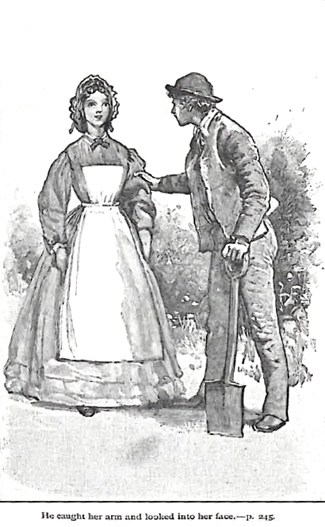
He caught her arm
and looked into her face.
He took two long steps and stood beside the girl. He caught her arm and looked into her face. For a moment, he was in doubt. She was a tall, slight girl, neatly dressed in a gay pink gown, snowy apron, and a little cap with pink ribbons. She was very unlike Hessie, all rags and flowers. But then—she raised her eyes to his face: and they were Hessie's eyes—there was no doubt about that.
"Oh, Hessie dear! 'Tis really you!" he cried.
Hessie clapped her hands in great glee.
"Are you surprised? I thought you would be! Oh, I would never let you see me, Christie, as long as there was anything left of the wild, foolish girl you came to help, and who would not be helped. Are you glad, Christie? I've been looking forward to this meeting for a long, long time."
"I've been wondering should I ever hear of you again, and getting nearly out of heart lately. Come over to yon seat, and tell me how this came about. I can't believe that this is Hessie yet."
"I can stay," she said, "for I told the mistress all about it this afternoon, and she got Janet to mind the children."
"But—Miss Persis might have told me! Have you been long with her?"
"Two years. I'm housemaid. I came as nurse now because Mary Banks wanted to go home, and I wanted to see you. I thought that the time I had set myself had come. As to my mistress telling you, she could not, for she did not know. When I left Blackmead, I made up my mind to use my mother's name, to help to keep my secret, and Mrs. Forster calls me Hester Lee."
"Hessie, did your father know where you were?"
"Yes; of course he did."
"I went up to seek you, and Ben said he knew nothing about you."
"Oh, well, he knew all about it. I'm going to tell you the whole story now. Before you came, just after the preaching man, I had got dreadful ashamed of myself, and after you came I took to fretting over it. I did not see what was to become of me, if I went on as I was, and yet father had no one else, and was fond of me. How could I leave him? Yet I knew that sooner or later I should fall into the old wild ways, but I tried to keep out of it all.
"Father was angry; he said I was stupid, and—we had words, often. He said I was no use to him, and that he'd marry Jenny Brent if I did not mind what I was about. I did try to please him, but it got harder and harder. Then one day he told me he was married, and in walked Jenny—and a nice life we had! I think she wanted to be friends, but I would not. Father needed me no longer, and I had my plans. You know, Christie, 'twas all your doing, after all."
"How was it my doing?"
"'Twas you told me of the training-school, and when I snapped the paper away from you, I kept it. So when I had kept them all dancing mad long enough—and really I did lead Jenny a frightful life—I told father that I should never be any better, but that, if he liked, I would go and learn to be a servant, and trouble him no more. But, said I, you'll have to pay."
"Ay—and did he say yes?"
"Not at once. He bid me say nothing to any one else, and he'd think it over. And I coaxed him, and plagued Jenny. I never would do a thing to help her, but played her every trick I could think of, till she was nearly mad."
"I don't doubt it," said Christie.
"If I was sure that no one could see us, I'd box your ears for that," said Hessie.
"I don't doubt that neither. Not the first time by a good many would it be. But go on, Hessie, for 'tis nearly time for me to go after the cow."
"Bother the cow! That's just you, Christie! I never knew you yet but in a hurry to do something else when I wanted to talk to you."
"Well, well! But you went to the training-school by the name of Hester Lee?"
"I did. Father gave in at last. But he didn't want Jenny to know that he either has money saved, or has some one that can give it to him; I think 'that's' it, because the payments for me were made by a Mr. Lardner, who has a big shop in Bradstone. Father got me into the school through him too.
"When it was all settled, he made me slip out and go down the road by the Water, and Mr. Lardner met me and took me off in a chaise. I was there for nearly three years. Many a time, specially at first, I thought I 'must' run off back to Blackmead; but they were very kind to me, and I thought of you, and of Mammie Brent, and I made up my mind to stick to it and learn to be good. I don't know that I am good, Christie, but I'm better than you had any right to expect.
"Then I got a place, and before long, I found out who my mistress was. But I kept my secret, because I would not tell you my story till I had proved that I 'can' work, and—and be a decent, good kind of girl, Christie—" with a little sob.
"You always could be, or do, anything you chose. I know that, Hessie. Dear heart, you've made me very happy. I do tell you true—the fear that harm would come to you, or want, was such that often I could think of nothing else. You know I always loved you well. I expect, Hessie, neither you nor I ever forgot the promise?"
"'Do' you want to have your ears boxed?" she said, blushing rosy red.
"Yes," he answered; "and not only just once, like this, but I want to make sure of getting them boxed often, all the rest of my life. But see," pulling out the cherished watch, "'tis getting very late for the cow."
Hessie sprang up, and ran down the garden as fast as her feet could carry her.
Christie stood gazing till she shut the gate, and could be seen no more. Then, just as he had done years ago, when he and she got safe out of the old mine, he took off his hat and said—
"Thanks be to God! My Hessie is safe."
*****
Poor old Mr. Arkwright always called this the "uncomfortable year." First, he did not very heartily approve of dark, swift-moving, outspoken Hessie, even though Persis gave her a very good character. Then, too, though Christie lived close by, and never allowed his dear master to be inconvenienced, it was not quite the same as having him in the house, and Mr. Arkwright was old enough to dislike a change, just because it "was" a change. Then, too, Ben Marks, when Christie wrote to him, merely replied that he and Hessie must do as they liked, but that he never wanted to see either of them.
Mr. Arkwright was distressed at this, but I cannot say that Christie cared.
And Hessie only laughed, and said, "We'll pay him a visit, sir, some day."
I do not know whether Mrs. Christie Brent ever boxed her husband's ears, but if she did, it agreed with him. They were a very happy couple.
But, with the curious reticence of his character, not even to his Hessie did Christie ever explain the mystery of his father's death. He had been silent about it so long that he really could not break that silence now. So poor Giles rests undisturbed in his wild grave.
THE END.
————————————————————————————————————
Richard Clay & Sons, Limited, London & Bungay.
                         Illustrated Books by the same Author.

                                    ————————————

               A "LEAL LIGHT HEART." Crown 8vo, cloth boards, 3s. 6d.
               A PROMISING BOY. Crown 8vo, cloth boards, 2s. 6d.
               ALONE IN CROWDS; or, Kindlup Tower. Crown 8vo, cloth, 3s.
               CHRYSSIE'S HERO. Crown 8vo, cloth boards, 2s. 6d.
               DADDY'S RIGHT HAND. Post 8vo, limp cloth, 6d.
               DORA AND NORA. Crown 8vo, cloth boards, 2s.
               DOROTHY THE DICTATOR. Crown 8vo, cloth boards, 2s. 6d.
               FAITHFUL: the Story of Daisy May. Crown 8vo, cloth boards, 3s.
               FAN'S SILKEN STRING. Crown 8vo, cloth boards, 1s. 6d.
               FOOTPRINTS: a Story of the Snow. Post 8vo, limp cloth, 9d.
               GRANNIE. Crown 8vo, cloth boards, 3s. 6d.
               HATHERLEY'S HOMESPUNS. Crown 8vo, cloth boards, 2s. 6d.
               MOTHER'S GOLDEN GUINEAS. Crown 8vo, cloth boards, 1s. 6d.
               MRS. DOBBS' DULL BOY. Crown 8vo, cloth boards, 2s. 6d.
               MY LONELY LASSIE. Crown 8vo, cloth boards, 2s. 6d.
               MURIEL'S TWO CROSSES: the Cross she Rejected, and the Cross
                  she Chose. Crown 8vo, cloth boards, 3s.
               NORTH WIND AND SUNSHINE. Crown 8vo, cloth boards, 2s. 6d.
               OUT IN THE COLD. Crown 8vo, cloth boards, 2s.
               THE INVASION OF IVYLANDS. Crown 8vo, cloth boards, 1s. 6d.
               THE PIANO IN THE ATTIC. Crown 8vo, cloth boards, 1s. 6d.
               THE WHITE GIPSY. Crown 8vo, cloth boards, 3s.
               TWO OLD MAIDS: or, Rosalind's Sisters. Crown 8vo, cloth, 3s.
               VERY MUCH IN EARNEST. Post 8vo, cloth boards, 1s.

                         ————————————————————————————————————

                       SOCIETY FOR PROMOTING CHRISTIAN KNOWLEDGE.
                          LONDON: NORTHUMBERLAND AVENUE, W.C.